The current escalation around Iran holds the potential for transforming the long-term geopolitical configuration of Eurasia, including Central Asia. In the short and medium term, aside from the security and safety of its citizens, Central Asia’s main concern is economic, because it puts stress on overland rail and trucking routes that cross Iranian territory. Central Asian exporters do not ship through the Gulf, so for now the key issue is whether an Iran-crossing land route remains reliable enough, and financeable enough, to serve as a routine outlet for trade.
The Iran transit option differs from trans-Caspian reliance on ports and rail interfaces around the Caspian Sea, transiting to onward rail across the South Caucasus and into Europe. The Iran option offers a continuous land arc from Central Asian railheads and road networks into Iran, then onward to Türkiye and connected European rail networks, with the additional possibility of reaching Iran’s southern ports for Indian Ocean-facing trade. Each route has its own chokepoints, paperwork burdens, and exposure to risk premiums.
Rail is efficient for bulk and container flows when schedules and documentation are stable. Trucking provides flexibility, short-notice capacity, and last-mile options, but it is more sensitive to security conditions and border clearance delays. Technical capacity at the Iran–Turkmenistan crossings is key. Recent reports of discussions in Sarakhs describe efforts to expand the use of a specialized rail logistics process whereby entire wheel assemblies are replaced on railcars to transition between different track gauges. There is also a need to address customs constraints at Sarakhs and Incheh Borun.
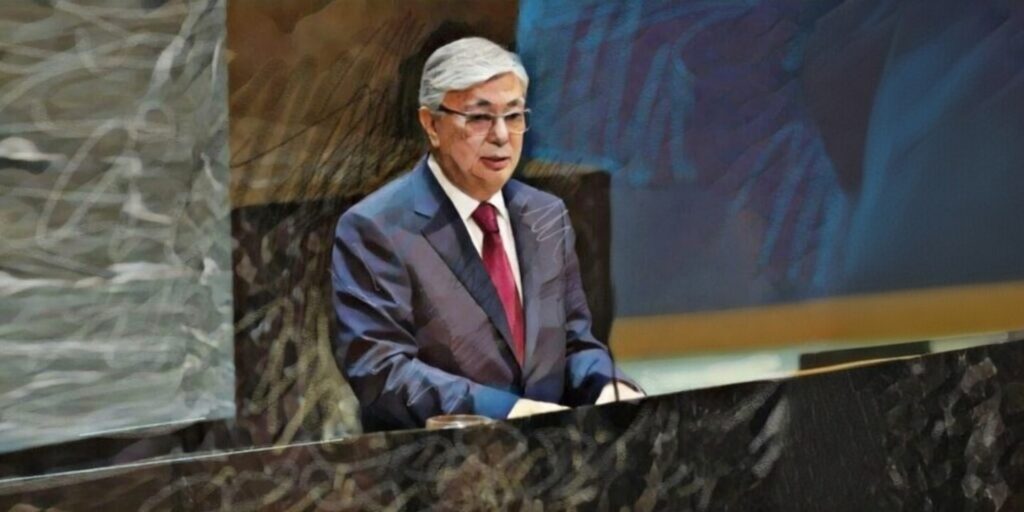
Against that operational background, Kazakhstan has signaled diplomatic attention to Gulf partners and Jordan. President Kassym-Jomart Tokayev has sent messages of support to leaders of the United Arab Emirates, Saudi Arabia, Qatar, Bahrain, and Kuwait, followed by a similar message to Jordan, and a phone call with Qatar’s emir. The language emphasized solidarity and diplomacy and, in commercial terms, reads as partner-management. It reassures major investors and energy-market counterparts that Kazakhstan is engaged, attentive, and positioning itself for stability rather than escalation.
The trans-Iran rail foundation is over a decade old. On December 3, 2014, the presidents of Kazakhstan, Turkmenistan, and Iran inaugurated the 928-kilometer Uzen–Bereket–Gorgan railway, characterized by RFE/RL (which gave the length as 935 kilometers) as the shortest railway connecting the three states. The International Union of Railways similarly notes the inauguration of the Gorgan–Inche Boroun link on that date as part of the corridor connecting Iran to Turkmenistan and Kazakhstan.
Recent reporting suggests renewed efforts to operationalize the Iran option as a westbound channel. Uzbekistan, in cooperation with Türkiye, launched freight rail services along the Uzbekistan–Turkmenistan–Iran–Türkiye route in 2022. The Organization of Turkic States described a December 2022 event in Tashkent as the first freight train organized from Türkiye to Uzbekistan, which anchors the same basic idea: make westbound rail via Iran more regular and more visible to logistics markets. The point is not that Iran becomes the sole answer, but that Central Asian exporters and transit states have been trying to keep multiple workable routes open at the same time.
The relevance of the Gulf is greatest regarding finance and logistics execution. The UAE’s AD Ports Group has completed its acquisition of a 60% stake in Tbilisi Dry Port, which has direct rail links to Türkiye and Black Sea ports. In Kazakhstan, AD Ports Group has announced agreements tied to fleet expansion and a planned multipurpose terminal at Kuryk, stating that these moves bring its overall investment in Kazakhstan to $775 million.
Against this backdrop, three scenarios frame the implications of the Iran crisis without locking in a single forecast.
The first scenario is a political transition in Iran with recoverable state capacity. The gain for Central Asia here would be that Iran could become a standard transit jurisdiction rather than a special-case route. A reduction in transaction costs would make rail and trucking more attractive, and insurance would become more regularized. Payment channels would become more fluid as sanctions are lifted. All this means logistics operators can commit to schedules without building elaborate escape clauses into contracts. The medium to long-term effect would be to expand corridor choices and reduce dependence on any single route.
The second scenario is governance degradation without a clean transition. Under this scenario, authority in Iran fragments, and enforcement becomes uneven. The result here would be that transit becomes episodic; delays and local disruptions become hard to predict. In this environment, trucking tends to carry a larger security and delay premium than rail and can substitute for it only occasionally and on short horizons. Shippers would respond by shifting time-sensitive or high-value cargo toward routes with better administrative predictability. Iran-crossing routes would be sporadic rather than foundational.
The third scenario is regime continuity under sustained sanctions pressure. This case makes trans-Iran connectivity usable but bounded. Some transit may continue, but compliance, financing, and payment risks would limit its scale. For Central Asia, the practical effect is a relatively low ceiling on how much Iran could function as a stabilizing outlet. Exporters would tend to favor other corridors that are more commercially viable and lower risk.
For Central Asia, the policy posture that holds across scenarios is to treat redundancy as a strategic necessity rather than a luxury and keep the trans-Iran option usable only where it remains operationally and commercially viable. Tokayev’s Gulf and Jordan outreach is consistent with that approach as a diplomatic move aimed at stabilizing the commercial environment around corridor investment and trade connectivity.