• KGS/USD = 0.01143 -0%
  • KZT/USD = 0.00192 -0%
  • TJS/USD = 0.10820 0.19%
  • UZS/USD = 0.00008 0%
  • TMT/USD = 0.28575 0%
  • KGS/USD = 0.01143 -0%
  • KZT/USD = 0.00192 -0%
  • TJS/USD = 0.10820 0.19%
  • UZS/USD = 0.00008 0%
  • TMT/USD = 0.28575 0%
  • KGS/USD = 0.01143 -0%
  • KZT/USD = 0.00192 -0%
  • TJS/USD = 0.10820 0.19%
  • UZS/USD = 0.00008 0%
  • TMT/USD = 0.28575 0%
  • KGS/USD = 0.01143 -0%
  • KZT/USD = 0.00192 -0%
  • TJS/USD = 0.10820 0.19%
  • UZS/USD = 0.00008 0%
  • TMT/USD = 0.28575 0%
  • KGS/USD = 0.01143 -0%
  • KZT/USD = 0.00192 -0%
  • TJS/USD = 0.10820 0.19%
  • UZS/USD = 0.00008 0%
  • TMT/USD = 0.28575 0%
  • KGS/USD = 0.01143 -0%
  • KZT/USD = 0.00192 -0%
  • TJS/USD = 0.10820 0.19%
  • UZS/USD = 0.00008 0%
  • TMT/USD = 0.28575 0%
  • KGS/USD = 0.01143 -0%
  • KZT/USD = 0.00192 -0%
  • TJS/USD = 0.10820 0.19%
  • UZS/USD = 0.00008 0%
  • TMT/USD = 0.28575 0%
  • KGS/USD = 0.01143 -0%
  • KZT/USD = 0.00192 -0%
  • TJS/USD = 0.10820 0.19%
  • UZS/USD = 0.00008 0%
  • TMT/USD = 0.28575 0%
14 December 2025

Almaty Gears Up to Host Real Madrid’s Galácticos

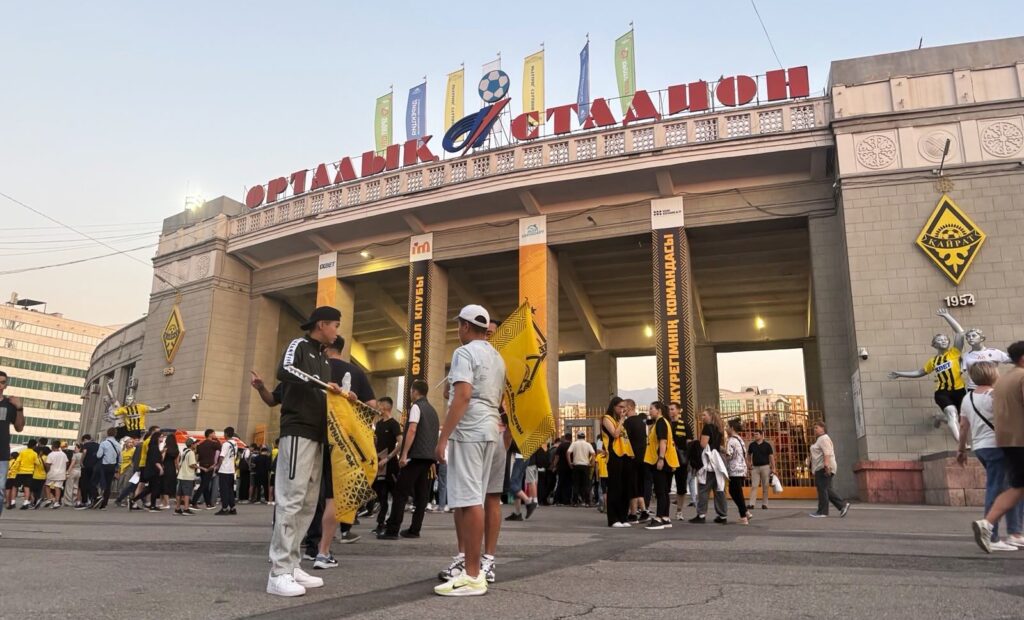
Football fans across Kazakhstan are preparing for arguably the biggest sporting occasion in the country’s history on Tuesday. Kairat Almaty play their first ever home Champions League game against the mighty Real Madrid at the Almaty Central Stadium.

The arrival of Madrid’s Galácticos has electrified the city, with fans camping outside the Intercontinental Hotel in Almaty just to catch a glimpse of the visiting superstars.

Kairat lost their first match 4-1 to Sporting Lisbon, a scoreline that the management felt didn’t do justice to a spirited performance. “The team lost focus for about five minutes, conceding three goals, but never gave up and scored a goal in the Champions League – the first in our club’s history. That experience is valuable,” Kairat Boranbaev, the club’s president, told The Times of Central Asia at the club’s training complex this week.

“We understand that the Champions League has the 36 best teams in Europe, so the level is extremely high. We don’t stress about the result; the team gains huge experience.” Boranbaev said, proudly adding that six Kairat academy products played in the match.

Kairat Almaty President, Kairat Boranbaev; image: TCA, Joe Luc Barnes

A Ten-Year Journey

The fifty-nine-year-old president and business magnate is not surprised his club has reached the higher echelons of European football. “This strategic work was built more than ten years ago, and we have been moving toward it all these years. I think it’s a natural result, a systematic effort by our club.”

Boranbaev says that when he took over the club’s presidency in 2012, the facilities were well below par. Kairat is traditionally Kazakhstan’s most storied club, their famed black-and-yellow jerseys representing all-Kazakhstan in the Soviet Top League in the communist years. But they had fallen on hard times in the independence era, even splitting into two rival clubs for a time.

“When we arrived, there was only one burned-down base from Soviet times,” Boranbaev told TCA. “We started developing, learning what football really is. Today, all the infrastructure is established, youth player development is in place, and the coaching staff training is organized. That’s why the results we’ve achieved today are the outcome of years of stable, professional management.”
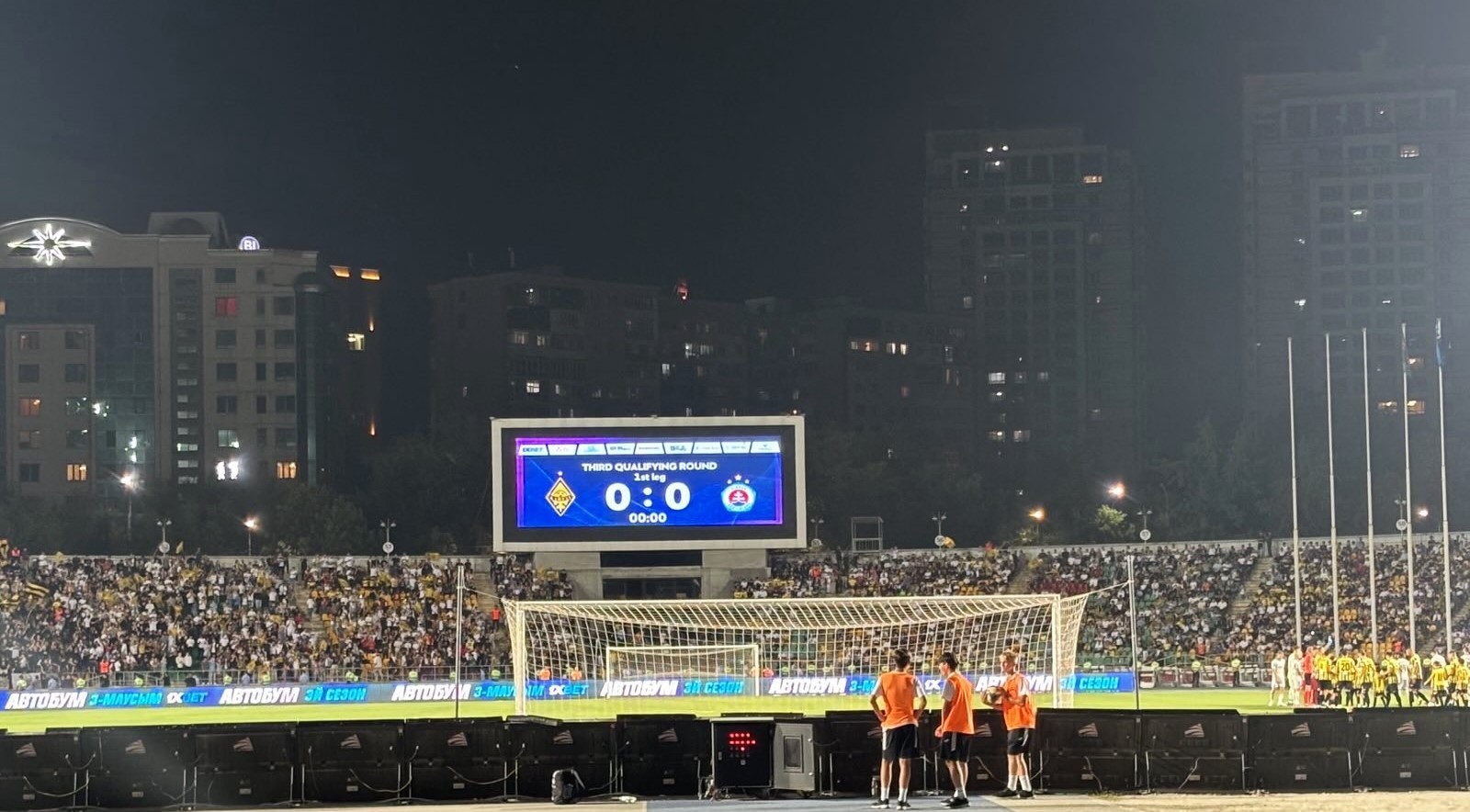
Kairat Almaty’s third qualifying round tie against Slovan Bratislava; image: TCA, Joe Luc Barnes

Nurturing Youth

Kairat differs from other Kazakh teams in the emphasis they place on their academy. While clubs such as FK Astana and Aktobe often import talent rather than investing in grassroots football, Kairat aims to develop its own.

The club’s most famous academy product is seventeen-year-old Dastan Satpaev, who will move to London side Chelsea upon turning eighteen. But during TCA’s tour of the stadium complex, we bump into the club’s newest teenage star, Sherhan Kalmurza, the eighteen-year-old goalkeeper who has been catapulted into the first XI due to injuries to other senior players. “He’s become famous,” booms Boranbaev. “He now has 40,000 Instagram followers after just two games!”

Kairat’s president notes that while the club respects the experience of foreign players – which includes Belarus’ Valeriy Gromyko and Portuguese forward Jorginho – the club’s priority is its academy, which caters to children from the age of six, with thirteen branches across the city. From fourteen onwards, prospective starlets live in boarding schools by the club’s academy.

Training facility in Besagash, on the outskirts of Almaty; image: TCA, Joe Luc Barnes

The Visit of the Galácticos

The arrival of the world’s most famous football team is perhaps a bigger prize than victory itself. Fans are struggling to contain their excitement. Rauan Mutair, 24, part of a group of fans that runs Kairat Makhabbatim, an Instagram page dedicated to the club, tells of his excitement when he saw that Kairat would be playing against Real Madrid. “My heart started racing,” he told The Times of Central Asia. “The Champions League is a great school and a grand stage; it’s a historic opportunity for the players and the city.”

Mutair went to his first game over a decade ago and was enchanted by the energy of the stadium: “The black-and-yellow sea, the sound of the drums captured me instantly. That feeling has never faded,” he said fondly.

Fans sing in both Russian and Kazakh, which reflects the city’s cosmopolitan history. It’s not unusual to hear “Алма-Ата, столица мира” (Alma-Ata, capital of the world) sung in Russian, followed by “Алға, Қайрат!” (Forward, Kairat!) ringing out in Kazakh from the terraces in the city’s Central Stadium.

Mutair promises that for the visit of Madrid, the supporters will pull out all the stops in support of their side. He promises a large banner (or tifo), drums, and call-and-response chants between different parts of the stadium.

The question, of course, is who will be in the stadium to see the big game. The visit of Madrid has opened some old wounds about inequality in the city. Fans who watched the four qualifying matches for the competition paid as little as 1,500 tenge ($2.80) for tickets in some cases. For the visit of Real Madrid, the minimum price for a ticket will be 75,000 Tenge, or $140.

But perhaps this should be expected. Stars do not often visit Central Asia. The biggest touring Western stars tend to be musicians – 2025 has seen Robbie Williams, the Backstreet Boys, and Jennifer Lopez. The minimum prices for these events were 50,000 tenge ($90) for the Backstreet Boys, and slightly under that for J-Lo. But, whilst these are all big names, they were at the top of their game around two decades ago. Real Madrid brings that rare cachet: world-class performers who are at their peak right now.

This means that the 20,000 or so tickets available for one of the biggest sporting events of Kazakhstan’s history are seeing stratospheric demand. On September 23rd, when the tickets went on sale, online retailer Ticketon reported over a million simultaneous users in the queue for tickets.

“We understand that Champions League group-stage matches are different from qualifiers,” said Boranbaev. “Our season ticket holders get priority to buy their seats. We aim to make tickets accessible to all. One problem is scalpers, but we will limit to two tickets per person to prevent resale.”

These scalpers have nevertheless been doing a roaring trade in Telegram groups, with some “VIP” tickets going for 430,000 tenge ($783), or the price of the monthly rental of an average two-bedroom apartment in the city center.

Flights from the capital Astana to Almaty have spiked on the Tuesday before the game, and on Wednesday morning for the return trip, suggesting that wealthy Kazakhs from across the country are flying in.

The idea of money and power buying their way past ordinary people is perhaps embodied by the club president himself. Boranbaev, whose daughter Alima married the former president’s grandson, leveraged his ties to the ruling family to build influence in oil, gas, real estate, and retail. At one point, he was the 14th most influential individual in Kazakhstan. However, after the protests of Bloody January, which saw Nazarbayev’s star fall, he was imprisoned for embezzlement after being convicted of stealing $30 million from a gas contract. However, he struck a deal with the state to hand over major assets and funds, and was released from prison in November 2023.

His phoenix-like return to grace rankles with many city residents who see that just as a man can buy his way out of the justice system, the rich can buy their way into football matches.

Boranbaev told The Times of Central Asia that he had been in discussions with Almaty’s mayor about creating a fan zone for the game, but these promises have come to nothing.

Kairat Almaty hosting FK Aktobe at the Almaty Central Stadium; image: TCA, Joe Luc Barnes

Spending Spree

Spent wisely, however, the windfall from this game has the potential to develop the club. Plans are afoot for a new stadium, and Mutair would like to see improved sports science and an even better academy.

For now, though, fans are focused on the present, and Mutair is even holding out hope for an unlikely upset.

“We’ll enjoy the game as a large-scale celebration, but on the pitch it’s about pragmatism: discipline, resilience under pressure, capitalizing on set pieces. Even a single goal would be historic.”


New York Film Academy Opens First Central Asian Campus in Kazakhstan

The New York Film Academy (NYFA) has opened its first campus in Central Asia, marking a significant milestone for the region’s creative industries. The official launch took place on September 27 in Kaskelen, a town located 20 kilometers from Almaty.

Situated within the Creative Industries Park of Energy University, the new campus spans more than 1,000 square meters. It features professional sound stages, editing and recording studios, lecture halls, dressing rooms, and specialized classrooms for acting. According to NYFA, the facilities are designed to support the full cycle of film production from concept development to shooting and post-production.

NYFA Kazakhstan will welcome its first cohort in autumn 2025, offering five of its most sought-after programs: filmmaking, screenwriting, acting for film, game design, and 3D animation and visual effects. Courses will be taught by faculty from NYFA’s U.S. campuses, bringing international expertise directly to Kazakhstan.

Speaking at the opening ceremony, NYFA President and CEO Michael Young emphasized the broader cultural significance of the project: “We are proud that the New York Film Academy has opened in Kazakhstan. This is not just an educational project, but a platform that brings together the region’s talent and introduces them to the global film industry.”

Officials stated that the campus is expected to become a regional hub for cultivating creative professionals, providing access to world-class film education without the need to study abroad.

Kyrgyzstan Moves to Develop Local Lithium Battery Production

On September 26, the Kyrgyz Ministry of Economy and Commerce signed a memorandum of cooperation with Russian state atomic energy corporation Rosatom, Energy Solutions Kyrgyzstan LLC, and Elbrus Construction Company LLC to explore the development of lithium battery and energy storage system production in Kyrgyzstan.

According to the ministry, the agreement outlines joint efforts to analyze the domestic lithium battery market, prepare proposals for localized production, and implement projects focused on energy storage solutions within the country.

The initiative is expected to attract high-tech investment, generate new jobs, and contribute to Kyrgyzstan’s energy independence. It also supports the development of clean and sustainable energy technologies.

The project is particularly relevant as the number of imported electric vehicles (EVs) in Kyrgyzstan continues to rise, alongside government plans to localize EV assembly. The initiative aligns with the country’s broader strategy to promote eco-friendly transport options and reduce air pollution, especially in urban areas such as Bishkek.

In a related development, the Ministry of Economy and Commerce signed a memorandum of understanding in June with South Korean companies EVSIS, NGS, and the Korea Automobile Environment Association. That agreement focuses on expanding EV charging infrastructure in Bishkek.

As The Times of Central Asia previously reported, South Korean stakeholders also plan to launch production of EV charging stations in Kyrgyzstan. The project aims to establish a local manufacturing facility and develop a nationwide charging network across major cities and regions.

Japarov and Tokayev’s High-Level Reshuffles Usher in a New Political Season

Kyrgyzstan and Kazakhstan recently witnessed high-level political developments that drew attention beyond their borders. In Kyrgyzstan, the national parliament self-dissolved, while Kazakhstan underwent a series of administrative reshuffles. Though both events were driven by reform-oriented policies, observers have offered sharply contrasting interpretations.

In Kyrgyzstan, the initiative to dissolve the Jogorku Kenesh (parliament) was led by a group of 32 deputies headed by Speaker Nurlanbek Turgunbek uulu. They cited logistical and financial concerns over the proximity of the next parliamentary and presidential elections, scheduled for November 2026 and January 2027, respectively. Holding two major elections in such a short span, they argued, would pose political and economic challenges.

As a result, early parliamentary elections will now take place on November 30, under revised electoral rules. The new system divides the country into 30 constituencies, each electing three deputies. Political parties may nominate only one candidate per district, and the overall number of deputies will remain at 90. However, the majority of seats are now expected to go to independents, reducing the dominance of political parties in the electoral process.

Some Kazakh observers, long accustomed to viewing Kyrgyzstan as a “democratic island” in the region, interpreted these changes as a move toward greater political openness. Former diplomat and public figure Kazbek Beysembayev contrasted Kyrgyzstan’s reforms with Kazakhstan’s political trajectory, where authorities are reportedly planning to eliminate single-mandate districts in favor of a fully party-based electoral system. He warned this would further consolidate the ruling party’s dominance. “Such a move might be acceptable if laws on political party registration had first been liberalized. But that hasn’t happened,” Beysembayev argued.

However, not all analysts share this optimistic view. Central Asia expert Arkady Dubnov sees the Kyrgyz move as a calculated maneuver by the ruling elite. He argues that a political duumvirate, composed of President Sadyr Japarov and State Committee for National Security (SCNS) chief Kamchybek Tashiev, has increasingly consolidated control. According to Dubnov, the early elections are designed to cement this grip on power.

“By extending the gap between the parliamentary and presidential elections to 14 months, the authorities are creating space for a politically engineered campaign,” Dubnov explained. “This may pave the way for General Tashiev’s eventual rise to the presidency. His image as the real power broker, from resolving the border conflict with Tajikistan to renaming his hometown Jalal-Abad to Manas, has been solidified. President Japarov would likely retain influence within a reconfigured leadership structure.”

In Kazakhstan, meanwhile, administrative reshuffles have continued, drawing significant attention, particularly the replacement of Foreign Minister Murat Nurtleu with seasoned diplomat Yermek Kosherbayev. The change followed speculation in early September that Nurtleu had been detained by the National Security Committee, a claim that proved false but nevertheless added intrigue to his removal from the Foreign Ministry. He has since been appointed presidential aide for international investment and trade cooperation.

Political analyst Daniyar Ashimbayev acknowledged that this role is technically a demotion but argued it still reflects political trust. “Tokayev doesn’t typically reappoint officials who have committed serious errors. In most cases, they face a temporary career freeze. Nurtleu’s new role keeps him close to the president and involved in all major international visits,” he said.

Tokayev’s press secretary, Ruslan Zheldibay, himself recently appointed as a presidential aide, emphasized that attracting foreign investment remains a key national priority. “This responsibility has been assigned to Murat Nurtleu, a seasoned diplomat. He will work to develop high-level contacts with foreign governments and global companies to enhance investment and trade cooperation,” Zheldibay said.

Thus, Kyrgyzstan’s dissolution of parliament may represent less a democratic evolution than a calculated move by entrenched power centers. In contrast, Kazakhstan’s leadership changes appear to be part of Tokayev’s cyclical reshuffle strategy, aligned with his policy agenda.

“Tokayev generally implements personnel changes in April and September, with the latter tied to the Address to the Nation,” Ashimbayev noted. “This year, the schedule was delayed due to the president’s visit to China, followed by the Congress of Leaders of World and Traditional Religions and the UN General Assembly. As a result, appointments that usually follow the Address have been spaced out across several weeks.”

ADB Approves $75M Loan to Boost Nursing Sector in Turkmenistan

The Asian Development Bank (ADB) has approved a $75 million loan and an additional $2 million grant from the Japan Fund for Prosperous and Resilient Asia and the Pacific to expand and improve the nursing and midwifery workforce in Turkmenistan. According to an ADB statement, this marks the bank’s first health sector project in the country.

“The project aims to provide high-quality health services based on people’s needs and ensure equitable access to health care through strengthening the nursing profession and education,” said ADB Country Director for Turkmenistan Artur Andrysiak. He noted that this is ADB’s third project in Turkmenistan, reflecting a growing partnership as the Bank and the country celebrate 25 years of cooperation.

The Turkmen government has prioritized healthcare reform, with a focus on improving the education and qualifications of health workers. Nurses, often the first point of contact in the health system, will be empowered to deliver both essential care and preventive services under the new initiative.

Plans include the design and construction of a climate-resilient nursing school in Ashgabat, featuring state-of-the-art facilities such as clinical simulation labs, dormitories, a mother-friendly room, and an edible garden to promote nutrition. The project will also provide new medical and educational equipment and update curricula, teaching methods, and faculty training in line with international standards.

The total project cost is estimated at $98 million, with the Turkmen government contributing $23 million in counterpart financing. The initiative builds on ADB’s growing cooperation with Turkmenistan in recent years.

In August 2024, ADB adopted a new country partnership strategy for Turkmenistan covering 2024-2028. The strategy focuses on supporting the transition to a climate-resilient and sustainable economy, enhancing competitiveness through diversification and human capital development, and advancing structural reforms and institutional capacity.

Tourism in Tajikistan: Five Years of Progress and Persistent Barriers

Five years ago, Canadian researcher Christian Bleuer identified 25 key obstacles hindering the growth of Tajikistan’s tourism sector. Since then, the industry has made measurable progress but many challenges remain unresolved.

Digitalization and Initial Progress

Significant strides have been made in digital infrastructure. The introduction of electronic visas, online services, and the availability of eSIM cards has improved access for international travelers. Dushanbe has witnessed the opening of new hotels and restaurants, an expansion of taxi services in major cities, and the reconstruction of sections of the M41 highway.

Other positive steps include training programs for tour guides, the creation of tourist information centers in Dushanbe, Khorog, and other cities, and growing competition in the hospitality and restaurant industries. Experts also note that travel bloggers and social media have, in some cases, done more to improve the country’s image than official marketing campaigns.

Partial Improvements

While services have improved in urban areas, regional disparities persist. Tourists can now find decent hotels and cafes in major cities, but service quality outside these hubs remains inconsistent.

The e-visa system has streamlined entry procedures, although public awareness of the platform is still low. Digital tools such as Google Maps and mobile apps assist navigation in urban centers, but coverage remains sparse outside Dushanbe and Khujand.

Financial infrastructure has also improved, with more ATMs available in the capital. However, access to foreign currency remains a barrier. Aviation has seen some progress under the “Open Skies” policy, with new routes to China and Uzbekistan launched, though high airfares continue to deter potential visitors.

Ongoing Challenges

Several systemic issues continue to hamper tourism development. Connectivity remains weak: Tajikistan ranks 117th globally for fixed internet speed and lags behind regional peers in mobile data performance, averaging under 24 Mbps.

Environmental concerns also diminish the visitor experience. Litter is visible not only in rural areas but even in Dushanbe. Transport remains problematic, with the Jirgatal border crossing closed to foreigners and the Pamir Highway via the Khaburabad Pass largely inaccessible during winter months.

A national ban on drones restricts opportunities for photo and video tourism. Additionally, poor coordination among tour operators, taxi drivers, and hoteliers prevents the formation of a unified tourism strategy.

Structural Constraints

Some limitations are more difficult to overcome. Tajikistan’s geography, landlocked and bordering Afghanistan, poses accessibility challenges. The country also lacks the architectural heritage that makes neighboring Uzbekistan a dominant player in regional cultural tourism.

Urban development trends further complicate matters. The demolition of historical buildings and widespread tree-cutting in Dushanbe have eroded the capital’s aesthetic appeal.

Tajikistan’s Tourism Development Strategy to 2030 acknowledges the sector’s underperformance. Its contribution to the global tourism market remains modest, constrained by low investment, weak infrastructure, and uneven service quality.

Nevertheless, experts believe the sector holds untapped potential. Tourism could create employment opportunities for young people and help reduce labor migration. Realizing this potential will require stronger private sector involvement, upgraded services, and more effective international promotion.