• KGS/USD = 0.01144 0%
  • KZT/USD = 0.00196 -0%
  • TJS/USD = 0.10904 0%
  • UZS/USD = 0.00008 0%
  • TMT/USD = 0.28490 0%
  • KGS/USD = 0.01144 0%
  • KZT/USD = 0.00196 -0%
  • TJS/USD = 0.10904 0%
  • UZS/USD = 0.00008 0%
  • TMT/USD = 0.28490 0%
  • KGS/USD = 0.01144 0%
  • KZT/USD = 0.00196 -0%
  • TJS/USD = 0.10904 0%
  • UZS/USD = 0.00008 0%
  • TMT/USD = 0.28490 0%
  • KGS/USD = 0.01144 0%
  • KZT/USD = 0.00196 -0%
  • TJS/USD = 0.10904 0%
  • UZS/USD = 0.00008 0%
  • TMT/USD = 0.28490 0%
  • KGS/USD = 0.01144 0%
  • KZT/USD = 0.00196 -0%
  • TJS/USD = 0.10904 0%
  • UZS/USD = 0.00008 0%
  • TMT/USD = 0.28490 0%
  • KGS/USD = 0.01144 0%
  • KZT/USD = 0.00196 -0%
  • TJS/USD = 0.10904 0%
  • UZS/USD = 0.00008 0%
  • TMT/USD = 0.28490 0%
  • KGS/USD = 0.01144 0%
  • KZT/USD = 0.00196 -0%
  • TJS/USD = 0.10904 0%
  • UZS/USD = 0.00008 0%
  • TMT/USD = 0.28490 0%
  • KGS/USD = 0.01144 0%
  • KZT/USD = 0.00196 -0%
  • TJS/USD = 0.10904 0%
  • UZS/USD = 0.00008 0%
  • TMT/USD = 0.28490 0%
08 December 2025

Tokayev’s Visit to New York: UN Speech, Investment Talks, Nuclear Power, and Digital Cooperation

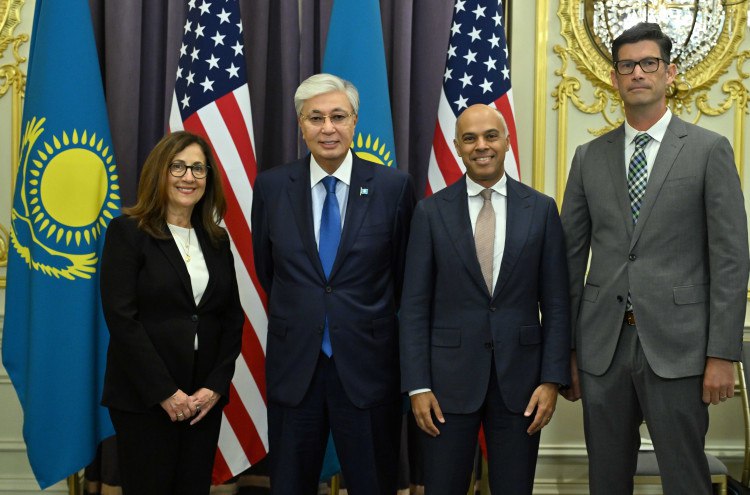
Kazakh President Kassym-Jomart Tokayev arrived in New York on September 21 for a working visit scheduled to last until September 23.

Diplomatic and Business Engagements

According to the presidential press service, Tokayev is set to deliver a speech during the general debate of the 80th anniversary session of the UN General Assembly. His agenda includes bilateral meetings with foreign leaders and heads of international organizations, as well as a roundtable discussion and a series of engagements with representatives of transnational companies. These meetings aim to highlight Kazakhstan’s investment opportunities.

Expanding Cooperation with Cameco

Tokayev’s first official meeting was with Tim Gitzel, President and CEO of Canada’s Cameco Corporation. The discussion focused on prospects for expanding cooperation in the uranium sector, particularly through the Inkai joint venture, which has been developing the Inkai deposit in the Turkestan region for over 25 years.

The president commended Cameco’s long-standing partnership with Kazatomprom, noting over $500 million in investments and the successful transfer of nuclear technologies. “Kazakhstan is entering a new stage of energy development, with plans to build three nuclear power plants. Our country is interested in the innovative methods used in the nuclear industry,” Tokayev stated.

Focus on Education and Testing Reform

A major component of the visit centered on human capital development. In talks with Amit Sevak, President of Educational Testing Service (ETS), Kazakhstan expressed interest in updating its national assessment systems. Sevak emphasized the importance of tailoring solutions to Kazakhstan’s specific needs and highlighted the role of artificial intelligence in this transformation.

Kazakhstan’s Minister of Science and Higher Education Sayasat Nurbek confirmed the country’s intention to elevate national exams to international standards. “GRE, SAT, and TOEFL are globally recognized, and they were developed in this scientific environment. Our goal is not to replace the Unified National Testing system but to enhance its quality. A large team of ETS researchers will arrive in Kazakhstan next month,” he said.

Cultural Cooperation with the Smithsonian Institution

Tokayev also met with representatives of the Smithsonian Institution, the largest scientific and cultural complex in the United States. Discussions focused on academic exchanges and the international promotion of Kazakhstan’s cultural heritage. Beginning next year, Kazakh researchers will be able to undertake internships and conduct studies at the institution.

Helle Bjetvin, Head of Folk Art Programs, expressed personal admiration for Kazakh applied arts: “I truly admire Kazakh ornaments and design. They beautifully combine tradition and craftsmanship. For me, it’s something very special.”

Digital Transformation and Artificial Intelligence

Digital development was another key topic of the visit. Joint projects involving data centers, infrastructure expansion, and the establishment of agencies for artificial intelligence implementation were explored.

Minister of Digital Development Zhaslan Madiev noted that Kazakhstan is steadily transitioning to a digital state model and seeks robust technological and financial partnerships. “We are discussing major joint projects in digital infrastructure and AI development. Kazakhstan’s market is attractive to global investors, and Goldman Sachs is being considered as a potential partner,” he said.

Opinion: Almaty as a Model for the Future: Central Asia’s Role in the Global Agenda

Almaty is gradually becoming a hub for resolving issues of not only regional but also global significance. The recent opening of the UN Regional Center for Sustainable Development Goals (SDGs) for Central Asia and Afghanistan here was an event no less significant than the 80th anniversary session of the General Assembly in New York.

This is no coincidence: the global agenda at the UN today is increasingly focused on the regional level. Central Asia is not a periphery, but a kind of “model for the future,” where climate, water resources, and security challenges are intertwined.

For example, the Tian Shan glaciers have shrunk by more than 25% over the past decade and continue to melt faster than predicted, directly threatening the Amu Darya and Syr Darya rivers. These rivers are increasingly failing to reach the Aral Sea, and its dried-up bed is turning into a giant source of dust and salt.

Air pollution levels in the region’s cities, as measured by PM2.5, exceed World Health Organization guidelines by an average of 4–6 times. Extreme heat and drought are leading to the loss of agricultural land and the degradation of ecosystems, which affects not only regional but also global food security.

Central Asia has already become a unique “testing ground for the future.” The region is testing mechanisms for cross-border cooperation. The CASA-1000 energy project connects Kyrgyzstan and Tajikistan with Afghanistan and Pakistan, creating a “green energy corridor.” Meanwhile, Afghanistan’s Qosh Tepa Canal is altering the balance of water usage on the Amu Darya, forcing neighboring countries to seek new models of agreement. The question is whether these nations can develop a system of joint water and energy management. The outcome will shape not only regional but also global processes.

At the same time, the United Nations itself is grappling with a deficit of trust and effectiveness. The Security Council is paralyzed, while General Assembly resolutions often carry only advisory weight. In the face of nuclear risks, environmental upheavals, and the threat of epidemics, the global community is stalling. Even large-scale initiatives such as the Glasgow Financial Alliance for Net Zero (GFANZ) remain largely declarative rather than actually limiting “dirty” investments.

Therefore, reform proposals are becoming increasingly vocal, in particular, to strengthen regional UN divisions that are capable of responding more quickly to crises and ensuring practical cooperation between countries. Another way to overcome the trust deficit could be to involve independent expert councils – scientists, NGOs, think tanks – more widely in the decision-making process, which would reduce the influence of political gridlock at the global level.

Overall, Almaty can be seen as a model of a “UN in miniature” – a regional center capable of promptly addressing issues that may seem “too small” for New York, yet are critically important for the countries of the region. For instance, the SDG Center could initiate the creation of a regional water monitoring system with unified measurement standards and transparent data sharing.

Such decentralization could form the basis for future UN reform. This is not an alternative to the organization but its renewal: granting more authority and resources at the regional level while maintaining strict accountability to headquarters in New York. In this model, regional SDG centers become not only analytical hubs but also coordination platforms, where decisions on concrete issues such as water, environment, energy, migration are made.

Decentralization also helps reduce vulnerability to political blockages. For example, disputes in the UN Security Council between major powers rarely touch on the actual situation in Central Asia. Yet the regional center in Almaty could ensure real-time data sharing on glacier conditions, Amu Darya and Syr Darya water levels, or air quality in urban areas, and propose collaborative projects. In this way, the UN transforms from an abstract “world organization” into a tool of direct benefit to people.

The financial foundation of such reform also requires innovative approaches. One possible solution would be to account not only for countries’ economic power (GDP) but also their ecological footprint. The higher a nation’s emissions and pollution levels, the greater its mandatory contributions. Such a model would encourage major polluters to invest in reducing their carbon footprint and in clean technologies, with contributions directed specifically toward regional UN operations.

More and more, ideas are emerging about humanity’s need to move from the stage of the “self-centered teenager” with a consumerist attitude toward the world and deep distrust to the stage of “adult responsibility,” based on cooperation and “global rationalism.”

Perhaps visions of global unification, or even a “world government”, remain utopian. But Central Asia may become the platform for implementing at least part of these ideas. By the UN’s 100th anniversary, a new world architecture is unlikely to emerge. Yet if Almaty becomes the place where real solutions for a sustainable future are developed. Such solutions as rational water distribution, transition to green energy, adoption of water-saving technologies, and investment in science will already mark a major step forward.


The views expressed in this article are those of the author and do not necessarily reflect the official policy or position of the publication, its affiliates, or any other organizations mentioned.

Ukrainian Prosecutors Say 13 Uzbek Workers Held in “Inhumane Conditions”

Prosecutors in Ukraine say they have detained four members of a human trafficking operation that exploited 13 Uzbek laborers and subjected them to humiliating treatment that included scheduled visits to the toilet.

Two Chinese citizens, an Uzbek national and a Ukrainian woman used coercion and deception to recruit vulnerable people with few resources outside Ukraine and move them to the Kyiv region for use in forced work for profit, the Kyiv Regional Prosecutor’s Office said on Thursday. Images provided by the office show the farm workers standing in front of greenhouse-like structures covered in plastic tarpaulins in a rural area. Other photos show the cramped, unsanitary conditions in which the men and women lived.

“To maintain control, the perpetrators used coercion and restrictions on freedom of movement, which indicates the exploitative nature of their actions,” the Ukrainian prosecutors said. “The victims were humiliated to the extreme: even visits to the toilet were allowed only according to a set schedule, and any minor violation was punished with fines.”

Ukrainian authorities said they searched the suspects’ residences and business sites on Wednesday, finding 13 Uzbek citizens who were being held in “inhumane conditions.”

Officials from the Uzbek embassy in Ukraine visited the greenhouse facility in the Kyiv region following the publication of reports in Ukrainian media about Uzbek citizens being treated as “slaves,” the embassy said on Friday.

“At present, it has been established that all our citizens are safe and in good health, and they have been placed in one of the local hospitals in the Kyiv region to receive the necessary medical treatment,” the embassy said.

It said steps are being taken to return the group to Ukraine, while noting that court proceedings are underway against the suspects. In a reference to the war against Russia, the embassy repeated guidance that Uzbek nationals should avoid travel to Ukraine because of safety concerns.

Under Ukrainian law, the four suspects could face long prison terms if convicted of human trafficking and other charges.

Glavcom, a Ukrainian news agency, said a 51-year-old Chinese citizen with a temporary residence permit in Ukraine was the head of the alleged human trafficking operation. The Uzbek workers were between the ages of 22 and 42 and had been offered high salaries to persuade them to go to Ukraine, an enticement that turned out to be false, according to Glavcom.

Once in Ukraine, the Uzbek nationals had to surrender their passports to their employers, the agency reported.

From Hydropower to Human Capital: Japarov Plans Strategic Visit to Japan

Kyrgyz President Sadyr Japarov is preparing for a visit to Japan that underscores growing strategic ties between the two countries. Kyrgyz officials say they plan to sign energy and infrastructure agreements in Tokyo, including support for a training center for the national electric grid and upgrades at the Kurpsai hydropower plant, according to Trend, citing the Kyrgyz Energy Ministry. The same report notes that grant funding from Japan’s international cooperation programs will back grid training and modernization efforts.

The timing reflects Tokyo’s recent step-up in activity vis-à-vis Central Asia. As previously reported by The Times of Central Asia, in late August 2025, Japan’s foreign minister undertook a multi-country tour that emphasized long-term engagement and connectivity across the region. Japanese officials framed their approach as trust-building, focused on people-to-people links, infrastructure, and practical cooperation.

Energy cooperation is expected to feature prominently during the visit. Kyrgyz officials say the Japan-backed training center is moving through final approval, and modernization of the Kurpsai facility is planned with Japanese grant support. Bishkek has also invited Japanese participation in additional hydropower projects, positioning Japan as a technology and financing partner in Kyrgyzstan’s power sector.

Labor mobility and skills are another focus. The authorities in Kyrgyzstan have been working with Japanese counterparts to create safe, legal pathways for Kyrgyz workers. In July, Kyrgyz officials met with Japan’s construction human-resources association to align training standards and prepare workers for job opportunities in Japan, and free Japanese-language courses were launched in Bishkek to improve employability for prospective migrants.

Education and cultural exchange underpin the relationship. Over three decades, Japan has funded scholarships, exchanges, and language programs that connect Central Asian students to Japanese universities. An overview of these initiatives highlights how education has become a durable pillar of Japan’s regional engagement, building familiarity with Japanese business practices and technology among Kyrgyz graduates.

For Bishkek, the visit is about turning ongoing cooperation into signed projects and new resources. Officials point to the grid training center and Kurpsai upgrades as near-term deliverables, while the broader agenda includes workforce programs and academic ties. The message from both sides is continuity: steady, practical steps rather than headline-grabbing announcements.

Regionally, Japan’s approach offers Central Asian countries additional partners for finance, training, and technology. For Kyrgyzstan, deeper ties with Tokyo complement existing relationships while helping diversify investment sources and markets. The outcome to watch is whether the visit locks in concrete funding and timelines for priority energy and skills initiatives outlined by the Kyrgyz side.

Backstreet Boys to Perform in Almaty on September 19 for City Day

Almaty is preparing to host one of its most anticipated music events of the year: the legendary Backstreet Boys will perform at Central Stadium on September 19 in celebration of City Day.

Organizers have promised a show featuring the group’s greatest hits from the 1990s and 2000s, complete with elaborate stage production and the signature energy that made the band a global phenomenon. To ensure public safety, approximately 2,500 police officers will be deployed, alongside on-site ambulance teams and fire crews.

The city administration has also announced that 150 volunteers will assist attendees in navigating the venue. LED screens around the stadium will display a hotline number for those needing assistance.

@Almaty Akimat

The concert is expected to attract Almaty residents as well as international fans, some of whom have traveled thousands of kilometers to see the iconic group perform against the backdrop of the Zailiyskiy Alatau mountains.

“I bought my ticket back in July and flew in from Minsk just for this show. The city is amazing, and the atmosphere promises to be unforgettable,” said Belarusian fan Yulia Makhovich.

For 35-year-old Almaty resident Alina Agapova, the event carries personal significance: “Backstreet Boys are my childhood and youth. Their songs always carried deep meaning and are tied to important memories. For me, this is not just a concert but a return to the times when we collected posters, magazines, and dreamed of seeing them live.”

@Almaty Akimat

Many fans see the band’s visit as a milestone for Kazakhstan’s cultural scene. “Before, to attend concerts like this, you had to fly to Europe or the U.S. Now global stars are coming to us. It’s a matter of pride for our city,” said Aigerim, a university student who purchased her ticket in the first days of sales.

Almaty is emerging as a regional hub for international music. After hosting stars like Jennifer Lopez and Marilyn Manson, the Backstreet Boys’ concert highlights the city’s drive to become Central Asia’s leading destination for major cultural events, with strong attention to safety and accessibility.

Kyrgyz Energy Minister Warns of Imminent Winter Power Shortages

Kyrgyzstan’s Energy Minister Taalaibek Ibraev has warned that the upcoming winter will be one of the most difficult in recent memory, with the country facing significant electricity shortages due to critically low water levels at the Toktogul Hydroelectric Power Plant (HPP) reservoir. Toktogul is Kyrgyzstan’s largest energy facility, generating approximately 40% of the country’s electricity.

According to Ibraev, the Toktogul reservoir currently holds 10.8 billion cubic meters of water, 1.6 billion cubic meters less than in 2024, when levels were already deemed critically low at 12.4 billion cubic meters. The “dead water level,” at which the turbines can no longer operate, is 6.5 billion cubic meters.

Kyrgyzstan has struggled with persistent electricity deficits in recent years, particularly during winter when demand spikes as households depend heavily on electricity for heating. In 2024, national consumption reached 18.3 billion kilowatt-hours, an increase of 1.1 billion kWh over 2023. To cover the shortfall, Kyrgyzstan imported 3.6 billion kWh from Kazakhstan, Turkmenistan, Uzbekistan, and Russia.

Ibraev urged citizens to conserve electricity and stressed that Kyrgyzstan aims to overcome its energy crisis by 2028. A key pillar of this strategy is the construction of the Kambarata-1 HPP, which is set to become the largest hydroelectric facility in Central Asia. With a planned capacity of 1,860 megawatts and an average annual generation of 5.6 billion kWh, the project is expected to significantly enhance long-term energy security.

In the short term, Kyrgyzstan is banking on regional cooperation. As previously reported by The Times of Central Asia, Kazakhstan, Kyrgyzstan, and Uzbekistan have all signed an agreement on coordinated water and energy management.

Under the agreement, Kyrgyzstan will release water from Toktogul for irrigation needs in downstream Kazakhstan and Uzbekistan, while receiving electricity supplies from both countries through spring 2026.

The Toktogul HPP serves a dual purpose: generating electricity for domestic use and regulating water flows for agriculture in neighboring states. In winter, higher hydropower output to meet heating demand often lowers reservoir levels, threatening irrigation supplies in spring. The trilateral agreement is intended to reduce this risk by enabling Kyrgyzstan to conserve water while ensuring essential electricity imports during peak consumption periods.