• KGS/USD = 0.01144 0%
  • KZT/USD = 0.00194 0%
  • TJS/USD = 0.10879 -0.18%
  • UZS/USD = 0.00008 0%
  • TMT/USD = 0.28490 0%
  • KGS/USD = 0.01144 0%
  • KZT/USD = 0.00194 0%
  • TJS/USD = 0.10879 -0.18%
  • UZS/USD = 0.00008 0%
  • TMT/USD = 0.28490 0%
  • KGS/USD = 0.01144 0%
  • KZT/USD = 0.00194 0%
  • TJS/USD = 0.10879 -0.18%
  • UZS/USD = 0.00008 0%
  • TMT/USD = 0.28490 0%
  • KGS/USD = 0.01144 0%
  • KZT/USD = 0.00194 0%
  • TJS/USD = 0.10879 -0.18%
  • UZS/USD = 0.00008 0%
  • TMT/USD = 0.28490 0%
  • KGS/USD = 0.01144 0%
  • KZT/USD = 0.00194 0%
  • TJS/USD = 0.10879 -0.18%
  • UZS/USD = 0.00008 0%
  • TMT/USD = 0.28490 0%
  • KGS/USD = 0.01144 0%
  • KZT/USD = 0.00194 0%
  • TJS/USD = 0.10879 -0.18%
  • UZS/USD = 0.00008 0%
  • TMT/USD = 0.28490 0%
  • KGS/USD = 0.01144 0%
  • KZT/USD = 0.00194 0%
  • TJS/USD = 0.10879 -0.18%
  • UZS/USD = 0.00008 0%
  • TMT/USD = 0.28490 0%
  • KGS/USD = 0.01144 0%
  • KZT/USD = 0.00194 0%
  • TJS/USD = 0.10879 -0.18%
  • UZS/USD = 0.00008 0%
  • TMT/USD = 0.28490 0%
15 December 2025

Starlink Expected to Launch in Uzbekistan in 2026

The U.S.-based satellite internet provider Starlink is expected to begin operations in Uzbekistan in 2026, according to information published on the company’s official service availability website.

Developed and operated by SpaceX, the aerospace company founded by Elon Musk, Starlink is designed to deliver high-speed internet access to underserved and remote areas around the world. Typical download speeds range between 50 and 250 megabits per second, making it an attractive option for regions with limited digital infrastructure.

In neighboring Kazakhstan, Starlink officially launched earlier this month following a pilot phase during which the system primarily served rural schools. With the commercial rollout now complete, the service is available to all users across Kazakhstan, signaling Central Asia’s increasing integration into global next-generation connectivity networks.

Meanwhile, Uzbekistan’s national space agency, Uzbekcosmos, has submitted a proposal to host the International Astronautical Congress in Samarkand in 2028. As part of the evaluation process, Christian Feichtinger, Executive Director of the International Astronautical Federation, recently visited Samarkand and Tashkent to assess infrastructure, security, and organizational capabilities.

If successful, Uzbekistan’s bid could bring global space industry leaders and potentially Elon Musk himself, to the historic Silk Road city.

Tokayev Urges Equal Education Standards Across Urban and Rural Kazakhstan

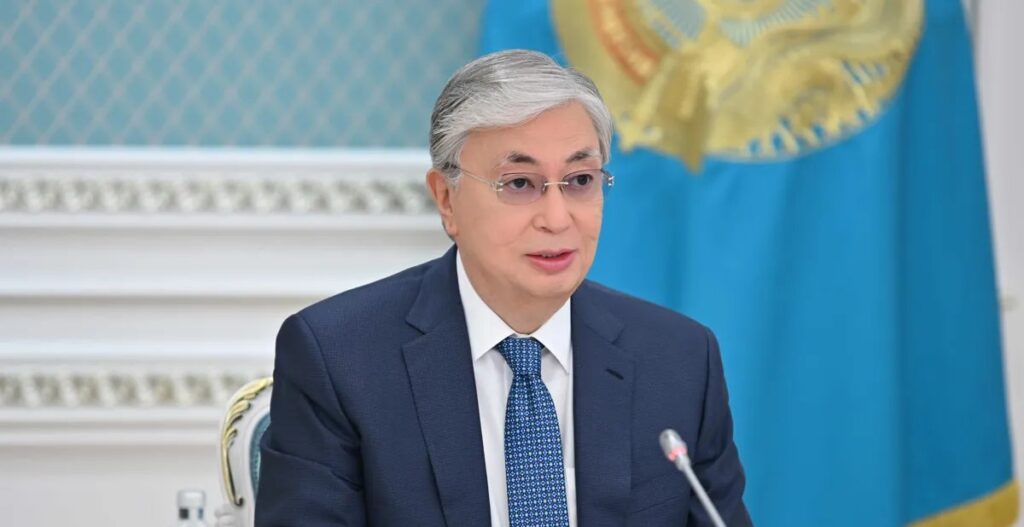
Kazakhstan’s President Kassym-Jomart Tokayev has called for narrowing the gap in education quality between urban and rural schools and accelerating the integration of digital technologies and artificial intelligence (AI) into the country’s education system.

Speaking at the annual August Teachers’ Conference, Tokayev emphasized that building a modern, inclusive nation requires equal opportunities for all children, regardless of geography. “All children must have equal opportunities. Therefore, an important task is to eliminate inequality in the quality of education in cities and villages,” he stated.

Over the past four years, the material and technical infrastructure of more than 4,000 rural schools has been upgraded. Still, Tokayev stressed that this progress must be complemented by digital transformation, including the introduction of AI into the curriculum. “The concepts of ‘progressive nation’ and ‘technological nation’ are synonymous today,” he said, adding that digitalization is central to improving educational outcomes.

Currently, over 95% of schools in Kazakhstan are connected to high-speed internet. Tokayev has instructed that this figure reach 100%, potentially through the use of Starlink satellite technology. “This is not just a technical issue, but a principle of social justice,” he added.

The president also noted that advanced technologies will support the development of an inclusive education environment, particularly benefiting children with special needs.

Several core educational services in Kazakhstan have already been digitized, including school and college admissions, inter-school transfers, and the Bilim service on the eGov mobile platform. However, Tokayev underscored the need to further equip schools with interactive tools and ensure universal access to digital platforms and electronic textbooks.

The president placed particular emphasis on early instruction in AI technologies and continuous professional development for teachers. “Teachers must not only know their subject, but also be able to apply new technologies,” he said.

As previously reported by The Times of Central Asia, the latest PISA assessment noted improvements in education access across Central Asia but highlighted a decline in academic performance among students in the region.

Ancient Water Pipeline Unearthed on 65-Meter Hill in Tajikistan

Archaeologists in Tajikistan have uncovered a remarkable ancient water pipeline system atop a 65-meter hill at the Mugtepa settlement, believed to have been constructed approximately 1,500 years ago.

The site, towering above the city at the height of a modern twenty-storey building, once hosted fortresses of the rulers of Uratyube across various historical periods. For nearly three decades, however, the archaeological site remained neglected. Construction in 2017-2018 further compromised its integrity, leading many to assume its secrets were lost forever.

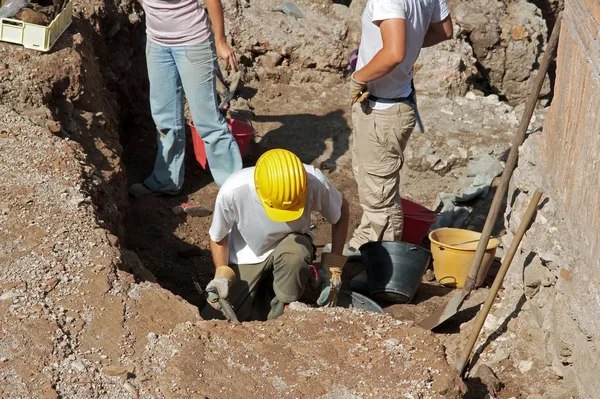
That changed in the summer of 2025, when an expedition from the Department of Archaeology, Ethnography, and Religious Studies at Khujand State University, led by Professor Nabijon Rakhimov, began new excavations. The project, supported by staff from the Kalai Mug Historical and Cultural Complex under Mirzo Olimov, proceeded without official funding but succeeded thanks to the contributions of students and specialists.

Between June 18 and July 18, the team examined three segments of the aqueduct system. Water was drawn from a spring at the base of a nearby hill and transported via ceramic pipes known as kuburs, each approximately 40 cm in length. The pipes were joined using waterproof alabaster mortar and laid in trenches 85 cm wide and 20 cm deep. Small pools, or hauzes, were found along the route, likely used for water collection.

All components of the system were uniformly manufactured, suggesting the existence of specialized production workshops.

Unearthing Everyday Life

In soil layers dating to the 5th to 8th centuries, researchers discovered pottery, stone grain grinders, and spindle whorls, evidence of a thriving agricultural and textile economy. Deeper strata revealed artifacts from earlier eras, ranging from the 1st-3rd centuries CE to the Achaemenid and Hellenistic periods (6th-1st centuries BCE). Notable finds included fragments of tall-stemmed goblets, cup-shaped vessels, and red-slip bowls.

“Archaeological monuments are not just stones and shards; they are material evidence of our history. Without protection and careful treatment, they can disappear,” said Rakhimov.

The team now plans to petition the Agency for the Protection of Monuments under the Government of Tajikistan to secure official support for continued excavations and preservation efforts at Mugtepa.

Other Significant Finds in the Region

This discovery follows several notable archaeological breakthroughs in Tajikistan in recent years.

In 2023, a 7th-century sewer system was uncovered in Istaravshan by architect Amindjonov Khomid and Professor Rakhim Nabiev. The structure, approximately 1,300 years old, highlights the advanced engineering of the period. A rare 6th-century jug, made of concrete and coated in clay, was found nearby.

In May 2025, archaeologists from the National Museum of Tajikistan discovered a Kushan-era clay vessel near the village of Sarband, inscribed in the Bactrian language. The inscription read, “This water jug belongs to a woman named Sagkina,” offering a rare glimpse into ancient literacy and social life.

And in November 2024, an international team led by Professor Yossi Zeidner of the Hebrew University reported the discovery of artifacts dating back 150,000 years at the Soyi Khavzak site in the Zeravshan Valley. Finds included stone tools, animal bones, and plant remains, reinforcing the theory that the region served as a migration corridor for early humans, including Homo sapiens and Neanderthals.

The preservation of organic material at the site raises the possibility of uncovering human remains, which could significantly deepen understanding of prehistoric human presence in Central Asia.

Over Sixty Kazakh Firms Compete to Join First Nuclear Power Plant Project

More than 60 Kazakh companies have expressed an interest in supplying goods, services, and undertaking construction work for the country’s first nuclear power plant, according to Sergey Agafonov, chairman of the Kazakhstan Association of Energy Repair, Design, Engineering Companies, and Energy Equipment Manufacturers.

Construction of the plant began last week near the village of Ulken on the shores of Lake Balkhash, approximately 400 kilometers from Almaty. Under the current plan, Russia’s state nuclear energy corporation Rosatom will commission two reactors with a combined capacity of 2.4 GW by 2035. The facility is expected to meet a substantial share of Kazakhstan’s growing electricity demand.

The estimated cost of the project is between $14 billion and $15 billion, with an additional $1 billion allocated for the development of social infrastructure in the region.

Rosatom CEO Alexei Likhachev confirmed the company’s readiness to involve Kazakh businesses during a meeting with Prime Minister Olzhas Bektenov.

According to the industry association, the preliminary list of potential Kazakh participants includes 66 companies: seven energy equipment manufacturers, 41 building materials producers, and 18 construction firms. Notable names include Tavrida Electric Astana, NERO Group, Kazakhstan Insulator Plant, Sayman Corporation, KARLSKRONA LC AB, Alageum Electric, and Karaganda Turbomachinery Plant. Among building materials suppliers, Qarmet is prominent, while Bazis-A Corp. stands out among construction companies.

Agafonov noted that the project could serve as a major driver for local industry, drawing a parallel to Turkey’s Akkuyu nuclear power plant, where local firms played a substantial role.

As previously reported by The Times of Central Asia, Kazakhstan plans to construct at least three nuclear power plants. The Chinese National Nuclear Corporation (CNNC) has been granted the rights to develop the second and third sites.

Italian Climber Dies During Descent from Peak Pobeda in Kyrgyzstan

An Italian climber has died and several others were injured during a descent from Peak Pobeda (Victory Peak), one of Kyrgyzstan’s three seven-thousanders, according to the Kyrgyz Ministry of Defense. The injured include citizens of Germany and Russia who were part of the same mountaineering group.

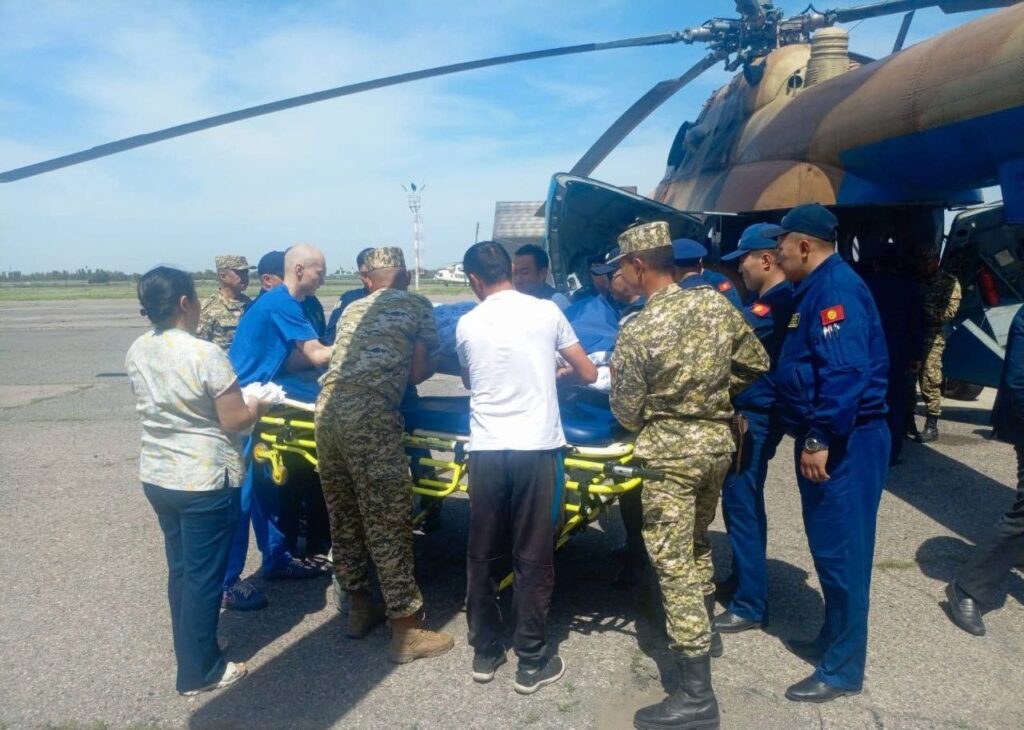
The Ministry dispatched a Mi-8 military helicopter with six rescuers on board to reach the group. However, adverse weather forced the helicopter to make a hard landing near the climbers. All those on board survived, though several sustained injuries of varying severity. A second helicopter was later sent to continue the rescue operation.

“The helicopter made a hard landing at high altitude under difficult weather conditions. The crew members and mountain rescuers involved in the evacuation were on board, and all of them survived. Specialists were sent to the scene to evacuate the injured,” the Defense Ministry told The Times of Central Asia.

The injured rescuers and crew members were transported to a hospital in Karakol, where they are in stable condition.

Peak Pobeda; image: 韵升(Yunsheng) 白(Bai)

Due to worsening weather and nightfall, not all climbers could be evacuated immediately. Recovery efforts resumed the following day. A special commission has been formed to investigate the incident, identify the causes of the accident, and assess the technical condition of the aircraft.

At 7,439 meters, Peak Pobeda is the highest point in the Tien Shan mountain range. Its eastern slopes lie within China. The routes to its summit are among the most technically challenging in the world, marked by steep ice faces, sudden gusts of wind, and extreme cold. Despite the risks, the area attracts dozens of climbers annually, drawn by its remoteness and the allure of unclimbed neighboring peaks.

How Armenia–Azerbaijan Peace Lowers Corridor Risk for Central Asia

The framework announced on 8 August 2025 in Washington for Armenia–Azerbaijan peace and development resets the security–economics equation in the South Caucasus and holds deep implications for Central Asia. At its core is the mutual recognition of territorial integrity, renunciation of force, and a transit arrangement under Armenian jurisdiction linking mainland Azerbaijan with its exclave of Nakhchivan across the Syunik province.

For Central Asia, the immediate significance is the de-risking of the westbound Caspian–Caucasus–Anatolia artery centered on Azerbaijan’s Alat Port and the Baku–Tbilisi–Kars (BTK) rail route. As reported by Azerbaijan Railways, BTK’s operating capacity was lifted to 5 million tons/year (t/y) in May 2024 and has a path for expanding to 17 million tons in later phases. Alat currently lists 13 berths and dedicated ferry roll-on/roll-off (“ro-ro”) facilities.

A dependable Armenian-jurisdiction link would create a second, legally unambiguous passage across the South Caucasus. Single-route dependence through Georgia would be reduced, as would the variance of end-to-end journey times. That reliability directly benefits Kazakhstan and Turkmenistan, whose westbound flows move by rail-ferry from Aktau/Kuryk to Alat and from Turkmenbashi to Alat before continuing overland toward Türkiye.

Peace Reframes the Middle Corridor

These developments also strengthen the business case for incremental investments in ports, ferries, rail paths, and energy interconnectors tied to the Middle Corridor, including swap-based energy routing already practiced between Azerbaijan and Kazakhstan. At Alat, confirmed as the hinge of the Middle Corridor, political risk converts into bankable time, which prices into contracts, which later in turn finances small but decisive capacity steps; bankable time begets bankable trade.

Conflict risk in the South Caucasus has been a priced variable since 2020. A durable peace narrows that risk band and yields three operational effects with country-specific salience. First, marine war-risk and cargo premiums in nearby high-risk theaters such as the Gulf, typically ranging from 0.2–0.3% of hull value, rose to 0.5% during recent tensions. This figure offers a benchmark for how underwriters re-price routes as perceived closure risk changes.

Second, forwarders can trim buffer time, improving asset utilization for rail paths and ro-ro (roll on, roll off) rotations pairing the Caspian ports (Alat, Aktau/Kuryk, Turkmenbashi). Third, carriers gain confidence to publish regular rotations and pre-position equipment; the Azerbaijan Caspian Shipping Company notes 1–2-day intervals in favorable conditions and shows multiple departures on a given day (e.g., August 15 listed Alat–Kuryk, Alat–Turkmenbashi, etc.).

Lower variance is not cosmetic; it is collateral for contracts. Banks recognize collateral. Insurers do, too. When variability falls, rate discovery improves; as a result, multi-month slots or rail-path agreements become financeable. This is precisely the mechanism exporters from Kazakhstan and Turkmenistan need to secure predictable capacity into Azerbaijan and onward to Türkiye.

Reliability also changes routing choices. At Alat, rail-ferry cargo arriving from Aktau/Kuryk or Turkmenbashi can be planned to run either via Georgia or via Syunik toward Kars, whichever route minimizes dwell time and schedule variance for the onward leg. Even where pure distance savings are modest, gains in reliability reduce movements of empty containers. They also reduce queues at South Caucasus transfer points and improve door-to-door competitiveness versus northern routings via Russia. At the planning desk in Alat, the question shifts from “Is the route open?” to “Which route keeps schedules steady enough to hit the target?”

Repricing Risk and Clarifying Schedules

The unresolved constraint has been the Caspian Sea, not the politics of the South Caucasus. Weather windows, draft variability, and limited ro-ro and rail-ferry tonnage cause irregular sailings and queues at Caspian ports. A peaceful South Caucasus turns that systemic weakness into an operations problem with tractable fixes. When downstream legs become predictable, carriers tighten rotations. ports keep their windows, and crews know the shift; as a result, fixed-day, fixed-hour departures become plausible on the Aktau–Alat and Turkmenbashi–Alat loops.

Once timetables hold, small capital expenditures yield outsized gains: one additional rail-ferry ramp at Alat and Aktau/Kuryk, yard automation at Turkmenbashi, and rapid-turn maintenance bays keep vessels on schedule. For context, the Turkmenbashi complex is rated around 17–18 million t/y (million tons per year) and includes rail-ferry and container facilities; its marshaling yard can handle 52 wagons per turn. On the demand side, exporters from Kazakhstan and Turkmenistan can pre-book sailings and rail paths on quarterly or semi-annual cycles, smoothing peaks that previously overwhelmed terminals.

The legal design will determine the friction costs on the new route. A regime clearly under Armenian jurisdiction, with normal passport and customs control and streamlined procedures, is easier for insurers to underwrite than other, more imprecise formulas. The operational target is predictable, paper-light transit. Implementation of electronic legal documents for international road transport of goods (e-CMR) is advancing thanks to a roadmap agreed with the UN Economic Commission for Europe, along with prototyping the system for the exchange of related data among national customs systems (e-TIR).

Clear, standardized transit rules – mutually recognized Authorized Economic Operator (AEO) status, single-window procedures, explicit security and jurisdiction – enable insurers to price risk cleanly and allow operators to lock predictable capacity via slot guarantees, take-or-pay floors, service-level agreements, limited indexation, and quarterly auctions, making clarity the cheapest capacity.

Operations Will Standardize as Legal Friction Falls

Peace lowers the political-risk hurdle for energy commerce centered on Azerbaijan and radiating across the Caspian. This is true for oil, gas, and power. Regarding oil, Kazakhstan has been steadily increasing flows through the Baku–Tbilisi–Ceyhan (BTC) pipeline via Azerbaijan, reaching 785,000 tons in the first half of 2025, with planning and discussions to scale beyond 2 million t/y in the near term. More predictable Caucasus legs favor term offtake and storage optimization.

As for gas, a calmer environment reopens space for modular trans-Caspian swaps and interconnectors anchored on Azerbaijan’s grid and improves prospects for future tie-ins from Turkmenistan as regulatory and technical pathways mature. This general bankability also improves for Caucasus-to-Türkiye and Black Sea electric power-lines interconnectors that, over time, could pull Kazakhstan and Turkmenistan renewables into synchronized markets through Caspian–Caucasus links.

External actors now operate as multipliers or dampers on the same operational chain. Türkiye stands to gain from higher utilization of its east–west rail and road links once cargo clears the South Caucasus reliably. Georgia remains important even as a second artery appears: a credible option through Syunik is a hedge, not a replacement. Iran will scrutinize engineering and legal details near its border; clear Armenian jurisdiction and standard customs procedures reduce frictions. Russia’s ability to gatekeep Central Asia’s westbound flows diminishes if both South Caucasus arteries -through Georgia and Armenia – remain open.

The Prospects Ahead

Peace between Armenia and Azerbaijan offers what the South Caucasus has lacked for years: predictability. With two lawful routes across the region and clearer rules at the border, Central Asian exporters can plan around timetables rather than uncertainty. The practical gains are familiar and cumulative: more regular ferry sailings on the Caspian, modest upgrades at the ports, and a straightforward transit regime under Armenian jurisdiction that keeps paperwork light and journeys transparent. Taken together, these changes will shorten queues and steady prices, allowing shippers to book capacity months in advance. The result will be a Middle Corridor that works as a primary route rather than a fallback, strengthening Azerbaijan, Kazakhstan, and Turkmenistan in their westbound trade and accelerating the ongoing transformation of Eurasian geoeconomics.