• KGS/USD = 0.01144 0%
  • KZT/USD = 0.00212 0%
  • TJS/USD = 0.10454 -0.1%
  • UZS/USD = 0.00008 0%
  • TMT/USD = 0.28571 0.28%
  • KGS/USD = 0.01144 0%
  • KZT/USD = 0.00212 0%
  • TJS/USD = 0.10454 -0.1%
  • UZS/USD = 0.00008 0%
  • TMT/USD = 0.28571 0.28%
  • KGS/USD = 0.01144 0%
  • KZT/USD = 0.00212 0%
  • TJS/USD = 0.10454 -0.1%
  • UZS/USD = 0.00008 0%
  • TMT/USD = 0.28571 0.28%
  • KGS/USD = 0.01144 0%
  • KZT/USD = 0.00212 0%
  • TJS/USD = 0.10454 -0.1%
  • UZS/USD = 0.00008 0%
  • TMT/USD = 0.28571 0.28%
  • KGS/USD = 0.01144 0%
  • KZT/USD = 0.00212 0%
  • TJS/USD = 0.10454 -0.1%
  • UZS/USD = 0.00008 0%
  • TMT/USD = 0.28571 0.28%
  • KGS/USD = 0.01144 0%
  • KZT/USD = 0.00212 0%
  • TJS/USD = 0.10454 -0.1%
  • UZS/USD = 0.00008 0%
  • TMT/USD = 0.28571 0.28%
  • KGS/USD = 0.01144 0%
  • KZT/USD = 0.00212 0%
  • TJS/USD = 0.10454 -0.1%
  • UZS/USD = 0.00008 0%
  • TMT/USD = 0.28571 0.28%
  • KGS/USD = 0.01144 0%
  • KZT/USD = 0.00212 0%
  • TJS/USD = 0.10454 -0.1%
  • UZS/USD = 0.00008 0%
  • TMT/USD = 0.28571 0.28%

Mirziyoyev and Berdymuhamedov Agree on New Projects as Trade Tops $1 Billion

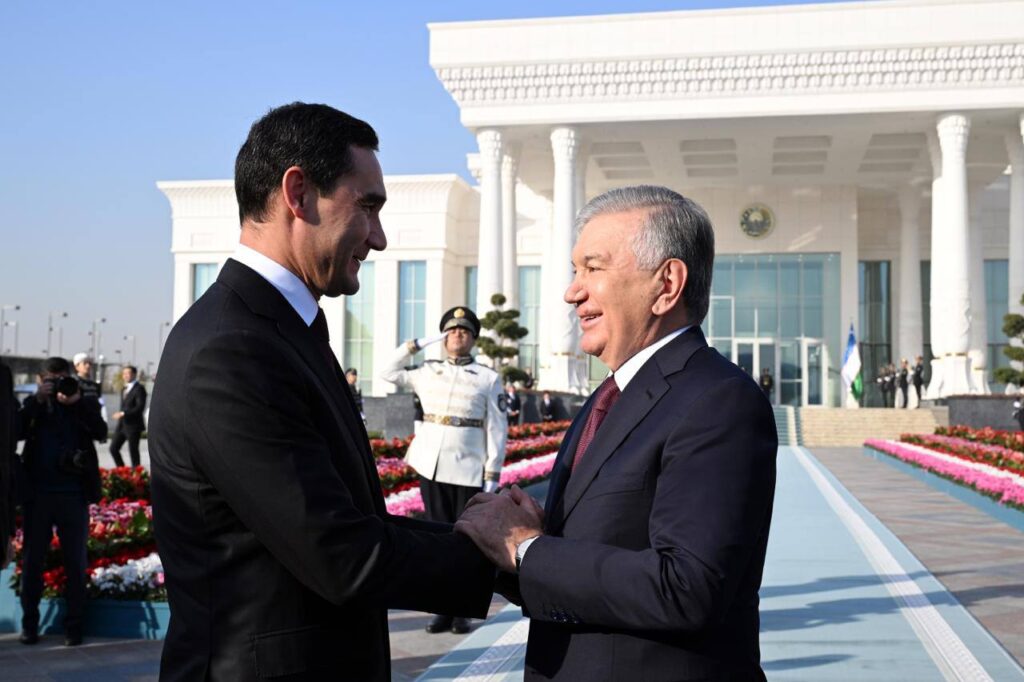
Uzbekistan and Turkmenistan have agreed to deepen political, economic, and humanitarian cooperation following President Serdar Berdymuhamedov’s state visit to Tashkent, where he held talks with President Shavkat Mirziyoyev on November 17.

The summit began in a narrow format at the Kuksaroy Residence, where both leaders emphasized the significance of the visit in strengthening the growing strategic partnership. They noted the increasing dialogue across various sectors and highlighted recent cultural initiatives, including the Days of Turkmen Culture and Cinema held in Urgench and Tashkent.

Bilateral trade continues to grow, having surpassed $1 billion last year, supported by rising freight flows through the Turkmenbashi port. The presidents explored new opportunities to boost mutual trade and deepen cooperation in industry, energy, transport, mechanical engineering, agriculture, and water management. They also agreed to expand interregional collaboration and to convene the next Forum of Regions in Khiva.

Talks then continued in an expanded format with the participation of both delegations. Mirziyoyev stated that the visit reflects the “centuries-old ties of friendship and good neighborliness,” and he praised Turkmenistan’s progress under the leadership of Gurbanguly Berdymuhamedov, Chairman of the Halk Maslahaty.

The two sides agreed to work toward increasing trade to $2 billion by expanding the range of goods and more effectively utilizing the free trade regime. They noted that the newly launched Shavat-Dashoguz cross-border trade zone would play a key role in achieving this target and agreed to replicate the model in other regions, starting with the Alat-Farab corridor.

Industrial cooperation is set to expand, with both sides encouraging businesses to launch joint projects in sectors such as building materials, pharmaceuticals, and food production. In the energy sector, the two countries plan to embark on larger-scale cooperative projects, including the development of promising natural resource deposits. Transport cooperation will also deepen through joint development of the Turkmenbashi port and the resumption of direct flights between Tashkent and Ashgabat.

The presidents instructed their governments to ensure timely implementation of all agreements by holding regular meetings of the Intergovernmental Commission and the Business Council. They also committed to intensifying collaboration in culture, education, youth exchanges, filmmaking, healthcare, and medical science.

Following the talks, the leaders jointly inaugurated the Shavat-Dashoguz trade zone, which includes customs, quarantine, and veterinary services, as well as warehouse facilities, a trade pavilion, and public services operating under a single-window system. The zone is expected to significantly boost economic ties between Uzbekistan’s Khorezm region and Turkmenistan’s Dashoguz region, which together are home to more than 3.5 million people.

At a ceremony held at Kuksaroy, Berdymuhamedov was awarded the “Oliy Darajali Dustlik” Order, Uzbekistan’s highest state honor. Mirziyoyev said the award reflects Turkmenistan’s contributions to strengthening friendship, trust, and strategic partnership. Berdymuhamedov expressed his gratitude and reaffirmed his commitment to enhancing bilateral relations.

The two sides signed a Joint Statement and oversaw the exchange of intergovernmental and interagency agreements covering trade, healthcare, agriculture, transport, biological safety, justice, forestry, and regional cooperation.

The Uzbekistan-Turkmenistan summit concluded the same day. As part of his visit, Berdymuhamedov also participated in the Seventh Consultative Meeting of the Heads of State of Central Asia.

Uzbekistan Revises 2024 GDP to $121.4 Billion

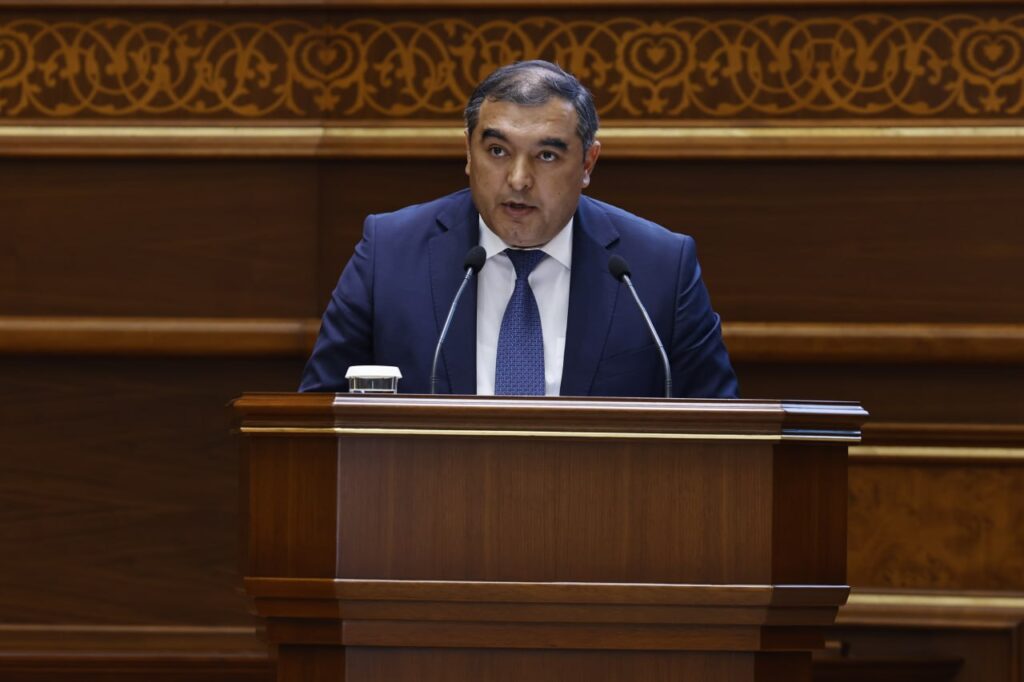
Uzbekistan’s gross domestic product (GDP) for 2024 has been revised upward to $121.4 billion, according to Behzod Hamroyev, Chair of the National Statistics Committee. The new figure was announced on November 17 during an international conference in Tashkent, as reported by the Statistika channel.

Hamroyev explained that the revision reflects newly identified value added across key sectors of the economy. According to the final calculations, Uzbekistan’s nominal GDP for 2024 rose from 1,454.6 trillion soums to 1,535.4 trillion soums, an increase of 80.9 trillion soums, or 5.6%. In dollar terms, this marks an upward revision from the previously reported $115.0 billion to $121.4 billion.

Following the recalculation, GDP per capita in 2024 reached 41.3 million soums.

Hamroyev highlighted that full coverage of state budget execution led to the identification of 36.4 trillion soums in additional newly created value. Sector-specific revisions also contributed significantly: added value in industry rose by 12.7 trillion soums, agriculture by 5.6 trillion soums, construction by 10.3 trillion soums, and services by 16.3 trillion soums.

Earlier this year, presidential spokesperson Sherzod Asadov reported that Uzbekistan’s GDP grew by 6.5% in 2024, reaching $115 billion before the revision. He also noted that foreign investment increased by 1.6 times to $34.9 billion, with 242 large and medium-sized projects worth $10 billion launched. National exports reached a record $27 billion.

Central Asia Confirms Joint Water Plan for Shardara Reservoir Ahead of 2025-2026 Season

Central Asian nations have reached a consensus on projected water inflow volumes to the Shardara Reservoir for the upcoming non-vegetation period, according to Kazakhstan’s Ministry of Water Resources and Irrigation.

The agreement was finalized during a regional meeting attended by senior officials: Durdy Gendjiev, Chair of Turkmenistan’s State Committee for Water Management; Nurzhan Nurzhigitov, Kazakhstan’s Minister of Water Resources and Irrigation; Shavkat Hamraev, Uzbekistan’s Minister of Water Management; and Jamshed Shodi Shoimzoda, First Deputy Minister of Energy and Water Resources of Tajikistan. Emil Shodikhanov, an adviser at the Kyrgyz Embassy in Turkmenistan, participated as an observer.

Participants reviewed outcomes from the 2025 irrigation season and approved the operational forecast for the Naryn-Syr Darya reservoir cascade for the 2025-2026 non-vegetation period. A consensus was reached on expected inflow volumes to Shardara Reservoir, which is a critical node in the region’s transboundary water system.

The meeting also included discussions on progress in implementing the commitments made during recent summits of the founding states of the International Fund for Saving the Aral Sea. The 92nd session of the Interstate Commission for Water Coordination (ICWC) is scheduled to take place next year in Tajikistan.

“Last irrigation season took place under difficult climate conditions. However, coordinated cooperation among the ICWC member states made it possible to ensure stability throughout the vegetation period,” said Nurzhigitov. “Through such meetings, we reach common agreements and lay the foundation for future cooperation. Together with our colleagues in Central Asia, we aim for a fair distribution of transboundary water resources that considers the interests of all parties.”

This agreement follows the 16 November regional summit chaired by Uzbek President Shavkat Mirziyoyev, during which Central Asian leaders discussed enhancing regional cooperation and accelerating joint infrastructure projects. The summit focused on escalating ecological and water challenges, and leaders stressed the need to adopt a “green development” framework for the region. They also proposed declaring 2026-2036 as the “Decade of Practical Action for the Rational Use of Water in Central Asia.”

Kyrgyzstan Moves Toward Fully Digital Justice System

On November 17, Kyrgyz President Sadyr Japarov signed new legislation aimed at modernizing the country’s judicial system and expanding citizens’ access to justice through advanced digital technologies.

The new law introduces a fully digital framework for legal proceedings, intended to accelerate litigation and increase transparency. Beginning January 1, 2026, administrative, civil, and economic cases will be processed entirely within a digital environment.

Under this system, court rulings, protocols, and other legal documents will be deemed legally valid if signed with a digital signature. All filings, including lawsuits, appeals, cassation complaints, and petitions for case review, must be submitted electronically through a unified digital platform, with each document requiring a digital signature and completion of an electronic form.

Participants in legal proceedings will be able to access and download court decisions online. The legislation significantly reduces and eventually aims to eliminate the need for individuals to appear in court in person as plaintiffs, defendants, witnesses, or experts. Remote participation and the mandatory audio and video recording of all court sessions will be central features of the new system.

According to government officials, the reform marks a systemic shift from paper-based litigation toward a digital, streamlined model designed to improve judicial efficiency and accountability.

In parallel, President Japarov also signed the Law “On Mediation,” which introduces mandatory pre-trial and extra-judicial mediation for certain categories of civil and criminal disputes. The goal is to ease the burden on courts and promote a culture of peaceful conflict resolution.

While these reforms represent a step toward modernization, Kyrgyzstan’s judiciary continues to face significant structural challenges. The Global Organized Crime Index identifies the judicial system as among the most corrupt institutions in the country, citing persistent issues of bribery, political pressure, and influence from organized crime networks.

The presumption of innocence is frequently disregarded, and courts are often criticized for operating under a de facto presumption of guilt. A 2023 nationwide survey by the International Republican Institute found that 49% of respondents identified the courts as the most corrupt institution in Kyrgyzstan.

Energy-Saving Measures Introduced in Kyrgyzstan: Who Will Be Affected?

Kyrgyzstan’s Cabinet of Ministers has implemented a series of measures aimed at improving energy efficiency and ensuring the rational use of electricity. The move comes amid an electricity shortage caused by persistently low water levels in the country’s main reservoirs.

What’s Happening?

Officials have reported a record surge in electricity consumption this year, coupled with a continuing regional drought. In response, the government has ordered a restriction on indoor and outdoor lighting between 6p.m. and 6a.m.

However, the Cabinet emphasized that the new measures will not apply to strategic facilities, 24-hour operations, or institutions responsible for defense, security, health care, social services, or other critical public functions.

“These measures do not affect processes essential to the technological operation of buildings,” stated the government’s press service.

According to official estimates, the restrictions could save approximately 40 million kilowatt-hours of electricity per month.

This year, Kyrgyzstan has already recorded electricity consumption that exceeds last year’s figures by 1 billion kilowatt-hours.

The government attributes the increased demand to the launch of new industrial enterprises, the expansion of social and educational institutions, and ongoing residential construction.

The situation is further worsened by declining water inflow to the Naryn River, which feeds the Toktogul Reservoir and its namesake hydroelectric plant. The reservoir’s water level is currently 2 billion cubic meters lower than it was during the same period last year.

“The Cabinet’s primary objective is to ensure rational water use in the Toktogul Reservoir and reduce the load on the energy system,” the government said. The goal is to prevent the reservoir from reaching a critical low.

Who Will Be Responsible?

The Ministry of Energy has mandated that all government agencies and state-owned entities switch off power in the evenings and at night once staff have left their workplaces. Heads of municipal bodies and public institutions will bear personal responsibility for any violations of the new regulations.

How Are Residents Responding?

For now, residents in the private sector report that little has changed. However, there are growing concerns that household power limits may soon be tightened.

“They say our electricity consumption will be restricted. It used to be capped at 5 kilowatts at a time, but now they’re talking about reducing it to 3. That would make things much harder, especially if it’s a cold winter,” said Alexander Verkholantsev, a resident of central Bishkek, who spoke with The Times of Central Asia.

Authorities have already announced that electricity restrictions for residential consumers during peak hours will be in place from October 2025 through March 2026. Despite this, many households still exceed the 3-kilowatt threshold.

TCA Interview: Kazakh Director Venera Kairzhanova on the Bravery of Children with Special Needs

November saw the premiere of Venera Kairzhanova’s debut feature film, Second Mother. The documentary centers on the Meyirim rehabilitation center for children with developmental disabilities. But the film is more than a social chronicle; it’s a warm and luminous portrait of people who help children explore the world every day. Step by step, movement by movement.

Kairzhanova spoke with The Times of Central Asia about the making of the film.

TCA: Venera, congratulations on the premiere. How did you feel seeing your work on the big screen?

Kairzhanova: It was very exciting, but everything went smoothly in a warm, friendly atmosphere. The film was well received, and the theater was full. The audience included employees of the Meyirim center, parents, media representatives, and industry colleagues. The first private screening was back in September, but it was in a small theater with limited guests. This time, it was a huge hall with lots of people, a completely different experience.

What’s interesting is that when the project is finished and you watch it with the audience, you see it not just as a director, but also as a viewer.

TCA: The audience cried. Did you?

Kairzhanova: Yes. At the first screening, very much so. At the second, the emotions were a bit less intense, but the material still moves me: stories about the children, their teachers, their victories. After the screening, people came up to me to share their impressions and that was incredibly valuable. It’s important when a film is not just watched but really touches people’s hearts.

@Galiya Baizhanova

TCA: Working with children is always a special process. How did you prepare?

Kairzhanova: Honestly, I didn’t prepare specifically. I arrived early, observed the classes and that was it. I was nervous, of course, because I didn’t know how the children would react to the cameras, lights, and equipment. But everything went surprisingly well.

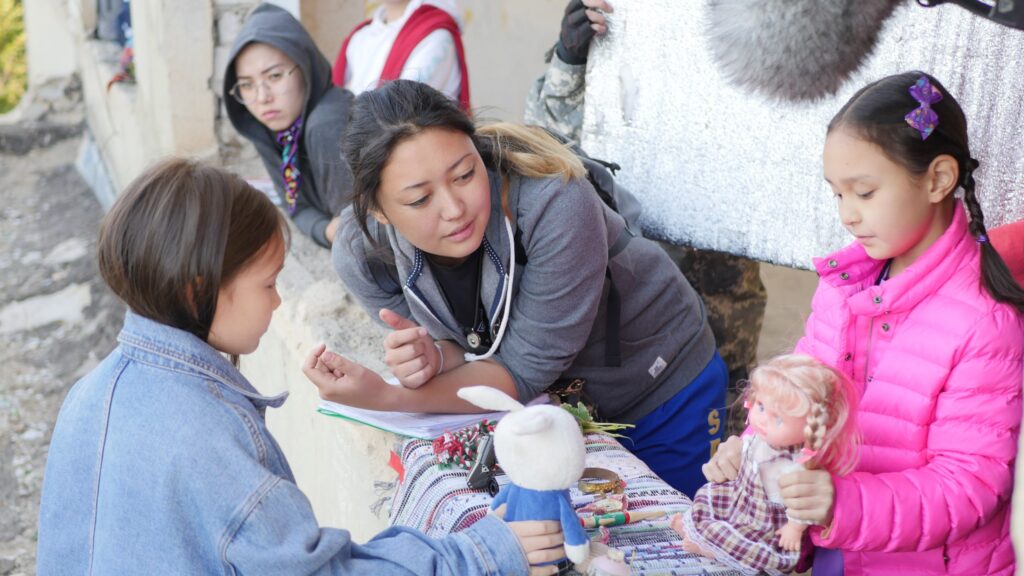
The children turned out to be incredibly open and sociable. They weren’t shy about the cameras; on the contrary, they played around and looked straight into the lens. Everything was so natural that we hardly interfered. We didn’t ask them to repeat anything or stage any shots. We just captured moments: in the dining room, during classes, and in their interactions.

This project made me fall even more in love with documentary filmmaking, even though this is already my fifth documentary.

TCA: Which episode was the most emotional for you?

Kairzhanova: The film mainly focuses on the rehabilitation center’s educators. We filmed their daily routines: classes, meetings, celebrations. By the third day, everyone had gotten used to each other, and the atmosphere became very warm.

One day, we filmed an individual session between instructor Anna Kosenko and a girl named Aisha. She was learning to walk with the help of an exoskeleton. Aisha, fragile, small, beautiful, was taking steps, and Anna was helping her. At one point, Anna asked, “Are you okay?” Aisha smiled and said, “Yes, I’m fine.”

TCA: And you couldn’t hold back…

Kairzhanova: I just started crying. I looked at the monitor and cried.

I’d been working for three days, just recording what was happening. And then suddenly, something clicked. I realized this wasn’t just a shot. This was real life, the children’s efforts, their inner strength. I turned away so no one would see me and sat behind the monitor, crying.

Our cameraman, the wonderful Azamat Zhanabekov, came over and said he’d also barely held it together. It was a very moving moment.

@Galiya Baizhanova

TCA: What touched you so deeply, her joy at taking her first steps?

Kairzhanova: It was her inner strength and the joy with which she accepts life. We often get upset over nonsense. But these children work every day to learn to walk, talk, hold a spoon, things that come naturally to us. And they smile while doing it.

They look at you with such warmth, such gratitude for life, that it turns everything inside you upside down. Even now, talking about it, my voice trembles. That moment will stay with me forever.

TCA: You were the screenwriter for the film Paralympian. Did you choose inclusive cinema consciously, or was it a coincidence?

Kairzhanova: It started back when I was a student. Aldiyar and I have been working together for a long time. One of our first inclusive projects was the short film Hop-Top. It was successful, got a lot of feedback, and then we were invited to make a social video about a girl with Down syndrome. Then Aldiyar came up with the idea for Paralympian.

That film probably led to Second Mother. The author of the idea, Bakhyt Saparov, suggested making a film about teachers at rehabilitation centers, to show their work and the atmosphere from the inside.

You could say this topic found us. We weren’t looking for it.

TCA: “Khlop-Top” is the one where Santa Claus visits a rehabilitation center?

Kairzhanova: Exactly. An actor is sent without being told the details. He walks in and sees most of the children in wheelchairs. He panics and leaves. The teacher runs after him and says, “Please don’t leave. The children were waiting for you.”

He returns, and the children experience a real miracle.

That’s how we got drawn into the topic of inclusion. We didn’t have any personal experience with it; it just found us.

TCA: In Paralympian, you don’t push for pity but use humor. Why?

Kairzhanova: Because we listened and observed a lot. We realized that people overcome difficulties through humor.

The characters joked about their situations but in a kind, good-natured way. And it’s not just about people with disabilities. Everyone lives like that. Life is hard, and humor helps you get through it without staying stuck in pain.
@Galiya Baizhanova

TCA: Is your new film also uplifting?

Kairzhanova: Yes. Many expected a heavy film, but they smiled throughout. And I loved that.

We didn’t focus on how hard things are for the children. We showed how they live, how they’re supported, how they grow.

The centers create an atmosphere of complete safety and acceptance. No one is judged. There, children are just children.

TCA: Second Mother is your feature film debut. What were your earlier works about?

Kairzhanova: My first documentary was about our friend Sofia Tormysheva, who passed away. It was a very personal story.

Then in 2021 came a turning point. After the pandemic, I had two offers: to work as an assistant on a TV series, a feature film, my comfort zone or to direct a documentary project. It was scary, but I chose documentary. I have no regrets – it was a turning point.

After that came projects: a film about cattle breeding for the Meat Union of Kazakhstan, one about Turkestan, and a project for the 30th anniversary of a mineral water plant.

And Second Mother is already a social film and a special one.

TCA: Will the film be released?

Kairzhanova: The producers are considering it, but it’ll most likely go to festivals and streaming platforms.

Theatrical release is harder. As far as I know, the only documentary to make it to theaters was Kanat Beysekeev’s Winter in Rehab. He’s a media personality with his own audience. It’s much more difficult for other filmmakers.

TCA: Social films are increasingly being made in Kazakhstan now. Can such films become part of theatrical distribution?

Kairzhanova: I think so. When major players like Tiger Films focus on social issues, it’s important. Inclusive stories need to be seen they shouldn’t stay hidden in festival niches.

The potential for such films is huge. Look at the global success of 1+1, that’s a social film too. Our film Paralympian was also very well received.

Audiences are changing, opening up to new topics, and that’s wonderful. I’m glad there are directors and producers taking on such bold stories.