Kazakhstan Courts Global Investment with Critical Minerals and Green Energy Push
-
By
 Aliya Haidar
Since gaining independence, Kazakhstan has established itself as a reliable global supplier of raw materials. Today, the country’s economic structure is evolving as it positions itself as a high-added-value hub for industrial production. These developments are closely tied to Kazakhstan’s transition to a green economy and its role in global supply chains for critical minerals.
Creating a Favorable Investment Climate
Kazakhstan has taken significant steps to create a transparent, predictable investment environment and enhance its business competitiveness. Among these measures is the introduction of investment agreements that guarantee legislative stability for up to 25 years for large projects exceeding $60 million. The legal framework has also undergone reforms, procurement procedures have been modernized, and judicial reforms have created separate cassation courts and redefined the Supreme Court’s role.
These reforms have drawn the attention of international investors and rating agencies. In 2024, Moody’s upgraded Kazakhstan’s long-term credit rating to the highest level in the country’s history, citing macroeconomic stability and policy predictability. In the first nine months of 2025, GDP grew by 6.3%, while investment in fixed capital rose by 13.5% to reach $26 billion.
Moody’s analysts also highlighted Kazakhstan’s stronger economic outlook compared to other hydrocarbon-exporting nations, attributing this to ongoing reforms that enhance the country’s competitiveness. One key driver is the rapid development of the transport and logistics sector, particularly through the Trans-Caspian International Trade Route, also known as the Middle Corridor.
This corridor is attracting foreign investors across a range of non-oil sectors, including automotive, pharmaceuticals, food production, and construction materials.
Kazakhstan is also home to the Astana International Financial Centre (AIFC), a platform that operates under English common law. The AIFC offers tax exemptions, simplified labor regulations, and digital arbitration. It currently ranks first in Eastern Europe and Central Asia in the Global Financial Centres Index. More than 4,200 companies from 80 countries, including over 60 American firms, are registered with the AIFC.
Strategic Projects Take Shape
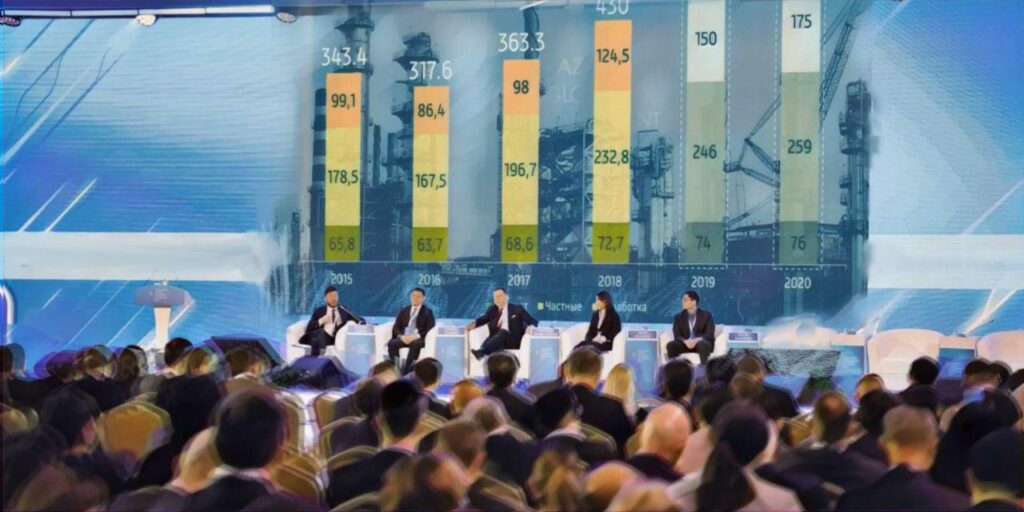
Kazakhstan’s diversification strategy and focus on critical minerals were prominently showcased during the 8th Kazakhstan Global Investment Roundtable (KGIR-2025), held in Astana in October. The event attracted over 1,000 participants from 55 countries, resulting in the signing of 49 agreements worth $7.5 billion.
A key session focused on critical minerals and the energy transition, signaling the country’s long-term growth trajectory. Among the highlights was a meeting between the government and Mohammad Vahid Sheikhzadeh Najjar, CEO of FakoorSanat Tehran Engineering Co., to explore cooperation in mining and metallurgy, including new technologies for processing mineral raw materials.
Sheikhzadeh Najjar noted that the global market for critical minerals, currently valued at $328 billion, is expected to double by 2032. He emphasized that Kazakhstan is well-positioned to lead this growth. Environmental initiatives, such as a project to process 55 billion tons of mining waste, offer additional economic potential.
Meanwhile, Chinese investor Zhang Jintao, founder of Chengdu Sepmem Energy, proposed a long-term plan to develop an LNG cluster in Kazakhstan. The project envisions a nationwide network of LNG plants and supporting infrastructure to reduce emissions and enhance energy access during the green transition. Chengdu Sepmem Energy already operates 12 LNG facilities in China and has completed over 500 projects.
Zhang highlighted China’s success in reducing winter air pollution through LNG, expressing confidence that Kazakhstan could achieve similar outcomes. The plan includes scaling up LNG use in freight and public transportation to support Kazakhstan’s carbon-neutrality goals.
Experts underscore that Kazakhstan’s natural gas reserves and strategic location between Asia and Europe make it an ideal base for LNG development. These efforts also support the expansion of the Middle Corridor, which connects China and Europe via the Caspian Sea and serves as a vital route for energy, minerals, and goods.
Competitive Edge in Critical Minerals
Global markets are shifting toward critical minerals, which are essential for producing electric vehicles, wind turbines, energy storage systems, and more. Demand is projected to increase tenfold in the coming years. For example, lithium demand could rise 42-fold by 2040, while copper, nickel, and cobalt demand could also double by 2035. By 2040, demand for minerals used in electric vehicles and energy storage systems could rise more than 30-fold.
Kazakhstan has designated the development of its critical minerals industry as a strategic priority. This is seen as the nation’s key contribution to the global clean energy transition.
Several national initiatives are already underway. These include the 2023-2027 Concept for the Development of the Geological Industry and the 2024-2028 Comprehensive Plan for the Development of the Rare and Rare Earth Metals Industry. A notable achievement under these programs was the opening of Kazakhstan’s first tungsten concentrate processing plant in November 2024. The United States is backing a private American bid by Cove Kaz Capital Group LLC to develop Kazakhstan’s major tungsten deposits at Upper Kairakty and North Katpar.
The country holds nearly 4% of the global copper market and ranks among the top 20 nations for nickel reserves, with 1.5 million tons, roughly 2% of global supply. In March 2024, a new lithium deposit valued at $15.7 billion was discovered in Eastern Kazakhstan by the Korea Institute of Geoscience and Mineral Resources.
The United States: Kazakhstan’s Leading Partner in Central Asia
U.S.-Kazakhstan cooperation continues to deepen. Since independence, U.S. companies have invested over $60 billion in Kazakhstan, 13% of the country’s total foreign direct investment. More than 630 American firms operate in Kazakhstan, drawn by its stability, market size, and access to regional supply chains.
In 2024, bilateral trade reached $4.2 billion, nearly double the amount five years prior. Kazakhstan accounted for 96.7% of all Central Asian exports to the U.S. that year, totaling $2.4 billion.
Kazakhstan’s green and industrial transitions have not gone unnoticed. The country remains committed to reform, economic diversification, and maintaining an investor-friendly environment, reinforcing its role as a strategic partner in a rapidly changing global landscape.