• KGS/USD = 0.01144 0%
  • KZT/USD = 0.00209 0%
  • TJS/USD = 0.10523 0%
  • UZS/USD = 0.00008 0%
  • TMT/USD = 0.28530 -0.14%
  • KGS/USD = 0.01144 0%
  • KZT/USD = 0.00209 0%
  • TJS/USD = 0.10523 0%
  • UZS/USD = 0.00008 0%
  • TMT/USD = 0.28530 -0.14%
  • KGS/USD = 0.01144 0%
  • KZT/USD = 0.00209 0%
  • TJS/USD = 0.10523 0%
  • UZS/USD = 0.00008 0%
  • TMT/USD = 0.28530 -0.14%
  • KGS/USD = 0.01144 0%
  • KZT/USD = 0.00209 0%
  • TJS/USD = 0.10523 0%
  • UZS/USD = 0.00008 0%
  • TMT/USD = 0.28530 -0.14%
  • KGS/USD = 0.01144 0%
  • KZT/USD = 0.00209 0%
  • TJS/USD = 0.10523 0%
  • UZS/USD = 0.00008 0%
  • TMT/USD = 0.28530 -0.14%
  • KGS/USD = 0.01144 0%
  • KZT/USD = 0.00209 0%
  • TJS/USD = 0.10523 0%
  • UZS/USD = 0.00008 0%
  • TMT/USD = 0.28530 -0.14%
  • KGS/USD = 0.01144 0%
  • KZT/USD = 0.00209 0%
  • TJS/USD = 0.10523 0%
  • UZS/USD = 0.00008 0%
  • TMT/USD = 0.28530 -0.14%
  • KGS/USD = 0.01144 0%
  • KZT/USD = 0.00209 0%
  • TJS/USD = 0.10523 0%
  • UZS/USD = 0.00008 0%
  • TMT/USD = 0.28530 -0.14%

Kyrgyzstan Begins Building Strategic Highway to China’s Xinjiang

Kyrgyzstan has begun construction on the Barskoon-Bedel highway, a key section of the future Barskoon-Uchturfan-Aksu corridor that will link the Issyk-Kul region with China’s Aksu prefecture in Xinjiang via the Bedel Pass.

The new road is expected to shorten the distance between Aksu and Kyrgyzstan by 500 kilometers, saving at least 12 hours of travel time for freight carriers.

Route and Infrastructure

The highway will cross the Barskoon and Soek passes, the Kara-Sai valley, and the Ashuu-Suu pass. To ensure year-round use, the project includes construction of a 5.5 km tunnel under the Soek pass and a 3.8 km tunnel beneath the Ashuu-Suu pass, both areas prone to heavy winter closures.

Timeline and Contractor

Construction is being carried out by China Road and Bridge Corporation (CRBC). The main roadworks are scheduled for completion in September 2029, with full commissioning of the highway and supporting facilities expected by September 2030.

The Bedel checkpoint, first opened under a simplified regime in September 2024, lies in a remote mountain zone roughly equidistant from Karakol in Kyrgyzstan and Aksu in China. Its full-scale development with international-standard infrastructure is slated for completion by 2027.

Trade and Regional Connectivity

Once finished, the Barskoon-Bedel corridor will become Kyrgyzstan’s third road crossing with China, alongside the Irkeshtam (Osh region) and Torugart (Naryn region) passes. Unlike the older routes, which are frequently closed during winter, the new corridor is designed to provide a more reliable and time-efficient link.

The project is expected to strengthen Kyrgyzstan’s role as a transit hub for Chinese goods heading to third-country markets. Bilateral trade between Kyrgyzstan and China reached $23 billion in 2024, an eightfold increase in recent years.

Chinese Support

Speaking at the ceremony, Chinese Ambassador Liu Jiangping said the new highway is part of a wider set of strategic projects advancing between the two countries, aimed at accelerating cargo flows and expanding trade, investment, and economic cooperation.
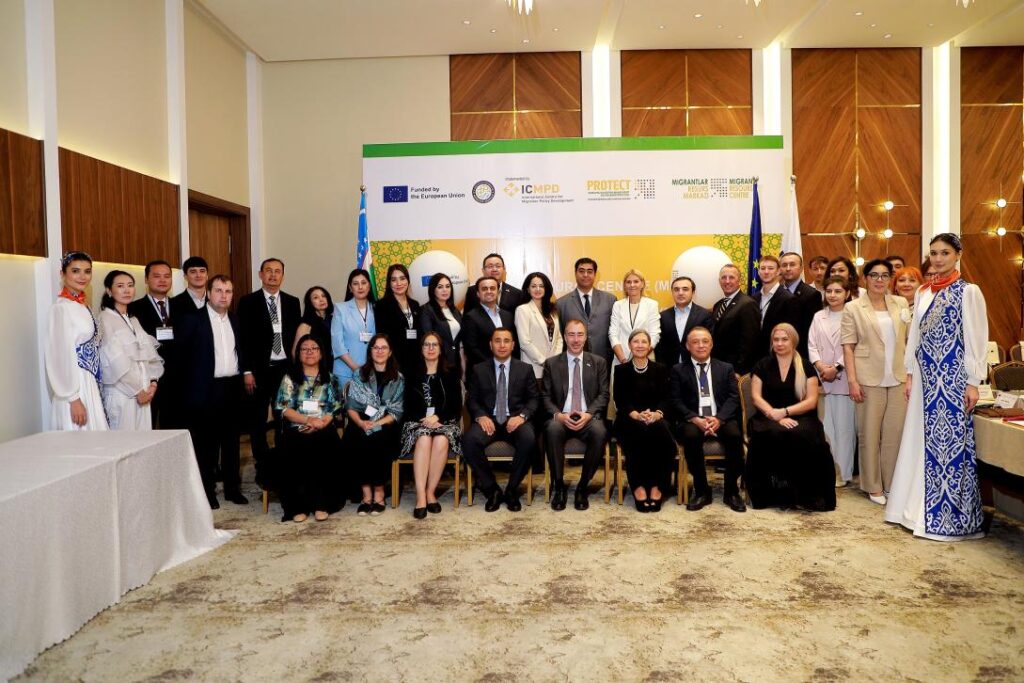

EU Opens First Migrant Resource Center in Uzbekistan as Russia Moves to Tighten Control

The European Union has launched Uzbekistan’s first Migrant Resource Center in Tashkent, while Russia is preparing to roll out a mobile application to monitor foreign workers starting September 1.

Migrant Resource Center in Tashkent

The EU Delegation in Uzbekistan announced that the centre opened on August 26 as part of the EU-funded PROTECT program: Improving Migration Management and Migrant Protection in Selected Silk Routes and Central Asian Countries. The initiative is implemented by the International Centre for Migration Policy Development (ICMPD) in partnership with Uzbekistan’s Migration Agency.

The Center will provide information on legal employment opportunities abroad, raise awareness about the risks of irregular migration, and support the reintegration of returning migrants. Similar centers already operate in Tajikistan and Kyrgyzstan.

At the opening ceremony, EU Ambassador Toivo Klaar said the centers “play a crucial role in providing people with the information they need to make informed decisions about migration.” ICMPD Deputy Director General Sedef Dearing added that the new facility will be “practical and timely for those considering migrating and returning.”

Russia’s Mobile Application for Migrants

Meanwhile, Russia will begin testing a new digital monitoring system in Moscow and the Moscow region on September 1, according to the Multifunctional Migration Centre in the Russian town of Sakharovo.

Citizens from Uzbekistan, Tajikistan, Kyrgyzstan, Armenia, Kazakhstan, Georgia, Azerbaijan, Moldova, and Ukraine will be required to install a mobile application called Amina. The app will handle residence registration, address updates, work permit payments, and appointment scheduling.

The Ministry of Internal Affairs will also have access to users’ geolocation data. Migrants who fail to confirm their location within three working days risk being removed from the registration system and placed on a monitoring list.

Migration Management in Focus

The launch of the EU-backed center in Tashkent reflects Europe’s emphasis on support services and informed choice for migrants, while Russia’s mobile app signals a shift toward stricter surveillance and control. Together, these measures highlight the growing importance of migration management across Central Asia and Eurasia.

Domestic Abuse Back in Spotlight After Self-Immolation, Hostage Cases in Kazakhstan

Two shocking incidents at Almaty airport this year, one involving self-immolation, the other a hostage-taking, have once again led to discussions about gender issues in Kazakhstan.

Two Tragedies at Almaty Airport

On August 25, CCTV cameras recorded a man pouring gasoline over himself at an airport ticket counter after a “personal conflict with his common-law wife,” before setting himself alight. Police extinguished the fire, but the man remains in critical condition in hospital, according to the Transport Police Department. The airport chief of police stated that “according to preliminary data, the man committed this offense because of domestic relations.” Although internet platforms have been rife with speculation about what lies behind the incident, no further information is currently available.

Earlier, on March 7, Mashrapbek Baratov assaulted a female security officer at the same airport, dragging her by the hair and threatening her with a knife while claiming to be carrying a bomb. He was disarmed by a bystander, Musa Abdraim, who was later awarded a medal for bravery by President Kassym-Jomart Tokayev. Baratov, who had a history of violence against women, was sentenced to 11 years in prison in July.

The Bishimbayev Case and “Saltanat’s Law”

These cases reflect a wider pattern of violence against women. The most infamous case involved former Minister of National Economy Kuandyk Bishimbayev, who beat his partner, Saltanat Nukenova, to death in November 2023. The trial, broadcast live, shocked the country and drew international attention. Bishimbayev was sentenced to 24 years in prison in May 2024.

The case coincided with the introduction of new legislation, the Law on Ensuring Women’s Rights and Child Safety, signed by Tokayev in April 2024. Publicly dubbed “Saltanat’s Law,” it toughened penalties for domestic abusers and marked a turning point in public awareness of gender-based violence.

High-profile prosecutions continue. On July 18, former diplomat Saken Mamash was sentenced to six years in prison for psychological and physical abuse of his ex-wife.

Progress and Persistent Gaps

Officials report cautious progress. State Councilor Yerlan Karin announced in June 2025 that domestic violence reports had dropped by 20.5% year-on-year. Serious domestic crimes fell by nearly one-third, and crimes against minors also declined. Overall, the number of crimes against women has halved in five years.

Yet experts warn the problem is far from solved. Kazakhstan still lacks trained police officers, shelters, and support services for victims. Civil society groups stress that legal reforms must be accompanied by education campaigns to challenge entrenched attitudes that relegate women to a secondary role within families.

Despite women’s growing participation in business and public life, traditional norms often leave them vulnerable. Many abusers justify violence as a way of “correcting” women who fail to meet domestic expectations. High levels of objectification and sexualization further reinforce inequality.

A Continuing Struggle

While Saltanat’s Law has signaled a strong state response, the Almaty airport tragedies reveal the dangers of ignoring early warning signs of violence. Until legal measures are matched with deeper cultural change and expanded support networks, Kazakhstan’s women remain at risk.

Yacht Fleet Launched on Lake Issyk-Kul to Boost Tourism and Sports

On August 26, Kyrgyzstan’s resort city of Cholpon-Ata inaugurated the first monotype yacht fleet on Lake Issyk-Kul, marking a new stage in the development of the region’s tourism infrastructure.

The project was spearheaded by Evgeny Kotov, a Russia-born entrepreneur, international business trainer, and founder of the Practicum business school.

At the opening ceremony, Kyrgyzstan’s Minister of Economy and Commerce Bakyt Sydykov highlighted the significance of the initiative, noting that tourism is defined as a strategic sector of the national economy under the National Development Program until 2030.

According to Sydykov, the yacht fleet will help diversify Issyk-Kul’s tourism offerings by developing water sports and recreation, attracting visitors year-round, creating new jobs, and strengthening Kyrgyzstan’s international image and investment appeal.

The new sailing infrastructure also opens opportunities for training athletes and hosting international competitions. Earlier this year, the ministry backed a proposal from the Sailing Federation of the Kyrgyz Republic to exempt sports equipment, including sailing yachts, from customs duties and to simplify procedures for the temporary import of vessels participating in competitions.

Discovery in Uzbekistan Reveals Early Steps Toward Agriculture 9,200 Years Ago

An international team of archaeologists has uncovered evidence that hunter-gatherer communities in southern Uzbekistan were harvesting wild barley as far back as 9,200 years ago, reshaping current understanding of how agriculture first emerged.

Until now, scholars largely believed that the domestication of crops such as barley and wheat began in the Fertile Crescent about 10,000 years ago, particularly among the Natufian people. But new findings from Uzbekistan’s Surkandarya Valley indicate that the cultural practices leading to farming extended much further afield. Researchers argue this challenges long-held assumptions that agriculture arose only once, in response to climate change or population pressures, in a single geographic cradle.

Excavations at Toda Cave

The discovery was made at Toda Cave, excavated under the direction of Xinying Zhou of the Institute of Vertebrate Paleontology and Paleoanthropology in Beijing, with oversight from Farhad Maksudov, director of the Institute of Archaeology in Samarkand.

From the cave’s oldest layers, the team recovered stone tools, charcoal, and plant remains. Archaeobotanical analysis by Robert Spengler of the Max Planck Institute of Geoanthropology confirmed the presence of wild barley, along with pistachio shells and apple seeds, suggesting a diverse diet.

Stone blades and flakes, mostly made from limestone, showed clear use-wear patterns consistent with cutting grasses and plants. These tools closely resemble those found at early farming sites elsewhere.

Rethinking the Origins of Agriculture

“This discovery should change the way scientists think about the transition from foraging to farming,” Zhou said. Spengler added that repeated harvesting of wild plants may have led to unintentional domestication, with early foragers gradually shaping the plants they relied on.

The researchers suggest that the behaviors seen in Toda Cave could represent either an independent experiment in cultivation or evidence of an earlier-than-assumed eastward spread of farming traditions from the Fertile Crescent. Either way, the findings highlight the role of Central Asia in the global story of agriculture.

Next Steps

The team plans to expand excavations in the region to determine whether similar practices existed among other communities. “These ancient hunters and foragers were already tied into the cultural practices that would lead to the origins of agriculture,” Spengler noted.

The discovery underscores that Central Asia, long overlooked in studies of agricultural origins, may have played a crucial role in humanity’s shift from foraging to farming.

Kazakhstan Considers Lowering Speed Limits in Populated Areas

Kazakhstan’s parliament is set to debate reducing the maximum speed limit for motor vehicles in populated areas when deputies return from their summer recess, according to Kaisar Sultanbaev, chairman of the Administrative Police Committee of the Ministry of Internal Affairs.

“As for reducing the speed limit in populated areas, we are constantly working on legislation and our regulatory documents. We are currently considering this issue in working order. When our MPs return from their vacation, we will discuss it with them. The issue is in progress, and we will provide additional information about the decisions taken,” Sultanbaev said at a briefing.

Currently, the standard speed limit in populated areas is 60 km/h, with variations in certain zones: 40 km/h near schools and up to 80 km/h on bypass roads within city limits. Sultanbaev did not indicate what the new limit might be.

The Interior Ministry has previously raised similar initiatives. In spring 2024, it proposed reducing the speed of freight vehicles in populated areas to 50 km/h. The Urban Forum Kazakhstan foundation has also suggested lowering limits in Almaty to 30-50 km/h for all vehicles. More recently, in February 2025, the Prosecutor General’s Office proposed cutting the maximum speed on suburban roads from 90 to 60 km/h.

Road safety remains a pressing concern. In the first half of 2025 alone, police recorded more than 3 million speeding violations nationwide. Speeding remains one of the leading causes of fatal crashes: 1,129 traffic accidents in populated areas were attributed to speeding in that period, resulting in 95 deaths. On national and regional highways, 986 similar accidents killed 180 people.

At the same time, Sultanbaev noted that stricter enforcement is helping reduce casualties. Between January and June 2025, traffic accidents left 16,000 people injured, down from 26,000 a year earlier. Road fatalities also fell by 8 percent, from 1,480 to 1,366.

Kazakhstan’s growing vehicle fleet compounds the challenge. Over the past 34 years, the number of registered vehicles has risen from 2 million to 5.5 million.

Earlier this year, The Times of Central Asia reported that senators also proposed introducing a so-called “idiot test”, a psychophysiological assessment for repeat offenders who frequently violate traffic rules, including speed limits.