• KGS/USD = 0.01144 0%
  • KZT/USD = 0.00213 0%
  • TJS/USD = 0.10456 0.19%
  • UZS/USD = 0.00008 0%
  • TMT/USD = 0.28490 0%
  • KGS/USD = 0.01144 0%
  • KZT/USD = 0.00213 0%
  • TJS/USD = 0.10456 0.19%
  • UZS/USD = 0.00008 0%
  • TMT/USD = 0.28490 0%
  • KGS/USD = 0.01144 0%
  • KZT/USD = 0.00213 0%
  • TJS/USD = 0.10456 0.19%
  • UZS/USD = 0.00008 0%
  • TMT/USD = 0.28490 0%
  • KGS/USD = 0.01144 0%
  • KZT/USD = 0.00213 0%
  • TJS/USD = 0.10456 0.19%
  • UZS/USD = 0.00008 0%
  • TMT/USD = 0.28490 0%
  • KGS/USD = 0.01144 0%
  • KZT/USD = 0.00213 0%
  • TJS/USD = 0.10456 0.19%
  • UZS/USD = 0.00008 0%
  • TMT/USD = 0.28490 0%
  • KGS/USD = 0.01144 0%
  • KZT/USD = 0.00213 0%
  • TJS/USD = 0.10456 0.19%
  • UZS/USD = 0.00008 0%
  • TMT/USD = 0.28490 0%
  • KGS/USD = 0.01144 0%
  • KZT/USD = 0.00213 0%
  • TJS/USD = 0.10456 0.19%
  • UZS/USD = 0.00008 0%
  • TMT/USD = 0.28490 0%
  • KGS/USD = 0.01144 0%
  • KZT/USD = 0.00213 0%
  • TJS/USD = 0.10456 0.19%
  • UZS/USD = 0.00008 0%
  • TMT/USD = 0.28490 0%

As War Rages at Home, Sudanese Student Leaves Kazakhstan for Uncertain Future 

A Sudanese student named Amir began studying at a university in Almaty, Kazakhstan in 2023, just a few months before rival military factions in his country launched a devastating civil war that, according to some estimates, has killed tens of thousands of people and forced more than 10 million to flee their homes.

For Amir, the war was the beginning of an extended period of uncertainty during which he faced financial problems, worried about his displaced family back home, unsuccessfully applied for refugee status in Kazakhstan, feared deportation to Sudan and even faced the possibility of living in limbo in the Almaty airport.

This weekend, a Kazakh human rights group said the situation of the Sudanese man had been “conditionally resolved positively for the moment” because authorities let him fly to an unspecified country that has visa-free entry for Sudanese nationals. Work on his case is expected to continue.

The Kazakhstan International Bureau for Human Rights and Rule of Law (KIBHR), a non-governmental group that was founded in 1993, had helped Amir during his ordeal. The group did not provide his surname but posted photos of the young man on Facebook. It thanked Almaty airport officials for helping to resolve difficult issues as well offices of UNHCR, the United Nations refugee agency, in at least three countries.

The relative improvement in Amir’s situation follows a state of limbo whose roots lie in the war between the Sudanese military and a militia called the Rapid Support Forces, the latest episode of violence in a country that has experienced multiple coup attempts over the decades. The latest fighting set off a humanitarian crisis and allegations of ethnic cleansing and war crimes.

Amir “tried to obtain refugee status in Kazakhstan, but in practice, the country grants that status only in extremely rare cases,” said the human rights group KIBHR, which helped the Sudanese students with his unsuccessful appeals of the Kazakh court ruling against him.

“Under the court’s decision, Amir had to leave Kazakhstan by May 1, so concerned individuals raised money for a ticket to Rwanda — one of the few countries Sudanese citizens can enter without a visa,” KIBHR said. “However, something went wrong: they didn’t even take his documents for review and immediately deported him from the airport back to Qatar, through which he had traveled en route to Rwanda.”

In Doha airport, Amir was put on a flight back to Almaty, where authorities prepared to send him back to Qatar, according to the human rights group. But an airline refused to fly him to Qatar, leaving him stranded in Almaty and facing the possibility of deportation to Sudan.

“What saved the situation was the concern that Amir might harm himself during the flight or his condition might seriously deteriorate, and they were unable to provide an escort. As a result, he was allowed to fly to one of the countries (not specified) that still has visa-free entry for Sudanese nationals, and he was admitted there,” the human rights group.

In 2013, a Palestinian man lived at the Almaty airport for an extended period because the law didn’t allow him to get refugee status and he didn’t have a visa to travel anywhere else, according to media in Kazakhstan. The man’s limbo was reminiscent of the 2004 movie The Terminal, which stars Tom Hanks as a man who gets stuck at New York’s JFK airport after there is a military coup in his home country.

As of January this year, there are 646 refugees or asylum-seekers in Kazakhstan, most of them from Afghanistan and Ukraine, according to UNHCR.

The Kazakh government provides information about how to apply for refugee status.
OSCE, European Embassies Concerned About Media Freedom in Tajikistan

A conference was held in Dushanbe to mark World Press Freedom Day, celebrated annually on May 3. Despite Tajikistan’s slight rise in the 2025 Press Freedom Index, international observers remain unconvinced that the situation in the country has improved.

Official ratings vs. real-world conditions

The event was organized by the media unit of the OSCE Office of Programs in Tajikistan, with support from Internews, the EU Delegation, and the embassies of Germany, France, and the United Kingdom. Discussions focused on the state of free speech, prospects for sustainable media development, and the role of women in journalism.

According to Reporters Without Borders, Tajikistan ranked 153rd out of 180 countries in 2025, an improvement of two places from the previous year. However, Nuriddin Karshiboev, chairman of the National Association of Independent Media of Tajikistan (NAIMT), argued that the ranking does not reflect the lived reality.

“The reality is different. The situation with freedom of expression and freedom of the press remains tense due to the prosecution of journalists, pressure on their relatives, self-censorship, and other factors,” he said.

Karshiboev also criticized the ineffectiveness of existing mechanisms to protect journalists and a lack of understanding among some international media-support organizations.

Freedom of speech is a right, not a privilege

EU Ambassador to Tajikistan Raimundas Karoblis emphasized that journalism should never be grounds for intimidation or imprisonment.

“No journalist should be subjected to intimidation or imprisonment for doing their job,” he told forum participants.

Karoblis underlined that freedom of expression is not a political stance or cultural nuance, but a universally recognized right.

“Freedom of expression in the media is a right, not a crime. The European Union’s protection of media freedom is not an external imposition. It is not a ‘European or Western value’ that can be exported or imposed, it is a universal human right recognized by all who believe in justice, dignity, and responsibility,” he said.

He added that independent media do not threaten social stability but rather form its cornerstone.

“Dynamic, independent media are not a threat to stability. They are the foundation of peace, democratic and economic progress,” Karoblis said, reaffirming the EU’s commitment to supporting journalists in Tajikistan and globally.

High-profile cases against journalists

In February 2025, Reporters Without Borders published a report highlighting increased repression of media figures in Tajikistan. One of the most notable cases involved freelance journalist Rukhshona Khakimova, who was sentenced to eight years in prison for treason following a closed trial. Her alleged offense was writing an analytical article on Chinese influence in Tajikistan. Khakimova is also the niece of an opposition politician sentenced to 18 years for an alleged coup attempt.

Another case involved Ahmad Ibrohim, editor-in-chief of the weekly Payk, who was arrested in August 2024 on charges of corruption, extortion, and extremism. His trial was also held behind closed doors. According to media reports, the case was triggered by an officer from the State Security Committee demanding a bribe in exchange for renewing the paper’s state registration. Despite prosecution witnesses failing to confirm his guilt, Ibrohim received a 10-year sentence.

Human rights advocates note a new wave of pressure on independent media since late 2022, with several journalists convicted in opaque trials. As of publication, nine journalists are reportedly imprisoned, more than in any other Central Asian country.

Rights organizations stress that despite marginal gains in international rankings, the press situation in Tajikistan continues to deteriorate. The international community has called for the immediate release of imprisoned journalists and an end to the pressure on independent media.

Uzbekistan Raises Concern over Treatment of its Migrants in Russia

Uzbekistan has urged Russia to pay greater attention to reports of mistreatment and rights violations involving Uzbek migrant workers living and working in Russia. The issue was formally raised on May 2 during a meeting in Tashkent between Uzbekistan’s Deputy Foreign Minister Bobur Usmonov and Russian Ambassador to Uzbekistan Oleg Malginov.

According to Uzbekistan’s Ministry of Foreign Affairs, Usmonov expressed deep concern over the growing number of reports detailing abuse and harsh treatment of Uzbek migrants. He emphasized that such cases constitute violations of the rights and freedoms of Uzbek citizens, which should be safeguarded under the laws of their host country.

The two officials also reviewed priority areas of bilateral cooperation, including upcoming events on both bilateral and multilateral agendas. They confirmed that collaboration in the consular and legal sectors remains strong. Regular consultations are held on consular issues, and a joint working group on labor migration continues to operate, focusing on employment and migration processes.

“Protecting the rights and interests of citizens is at the center of our cooperation,” the Uzbek side said in an official statement. Topics discussed included pre-departure language and vocational training, simplifying the work permit application process, and ensuring that migrants comply with Russian legal requirements upon arrival.

Meanwhile, on May 3, Uzbek President Shavkat Mirziyoyev and his Russian counterpart Vladimir Putin held a phone call to discuss deepening their strategic partnership. The leaders reviewed cooperation in trade, industry, and regional business, and praised the recent Innoprom. Central Asia exhibition in Tashkent. They also noted expanding ties in education, culture, sports, and tourism.

Just days earlier, on April 29, a delegation from Uzbekistan, led by Deputy Prosecutor General Shohrukh Aminov, visited Moscow for the first session of a joint labor migration working group. Both parties agreed to enhance legal migration frameworks and to ensure fair and dignified treatment of migrant workers. The Uzbek government reiterated its expectation that Russian authorities will investigate the reported abuses and keep their Uzbek counterparts informed of the outcomes.

Supreme Court of Kyrgyzstan Speaks Out Against Racial Discrimination

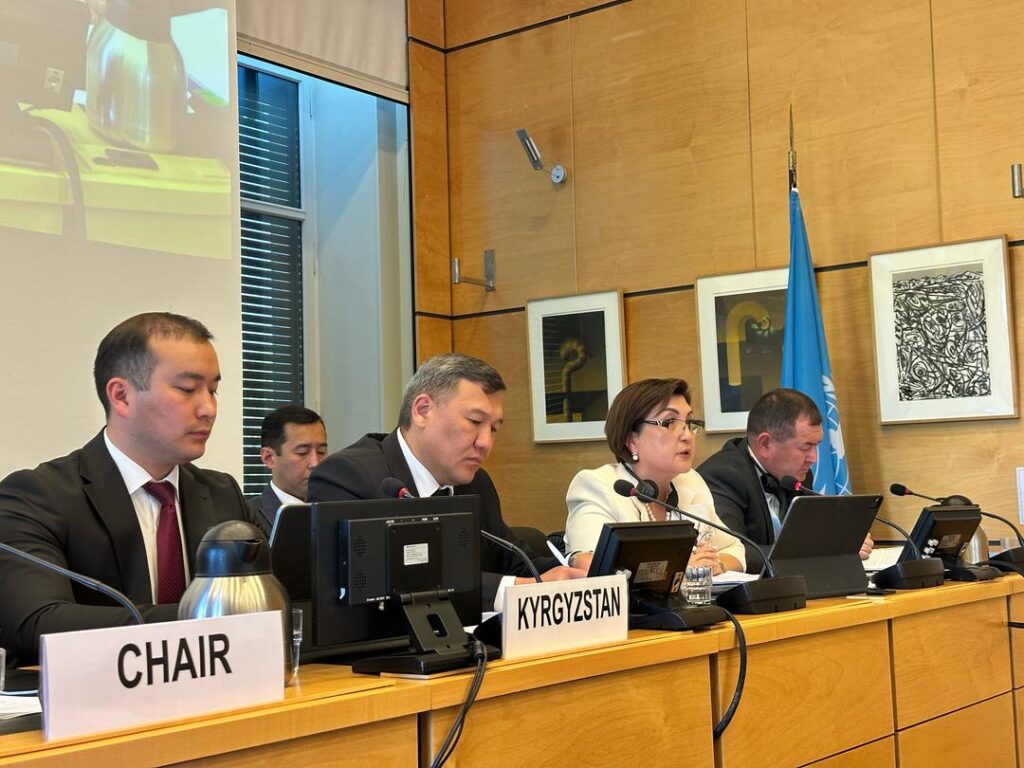
Deputy Chair of the Supreme Court of Kyrgyzstan, Nurgul Bakirova, presented a report during the 115th session of the UN Committee on the Elimination of Racial Discrimination, held in Switzerland.

In response to committee questions, Bakirova affirmed that Kyrgyz law prohibits discrimination on any grounds, racial, ethnic, or national. She emphasized that the Supreme Court ensures effective legal protection for all individuals, regardless of origin. Kyrgyz courts apply both domestic and international legal standards, and a mechanism exists to challenge legislation that violates anti-discrimination principles.

Since 2019, over 400 Kyrgyz judges have undergone training in human rights protection and compliance with international norms. Bakirova also noted that crimes motivated by racial, ethnic, or religious hatred are treated as offenses with aggravating circumstances under Kyrgyz law.

“Kyrgyzstan remains committed to the principles of equality, justice, and respect for diversity. We recognize that combating racial discrimination is not only an international obligation but also an important step towards a harmonious and inclusive society,” she said.

It is worth noting that May 5 marks Constitution Day in Kyrgyzstan. Since its adoption in 1993, the constitution has been amended 12 times. The most recent constitutional referendum was held in 2021.

Kazakhstan Reduced Fish Exports Last Year

Kazakhstan exported 23,400 tons of fish products in 2024, marking a decline from the previous year despite an overall 7% growth in domestic fish production. The figures point to a significant rise in domestic consumption of fish.

According to the Ministry of Agriculture of Kazakhstan, 72 enterprises are currently engaged in fish processing, with 20 of them supplying products to the European Union. Kazakhstani fish products, over 50 types in total, are exported to 21 countries. However, the 2024 export volume fell short of the 25,300 tons reported in 2023, which included 11,800 tons of processed fish, a slight increase over 2022.

In contrast, domestic consumption has surged. The domestic market absorbed 94,600 tons of fish products in 2024, up 7% compared to 2023.

“The state actively supports the development of aquaculture. Subsidies to the industry have increased ninefold since 2021, reaching KZT 4.5 billion ($8.7 million) in 2024. Kazakhstan provides reimbursement of up to 25% of investment costs, 30% of feed costs, and 50% of the cost of purchasing young fish, broodstock, and veterinary drugs,” the Ministry of Agriculture stated.

The number of fish farms in Kazakhstan has doubled in the past three years, reaching 600. In 2024, investments in fixed assets in the fishing industry exceeded KZT 5.2 billion ($10.1 million).

Despite this growth, concerns remain about the ecological health of regional fish stocks. As previously reported by The Times of Central Asia, the Caspian sturgeon population has plummeted by 90% amid an ongoing environmental crisis.

Binance Founder to Advise Kyrgyzstan President on Digital Assets

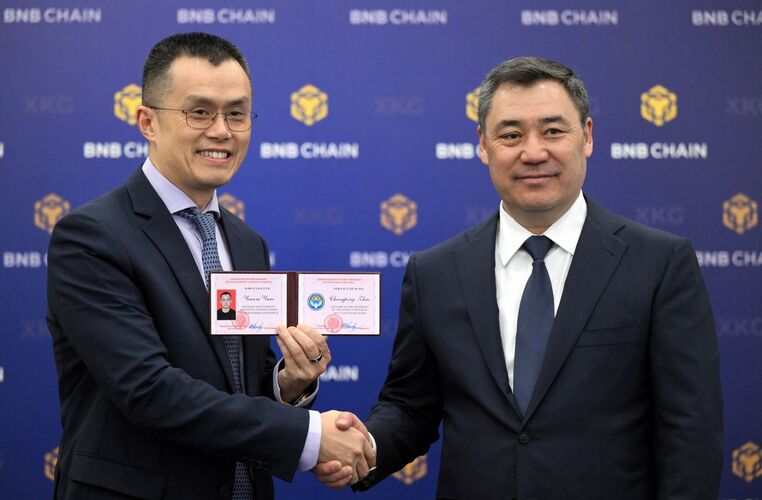
On May 3 in Cholpon-Ata, President Sadyr Japarov met with Changpeng Zhao, founder of Binance, the world’s largest cryptocurrency exchange, to discuss the future of digital assets and blockchain technologies in Kyrgyzstan.

The meeting focused on the development of the country’s digital asset ecosystem, the introduction of blockchain technology into public administration, and measures to bolster cybersecurity. Japarov emphasized that Kyrgyzstan is actively promoting digital assets, particularly through the planned introduction of a national digital currency, the digital som.

Changpeng Zhao expressed his readiness to support Kyrgyzstan’s digital transition by consulting and training local specialists involved in developing and implementing the digital som. During the meeting, Japarov presented Zhao with a certificate appointing him as a public adviser to the President of Kyrgyzstan on the development of digital assets.

The following day, May 4, Japarov chaired the inaugural session of the National Council for the Development of Virtual Assets and Blockchain Technologies in Cholpon-Ata. Zhao was officially accepted as a member of the Council, which was established to formulate a unified state policy on virtual assets and promote their use in governance and key economic sectors.

Japarov outlined the Council’s main areas of focus:

  • Enhancing financial literacy and supporting educational programs
  • Strengthening cybersecurity and protecting users from digital fraud
  • Integrating blockchain technologies into public administration systems

“Interest in cryptocurrency is growing every year in Kyrgyzstan, and blockchain technologies and digital assets are becoming the basis of a new financial system,” Japarov stated.

Earlier, the National Investment Agency of Kyrgyzstan signed a Memorandum of Cooperation with Zhao. Under the agreement, Binance will assist in developing blockchain infrastructure, creating a national cryptocurrency reserve, and training professionals in blockchain technology, virtual asset management, and cybersecurity.