L’Étranger: Paris Hosts the Reclusive Leader of Turkmenistan

Gurbanguly Berdimuhamedov, Turkmenistan’s longtime ruler, no longer holds the title of president; that has been passed, along with much of the public burden, to his son. He now reigns from the shadows as Hero-Arkadag (“Hero-Protector”), but he retains the ability to open doors.
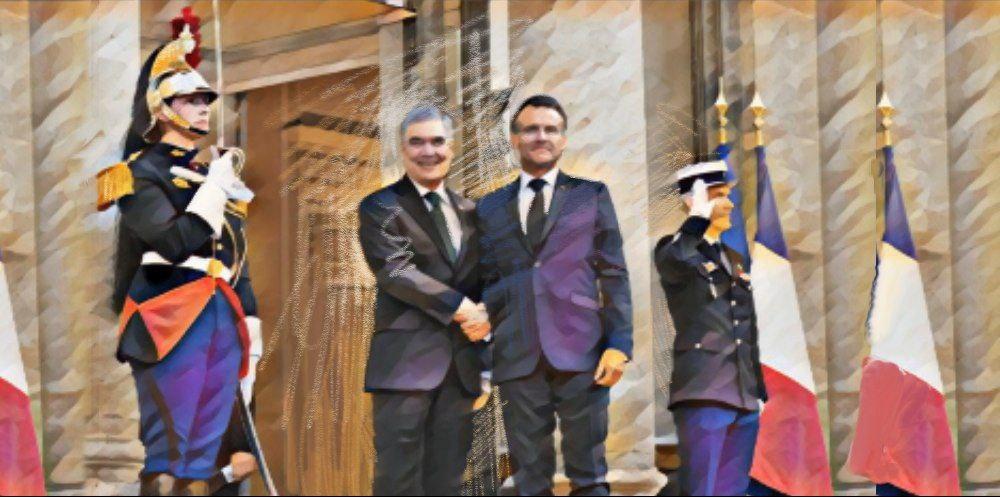
Nearly 14 years after his last official visit, Berdimuhamedov landed at Paris’ Orly airport last Monday. He was in France ostensibly to attend the Franco-Turkmen Economic Forum, but the visit also saw him ushered into the Élysée Palace for an audience with President Emmanuel Macron.
Characteristically, his presence in Paris was kept quiet, receiving very little coverage even in the French media.
“It was much less discussed than the near-concurrent visit of the Syrian leader, Ahmed Al-Charaa,” Michaël Levystone, co-founder of l’Observatoire de la Nouvelle Eurasie, a Paris think tank told The Times of Central Asia. “You have to understand that Turkmenistan is a country that is virtually unknown to the general public in France – and for good reason: it goes out of its way to remain extremely discreet!”
Nevertheless, the visit marks a rare moment of high-level Western diplomacy with one of the world’s most opaque regimes, as well as an extremely uncommon public diplomatic appearance from Berdimuhamedov Senior since ceding formal power in 2022. The questions are why France? And why now?
What Was Discussed
The two readouts of the encounter were notably different. The Élysée offered a terse summary on its website, noting vaguely that the meeting “provided an opportunity to review the bilateral relationship between Turkmenistan and France as well as regional issues.” Macron then followed this up with an equally laconic post on X, noting that the two had “signed several agreements between Turkmenistan and France in the areas of energy transition, infrastructure, education, and culture. They demonstrate the strengthening of our cooperation. We also took stock of major regional and international crises, including Russia’s war of aggression against Ukraine and the situation in the Middle East.”
On the other hand, the state-run news service Turkmenistan Today provided what can only be described as a detailed travelogue, noting the many dignitaries who had the pleasure of meeting the Hero-Arkadag on his whistle-stop tour of the City of Lights.
According to the Turkmens, the visit yielded a flurry of agreements. A memorandum of understanding was inked between state-owned Türkmengaz and French tech firm Kayrros SAS, while France’s Thales Alenia Space Group signed a framework deal to provide Ashgabat with a second communications satellite. There were further promises of joint work on green energy, education, and archaeological research.
A Foot in the Door
One French company in particular is responsible for much of the engagement between the two countries. As part of his trip to Paris, Berdimuhamedov met with construction magnate Martin Bouygues, CEO of the firm that bears his family’s name.

The Presidential Palace and ministries complex, built by the French company Bouygues; image: TCA, Stephen M. Bland
“Bouygues has built numerous monumental buildings in Ashgabat since Turkmenistan’s independence,” Levystone told TCA. “I believe the head of the group is received annually at the Oguz Khan Presidential Palace, a building constructed by Bouygues during the Saparmurat Niyazov era. Many construction projects carried out by Bouygues – for staggering sums – justify, as part of economic diplomacy, a French diplomatic presence of substance in Turkmenistan.”
Indeed, unlike Britain and Germany, whose delegations are cooped up in a hotel overlooking the Turkmenistan State Circus, France has its own physical embassy building in the Turkmen capital. It also maintains a relatively active Institut Français.
In 2024, Turkmenistan even unveiled a statue of author Honoré de Balzac, quite an achievement in a country where monuments tend to be dedicated to those currently occupying the seat of power, their published works, and their assorted pets.

Niyazov’s Ruhnama Monument; image: TCA, Stephen M. Bland
Energy to the East
But Turkmenistan presents a prize not only to the business and literary communities. The country is also viewed as a potentially important factor in Europe’s energy security.
France in particular is moving to shore up its energy supply lines. Kazakhstan’s Kassym-Jomart Tokayev’s state visit in November was quickly followed in March by the arrival of Uzbekistan’s Shavkat Mirziyoyev, as Paris quietly expands its diplomatic overtures toward Central Asia.
One key interest is uranium. In the decade 2012-2022, Kazakhstan (27%) and Uzbekistan (19%), accounted for almost half of the fuel supplied to France’s network of nuclear power stations. This reliance is only likely to have increased since French troops were expelled from Niger in 2023, a country that used to supply around 20% of France’s uranium needs.
Turkmenistan on the other hand, is attractive because of gas. With Europe seeking to limit purchases of Russian gas, and with American liquified natural gas (LNG) now posing its own risks due to a newly capricious White House, diversification has become more important. This has led to a covetous gaze being cast across the Caspian: Turkmenistan possesses the world’s fifth-largest proven natural gas reserves.
Supply of Gas to the European Union (2024):
| Gas Supplier | Billion cubic meters | Percentage of total supply |
| Norway | 91.12 | 33.4% |
| United States | 45.14 | 16.5% |
| Algeria | 39.19 | 14.4% |
| Russia (pipeline) | 31.62 | 11.6% |
| Russia (LNG) | 20.05 | 7.3% |
| Qatar | 11.82 | 4.3 |
| Azerbaijan | 11.66 | 4.3 |
| UK | 11.66 | 4.3 |
| Others | 10.63 | 3.9 |
Source: European Commission – https://www.consilium.europa.eu/en/infographics/where-does-the-eu-s-gas-come-from/
What Does Ashgabat Want?
Turkmenistan too is seeking diversification. The country is currently China’s largest gas supplier, surpassing even Russia, with revenues from gas sales to Beijing offering around $10 billion a year to the Turkmen treasury.
But this relationship has become increasingly asymmetrical. In 2012, gas sales to China accounted for 52% of Ashgabat’s total exports and 51% of Beijing’s total gas supply. In the intervening decade, China has diversified suppliers, helped by the growing viability of LNG and the Power of Siberia pipeline from Russia.
Meanwhile, Turkmenistan has doubled down on its golden goose. By 2022, China represented 81% of Turkmenistan’s gas exports, while China now imports just 28% of its supplies from Ashgabat.
With the Chinese economy slowing and Ashgabat in a position of increasing dependence, over the past two years Turkmenistan has belatedly begun a search for new markets. Some of the slack has been taken up by the growing gas deficit in Uzbekistan, while plans are mooted to increase gas pipeline capacity to Kazakhstan.
Turkmenistan has also begun offering gas swaps to drive sales to the West. This involves pumping gas to Iran, which then sells on some of its own production. Iraq signed a deal to receive 10 bcm last year, and Turkey concluded its own gas swap deal in March.
In August 2023, Turkmenistan also announced its intention to transport gas to the EU. Accessing this Turken gas will not be easy. The long-proposed 300-kilometer pipeline under the Caspian from Turkmenbashi to Baku continues to founder, with financing a particular issue.
There are potential workarounds, however. The gas swaps with Iran could eventually reach European markets, while gas from Kazakhstan is now being transported as LNG across the Caspian. With Turkmenistan proclaiming at a recent Samarkand summit that Turkmenbashi Port might be expanded as part of the Trans-Caspian Transport Corridor initiative, this represents another plausible export route.
But such attempts may be a long way in the future. Europe also remains reluctant to purchase Turkmen gas given its production involves some of the highest methane emissions in the world. French tech-firm Kayrros described the emission levels as “mind-boggling” in 2023, and it is notable that methane monitoring was one of the key agreements signed at the Franco-Turkmen economic forum.
So, it’s likely that for all the pipeline dreams, the main reason for Arkadag’s visit was to boost his legitimacy. Even though Macron only managed to squeeze him into a busy week that involved meetings with the leaders of Syria, Ecuador, and Germany, VE Day celebrations, and a trip to Ukraine, the fact that he met Arkadag at all boosts the Turkmen leader’s profile. For a reclusive leader who has by and large retreated from public life, a smiling photo-op on the steps of the Élysée is an excellent way of remaining relevant.
Tellingly, not a word was uttered, at least publicly, on Turkmenistan’s domestic human rights record, which continues to rank among the worst in the world.
Berdimuhamedov has also extended an invitation to Macron to attend an international forum in Ashgabat in December this year, marking the 30th anniversary of Turkmenistan’s neutrality. Another small sign, perhaps, that Turkmenistan is taking some tentative steps on the tightrope between openness and control.