• KGS/USD = 0.01144 0%
  • KZT/USD = 0.00192 -0%
  • TJS/USD = 0.10866 0.18%
  • UZS/USD = 0.00008 0%
  • TMT/USD = 0.28571 0%
  • KGS/USD = 0.01144 0%
  • KZT/USD = 0.00192 -0%
  • TJS/USD = 0.10866 0.18%
  • UZS/USD = 0.00008 0%
  • TMT/USD = 0.28571 0%
  • KGS/USD = 0.01144 0%
  • KZT/USD = 0.00192 -0%
  • TJS/USD = 0.10866 0.18%
  • UZS/USD = 0.00008 0%
  • TMT/USD = 0.28571 0%
  • KGS/USD = 0.01144 0%
  • KZT/USD = 0.00192 -0%
  • TJS/USD = 0.10866 0.18%
  • UZS/USD = 0.00008 0%
  • TMT/USD = 0.28571 0%
  • KGS/USD = 0.01144 0%
  • KZT/USD = 0.00192 -0%
  • TJS/USD = 0.10866 0.18%
  • UZS/USD = 0.00008 0%
  • TMT/USD = 0.28571 0%
  • KGS/USD = 0.01144 0%
  • KZT/USD = 0.00192 -0%
  • TJS/USD = 0.10866 0.18%
  • UZS/USD = 0.00008 0%
  • TMT/USD = 0.28571 0%
  • KGS/USD = 0.01144 0%
  • KZT/USD = 0.00192 -0%
  • TJS/USD = 0.10866 0.18%
  • UZS/USD = 0.00008 0%
  • TMT/USD = 0.28571 0%
  • KGS/USD = 0.01144 0%
  • KZT/USD = 0.00192 -0%
  • TJS/USD = 0.10866 0.18%
  • UZS/USD = 0.00008 0%
  • TMT/USD = 0.28571 0%
12 December 2025

The Illusion of Influence: The CSTO’s Journey From Symbolic Maneuvers To Real Challenges

Accompanied by a picture of military hardware – though in reverse gear as if symbolically – today, the CSTO (Collective Security Treaty Organization) website announced that “From 26 to 30 September, formations participating in the command-staff exercise ‘Unbreakable Brotherhood-2024’ with the CSTO Peacekeeping Forces are regrouping in the Republic of Kazakhstan. Contingents of CSTO troops are being sent from the Republic of Belarus, the Kyrgyz Republic, the Russian Federation, and the Republic of Tajikistan to the exercise area in accordance with the plan.”

In reality, the history of the CSTO is one of refusals, inaction, and sometimes unexpected successes.

On August 31, Armenia announced it had frozen its participation in the CSTO. Prime Minister Nikol Pashinyan said he would not name the day when Armenia would leave the CSTO and called the decision to freeze the republic’s participation in all structures of the organization correct “at this stage.” In many ways, this half-hearted decision reflects a certain amorphousness that originally characterized the CSTO.


History

The history of the structure’s emergence reflects this lack of crystalline form. The Collective Security Treaty (CST) was signed in Tashkent between Armenia, Kazakhstan, Kyrgyzstan, Russia, Tajikistan and Uzbekistan on May 15, 1992. Azerbaijan, Belarus and Georgia later joined in 1993. The treaty came into effect in 1994 and was set to last five years.

During the 1990s and the disintegration of Soviet-era institutions, organizations such as the CSTO or the previously created Commonwealth of Independent States (CIS), whose founding protocol was signed in Almaty, were created to facilitate a smooth “divorce” between the newly independent states. The CSTO was also seen as a force capable of curbing the regional conflicts which were boiling over, such as the Mujaheddin in Afghanistan. Tashkent’s bet on Russian weapons in case of conflicts with the Taliban did not work out, however. From the turn of the 1990s into the 2000s, two serious fissures across the borders of Uzbekistan and Kyrgyzstan took place; the republics fought back with their own military and weapons, in addition to Kazakhstan coming to the rescue.

The Collective Security Treaty expired in 1999, with Uzbekistan, Azerbaijan, and Georgia withdrawing, whilst Armenia, Belarus, Kazakhstan, Kyrgyzstan, Russia, and Tajikistan soldiered on under a new pact. The remaining states later transformed the CST into the Collective Security Treaty Organization in 2002. Uzbekistan joined as a full member of the CSTO in 2006 but then flip-flopped and suspended its membership in 2012.


A powerless organization

While the CSTO was still developing, with President Vladimir Putin coming to power in Russia, the Kremlin’s foreign policy changed substantively from that of the Yeltsin era, when Moscow remained indifferent to Nursultan Nazarbayev’s integration initiatives. The new direction of Russian foreign policy was expressed in the concepts of “Russia rising from its knees” and the “gathering of lands.” Over time, this evolved into joint war games and military operations with the West in the Middle East and Africa, and for a period the Kremlin seemed to lose interest in Central Asia.

This is probably why in 2010, when a second revolution in Kyrgyzstan turned into an outright massacre in the Uzbek enclaves around Osh and interim President Roza Otunbayeva called on the Kremlin and the CSTO to bring in troops to restore order, her request was flatly ignored. Tashkent, having failed to receive any justice for the Uzbeks in Kyrgyzstan who suffered massively in those events, suspended its membership in the CSTO and has not resumed it to this day.

The position of the CSTO was also criticized by Belarusian President Alexander Lukashenko, who a year earlier refused to sign an agreement between CSTO member states on the creation of the Collective Rapid Reaction Force (CRRF). At that time, relations between Moscow and Minsk were going through a rough period due to the so-called “milk war,” when dairy products from Belarus fell under the ban on imports into Russia. It was believed that the Kremlin implemented this ban to induce Lukashenko to resign as president of Belarus. At that time, Russia was headed by Dmitry Medvedev, for whom Lukashenko seen as an “inconvenient partner.”

In the same year, Medvedev attempted to persuade Viktor Yanukovych, then president of Ukraine, to join the CSTO, but this staunch Russian ally refused the overtures.


Article 4

It wasn’t until January 2022 that the CSTO proved itself as a structure capable of stopping the escalation of violence and helping to restore constitutional order. This happened during Qantar (Bloody January) in Kazakhstan, which, according to the official narrative, was the result of an attempted coup d’état.

As the violence escalated, Kazakh President Kassym-Jomart Tokayev appealed to the CSTO for support, referring to Article 4 of the Collective Security Treaty which reads: “If one of the participating States is subjected to aggression (armed attack threatening security, stability, territorial integrity, and sovereignty), it will be considered by the participating States as aggression against all the participating States of this Treaty. In the event of aggression against any of the States Parties, all other States Parties shall, at the request of that State Party, immediately provide the necessary assistance, including military assistance, as well as support with means at their disposal in the exercise of the right of collective defense in accordance with Article 51 of the UN Charter.”

The peacekeeping troops that arrived in Kazakhstan did not engage in direct confrontation with protesters and criminal elements, however, instead guarding strategically important facilities. They were deployed primarily in Almaty and Astana, the capital of Kazakhstan, freeing up police and military forces to restore order. During the entire time they were in the country, sentiments such as “Russia is here for the long haul” were often fostered, but at the end of the mission, CSTO peacekeeping forces left Kazakhstan in an orderly manner. and as early as February of that same year there was not even the slightest hint of interest in engaging when Russian troops were sent on their so-called “Special Military Operation” in Ukraine.


Kursk anomaly

In terms of the Russia-Ukraine conflict, which Central Asian governments have commented on in terms of “a bad peace [being] better than a good war,” it is important to discuss a recent episode in this military misadventure which directly relates to the CSTO and Article 4’s pledge for member states to help each other in case of violation of territorial integrity and threats to sovereignty.

The reason for the invasion of Ukraine was repeatedly referred to by Vladimir Putin as being a preventive measure in response to threats to its sovereignty. From this stance, there are vague grounds for Russia inviting CSTO allies to participate in the race across Ukraine. However, this year, there has been a counter-invasion of Russia itself, with the occupation of territories in the Kursk region, which has now been ongoing for more than a month. Even in this case, however, Russia has not called upon its CSTO colleagues for assistance.

Obviously, the Kremlin understands that such a request would lead to the end of the organization and thus dispel the the last illusion of Russia’s military influence in the region faster than any other action or inaction it is currently taking.

Uzbekistan Implicated in U.S. Investigation of NYC Mayor Eric Adams

Uzbekistan has been implicated in a serious investigation into the sources of donations to New York City Mayor Eric Adams’ 2021 campaign.

The investigation appears to be intensifying, a source said, after federal prosecutors issued subpoenas to his team members, including the mayor himself, in July.

The US investigation into the mayor of New York spans six countries. It includes Adams’ ties to Turkey, Israel, Qatar, China, South Korea, and Uzbekistan.

The big question investigators are trying to answer is whether his 2021 mayoral campaign conspired with Turkey’s government to receive illegal foreign donations, and whether the fire department was pressured to approve a new high-rise Turkish consulate despite safety concerns.

Prosecutors seek additional information on Adams’ relations with the other countries, including Uzbekistan – the only one of the six that Adams has not visited.

Chinese Company to Build Sugar Substitutes Plant in Kazakhstan

Chinese state company CITIC Construction plans to invest more than 1 billion dollars in constructing a plant for deep grain processing in the Almaty region. The agreement was reached during the meeting of the Vice-Minister of Agriculture of the Republic of Kazakhstan, Ermek Kenzhekhanuly, with representatives from the Chinese delegation.

The parties discussed the development of Kazakhstan’s agro-industrial complex and details of the project to build a production line for deep wheat processing with an annual capacity of 300,000 tons. The enterprise will produce maltose, fructose, crystalline fructose, allulose, crystalline dextrose, sodium gluconate, gluten by-products, and feed.

The project will be realized in the Kazbek bi-industrial zone in the Almaty region. CITIC Construction’s total investment will be about $1.07 billion, and the total value of its products will be $1.87 billion. More than 2,000 jobs will be created.

In mid-July, the Ministry of Agriculture of Kazakhstan signed an agreement with Chinese companies CITIC Construction and Beijing Capital Agro to attract $600 million in investment to develop beef cattle breeding in the country. The funds will be used to establish feedlots, with the partnership expected to involve more than 600 farms and existing feedlots.

China is Kazakhstan’s leading trading partner. At the end of 2023, agricultural exports from Kazakhstan to China doubled and reached $1 billion. In 2023, the volume of bilateral trade turnover amounted to $41 billion, and Kazakhstan intends to double this figure. In addition, Beijing is one of the leading foreign investors in Kazakhstan, having invested about $25 billion in its economy over the past 15 years.

Passenger Train Between Tashkent and Moscow Resumes

After a four-year break, the passenger train service on the Tashkent-Moscow-Tashkent route has resumed.

The service reopened this week, with passenger trains now departing from Tashkent and back from Moscow once a week.

The first Tashkent-Moscow train departed from Tashkent’s central railway station on September 24, and is scheduled to arrive at the Paveletsky railway station in Moscow on September 27.

Passenger train service on the Bishkek-Moscow route will resume in 2025.

The passenger train between Bishkek and Moscow has been out of operation since the COVID-19 pandemic. After the pandemic, trains from Bishkek and the Russian city of Samara resumed.

Passenger trains to Moscow were temporarily suspended from Bishkek and other Eurasian countries due to a large-scale reconstruction of the Moscow railway junction that began after the pandemic.

Relatively cheap railway service to Moscow (compared to air transport) is essential for Kyrgyzstan and Uzbekistan, as hundreds of thousands of Kyrgyz and Uzbek labor migrants work in Russia.

Kyrgyzstan Begins Development of Large Titanomagnetite Deposit

Kyrgyzstan has begun developing its largest titanomagnetite deposit, Kyzyl-Ompol, in the Issyk-Kul region.

Speaking at the launch ceremony on September 25, the Chairman of the Kyrgyz Cabinet of Ministers, Akylbek Japarov, emphasized that the state will develop and finance this strategic deposit.

“This is a very important event for Kyrgyzstan. The Kyzyl-Ompol deposit contains millions of tons of titanomagnetite. Titanium is valuable in various industries, including medicine, aviation, and space. The development of this deposit will allow us not only to increase exports but also to create new jobs, which will give an impetus to developing the country’s economy,” Japarov said.

Japarov also emphasized the importance of an environmentally friendly approach to the deposit’s development, saying that technologies used to extract titanomagnetite will guarantee the safe extraction of associated minerals such as uranium and thorium.

Early in June, the Kyrgyz parliament approved a government bill lifting a ban on the mining of uranium and thorium that had been in place since 2019. The move caused environmental concerns in Kyrgyz society, as the country still works on the rehabilitation and conservation of radioactive uranium waste sites left over from the Soviet era.

The ban was lifted to start the mining of titanomagnetite, which is accompanied by uranium and thorium. The government plans to process both elements at the Kara-Balta Mining Combine, some 100 km west of Bishkek.

Kazakhstan and China to Increase Cargo Transportation Along Trans-Caspian Route

On September 25, Kazakhstan and China held the first meeting of a joint working group on cargo transportation along the Trans-Caspian International Transport Route (TITR), also known as the Middle Corridor, connecting China and Europe via Central Asia and the Caucasus.

According to Kazakhstan’s Ministry of Transport, the members agreed on the projected volumes of cargo transportation from China to Europe and in the opposite direction along the TITR until the end of 2029.
Kazakhstan and China will increase the volume of cargo transportation along the TITR to 600 container trains per year in 2025 and 2026. In 2027, there will be 1,000 container trains, and in 2029, there will be 2,000.
Given the increase in transit container trains, the Kazakh side has committed to ensuring the appropriate infrastructure in its Caspian ports to ensure timely transportation and prevent delays.
At least 50,000 standard containers will be handled (transshipped) at Kazakh ports in 2025. An increase to 85,000 containers per year is expected for 2026-2029.
According to Kazakhstan’s Ministry of Transport, in 2023, the volume of transit transportation between China and Europe through Kazakhstan amounted to 2.76 million tons, 65% more than in 2022 (1.7 million tons).
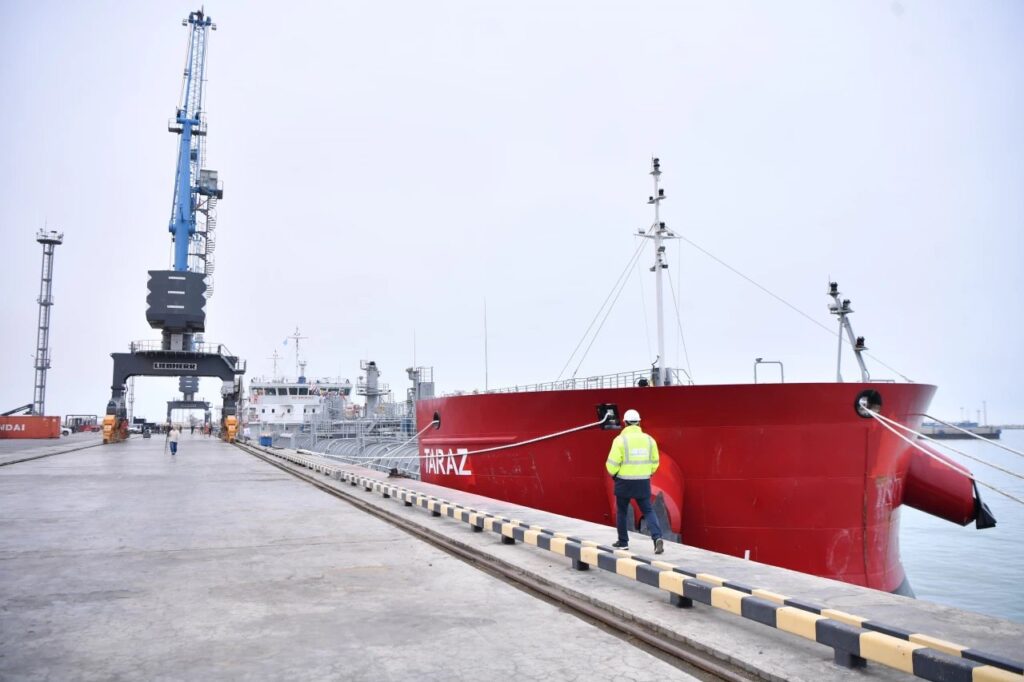
Kazakhstan is now working to increase the transit capacity of the Aktau and Kuryk seaports. A container hub will be built in the port of Aktau, increasing transportation volume to 300,000 TEU (twenty-foot equivalent units) per year. A grain terminal will be launched in Kuryk’s port later this year.
Dredging of the Kuryk port is underway to ensure sufficient depth for ships to enter the harbor. Dredging works are also planned in the port of Aktau. Altogether, these measures will increase the throughput capacity of Kazakhstan’s ports by 10 million tons of cargo annually, to reach 30 million tons annually.