
• KGS/USD = 0.01144 0%
  • KZT/USD = 0.00211 0%
  • TJS/USD = 0.10460 0.19%
  • UZS/USD = 0.00008 0%
  • TMT/USD = 0.28490 0%
  • KGS/USD = 0.01144 0%
  • KZT/USD = 0.00211 0%
  • TJS/USD = 0.10460 0.19%
  • UZS/USD = 0.00008 0%
  • TMT/USD = 0.28490 0%
  • KGS/USD = 0.01144 0%
  • KZT/USD = 0.00211 0%
  • TJS/USD = 0.10460 0.19%
  • UZS/USD = 0.00008 0%
  • TMT/USD = 0.28490 0%
  • KGS/USD = 0.01144 0%
  • KZT/USD = 0.00211 0%
  • TJS/USD = 0.10460 0.19%
  • UZS/USD = 0.00008 0%
  • TMT/USD = 0.28490 0%
  • KGS/USD = 0.01144 0%
  • KZT/USD = 0.00211 0%
  • TJS/USD = 0.10460 0.19%
  • UZS/USD = 0.00008 0%
  • TMT/USD = 0.28490 0%
  • KGS/USD = 0.01144 0%
  • KZT/USD = 0.00211 0%
  • TJS/USD = 0.10460 0.19%
  • UZS/USD = 0.00008 0%
  • TMT/USD = 0.28490 0%
  • KGS/USD = 0.01144 0%
  • KZT/USD = 0.00211 0%
  • TJS/USD = 0.10460 0.19%
  • UZS/USD = 0.00008 0%
  • TMT/USD = 0.28490 0%
  • KGS/USD = 0.01144 0%
  • KZT/USD = 0.00211 0%
  • TJS/USD = 0.10460 0.19%
  • UZS/USD = 0.00008 0%
  • TMT/USD = 0.28490 0%

Life After Relocation: Kazakhstani Inna Baitukenova on the U.S., Blogging, and Building a Business

Kazakh producer and screenwriter Inna Baitukenova, known for projects such as Satash, the documentary Oleg: The Story of Oleg Vidov, and the television series Ana Zhuregi and Taitalas, has opened a new chapter in her professional life since relocating to the U.S. A lawyer by education, she now works as a blogger and is developing her own beauty business in the American market.

She spoke with The Times of Central Asia about adapting to life abroad, navigating the U.S. blogging scene, and the challenges and rewards of launching a business as a Kazakhstani immigrant.

TCA: Inna, how long have you been living in the U.S.?

Inna: My husband and I first came here as tourists in 2018. During that trip, my husband, journalist and film director Tolegen Baitukenov, met an American producer interested in making a documentary exploring potential familial ties between Native Americans and Kazakhs. He signed a contract, and we returned to Kazakhstan. In 2019, he presented the project at the Kazakh pavilion at the Cannes Film Festival. Interest was high, so we decided to change our status from tourists to working residents. We officially moved to the U.S. in 2019. We’ve now been living here for seven years.

TCA: Did you and your husband come on talent visas?

Inna: Yes. Initially, we came without our children, just to see how it felt. We liked it, returned home, and began applying for work visas. It wasn’t easy; we even had to obtain approval from the Directors Guild of America.

TCA: How long did it take you to adapt? When did you begin to feel at home?

Inna: I think we’re still adapting. But the first time I really felt at home was in 2022, after moving from Los Angeles to Orange County. It’s a suburb about 90 minutes from LA. I was driving around, and suddenly everything felt familiar: the streets, the houses. That’s when I realized I felt a sense of home.

The early days were very tough, but day by day, it got easier. We got used to the environment, improved our English, and started understanding how daily life works here, from utility payments to taxes. At first, we were converting all prices into tenge. When Tolegen started his company in 2019, everything was a challenge; there wasn’t even ChatGPT back then to ask questions. We were googling everything: how to get a license, register a business, and secure a trade name. When I started my own beauty studio in May 2025, I already knew how to rent an office and obtain all the necessary permits.

TCA: You seem to have found your footing once you landed a good blogging contract. You now work with major brands, right?

Inna: Yes, but blogging wasn’t my goal. It happened by accident. I used to keep an Instagram account as a hobby back in Kazakhstan and never thought of it as a platform for making money. But I’ve always loved cosmetology and beauty. One day, I began posting about the products I use, unboxings, and reviews. I tagged an American brand in a post, and to my surprise, they reached out offering to send me a gift. They told me I could choose anything I wanted from their site. It was a huge surprise. They sent me almost a year’s worth of cosmetics, probably worth over $1,000. As a woman, and especially an immigrant, I can say it was an amazing gift. Cosmetics aren’t a necessity, but they’re always a pleasure.

TCA: When did you start working with bigger names like Prada and Shiseido?

Inna: A little later. One of my first major clients was LPG France, a top cosmetics and beauty tech brand. A marketing agency contacted me by email. I was skeptical at first, worried it might be a scam, but it turned out that email is a standard business channel in the U.S. They commissioned two reels and several stories, and also gave me a course of treatments, body, and anti-cellulite programs.

I remember when they asked for my rate, I had to Google how much bloggers charge for posts, reels, or stories. I quoted an average rate, and we reached an agreement. Even though I was a beginner, we took it seriously and filmed professional content with Tolegen’s help. I eventually took a course at UCLA on influence marketing to understand the U.S. market, how much brands spend, and what niches exist. For me, beauty is the most profitable niche, followed by fashion, food, e-commerce, and home goods.

My account also appeals to a broad audience; it’s family-focused. I have a husband and three children: a college student, a schoolgirl, and little Tanya, who’s 3 1/2 years old.

TCA: Can a Kazakhstani blogger succeed in the U.S. market?

Inna: Yes, but brands are primarily interested in a U.S. audience. That’s why I had to switch to English. It’s not easy; some followers in Kazakhstan prefer Kazakh or Russian, but my Instagram has grown to around 126,000 followers, and more and more are American. Advertisers also care about TikTok, Threads, and other platforms; they often ask for cross-posting, so presence across multiple channels is a plus.

TCA: In Kazakhstan, bloggers are often more popular than artists. What about in America?

Inna: Here, too, whatever your field, blogging is an advantage. That’s why everyone blogs here, from plastic surgeons to musicians. When I opened my beauty studio, I realized that blogging is essential for promotion.

TCA: Is it true that most things in the U.S. are handled through agencies or intermediaries?

Inna: Often, yes, but I work independently. I haven’t signed with any agency. The only time I worked through one was with LPG France. Even then, I didn’t have a direct contract with the brand; the agency did.

TCA: Is there a lot of competition among bloggers?

Inna: Tremendous competition. And income is highly unstable. During holidays like Christmas, New Year, or Black Friday, when brands allocate large budgets, income can be good. But there are dry spells too; you can go months without work. It’s not reliable as a main source of income.

TCA: Could a Kazakhstani blogger work remotely in the U.S. market?

Inna: It’s possible, but difficult. Brands need to ship products, and international logistics can be tricky. Deadlines are strict. You also need U.S. registration, bank accounts, documentation, and a social security number.

TCA: After seven years in the U.S., are you financially stable?

Inna: We’ve made good progress. We live comfortably in a nice area. But we’re still growing. Tolegen has a production company, and I have my studio. I even went back to school to get a cosmetology license. I was recently offered a position at a Beverly Hills clinic by the owner, a doctor. That job means a lot; it’s a new professional level. Eventually, I want to pursue a medical degree and continue in this field. Blogging is a passion project with some nice perks.

TCA: You’re in Los Angeles, the heart of the film industry. Have you thought of returning to film?

Inna: I have, and I still dream of it. We haven’t given up, we keep writing. Tolegen recently won a screenwriting contest with a short film. We still love everything about cinema, film festivals, and discussions. We even run through scripts on the go. But right now, it’s more of a hobby. It’s not monetized yet.

TCA: Why is that? Is it hard to break into the industry?

Inna: That’s part of it. Early on, the pay is low, and the work is demanding: 4 a.m. call times, long shoots in all kinds of weather. I have a small child, and I’m just not ready for that kind of schedule. Many famous people started out doing tough jobs. Brad Pitt worked as an entertainer, but I can’t do that at this point in life.

TCA: Is Los Angeles really the city of stars?

Inna: Absolutely. When we first arrived, we walked around like wide-eyed kids. You’d see Anne Hathaway one day, Janet Jackson the next. Celebrities are especially common in Beverly Hills and West Hollywood.

TCA: Do you miss Kazakhstan?

Inna: Of course. I miss the people: my parents, my little brother, and my friends. We stay in touch, but nothing replaces being together in person. I also miss the food, kazy, irimshik, and zhen. Sometimes we meet someone here, an African American woman or a Mexican, and she reminds us of a Kazakh apashka or tateshka (a familiar, older auntie or grandma-type figure). It’s such a warm, familiar feeling. We even say, “What a nice tateshka,” and that means a lot.

New Rail Tour Launched Across Silk Road Routes in Central Asia

Rail tourism is gaining traction in Central Asia, offering travelers a slower yet more immersive way to experience the region’s historic Silk Road cities. Kazakhstan and Uzbekistan have recently expanded their joint Jibek Joly tourist train route to include Dushanbe, the capital of Tajikistan, an initiative that further strengthens regional railway tourism.

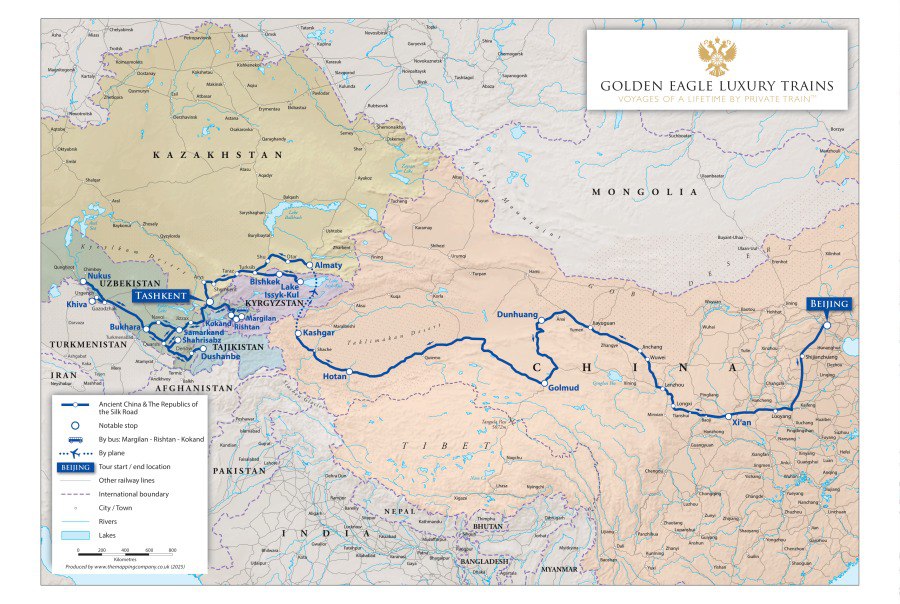
A new high-end offering has now entered the market. British operator Golden Eagle Luxury Trains has launched The Grand Silk Road, a 22-day luxury rail journey traversing key cultural and historical landmarks along the ancient Silk Road corridor.

Spanning approximately 3,862 kilometers, the route begins in Beijing and concludes in Tashkent. It passes through northwest China and four Central Asian countries: Kazakhstan, Kyrgyzstan, Tajikistan, and Uzbekistan. Notable stops include Almaty, Bishkek, Lake Issyk-Kul, Dushanbe, and Uzbekistan’s major heritage cities, Samarkand, Bukhara, Khiva, Kokand, and Nukus. The inaugural departure is scheduled for September 21 to October 12, 2026.

The route is expected to increase high-end tourism to Central Asia. Due to the absence of a direct railway link between China and Kyrgyzstan, a segment of the journey, between Kashgar and Almaty, will be completed by air. Kyrgyzstan’s existing rail network connects to Kazakhstan, extending to Bishkek and Balykchi, near Lake Issyk-Kul.

Meanwhile, China, Kyrgyzstan, and Uzbekistan are advancing the construction of a new cross-border railway that will directly link the three countries. Once operational, the line is expected to facilitate both freight transit and tourism, providing a critical new artery for regional connectivity.

EBRD Invested Over $100 Million in Tajikistan’s Economy in 2025

The European Bank for Reconstruction and Development (EBRD) invested nearly $103 million in Tajikistan’s economy in 2025, signing 19 agreements over the course of the year. The funding targeted key sectors including energy, transport, municipal infrastructure, and private sector development.

According to the bank, 83% of its 2025 loan portfolio in Tajikistan supported sustainable infrastructure projects. Another 14% of resources were channelled through local banks to finance small and medium-sized enterprises (SMEs), women’s and youth entrepreneurship initiatives, and programs focused on climate adaptation and resource efficiency.

The public sector received the majority of financing, accounting for 83% of the EBRD’s annual activity in the country. Of the total lending volume, approximately 58% was directed toward green economy development.

One of the year’s largest initiatives was a financing package of up to €43 million for the state-owned power distribution company, Shabakahoi Taqsimoti Barq. The package includes an EBRD sovereign loan of up to €28 million and a €15 million grant from the European Union. These funds are being used to modernize electricity metering and billing systems across nine cities in the Khatlon and Sughd regions.

Significant investment also went into road infrastructure. An EBRD sovereign loan of up to €38 million, combined with an $86.7 million grant from the Asian Development Bank, will fund the reconstruction of the Danghara-Guliston highway. The route connects the north and south of the Khatlon region, which produces over half of Tajikistan’s agricultural output and is home to more than one-third of the population.

A major energy milestone was achieved in 2025 with the completion of the Kayrokkum hydropower plant’s modernization. The plant’s installed capacity increased from 126 MW to 174 MW after all six units were brought online. Serving around 500,000 people in the Sughd region, the project, initiated in 2019, was financed with $196 million arranged by the EBRD.

The bank also issued three sovereign loans totaling over €12 million for water supply system upgrades in Kulyab and Yavan, and for the modernization of Dushanbe’s centralized heating system.

Alongside infrastructure projects, the EBRD expanded its support for the private sector. In 2025, more than 500 small enterprises across Tajikistan received various forms of assistance from the bank.

Abdukodir Khusanov Named Manchester City’s Player of the Month for January

Uzbekistan national team defender Abdukodir Khusanov has been named Manchester City’s Player of the Month for January, marking a major milestone in his early Premier League career. The club announced that Khusanov won the fan vote by a wide margin following a string of standout performances.

The 21-year-old made seven appearances during the month, demonstrating consistency and adaptability while partnering with various defenders. Manchester City praised Khusanov’s composure and tactical discipline, noting that his decision-making under pressure set him apart. He finished ahead of high-profile teammates, including goalkeeper Gianluigi Donnarumma and club captain Bernardo Silva, to earn his first individual accolade at the club.

Khusanov’s rise at City has drawn significant attention in Uzbekistan, where he is regarded as one of the country’s brightest footballing talents. His January performances reinforced that status, as he secured a regular spot in the defensive lineup and proved dependable in critical matches.

Ahead of a UEFA Champions League fixture in January, Manchester City head coach Pep Guardiola commended the young defender’s rapid development. “Just read the media, how they praised Khusanov. They’re right. He’s top,” Guardiola said, describing the player’s recent form as “exceptional.”

Khusanov played the full 90 minutes in City’s Champions League clash against Norway’s Bodo/Glimt on January 20, anchoring the defense despite the team’s defeat. Guardiola also highlighted Khusanov’s discipline during earlier periods of limited playing time, citing his professionalism and commitment to improvement as a reflection of his football education in Uzbekistan.

11-Year-Old Uzbek Girl Killed by School Bus in Brooklyn

An 11-year-old girl from Uzbekistan was fatally struck by a school bus on the afternoon of February 5 in the Bath Beach neighborhood of Brooklyn, New York Daily News reported.

The incident occurred shortly after 3 p.m. at the intersection of Bath Avenue and 23rd Avenue. According to police, the girl was crossing the street when a yellow school bus turned into the crosswalk and hit her. She was transported to Maimonides Medical Center, where she was pronounced dead.

The victim, later identified as Amira Aminova, had just purchased chocolate at a nearby store moments before the collision. Wael Alghithi, a 22-year-old employee at Bath Healthy Deli and Grill, told the Daily News that Amira was a familiar face.

“She came in every day. She bought chocolate and a soda,” Alghithi said. “She left here and then the accident happened. She didn’t usually cross that way, and she was alone.”

Alghithi stated that Amira was crossing Bath Avenue heading north when the bus, traveling south on 23rd Avenue, turned right and struck her in the crosswalk. He added that it seemed the driver did not stop immediately. “Maybe she thought he was going to stop for her,” he said. “It all happened very fast.”

Surveillance video obtained by the Daily News shows Amira beginning to cross the street at a walking pace before breaking into a run as the bus approached. She appeared to attempt to outrun the vehicle but was struck as it entered the crosswalk.

Later that evening, two men affiliated with Consolidated Bus Service told the newspaper that one of their vehicles was involved in the incident. “We’re looking for the exact location of where the girl was struck,” one said at the scene.

Police confirmed that officers stopped the driver shortly after the crash. The driver, identified as Wawa Aurelus, was charged with failure to yield and failure to exercise due care. The investigation remains ongoing.

Amira lived just a block from where the accident occurred. According to a GoFundMe campaign organized by Brooklyn resident Saykhuna Artikova, Amira and her mother, Zilola, had moved to the United States from Uzbekistan several years ago. The fundraiser, written in Russian, describes Zilola as a single mother who raised Amira on her own. “Amira was everything to her, the meaning of her life, her joy, and the most precious person in the world,” the page states.

Zilola hopes to return her daughter’s body to Uzbekistan for burial. The campaign has raised over $33,000 to cover funeral costs, including repatriation expenses.

Uzbekistan’s Consulate General in New York confirmed the child’s death in an official statement, extending condolences to the family and affirming its continued communication with Amira’s mother. The consulate also pledged full cooperation with relevant U.S. authorities and said Uzbekistan’s diplomatic missions in the country stand ready to provide necessary support.

A recent amendment to Uzbekistan’s law “On Burial and Funeral Services,” published on Lex.uz on February 5, allows for state financial support for transporting the remains of citizens who die abroad. The measure aims to protect citizens’ rights and reduce the financial burden on families of labor migrants.

Nearly 200 Uzbek Citizens Sought Asylum in Russia in 2025

In 2025, a total of 191 Uzbek citizens applied for asylum in Russia, underscoring evolving migration dynamics in the region and increased pressure on labor and humanitarian migration systems across Central Asia. The figures were reported by Gazeta.ru, citing data from Russia’s Ministry of Internal Affairs.

According to the data, 8,820 foreign nationals sought temporary asylum in Russia last year. Ukrainians accounted for the largest group, with 3,332 applicants, followed by 3,196 Syrians. Other significant groups included 313 Palestinians, 281 Afghans, and 191 Uzbeks. Additional applicants came from countries such as Germany, Kazakhstan, Turkmenistan, Israel, and Armenia, placing Central Asian states firmly within Russia’s broader migration framework.

The total number of asylum applications marked an increase compared to 2024, when Russian authorities registered 6,879 requests.

Despite ongoing political and economic turbulence, officials said the overall structure of migration remained largely stable.

Regional developments also influenced migration trends. In early January, Ukraine’s State Border Guard Service reported that around 1,400 Ukrainian citizens attempted to cross borders illegally in 2025, including via Belarus. Most attempts occurred along European Union borders. Meanwhile, the EU recorded a 20% drop in asylum applications, especially among Syrians, indicating that some migratory pressure may be shifting eastward.

For Uzbekistan, the asylum figures come amid broader labor migration trends. According to official Uzbek statistics, 1.86 million citizens left the country for employment abroad between January and September 2025, a 1.38-fold increase year-on-year. Of these, an estimated 1.3 million were working in Russia, reaffirming its role as the main destination for Uzbek labor migrants.

Migration policy has also featured in recent diplomatic discussions. According to RIA Novosti, Russian Ambassador to Uzbekistan Aleksey Yerkhov informed the Uzbek Foreign Ministry of Russia’s updated migration policy concept, approved in October 2025. During a meeting with Deputy Foreign Minister Olimjon Abdullaev, both sides addressed the need to improve labor migration mechanisms and ensure the protection of Uzbek citizens’ rights during inspections and employment procedures.

Russia’s 2026-2030 migration policy concept states that external political and economic pressures have not significantly altered migration patterns. The policy projects continued growth in labor migration, driven by sustained demand for foreign workers.

At the same time, Moscow is introducing new mechanisms to attract skilled foreign nationals. Russian Foreign Minister Sergey Lavrov announced that, beginning in April 2026, Russian embassies and consulates will issue one-year, multiple-entry business visas to qualified individuals deemed beneficial to the Russian Federation. Eligible applicants will include professionals with achievements in science, technology, manufacturing, sports, the creative industries, education, or other high-demand sectors, as outlined in a presidential decree promoting high-quality migration.