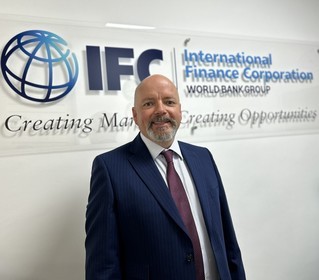
Neil McKain, the IFC regional manager for Uzbekistan and Turkmenistan, says renewable energy sources are helping Uzbekistan reduce natural gas consumption. The country can become a regional leader in renewable energy sources, he told The Times of Central Asia in an interview.
ТСА: To begin, could you give us an overview of the current state of renewable energy in Uzbekistan?
Neil McKain: Uzbekistan has significant renewable energy potential — primarily solar and wind — and is well equipped to fulfill its growing energy needs and transition to a clean energy economy. Renewable energy can help diversify the energy mix and reduce the country’s heavy reliance on natural gas.
The government is focused on increasing the share of renewables in power production by up to 25 GW, or 40% of the country’s overall electricity consumption, by 2030. These efforts support the country’s clean energy transition and address the increasing demand for energy in Uzbekistan’s economy and among its citizens. In this context, the World Bank Group is helping Uzbekistan develop 1,000 MW of solar and 500 MW of wind energy by attracting private sector investments.
ТСА: With these developments, what challenges does Uzbekistan face in transitioning to renewable energy?
McKain: Like many countries, Uzbekistan faces many challenges as it transitions. The government has substantial natural gas reserves, and the economy relies heavily on fossil fuels. Transitioning away from these energy sources can be economically and politically challenging. It requires building public support and raising awareness of the many benefits of renewable energy.
In addition, building the necessary infrastructure, such as solar farms, wind turbines, and an updated electrical grid, requires significant investment, time, and technical expertise. As renewable energy sources are intermittent, developing efficient energy storage solutions will be vital to ensuring a stable energy supply. Also, securing the required capital can take time, as it often involves enormous upfront costs and long-term investment before seeing returns.
Addressing these multifaceted challenges will require coordinated efforts from the government, private sector, and international partners.
ТСА: What is the IFC’s involvement in renewable energy projects in Uzbekistan?
McKain: The IFC is deeply committed to supporting renewable energy in emerging markets, and Uzbekistan is a key country. We’ve been involved in several initiatives, including advising on and financing solar power projects. One of our first projects is a solar plant in the Navoi region, which provides electricity to 31,000 homes. This project was established through a public-private partnership (PPP) between the Uzbek government and Masdar, the United Arab Emirates’ flagship renewable energy company. IFC assisted the government as a transaction adviser in designing and tendering the PPP under its Scaling Solar Program. It is now a significant milestone in the country’s renewable energy journey.
In collaborationwith other lenders, IFC also provided a financing package to support the construction of a 500-megawatt wind farm in the Navoi region, which Masdar is also building. Capable of powering 500,000 homes, it will be the largest facility in Central Asia—and, incidentally, the largest wind farm IFC has ever sponsored.
Together with our state and private sector partners, we are exploring using shallow geothermal energy for heating and cooling buildings. Utilizing this energy source within the country can help reduce reliance on gas and electricity and ease the burden on the grid. We are mapping the licensing and permit processes and the local production and distribution of heat pumps. Additionally, we are exploring regulatory and incentive policies to encourage investments, promote the expansion of surface geothermal solutions, and implement surface geothermal projects in the country.
Finally, just last week a financial package for a 250-megawatt solar photovoltaic plant was signed between the World Bank Group, Masdar, and the government of Uzbekistan. This new solar power plant, to be constructed in the Alat district of the Bukhara region, will provide clean, reliable electricity access to approximately 75,000 households. In addition, the project introduces an innovative battery energy storage system (BESS) component that will help improve the efficiency and flexibility of the power system, providing greater supply security and mitigating the intermittency of renewable generation. The project, in which IFC also acted as a transaction advisor to the government, marks Central Asia’s first renewable energy initiative with an integrated BESS component.
ТСА: Could you tell our readers more about the battery energy storage system technologies?
McKain: One key innovation in the solar energy sector is integrating battery energy storage systems. These systems are crucial for addressing the intermittent nature of solar power, as they store excess energy produced during peak sunlight hours and make it available during periods of low solar generation or high demand. This not only ensures a stable energy supply but also enhances the efficiency of solar plants.
The battery energy storage market is at a critical juncture in its evolution, with prices and technologies expected to become even more favorable over time. The technology is now cost-effective for various on- and off-grid applications in countries worldwide. However, most new project development and associated benefits are concentrated in developed economies.
Although innovative battery storage with solar plants in Uzbekistan is still new, the potential benefits are significant. Battery storage can help stabilize the national grid, reduce reliance on fossil fuels, and provide a more reliable power supply to remote areas. It can also support the country’s goals of reducing greenhouse gas emissions and transitioning to a more sustainable energy system.
For these reasons, supporting energy storage technology is a strategic focus for the government of Uzbekistan as it will extend the reach and uses of renewable energy. By helping to introduce technologies in the energy sector, IFC supports Uzbekistan’s efforts to ramp up its use of renewables, improve energy security, increase grid stability, and expand access to electricity.
ТСА: You mentioned PPP projects; could you elaborate on PPPs in Uzbekistan?
McKain: Public-private partnerships, or PPPs, are essential tools that leverage private sector expertise and resources to help deliver public services or manage public assets. Through our global experience in PPPs, we are assisting governments in identifying, structuring, and procuring PPP projects transparently and competitively.
Since late 2018, Uzbekistan has been building a successful track record in PPPs. The government’s reformist mindset, urgency, and pragmatism in pursuing needed reforms are helping create a series of bankable PPP projects delivered under a robust and transparent PPP framework.
At this point, IFC’s portfolio in PPP Transaction Advisory in Uzbekistan includes projects at various stages of development. It covers the energy, healthcare, and education sectors, with an overall expected mobilization of approximately $700 million. In addition, we have closed several projects in the energy and healthcare sectors, with an overall expected mobilization of roughly $1.8 billion.
But there is still more that can be done. While most current PPP projects are in the energy generation, utilities, and health sectors, the government is now focusing on other vital industries such as education, irrigation, transport, water supply, and wastewater treatment. These sectors have been strained by years of underinvestment, sub-optimal operation and maintenance, and rapid urbanization rates. Still, PPPs can attract much-needed investment and private sector expertise to these sectors. We stand ready to support this by developing, structuring, and implementing PPP projects.
ТСА: Looking ahead, what’s the future of renewable energy in Uzbekistan?
McKain: The prospects are very bright. The government is highly supportive and responsive, implementing reforms to attract foreign investment and liberalize the energy market. This creates a favorable environment for investment in renewable energy in the country. With the government’s proven commitment and implementation of ongoing projects, Uzbekistan is on track to become a regional leader in renewable energy. Moreover, the country’s strategic location and rich natural resources provide a unique opportunity to meet its energy needs and potentially export clean energy. IFC remains firmly committed to facilitating sustainable energy projects. We encourage other investors to explore these opportunities and contribute to the country’s renewable energy future.