• KGS/USD = 0.01144 0%
  • KZT/USD = 0.00213 0%
  • TJS/USD = 0.10456 0.19%
  • UZS/USD = 0.00008 0%
  • TMT/USD = 0.28490 0%
  • KGS/USD = 0.01144 0%
  • KZT/USD = 0.00213 0%
  • TJS/USD = 0.10456 0.19%
  • UZS/USD = 0.00008 0%
  • TMT/USD = 0.28490 0%
  • KGS/USD = 0.01144 0%
  • KZT/USD = 0.00213 0%
  • TJS/USD = 0.10456 0.19%
  • UZS/USD = 0.00008 0%
  • TMT/USD = 0.28490 0%
  • KGS/USD = 0.01144 0%
  • KZT/USD = 0.00213 0%
  • TJS/USD = 0.10456 0.19%
  • UZS/USD = 0.00008 0%
  • TMT/USD = 0.28490 0%
  • KGS/USD = 0.01144 0%
  • KZT/USD = 0.00213 0%
  • TJS/USD = 0.10456 0.19%
  • UZS/USD = 0.00008 0%
  • TMT/USD = 0.28490 0%
  • KGS/USD = 0.01144 0%
  • KZT/USD = 0.00213 0%
  • TJS/USD = 0.10456 0.19%
  • UZS/USD = 0.00008 0%
  • TMT/USD = 0.28490 0%
  • KGS/USD = 0.01144 0%
  • KZT/USD = 0.00213 0%
  • TJS/USD = 0.10456 0.19%
  • UZS/USD = 0.00008 0%
  • TMT/USD = 0.28490 0%
  • KGS/USD = 0.01144 0%
  • KZT/USD = 0.00213 0%
  • TJS/USD = 0.10456 0.19%
  • UZS/USD = 0.00008 0%
  • TMT/USD = 0.28490 0%

Household Debt Persists Despite Lending Slowdown in Kazakhstan

At the start of 2026, Kazakhstan’s financial indicators appear promising: the population is borrowing less, and banks are increasing financing to businesses. Yet behind this macroeconomic optimism lies a more complex picture. The debt burden on citizens has not disappeared; it has simply changed form. While less visible in financial reports, household debt is becoming increasingly evident in everyday family budgets.

Two Realities, One Economy

Madina Abylkasymova, chair of the Agency for Regulation and Development of the Financial Market, reported to President Kassym-Jomart Tokayev that consumer lending has slowed, while business lending has begun to grow steadily for the first time in three years.

Data from the National Bank confirm this trend. In 2024, lending to individuals increased by 23.5%. By the end of 2025, growth had slowed to 17.7%. Business lending, meanwhile, accelerated from 17.9% to 19%.

From a macroeconomic perspective, the regulator has met its interim objective: banks are channeling more resources into the productive economy. However, an analysis of second-tier banks’ portfolios suggests that a fundamental imbalance persists.

Excluding development institutions and the quasi-public sector, end-of-year data show household debt to commercial banks at $55.1 billion, compared with business debt of 15.4 trillion tenge, or approximately $34.2 billion. The resulting $22.2 billion gap points to a structural issue: individuals remain the primary source of income for major private banks, including Halyk Bank, Kaspi Bank, and Bank CenterCredit (BCC), while the real sector continues to be underfinanced by market-based institutions.

Shift to Installment Plans

In 2025, under pressure from regulators, banks tightened lending standards for consumer loans. Traditional cash loan issuance slowed significantly.

Despite this, total household debt continued to grow. According to the National Bank, the consumer loan portfolio expanded by KZT 2 trillion in the first half of 2025, reaching $55.1 billion by year’s end.

This growth was driven not by large loans but by installment plans and Buy Now, Pay Later (BNPL) services. The number of loan contracts is rising much faster than the number of borrowers, a classic sign of demand fragmentation. Instead of a single large loan, citizens are taking out multiple small loans for food, clothing, and everyday necessities.

This reflects declining purchasing power. Inflation reached 12.3% by the end of the year, with food prices rising 13.5%. At the same time, official data shows real incomes fell by 2%.

Installment plans, once used primarily to purchase durable goods, are increasingly being used to “make ends meet.” Statistically, this appears as a reduction in average loan size and risk exposure. In reality, it points to growing debt dependency among households.

Why the Bankruptcy Law Has Fallen Short

The 2023 law on restoring personal solvency and bankruptcy was designed to address over-indebtedness structurally. But by early 2026, it was clear the system was functioning unevenly.

Data from 2025 reveals the scale of rejections. Of more than 270,000 submitted applications, only about 34,000, just 12%, were approved. Approximately 87% of applicants received official denials.

The main reason lies in strict eligibility criteria. For out-of-court bankruptcy, an applicant must have made no loan payments for 12 months. Even minimal payments reset this period. A second barrier is ownership of any property, such as a share in a privatized apartment or a small land plot.

Until mid-2025, applicants were also required to submit a bank-issued confirmation of debt settlement, a document that was often difficult to obtain. That requirement was removed later in the year, and the list of eligible creditors was expanded to include microfinance institutions and debt collectors. Still, approval rates did not improve significantly.

As a result, many citizens now find themselves in a legal limbo. They are functionally insolvent but unable to clear their debts through formal bankruptcy. With no access to legal credit and continued pressure from collectors, they remain trapped in a “gray zone” of the economy.

A Fragile Financial Recovery

The 19% increase in corporate lending at the end of 2025 is, on paper, a positive development. In theory, it should drive investment, employment, and GDP growth. In practice, however, a disconnect persists between business expansion and household financial well-being.

Kazakhstan’s banking sector remains heavily retail-focused. The gap between household and corporate debt underscores the sector’s continued dependence on consumer lending.

The main risk for 2026 is the deteriorating quality of retail loan portfolios. Analysts at Halyk Finance estimate that non-performing loans (NPLs 90+ days overdue) reached $3.5 billion by the end of 2025, a 44.8% increase since the start of the year. Their share of the total loan portfolio rose to 3.7%.

At the same time, banks’ capacity to absorb these risks is shrinking, as provisioning ratios fell from 141.7% to 132.2%.

While regulators have restricted large cash loans, the deeper issue remains unresolved. Hundreds of thousands of citizens, denied bankruptcy and burdened with trillions of tenge in debt, now form a growing segment that is effectively excluded from the legal financial system.
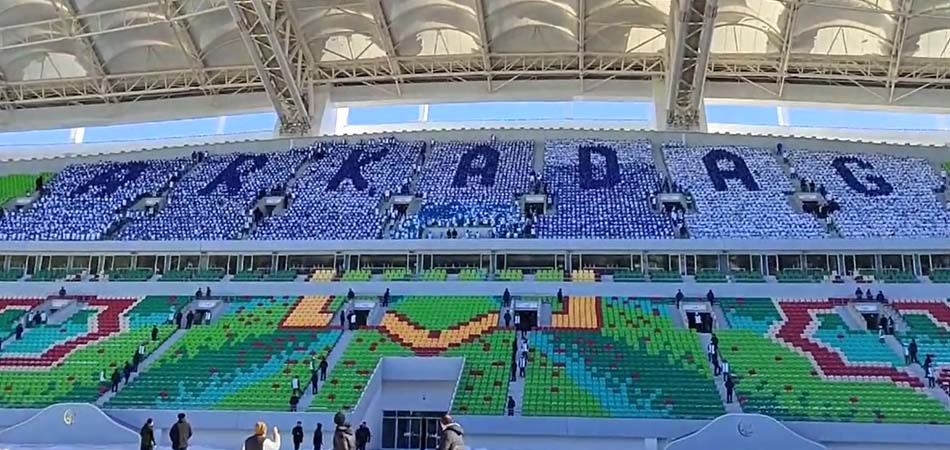

Turkmen Football Fans Moved to Worse Seats for Match with Cristiano Ronaldo’s Al-Nassr

Fans who have bought tickets to the upcoming Asian Champions League match between Turkmenistan’s Arkadag and Saudi Arabia’s Al-Nassr on February 11 have been informed, sometimes repeatedly, that their seats are being changed to make room for “organized support” groups.

According to a source in Ashgabat, notifications are being sent via users’ personal accounts on ticketing platforms. The vacated sections, the source said, are being allocated to students who are reportedly being trained in advance to provide choreographed support for the home team.

Affected spectators are often offered seats with worse visibility, and in many cases, fans, especially families and groups, are being split across different sectors of the stadium, making it nearly impossible to watch the match together.

Public frustration has grown as a result.

“A 45,000-seat stadium was specifically allocated for this match. If officials had plans for some sections, they could have decided in advance and sold tickets accordingly. If they can’t even organize one match properly, how can we expect them to handle more serious events?” the source said.

Some fans have opted not to attend the match at all, despite having already paid for tickets. Others are seeking to resell their tickets, though doing so is complicated. Ticket purchases required passport details, and it is believed that ID checks may be enforced at the gates, making resale risky.

Adding to the discontent is the asymmetry in ticketing policy: the Ashgabat city administration’s ticket regulations prohibit buyers from exchanging or returning tickets, while allowing organizers to unilaterally reassign seats.

According to reports, the most prominent seating sections will not be occupied by club supporters, but by students compelled to rehearse chants and routines for the game.

Arkadag will host Al-Nassr in the last 32 round of the AFC Champions League. The Saudi club’s lineup includes global football star Cristiano Ronaldo. The return leg is scheduled to take place in Saudi Arabia on February 17 or 18.

Uzbekistan Fires Counter-Narcotics Chief as Drug Trade Surges

In late January, Uzbek President Shavkat Mirziyoyev sacked a series of high-ranking officials in the Interior Ministry, National Guard, and the Emergency Situations Ministry.

Their dismissals for corruption overshadowed the firing of the director of the Agency for Control of Narcotics and Illegal Firearms, who was let go for failing badly to combat illegal trafficking and use of drugs.

Poor Results

Ravshan Mamatov was appointed director of the National Center for Narcotics Control in August 2024. In July 2025, a presidential decree transformed the center into the Agency for Control of Narcotics and Illegal Firearms.

On January 27, President Mirziyoyev criticized the work of the Narcotics Control Agency and warned Mamatov to engage in more than simply “analytical work and international cooperation.” Mirziyoyev dismissed Mamatov the next day, and it was not a surprise.

Exactly two weeks earlier, Bahodir Kurbanov, the head of Uzbekistan’s State Security Service (SGB), spoke at a session of the country’s Security Council, chaired by President Mirziyoyev.

Kurbanov detailed security measures along Uzbekistan’s borders, including the use of military surveillance drones.

The security chief also spoke about illegal narcotics, noting the amount of drugs seized in 2024 was some 1,700 kilograms and that figure more than doubled to 3,600 kilograms in 2025. Kurbanov noted the 2025 figure included more than 180 kilograms of synthetic drugs and more than one million doses of psychotropic drugs.

Additionally, the number of people arrested for illegal narcotics went from some 2,600 in 2024 to some 4,500 in 2025.

In his January 27 comments, President Mirziyoyev said that during the last three months, the authorities in the capital Tashkent, had detained members from approximately 50 major narcotics trafficking groups and seized some 500 kilograms of illegal drugs.

“Last year, more than 1,500 drug users were officially registered in the capital,” Mirziyoyev said, noting, “The saddest part is that the number of drug addicts living in the shadows is even higher.” The Uzbek president added that most were young people and that “in their quest to raise money, drug addicts naturally resort to crime.”

Mirziyoyev also criticized the penal system, remarking that a significant number of people convicted for illegal narcotics were released from jail before serving even half their sentences. Mirziyoyev said that this has led to a 25% increase in the number of repeat offenders.

Mamatov addressed Uzbekistan’s parliament on December 17, admitting the amount of synthetic drugs being seized had increased phenomenally during the last five years and that the number of crimes involving illegal narcotics had doubled during that time. Mamatov claimed that in a number of cases, “drug trafficking was being facilitated by officials,” though he did not name any specific officials.

A Regional Problem

The other Central Asian countries are facing the same problems as Uzbekistan.

The amounts of drugs seized and people arrested have been growing in the last few years and continue to increase.

Part of the problem is that the region’s counter-narcotics agencies are facing a new situation in combating the illegal drug trade. Synthetic drugs are usually in pill form or contained in small packets, making it easy to transport these substances without attracting attention.

The same day Mirziyoyev criticized Mamatov, the Uzbek president also announced that a new department for battling cybercrime was being created in the Justice Ministry.

Mirziyoyev said that “95% of the cases involving the selling of synthetic drugs are done through the internet and paid for using cryptocurrency.”

The percentage might differ from country-to-country in Central Asia, but the use of the internet, particularly Telegram, to sell narcotics and make payments in cryptocurrency is growing. Many of the illegal narcotics are produced at laboratories inside these countries for domestic sales, thus eliminating the chances that the drugs will be caught during searches by border guards.

Mamatov spoke at Uzbekistan’s parliament the same day deputies were debating increasing punishments for involvement in illegal narcotics. Traffickers and sellers of drugs could face up to 20 years in prison under a new draft law.

Similar discussions about how to counter the growing illegal narcotics trade are taking place in other Central Asian states. While neighboring countries face comparable challenges, it remains too early to say whether Uzbekistan’s decision to remove Mamatov will be replicated elsewhere in the region.

Kyrgyzstan and China to Launch Direct Flight Between Osh and Kashgar

A new air route connecting Osh, Kyrgyzstan’s second-largest city, with Kashgar in China’s Xinjiang Uyghur Autonomous Region is expected to launch in April, according to a statement from Airports of Kyrgyzstan JSC. The announcement follows a meeting held on January 30 with the Commercial Aircraft Corporation of China (COMAC).

The new flight is intended to enhance transport connectivity between the two neighboring countries, deepen bilateral trade and economic ties, and promote tourism and cultural exchange.

The route is expected to be operated by Chengdu Airlines, a COMAC-affiliated carrier, using COMAC’s C919 aircraft, China’s first domestically developed short-to-medium-range turbofan jet, which can accommodate up to 97 passengers.

Osh already has an existing air link to Xinjiang. In November 2025, China Southern Airlines resumed flights between Osh and Urumqi, the region’s capital.

Xinjiang serves as a strategic gateway to China for Kyrgyzstan, and Kashgar is the departure point for the China-Kyrgyzstan-Uzbekistan (CKU) railway, an ambitious regional infrastructure project aimed at connecting China with Central Asia, the Middle East, and Europe. The 523-kilometer railway will run from Kashgar to Andijan, Uzbekistan, passing through Kyrgyzstan via Torugart, Makmal, and Jalal-Abad.

Construction on the CKU railway officially began on December 27, 2024, in Kyrgyzstan’s Jalal-Abad region.

New transport links by air and rail are expected to further boost trade between Kyrgyzstan and China. According to Chinese Ambassador to Kyrgyzstan Liu Jiangping, bilateral trade reached a record $27.2 billion in 2025, up 20% from the previous year.

Iran Protests and Regional Stability: An Afghan Perspective

The protests that spread across Iran in late 2025 and early 2026 reflected more than short-term public discontent, instead exposing the cumulative effects of a prolonged socio-economic crisis. Persistently high inflation, declining real incomes, and falling living standards have placed sustained pressure on households and weakened the social contract between the state and society.

Against this backdrop, the unrest increasingly acquired a foreign policy dimension. Strong statements from U.S. officials warning of consequences in response to Iran’s handling of the protests, combined with Tehran’s rejection of what it described as external interference, heightened the risk of the crisis becoming internationalized. Thus, the protests in Iran ceased to be an exclusively domestic issue and became a factor of regional instability.

A key feature of the current situation is that the Iranian crisis is developing simultaneously on three fronts:

  • socio-economic, where protests are fueled by deteriorating living conditions;
  • political, linked to a crisis of confidence and governability; and
  • geopolitical, where internal processes are used by external actors as a tool of pressure.

Consequences for Afghanistan

For Afghanistan, developments in Iran carry direct and practical significance. Since late 2024, Iran has become a source of large-scale returns of Afghan migrants, both voluntary and forced. By 2025, this process had become systematic, placing a heavy burden on Afghanistan’s western provinces, particularly Herat.

In the event of prolonged instability and a deepening economic crisis in Iran, the likelihood of additional waves of migrant returns would increase. This would place further strain on Afghanistan’s labor market, healthcare system, social infrastructure, and already limited economic resources. In a fragile economy, the return of large numbers of migrants intensifies competition for jobs and raises the risk of local social tensions.

The trade and logistics dimension is equally significant. Iran remains Afghanistan’s key economic partner and a vital transit corridor, including through the Islam Qala border crossing. Any deterioration in Iran’s socio-economic conditions has a direct impact on trade flows, supply chains, and broader regional economic stability.

Significance for Central Asia

The ongoing protest movements and the deterioration of the situation in Iran, driven by a systemic economic crisis and growing political and social discontent, could have a significant impact on political and economic dynamics, as well as security, across Central Asia.

On the one hand, governments in the region are responding with cautious concern, mindful of the potential spillover effects of instability and rising internal discontent. A prolonged crisis in Iran increases the risks of migration pressure, border instability, and cross-border threats, all of which directly affect regional security.

On the other hand, a further deterioration of Iran’s internal situation could disrupt trade, transit, and energy ties with Central Asia, weakening Tehran’s regional influence and reshaping the balance of power. Under such conditions, the role of other regional and external actors, including Russia, China, Turkey, and Western countries, is likely to grow as they gain opportunities to strengthen their positions in the region.

As a result, the crisis in Iran is evolving beyond a domestic challenge and is becoming a factor in the transformation of the regional landscape, compelling Central Asian states to contend with heightened uncertainty and adjust their foreign policy and economic strategies accordingly.

Conclusions

Protests can lead to political change only when accompanied by a clear vision of the future. In the current Iranian case, mass discontent appears to reflect a protest of despair rather than an organized project of transformation, even amid external attempts to politicize events on the ground.

For the region, this translates into heightened uncertainty. The Iranian crisis is already extending beyond national borders, affecting migration, trade, food security, and regional stability. Afghanistan, within this configuration, is among the most vulnerable neighbors, confronting consequences over which it has little objective influence.

The issue of double standards in international responses to protests also warrants special attention. Identical actions by states are interpreted either as expressions of sovereignty or as violations of human rights, depending on the political context. Such selectivity not only fails to contribute to crisis resolution but also deepens societal distrust in existing political and legal mechanisms.

Under these circumstances, recognizing the right to peaceful protest, refraining from exploiting internal crises, and accounting for cross-border consequences emerge as essential conditions for preventing further destabilization at both the national and regional levels.

Adapted translation: Aidar Borangaziyev, Open World Policy Lab, Astana, Kazakhstan

Kazakhstan’s Banking System and the Logic of Early Enforcement

Kazakhstan’s growth model depends on uninterrupted access to international finance. Because its largest energy and mining projects rely on foreign capital, hard-currency financing, and offshore banking channels, confidence in the integrity of its banking system is not just a regulatory issue; it is a macroeconomic constraint.

This reliance is structural. Export revenues are concentrated in globally-priced commodities—especially oil (up to 60% of total exports in recent years), and uranium (40%+ of global output)—linking fiscal stability directly to hard-currency liquidity and correspondent banking access. In that context, correspondent banking is a systemic requirement underpinning international payments and trade. Because international banks incorporate sanctions exposure and AML/CFT risk into their assessments, adverse risk perceptions can trigger de-risking behavior that raises costs and slows flows.

Astana is now courting U.S. and European investment in multibillion-dollar initiatives, including the Trans-Caspian/Middle Corridor and projects related to rare earth and critical minerals supply chains. This further increases Kazakhstan’s exposure to Western compliance standards and regulatory scrutiny. With a growth model heavily driven by foreign capital, Kazakhstan understands that perceived weaknesses in banking system compliance would not halt investment outright, but would translate into higher funding costs and reduced appetite in international capital markets.

Sanctions Exposure After 2022: Structural, Not Tactical

Russia’s full-scale invasion of Ukraine in February 2022 sharply increased Kazakhstan’s exposure to global sanctions enforcement. Geography, membership in the Eurasian Economic Union, and dense trade and infrastructure ties with Russia made Kazakhstan a focal point for concerns over re-exports and sanctions leakage. At the same time, its border with China—an important source of dual-use goods—has added another layer of scrutiny, even as reporting later showed that China-origin cargo bound for Russia was, in documented cases, routed without physically entering Kazakhstan, despite being linked to it in trade flows.

Western sanctions reshaped logistics faster than enforcement capacity could adapt. Restrictions on shipping, insurance, and financial services increased reliance on overland transit routes through Central Asia, drawing attention to Kazakhstan, even where violations were difficult to substantiate. Western investigations later showed that EU-origin dual-use goods continued to reach Russia through intermediary channels, underscoring enforcement gaps beyond Kazakhstan itself.

For Kazakhstan, however, heightened scrutiny translated directly into financial risk, regardless of intent. In the logic of global compliance, perception can be as consequential as proof.

Early Intervention as Risk Management

Since 2022, Kazakhstan’s response has evolved from declaratory neutrality to early, containment-oriented enforcement. This shift has been driven less by foreign-policy alignment than by a calculation that even isolated violations can carry disproportionate financial consequences.

President Kassym-Jomart Tokayev has repeatedly emphasized that sanctions violations carry direct economic consequences for Kazakhstan, warning in public remarks that non-compliance could expose the country to secondary sanctions affecting trade, finance, and investment flows. By framing compliance as a matter of macroeconomic risk management rather than geopolitical positioning, the government signaled that enforcement would prioritize financial stability over short-term commercial convenience.

That logic has translated into practice. When Western sanctions were imposed on Sberbank in 2022, Kazakhstan approved the sale and restructuring of its local subsidiary to ring-fence the domestic banking system. Similar patterns have emerged in cases involving Kazakhstan-based trading and logistics firms designated by Western authorities, with accounts frozen, licenses revoked, and entities liquidated once violations were identified.

Rather than waiting for definitive findings, regulators have tended to intervene at early warning signs, reflecting concern that delayed action would increase exposure to correspondent banking restrictions. This approach reflects a preference for containment over adjudication, with early interventions later consolidated into a more durable compliance architecture, including tighter oversight of sensitive trade flows and strengthened end-user verification for dual-use goods.

International Engagement and External Oversight

Domestic enforcement has been accompanied by sustained engagement with sanctioning authorities, reflecting Kazakhstan’s need to manage external risk perceptions as well as internal compliance. Sanctions compliance has been incorporated into routine bilateral and multilateral formats, including the U.S.–Kazakhstan Enhanced Strategic Partnership Dialogue and the C5+1 framework, and the EU–Kazakhstan Cooperation Council pursuant to the Enhanced Partnership and Cooperation Agreement.

External assessments of Kazakhstan’s risk profile remain qualified. The country is not currently on FATF’s high-risk list or the list of jurisdictions under increased monitoring, though scrutiny of trade and financial flows continues. At the same time, Kazakhstan has not been placed on the Financial Action Task Force’s high-risk or increased-monitoring lists, indicating that its AML/CFT framework is not assessed as having strategic deficiencies. In practice, Kazakhstan has moved from being viewed primarily as a potential sanctions bypass to being treated as a managed-risk jurisdiction—subject to ongoing oversight rather than blanket de-risking.

Outlook

Its geography ensures that Kazakhstan will continue to hedge in its foreign relations. Finance, however, allows far less room for hedging. The country’s banking system is embedded in dollar settlement and correspondent banking, while its capital markets are anchored in the U.S.-led financial order. Access to that system underpins macroeconomic stability and investor confidence.

Statements from the Kazakhstan Government indicate that this reality is consistently understood and articulated. Since 2022, they have repeatedly signaled—publicly and institutionally—that violations of financial and sanctions-related regulations carry direct economic consequences, and that enforcement is a matter of state interest rather than tactical positioning. As a result, sanctions compliance in the banking sector has become less an exercise of political signaling than an act of financial prudence. Whatever balance Astana maintains with its neighbors, preserving the integrity of the financial system now appears to take precedence—and structurally, that pulls Kazakhstan closer to the Western financial order.