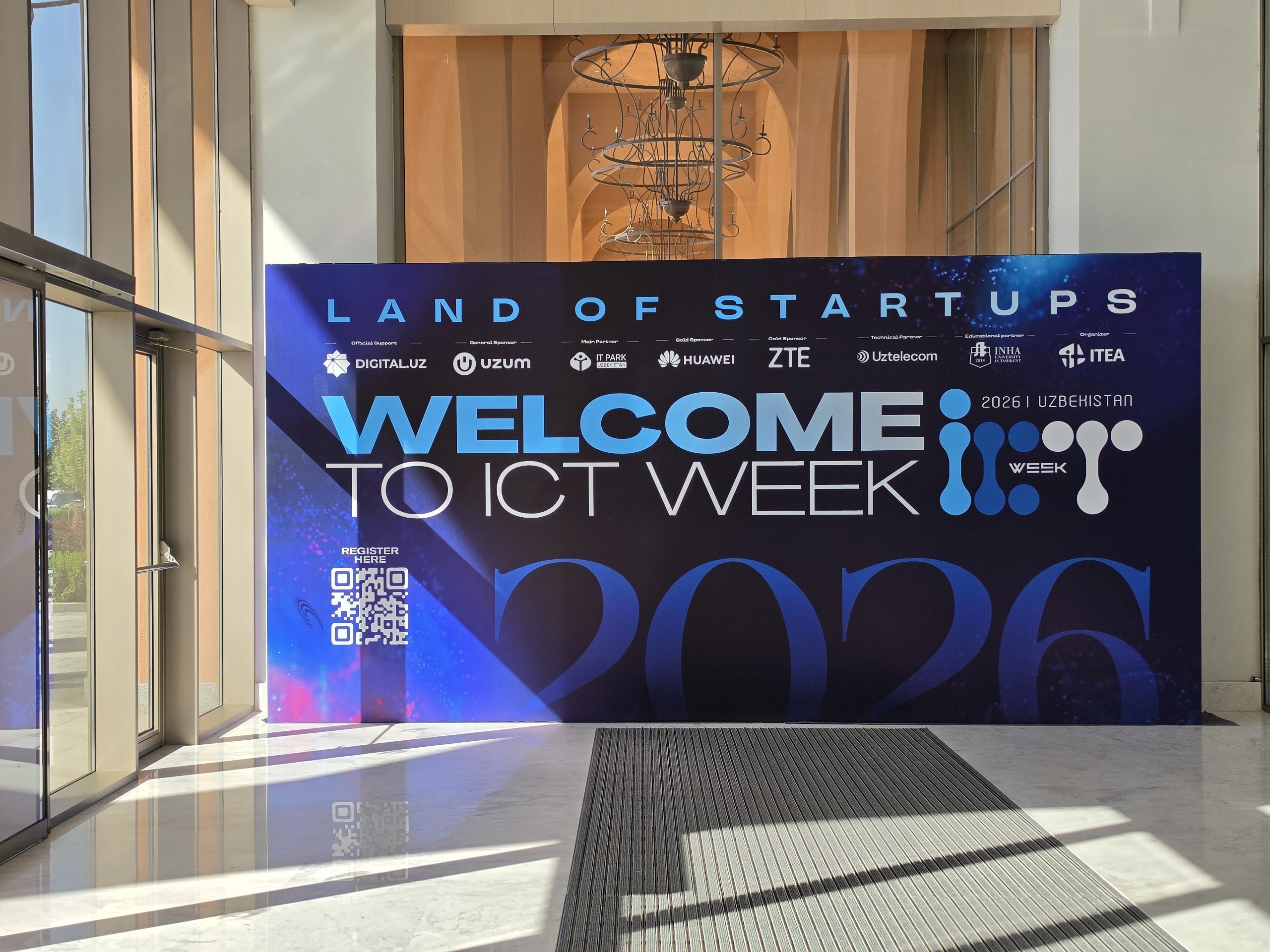
ICT Week Uzbekistan 2026 filled Tashkent’s Central Asian Expo with everything from biometric payment systems and health-monitoring AI to experimental satellites and drone football.
Held from September 22 to 25, the annual technology event brought together more than 300 exhibitors from 51 countries, according to the organizers. Walking through the exhibition, The Times of Central Asia spoke with developers and startup founders from Uzbekistan and Tajikistan about the latest generation of Central Asian tech products, and attempts to bring engineering education beyond the region’s largest cities.
Paying with a Palm or a Smile
At the BRB Tech stand, the Uzbek fintech company demonstrated products that it has developed for the banking sector, including biometric payment systems that use a customer’s palm or face. The idea is straightforward: instead of taking out a card or phone at a shop or coffee shop, a customer could authorize a payment using biometric data.
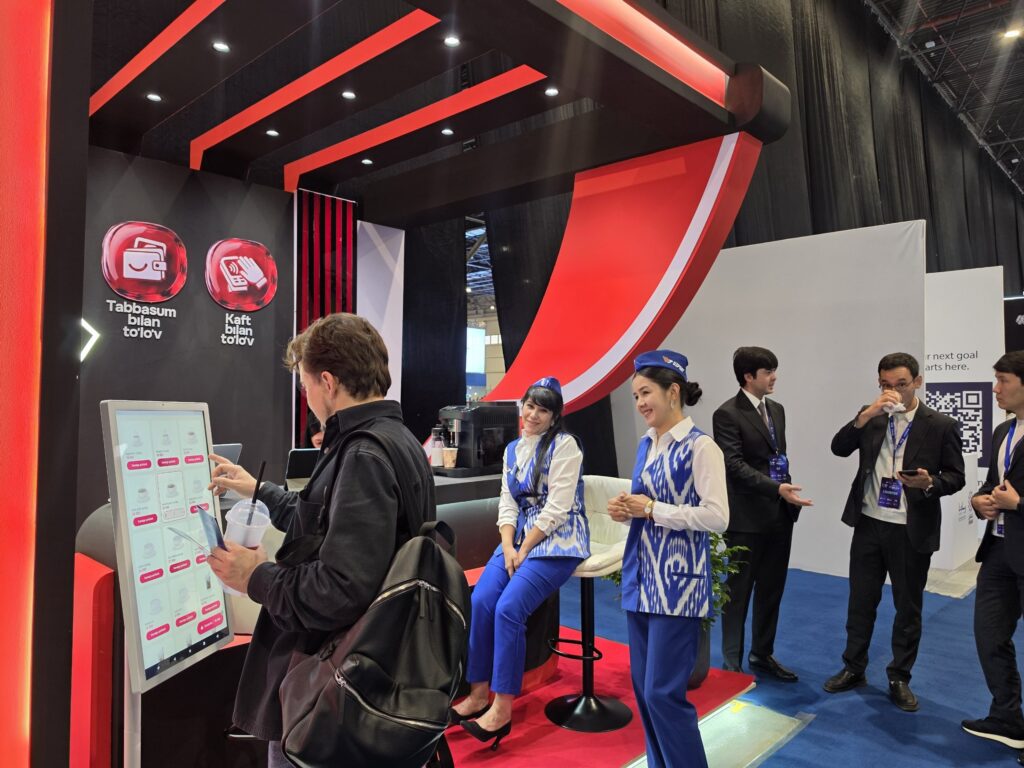
A representative of BRB Tech presents the company’s smile payment and palm payment solutions for shops and coffee shops.
Company representative Muratbek Azamkulov told TCA that Smile Payment was undergoing testing and had achieved 99.9% accuracy.
Palm Payment is initially being developed for Uzbekistan’s Business Development Bank, but Azamkulov said the company plans to offer the technology to other banks as well.
On a nearby stand, IT Park Dushanbe was trying pitch the Tajik capital as an attractive destination for technology companies. Hilola Safarova, head of marketing and public relations at the park, said it now has more than 100 residents and over 50 partners. The park offers technology companies tax benefits and customs preferences, including exemptions for qualifying imported equipment.
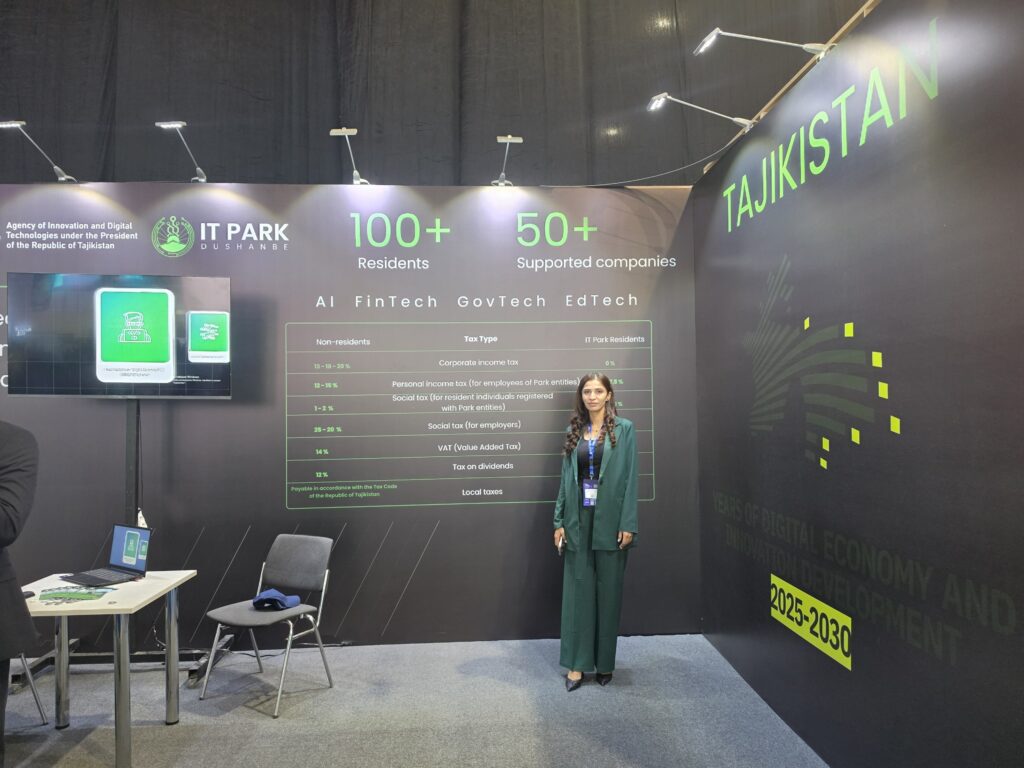
Hilola Safarova, Head of Marketing and Public Relations at IT Park Dushanbe, presents the park’s services and opportunities for IT companies.
A Startup Trying to Make Banks Compete for Borrowers
One of the smaller Uzbek startups at the exhibition was FINKO, founded by Jaloliddin Ibodov. Its model reverses the usual process of looking for a loan. Instead of approaching banks one by one, an individual or business submits information through FINKO. The application can then be sent to several banks and microfinance organizations, allowing the borrower to compare offers.
The cheapest interest rate is not necessarily the only consideration. “One borrower may want a lower monthly payment, while someone else might prefer a longer loan. Another person will look for the cheapest interest rate,” Ibodov said, adding that FINKO currently works with five banks and ten microfinance organizations and has around 30,000 registered users.
The platform charges users 10,000 Uzbek soums, about $0.80, to submit an application and receives a commission from a partner bank when a loan is issued.
For about a year, the founders financed development themselves. Ibodov said the startup has begun approaching venture capital firms as revenue starts to appear.
From Robotics Clubs to Satellites
A large part of the exhibition was aimed at a younger generation of engineers.
Diyorbek Kodiraliyev of the Robotics and Engineering Association of Uzbekistan said the organization works with robotics, drones, rockets and other engineering projects. A startup festival it organized in June received more than 1,200 projects from young people across 12 regions, according to Kodiraliyev.
The association wants to establish engineering teams outside Tashkent, where access to equipment remains more difficult.
“Our goal is for every region to have its own team,” Kodiraliyev said. The organization already runs educational centers in districts of Tashkent and is developing similar facilities in Kashkadarya, Samarkand and Surkhandarya, he added.
One of the projects on display showed the association’s work in aerospace engineering. Akbarshoh Kosimov, international department manager at the association, presented a small educational satellite system, known as CanSat, designed to reproduce some of the functions of a real satellite mission within a device roughly the size of a beverage can.
Kosimov said his team worked on a satellite payload carried by a rocket. “The device transmits data such as temperature, humidity and pressure to our ground station,” he explained.
According to Kosimov, a ten-person team spent eight months developing the project and the rocket reached an altitude of about two kilometers.
Uzbekistan’s Robotics and Engineering Association says its NazarX team became the first Central Asian team to qualify for the CanSat World Championship in the United States in 2026. Uzbekistan’s Youth Affairs Agency has also reported that the team qualified for the NASA-linked competition and launched its satellite to an altitude of two kilometers in Virginia.
Football, but with Drones
Another corner of the exhibition hall had a more immediately visual attraction: drone football. Players stood outside an enclosed field and aimed to fly drones through a goal ring while the opposing players tried to stop them.
Umid Atoyev, Uzbekistan’s representative for drone football, said the sport has been developing in the country for more than six years.
The competition is also used to introduce young people to drone technology and aviation engineering. Participants learn to fly the machines while gaining practical experience with the technology behind them.
Drone sports are already part of the association’s educational work. Uzbekistan’s Youth Affairs Agency reported in August that young participants at its TechnoCamp were learning to operate FPV drones alongside robotics, satellite modeling and aircraft engineering.
Can AI Spot Health Risks Before Symptoms Become Serious?
One of the more ambitious projects at ICT Week came from Sino AI, an Uzbek health technology startup founded by Alisher Akmaljonov.
The company is developing a preventive health platform that collects information from wearable devices, including its own Sino Band as well as Apple Watch and other fitness trackers. Its AI system uses the data to calculate health-risk scores and provide recommendations.
Akmaljonov said the project was developed in response to chronic diseases often being detected after symptoms have become serious.
Users can describe symptoms to an AI chat, while paid subscribers receive individualized risk assessments. The company says medical professionals review recommendations generated by the system before they reach users.
“We have a two-step verification process for every recommendation provided by the AI,” Akmaljonov said.
The founder said the model had reached 87% accuracy against international benchmarks. He also described an initial research and development study involving more than 5,400 people.
According to Akmaljonov, the company selected 15 people of different ages and genders for laboratory testing after its system identified potential health risks. He said laboratory results found diabetes in 14 of them, matching the AI risk assessment.
These results were provided by the company. The interview did not include enough information about the study methodology or independent clinical validation to assess the system’s accuracy.
Sino AI Technologies has been registered as a resident of Uzbekistan’s IT Park since 2025. Its basic AI chat, nurse-call function and doctor appointment service are available free of charge, Akmaljonov said, while individualized health-risk scoring requires a paid subscription.
Across the exhibition floor, much of the work centered on the same areas now drawing technology investment across Central Asia: digital finance, artificial intelligence, drones and engineering. For the smaller teams in Tashkent, the harder part begins after the exhibition – turning a working demonstration into a product people and businesses will actually use.