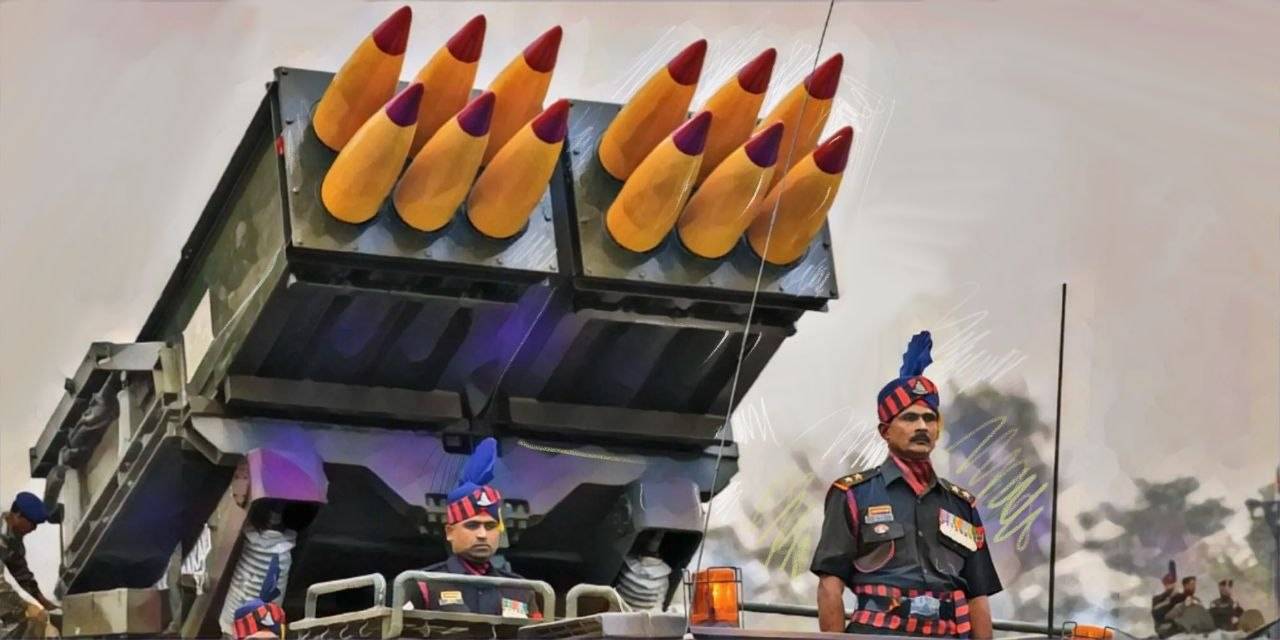
India could become another supplier of major weapons to Central Asia. Indian Masterminds reported in July that Samir V. Kamat, former chairman of India’s Defence Research and Development Organisation (DRDO), said India had exported Akash surface-to-air missile systems to Tajikistan and Turkmenistan.
The reported deliveries remain unconfirmed by the recipient governments. Publicly available accounts give no contract values, quantities, or delivery schedules.
DRDO says an initial Akash battery has been flagged off for export to friendly foreign countries, without naming the recipients.
Akash is a mobile medium-range surface-to-air missile system designed to counter aircraft, helicopters, cruise missiles, and drones. If the reported deliveries are confirmed, they would mark the first publicly known Akash exports to Central Asia following India’s deal with Armenia. The region’s armed forces still rely heavily on Soviet- and Russian-designed equipment, but governments are increasingly buying newer systems from other suppliers.
Russia retains a strong position where countries need to maintain Soviet- and Russian-designed equipment already in service. Other suppliers are winning orders for drones and aircraft, extending their role in the region’s defense procurement.
The figures illustrate the persistence of Russian influence. According to the Stockholm International Peace Research Institute (SIPRI), Russia accounted for 83% of Kazakhstan’s imports of major arms in 2021–25. These figures measure transfers of major weapons, rather than the full range of military supplies and support.
Russia’s exports of major arms, however, fell by 64% in 2021–25 compared with the previous five-year period. Nearly three-quarters of its exports went to India, China, and Belarus. SIPRI attributes much of the fall to reduced deliveries to Algeria, China, and Egypt.
The most visible shift has occurred in Uzbekistan. In late August, official footage showed Chinese-built J-10CE fighter jets carrying Uzbek markings. At least six aircraft could be seen.
For three decades, Soviet-designed MiG-29s and Su-27s formed the backbone of Uzbekistan’s fighter fleet. Operating the J-10CE requires different training and maintenance arrangements, alongside compatible weapons and ground equipment. The transition moves a key component of the Uzbek Air Force outside its traditional supply chain.
On September 25, Brazil’s Embraer delivered the first C-390 Millennium military transport aircraft to the Uzbek Air Force. The handover ceremony took place at the company’s facility in Gavião Peixoto, making Uzbekistan the first C-390 operator in Central Asia.
The late-2024 contract includes training to operate the aircraft and covers its upkeep with technical support and spare parts. The aircraft can carry payloads of up to 26 metric tons and can be configured for troop and cargo transport, aerial refueling, medical evacuation, and search-and-rescue missions.
Kazakhstan’s military has put Turkish Aerospace Industries’ ANKA drone into service after military trials. In its review of 2024, Kazakhstan’s Defense Ministry reported discussions with Baykar, another Turkish drone maker, on a roadmap for local production of tactical drones and loitering munitions. The latter can remain airborne while searching for a target before striking it.
The same review said the Turkish side had offered to provide Bayraktar Kalkan and Bayraktar Mini reconnaissance drones, along with the Mosquito-X loitering munition, for military trials at no cost.
During the Ashyq Aspán 2026 (Open Sky) exercises, Kazakhstan, which is expanding domestic drone production, integrated aviation and air-defense units with radar and electronic warfare systems. According to the Defense Ministry, the scenario included repelling a large-scale air attack and countering drones. Personnel also trialed automated command-and-control systems incorporating elements of artificial intelligence.
Kyrgyzstan acquired its first Turkish Bayraktar TB2 combat drones in late 2021. Officials subsequently announced purchases of Akıncı, Aksungur, and ANKA drones.
For a relatively small military, drones provide a way to improve reconnaissance and precision-strike capabilities without building an expensive manned combat-aircraft fleet. Following armed conflicts along the Kyrgyz-Tajik border, Bishkek increased military spending and expanded the size of its armed forces.
A private research center near Bishkek has expanded work on unmanned and robotic systems, although production volumes and the proportion of locally sourced components have not been disclosed.
In 2025, Kyrgyzstan received Russian S-300PS and Tor-M2KM air-defense systems.
In 2022, Iran opened a facility in Dushanbe, Tajikistan, to manufacture Ababil-2 drones.
In May 2026, China agreed to provide Tajikistan’s Interior Ministry with more than $7.6 million worth of intelligence, policing, and counterterrorism equipment free of charge. The package includes 34 intelligence devices alongside additional police and counterterrorism equipment, with installation and personnel training. It is intended for security agencies rather than the military, but expands the presence of Chinese technology in Tajikistan’s security sector.
In 2025, Russia and Tajikistan signed a strategic cooperation program between their defense ministries for 2026-30. Russia’s 201st Military Base remains in Tajikistan.
Domestic production could help reduce some of these dependencies. Writing in The Diplomat, Michael S. Coffey argues that Central Asian states should jointly develop drone capabilities to meet their security needs. Buying from a wider range of foreign suppliers does not itself remove reliance on imported equipment and support. For individual governments, buying platforms tailored to specific needs may make more sense than shifting wholesale to the standards of a single new supplier.
Across the region, Chinese fighters and Turkish drones now operate alongside Russian equipment. Uzbekistan’s Brazilian transport aircraft and Tajikistan’s Iranian drone factory further broaden the range of suppliers.
Diversification gives governments more choice, but each additional supplier brings its own maintenance and training requirements. Its military value will depend on whether countries can sustain these systems and integrate them into their existing forces.