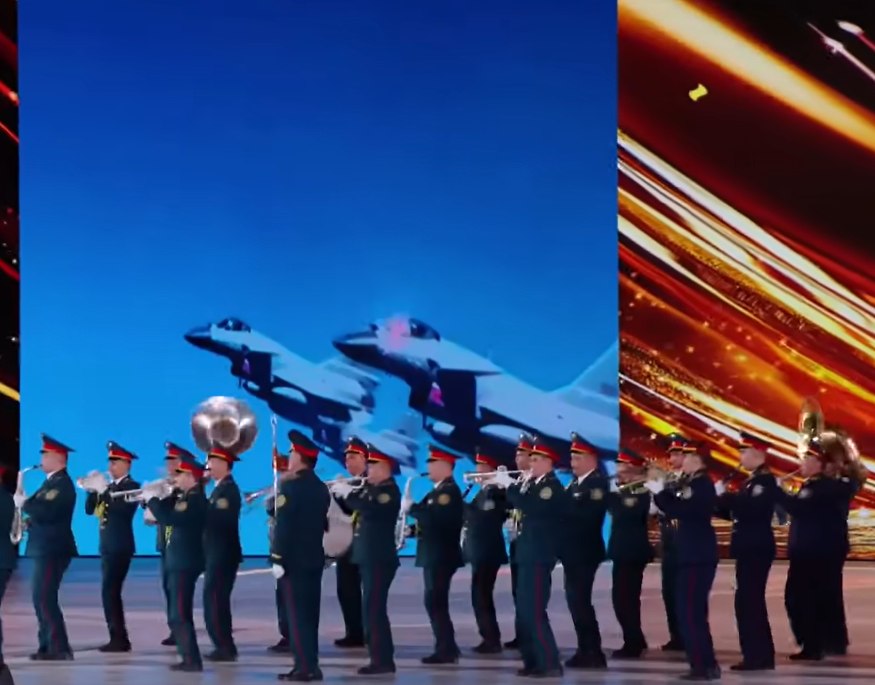
Uzbekistan has publicly unveiled Chinese J-10CE fighter jets for the first time, ending months of speculation over the aircraft’s arrival in its air force. Official footage shows at least six aircraft carrying Uzbek military markings.
For three decades, Soviet-designed MiG-29s and Su-27s have formed the backbone of Uzbekistan’s fighter fleet. The country has now become the first Central Asian state to operate a modern Chinese fighter and the second confirmed foreign operator of the J-10CE after Pakistan.
The first reports of a potential J-10CE purchase appeared several months before the aircraft were publicly unveiled. Confirmation came on August 28, when footage marking the 35th anniversary of Uzbekistan’s independence showed Chinese-built fighters carrying Uzbek insignia.
Uzbekistan’s Defense Ministry subsequently released its own video of the new aircraft. At least six J-10CEs have now been publicly shown, while earlier reports that Uzbekistan had ordered 24 aircraft remain unconfirmed.
The need to modernize the fleet has been apparent for years. Much of the country’s combat fleet consists of Soviet-designed aircraft, but open sources do not establish how many are currently combat-ready. GlobalMilitary.net, which updated its Uzbekistan inventory in July 2026, lists 38 MiG-29s, 25 Su-27s, and 13 Su-25 ground-attack aircraft as active.
The J-10CE gives Uzbekistan a modern platform as an alternative to relying exclusively on aging Soviet-designed fighters. The export version of China’s J-10C is equipped with an active electronically scanned array (AESA) radar and can employ modern Chinese guided weapons.
But the significance of the acquisition goes beyond the capabilities of the aircraft itself. Switching to a new fighter type requires training pilots and engineers, securing spare parts and munitions, maintaining engines and electronics, and, over time, developing domestic maintenance infrastructure. In combat aviation, choosing a new platform can create a relationship with its supplier that lasts for decades.
In Uzbekistan’s case, some of that infrastructure could build on existing military cooperation with China. Tashkent previously acquired Chinese FD-2000 air defense systems, the export version of the HQ-9. In 2019, the Uzbek military conducted the first publicly reported live-fire tests of the systems.
Chinese military analyst Zhang Junshe told the Global Times on August 31 that the six aircraft displayed could be the first batch of a larger delivery. The newspaper also raised the possibility of integrating the J-10CE with Chinese-made ground-based air defense systems through data links.
Diversifying Beyond Russia
The J-10CE acquisition, however, does not necessarily signal a sudden Uzbek shift from Russia to China. Tashkent has long diversified its military procurement and operates equipment from multiple suppliers.
This is particularly visible in transport aviation. Alongside Soviet-designed Il-76s, An-26s, and An-12s, Uzbekistan has acquired European Airbus C295s. In February 2026, Brazil’s Embraer officially identified Uzbekistan as the previously undisclosed customer for its C-390 Millennium and the first operator of the aircraft in Central Asia.
Fighter aviation had been different. For decades, the MiG-29 and Su-27 were the staples of its air force. China has now entered this segment for the first time.
It is therefore premature to speak of Russia being pushed out of the Uzbek defense market. More precisely, Moscow is losing the near-exclusive position it once held in one of the most technologically complex segments of Uzbekistan’s armed forces.
For Beijing, the Uzbek acquisition has significance of its own. Until now, Pakistan had been the only confirmed foreign operator of the J-10CE. Uzbekistan gives the aircraft its second foreign operator and its first foothold in Central Asia.
China is seeking to expand the aircraft’s export market. Reuters reported on August 25 that Bangladesh was moving toward formal negotiations with Beijing over a potential J-10CE purchase.
A New Precedent for Central Asia?
For decades, Central Asia was a natural market for Soviet, and later, Russian, military aviation. The arrival of the J-10CE does not overturn that model overnight. Kazakhstan continues to operate Russian Su-30SM fighters, while the fighter fleets of Kyrgyzstan and Tajikistan are far smaller. But Uzbekistan has created the region’s first precedent for operating a modern Chinese fighter.
If Tashkent stops at six J-10CEs, the new aircraft could operate alongside MiG-29s and Su-27s for years, consistent with Uzbekistan’s existing policy of diversifying suppliers.
If reports of 24 aircraft are eventually confirmed, the implications would be different. A fleet of that size would allow Uzbekistan to build full operational units around the Chinese platform and gradually replace a significant share of its Soviet-designed fighter fleet. For now, the unanswered question is whether the six aircraft already unveiled are the extent of the purchase or the first batch of a much larger fleet.