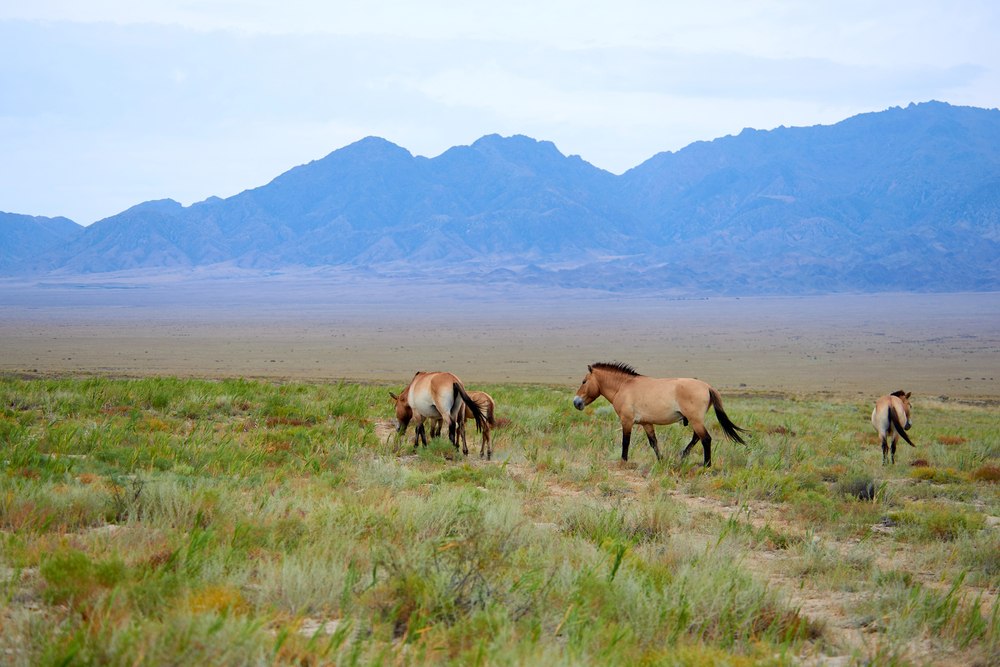
A group of five Przewalski’s horses has been released into the wild in Kazakhstan’s Kostanay Region as part of a reintroduction program to restore the species to its historical habitat, according to the country’s Ministry of Ecology and Natural Resources.
Przewalski’s horse is the last surviving horse species. Once widespread across the grasslands of Central Asia, including present-day Kazakhstan, the species is distinguished by its stocky build, large head, and dun-colored coat with a dark mane.
By 1969, Przewalski’s horses had disappeared from the wild and survived only in captivity. Kazakhstan launched a reintroduction program aimed at restoring a self-sustaining population in the country’s vast steppe ecosystems. The first seven horses arrived in Kostanay Region in the summer of 2024. A second group of seven horses was transported from Prague Zoo and Hungary’s Hortobágy National Park in June 2025.
On May 25, five horses from that second group were released into the Altyn Dala State Nature Reserve.
The group consists of Galvan, a stallion brought from Prague, and four mares from Hungary’s Hortobágy National Park.
According to the Kazakhstan’s Ministry of Ecology, the animals spent the past year in large acclimatization enclosures, where veterinarians and other specialists monitored their condition. Officials said the horses adapted to the local climate, survived the winter, and were considered ready for release onto the steppe.
Before the release, Galvan was fitted with a GPS collar to allow researchers to monitor the group’s movements and gather data on their behavior in a natural environment. According to reserve specialists, the horses are in good condition and have already begun exploring new grazing areas and watering sites.
Following their release, the animals remain under the supervision of state wildlife inspectors. Specialists will continue tracking their movements and adaptation to life in the wild.
The ministry said that the release of these Przewalski’s horses is an important milestone in a reintroduction project that began in 2024, involving partnership between Ministry of Ecology and numerous European zoos.
The initiative draws on Prague Zoo’s previous experience reintroducing Przewalski’s horses to Mongolia, one of the world’s most successful conservation programs for the species.
The first group of seven horses brought to Kazakhstan in June 2024 remained under veterinary and zoological supervision throughout its adaptation period. The animals successfully endured their first winter in the Torgai Steppe, where temperatures dropped to as low as -30°C, and completed all necessary veterinary procedures. Six of those horses were released into the wild in early June 2025 after a year of acclimatization.
Kazakh authorities plan to bring approximately 40-45 Przewalski’s horses to the country by 2029, a number considered sufficient to establish a breeding population capable of sustaining itself in the wild.