What should a robot do after making a mistake? The answer becomes more complicated when the person nearby does not explicitly say something has gone wrong, but merely hesitates, looks confused, or begins to lose trust in the machine.
This is one of the problems currently being studied by Kazakh researcher Arman Ibrayeva. Over several years, her scientific interests have developed from mechanics and walking robots to autonomous navigation, medical robotics, and human interaction with intelligent systems.
In June 2026, Ibrayeva was among the authors of REPAIR-Bench, a new research benchmark for studying how people respond to robot errors and how interaction can be restored after a failure. The researchers conducted 214 interaction trials involving 41 participants, recording speech, facial expressions, head movements, and users’ preferred responses to different robot failures.
The task goes beyond simply detecting a failure. A robot working alongside people needs to understand how its mistake has changed a person’s behavior. One user may become irritated, another confused, while a third may try to repeat the action. The robot’s response should depend on that reaction.
For Ibrayeva, this is a continuation of a scientific career that began not with generative AI, but with mechanics.
She studied mechanics at Al-Farabi Kazakh National University, receiving her bachelor’s degree in 2018 and master’s degree in 2020. She then continued her studies at King Abdullah University of Science and Technology (KAUST) in Saudi Arabia, where she conducted research in mechanical engineering. Her official KAUST profile lists robotics, mechanical engineering, and machine learning among her research interests.
One of the early areas of her work was walking machines. Ibrayeva studied how their design could be simplified and the number of actuators reduced without losing the required range of movement. Such an approach can reduce energy consumption and simplify robot control.
At a robotics conference at KAUST in 2022, she presented a walking robot design with decoupled limb motion. Agriculture was cited as one possible application because heavy wheeled machinery compacts soil and can damage plants. The walking mechanism was designed to move over uneven terrain while placing less load on its actuators.
This work later developed into research combining classical mechanics, numerical optimization, and machine learning. A 2025 paper co-authored by Ibrayeva describes several physical prototypes of walking robots, tests on uneven surfaces, and the use of LiDAR for autonomous navigation.
Another area was medical robotics. Ibrayeva took part in research on a lower-limb exoskeleton. The authors sought a design capable of reproducing the movements of the human leg with less mechanical complexity and more efficient force transmission.
She also worked on autonomous navigation for service robots in rehabilitation medicine. A 2024 study examined a system using 3D LiDAR that allows a robot to map its surroundings, determine its position, and avoid obstacles while moving through a medical facility.
At first glance, a walking machine for agriculture, a rehabilitation exoskeleton, and a robot interacting with a person belong to different fields. Yet all these projects involve the same practical problem: a machine has to operate in an environment whose behavior cannot be fully described in advance.
Once a person enters the equation, the task becomes even more difficult.
A conventional robot can be programmed to stop in front of an obstacle. When interacting with people, such rules alone are not enough. People do not always express their intentions directly; they react differently to the same situation, and an action that is technically correct for a machine may still cause confusion or mistrust.
Ibrayeva’s latest research addresses precisely this problem. In REPAIR-Bench, a robot’s error is treated not as an isolated failure but as part of an interaction: what happened before it, how the person responded, and what the machine should do afterward.
For robots expected to work alongside people in hospitals, homes, and other environments, the distinction is important. It is no longer enough for a machine simply to detect its own error. Understanding the person’s reaction and choosing what to do next is much harder.
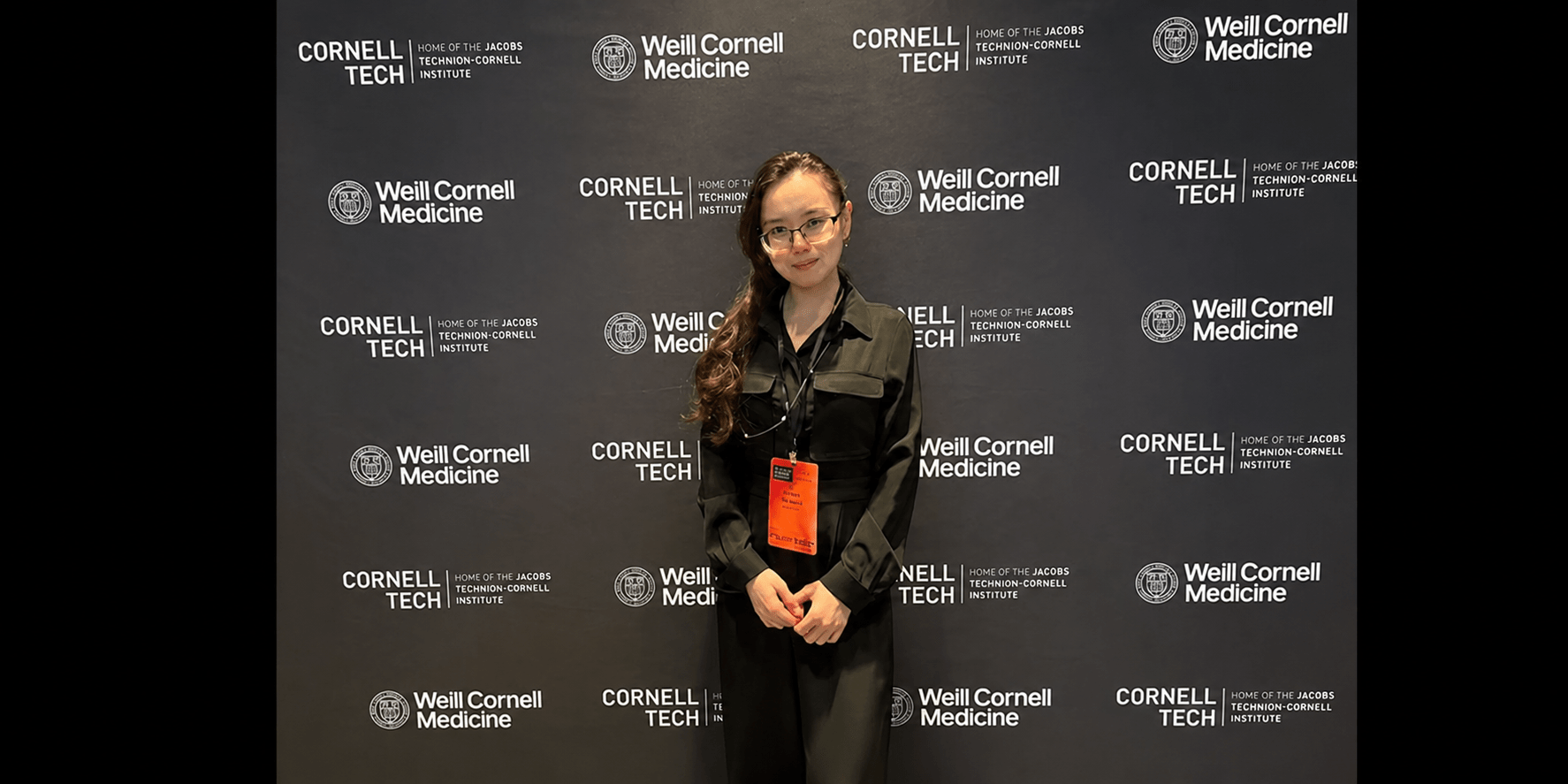
Ibrayeva is now continuing her research at Cornell University. Her current work concerns autonomous navigation and the behavior of intelligent systems in situations where machines have to make decisions with incomplete information. This is an important area of robotics research at Cornell, where university groups work on autonomous vehicles, aerial, medical, domestic, and other robotic systems.
One example Ibrayeva uses to explain the problem will be familiar to any driver. In heavy traffic, a person rarely waits for a completely empty road before changing lanes. The driver signals an intention, cautiously begins the maneuver, and watches how others respond. Road users are constantly reacting to one another.
For an autonomous vehicle, such a situation is much more difficult. It is not enough to calculate the trajectories of cars and pedestrians. The system must also take into account how its own maneuver will change the behavior of those around it. An excessively cautious vehicle may stop where a human driver would continue. An error in the opposite direction creates a risk of collision.
These are the kinds of problems that arise in open environments, where it is impossible to anticipate every situation in advance. A robot has to make decisions under uncertainty, with limited time, and finite computing resources. At Cornell, research and teaching on autonomous mobile robots cover localization, mapping, motion planning, collision avoidance, and interaction with people.
A similar problem is familiar to users of generative artificial intelligence. A large language model can produce a confident answer even when it does not have enough reliable information. This can lead to “hallucinations,” factually incorrect information presented as a plausible response.
Ibrayeva is interested in whether an intelligent system can recognize its own uncertainty before an error leads to undesirable consequences. In human-robot interaction, the person’s response can itself serve as a signal. A pause, hesitation, or change in facial expression may indicate a problem before the user has time to say so directly.
This leads to another question: what does a person know and understand at the moment they communicate with a machine? The same instruction may be obvious to a specialist but useless to someone without technical training. Ibrayeva is working on mathematical models of a user’s informational state so that an intelligent system can take account of their level of knowledge and choose an appropriate way to explain something.
According to Ibrayeva, she also participated in joint research with Columbia University on human gait analysis and rehabilitation, worked on autonomous drone navigation at IDSIA in Switzerland, and was involved in satellite technologies at TU Berlin.
Some of her work has also been connected with industry in Kazakhstan. Ibrayeva lists among her projects the robotization of technological processes in uranium production for Kazatomprom and the automation of operations for Kazakh car manufacturer Allur. In Kazatomprom’s case, the work included robotic systems for handling containers, monitoring tanks, and diagnosing pipelines. The national atomic company itself lists automation and robotization among the areas of its scientific and technological activity.
At least one development involving Ibrayeva has received patent protection in Kazakhstan. In 2022, the National Institute of Intellectual Property published a patent for a “walking mechanism for a vehicle,” with Arman Ibrayeva listed among the authors.
The emphasis of Ibrayeva’s work has gradually shifted from machine design toward how intelligent systems behave around people. Her early research focused on how to make a robot move, reduce the number of actuators, lower loads, and cut energy consumption. Now, she is increasingly interested in what an intelligent system should do when its usual algorithm stops working.
For Ibrayeva, this is particularly clear in the case of AI errors. Detecting a failure is not enough. A machine needs to assess its own level of confidence, understand the user’s response, and decide whether to continue, ask for more information, or explain what exactly it does not know.
Ibrayeva connects her own research with changes in Kazakhstan’s scientific environment. According to her, opportunities for young researchers have expanded, including through grant programs, interdisciplinary research, and funding for developments with potential practical applications. Government funding for science has increased substantially, while Kazakhstan has set a target of raising research and development expenditure to 1% of GDP, although the figure remains well below the level of leading research economies.
For 2026-2028, Kazakhstan has announced separate funding competitions for young scientists, fundamental research, and the commercialization of scientific developments. Priority areas include energy, advanced materials, digital and space technologies, and life and health sciences. Kazakhstan’s 2026 state budget provides around $442 million for the science development program and a further approximately $23 million for basic funding of scientific organizations.
Ibrayeva advises young researchers not to wait until graduation before becoming involved in science. Her own first research project began in her first year at university, when, she says, much of what she needed to know had to be learned directly through the work itself. For those hoping to continue their education abroad, she recommends joining research projects and academic competitions early, preparing for admission to strong universities, and taking English seriously. In modern science, the ability to read professional literature, discuss results, and work with colleagues from other countries has long been part of the profession.
Errors are inevitable in open environments. A robot may misjudge a person’s intentions, an autonomous vehicle may encounter an unfamiliar situation, and a language model may produce a convincing but incorrect answer. Ibrayeva is therefore interested not in the promise of error-free artificial intelligence, but in a more practical question: can a machine recognize when it does not have enough information?
That leads to another question: what should it do next? For a system operating alongside a person, the right answer may not be to carry out the next action automatically. Sometimes it is safer to stop, acknowledge uncertainty, request additional information, or change the way it communicates.
From her first walking mechanisms to her current research at Cornell, much of Ibrayeva’s path has revolved around a single problem: how to make a machine operate beyond a predetermined scenario. As such systems become more deeply embedded in everyday life, this question is increasingly becoming more than a problem for robotics alone.