Central Asia has produced remarkably few former presidents who simply retired from public life. In Kyrgyzstan, former leaders have been driven from office, prosecuted, imprisoned, or forced into exile. Kazakhstan’s Nursultan Nazarbayev has followed a different path, largely withdrawing from public view after losing much of his political influence. Elsewhere, some of the region’s founding presidents died in office, leaving no post-presidential career to examine.
The Times of Central Asia has previously examined how political succession has developed across the region. The fate of leaders after they leave office reveals another side of that political tradition.
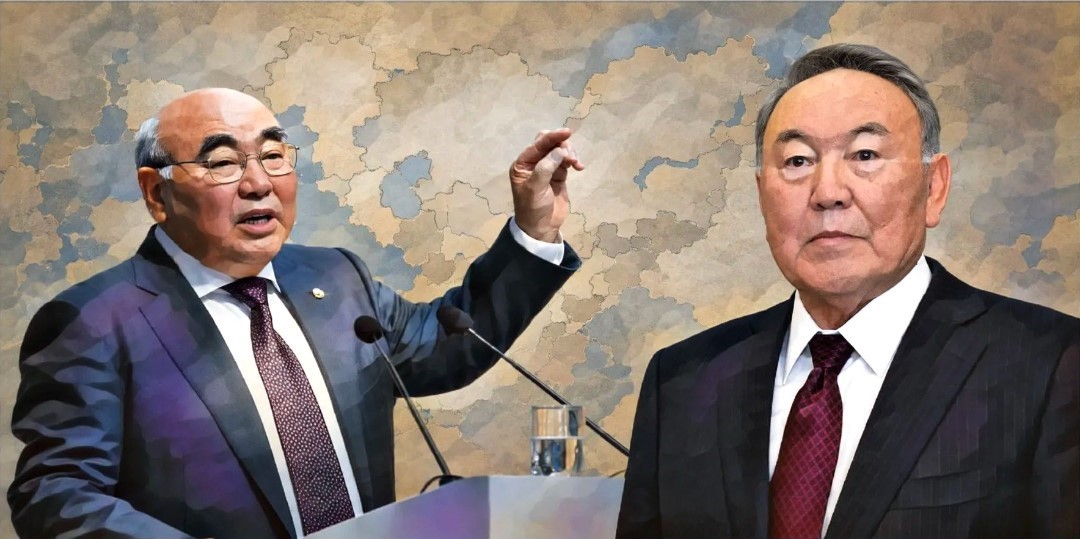
The architect of Kyrgyzstan’s early post-Soviet political model was its first president, Askar Akayev, who remained in office until 2005. Akayev introduced democratic institutions in Kyrgyzstan, but gradually tightened the pressure on his opponents as his presidency progressed.
His rule was badly shaken by the Aksy shootings in 2002, which followed the prosecution of opposition lawmaker Azimbek Beknazarov and a territorial dispute with China. Akayev’s government had agreed to transfer disputed border territory to China, a decision fiercely criticized by the opposition. In March 2002, demonstrators in southern Kyrgyzstan demanded Akayev’s impeachment. Security forces opened fire during the unrest, killing several people. The shootings became one of the defining political crises of his presidency.
In a 2003 referendum, Akayev significantly strengthened presidential powers at parliament’s expense. Economic hardship, unemployment, widespread corruption, and allegations of fraud in the 2005 parliamentary elections eventually helped trigger the Tulip Revolution in March of that year.
Akayev had to flee, with rumors at the time claiming that he was smuggled out in the trunk of an official car, wrapped in a carpet. Criminal cases involving corruption were opened against him and members of his family in Kyrgyzstan. The authorities repeatedly sought his extradition from Russia, but were unsuccessful. After leaving Kyrgyzstan, Akayev lived in Moscow and taught at Moscow State University. In 2006, he became a foreign member of the Russian Academy of Sciences.
In August 2021, Akayev reappeared in Bishkek. He unexpectedly flew into the country and was immediately questioned as part of the criminal investigation into corruption surrounding the Kumtor gold mine. Afterward, he said he had come to Bishkek for a week and was prepared to assist investigators.
“I came to speak honestly and sincerely about how we built Kumtor, why we built it, and what mistakes may have been made. The investigation will continue,” he said.
In 2023, Kyrgyzstan’s Prosecutor General’s Office announced that the criminal prosecution of Akayev had been terminated because the statute of limitations had expired.
Tajikistan’s former president Rahmon Nabiyev was also forced from power. The former Soviet politician lost power amid the country’s civil war in 1992. He died at his home in Khujand the following year, at the age of 62, reportedly from a heart attack. According to his wife, Nabiyev spent his final months in Khujand in conditions resembling house arrest and received a pension of just five rubles.
While Tajikistan did not repeat the experiment of violently removing a ruler, Kyrgyzstan saw another overthrow just five years after the Tulip Revolution. Kurmanbek Bakiyev, who had succeeded Akayev as president, was forced to flee, this time not to Moscow but to Minsk. Kazakhstan helped broker Bakiyev’s departure from Kyrgyzstan, as part of international mediation involving Russia, the United States, and the OSCE.
Bakiyev was subsequently handed down a series of prison sentences in absentia. In February 2013, a Kyrgyz court convicted him of abuse of office and sentenced him to 24 years. In April 2014, a Bishkek court sentenced Bakiyev in absentia to 25 years in prison for plotting the attempted murder of British businessman Sean Daley. In 2014, the Bishkek Garrison Military Court also sentenced him to life imprisonment over the killing of protesters in Bishkek on April 7, 2010. The Supreme Court reduced that sentence to 30 years in 2016.
In 2023, Bishkek’s Pervomaisky District Court sentenced Bakiyev to another 10 years in prison on corruption charges related to the Kumtor gold mine. Taking his previous sentence into account, the court set his final punishment at 30 years in a maximum-security prison, with confiscation of property and a three-year ban on holding public office.
The former Kyrgyz president received Belarusian citizenship, as did members of his family. His wife, Nazgul Tolomusheva, died in January 2023. Minsk has repeatedly rejected Kyrgyzstan’s requests for Bakiyev’s extradition.
In 2022, Kyrgyzstan’s Prosecutor General’s Office sent its Belarusian counterpart four extradition requests, along with a request that Bakiyev’s Kyrgyz court sentences be enforced in Belarus. The Belarusian authorities refused to extradite him, citing the risk of political persecution in Kyrgyzstan.
In 2025, Belarusian President Alexander Lukashenko effectively put an end to speculation about whether Bakiyev might be extradited to Kyrgyzstan.
“Bakiyev is living well. Fine. We’re not going to let him go back to you. I told him: ‘No more trips, that’s enough! Live in Belarus.’ He’s doing fine. I sometimes visit him when he invites me. So we won’t hand him over to you,” Lukashenko said during a visit to Bishkek.
The next elected Kyrgyz president after Bakiyev, Almazbek Atambayev, is also living abroad. In 2024, he and his son were photographed on the Barcelona metro in Spain.
Atambayev served as president of Kyrgyzstan from 2011 to 2017. In 2019, he was stripped of presidential immunity amid criminal investigations. Law enforcement officers eventually stormed Atambayev’s residence in the village of Koi-Tash to arrest him after his supporters resisted an initial operation.
Several criminal cases were brought against Atambayev. In June 2020, a Bishkek court sentenced him to more than 11 years in prison in connection with the illegal release of crime boss Aziz Batukayev. That conviction was later overturned, and Atambayev was released in February 2023 and allowed to travel abroad for medical treatment. He subsequently settled in Spain.
His legal troubles, however, did not end there. In June 2025, a Bishkek court sentenced Atambayev in absentia to 11 years and six months in prison on charges including corruption and organizing mass unrest related to the 2019 events in Koi-Tash.
His successor as president and former party ally, Sooronbay Jeenbekov, whose presidency saw the prosecution of Atambayev, remains in Kyrgyzstan and retains the status of a former president. But his future has not always appeared entirely secure.
In 2023, members of parliament raised the possibility of stripping him of that status. Such a move would remove his immunity from prosecution and the privileges provided to a former president, including accommodation at a state residence, state protection, transportation, government communications, and free medical care for him and his family.
Uzbekistan and Turkmenistan provide fewer examples of conventional post-presidential life. Uzbekistan’s first president, Islam Karimov, died in office in September 2016, so he never became a retired national leader. Turkmenistan’s first president, Saparmurat Niyazov, likewise died while still in power in December 2006.
Gurbanguly Berdimuhamedow presents a different case. He stepped down as president in 2022, when his son Serdar became president, but did not withdraw from political life. He remains chairman of the Halk Maslahaty and is officially described as the National Leader of the Turkmen people. His position is therefore very different from that of a former president who has retired from public affairs.
Kazakhstan’s first president, Nursultan Nazarbayev, initially left office under very different circumstances. When he resigned in 2019, he retained considerable influence as chairman of the ruling Nur Otan party, lifetime chairman of the Security Council, and holder of the special title of Elbasy, or Leader of the Nation. The capital was renamed Nur-Sultan in his honor immediately after his resignation.
That position changed sharply after the unrest of January 2022. Nazarbayev’s remaining political influence was progressively dismantled, while many of the symbols and legal privileges associated with his rule were removed. The capital reverted to Astana later that year, references to his status as Leader of the Nation were removed from the Constitution, and the law granting the first president special privileges and protections was subsequently repealed. The Times of Central Asia has described 2022 as the beginning of the end of Nazarbayev’s remaining rule and influence.
Nazarbayev now rarely appears in public, although occasional meetings with Russian President Vladimir Putin continue to attract attention. Despite the dismantling of Nazarbayev’s former political position, President Kassym-Jomart Tokayev has continued to acknowledge his historical role in the formation of independent Kazakhstan.
In an interview in January 2025, Tokayev said that Nazarbayev himself initiated the meetings with Putin and that the Russian leader could hardly refuse him.
“Nursultan Abishevich initiates these meetings; they are extremely important to him. We should not forget that, as a former chairman of the Council of Ministers of the Kazakh SSR, a party leader, and later president of sovereign Kazakhstan, he is morally and politically closely connected with the Kremlin. After all, he spent so much time on business trips to Moscow, at congresses and plenums, and on working and official visits,” Tokayev explained.
As for the former president’s place of residence, his spokesman, Aidos Ukibay, has repeatedly said that Nazarbayev permanently resides in Kazakhstan.
Astana residents may see him again on August 23 at the polling station where the former president is registered. Kazakhstan is holding an election to its new unicameral parliament, the Kurultai, on that date. Nazarbayev has continued to appear publicly to vote in elections and referendums in recent years.
Across Central Asia, former presidents have followed very different paths. Kyrgyzstan has seen exile, prosecution, and repeated battles over the legal status of former leaders. Tajikistan’s early post-Soviet experience ended with a president forced from power during civil war. Uzbekistan and Turkmenistan produced fewer conventional former presidents because their founding leaders died in office, while Gurbanguly Berdimuhamedow remains politically prominent despite leaving the presidency. Nazarbayev represents another model, having left office without facing the exile or criminal prosecution experienced by several former Kyrgyz leaders.