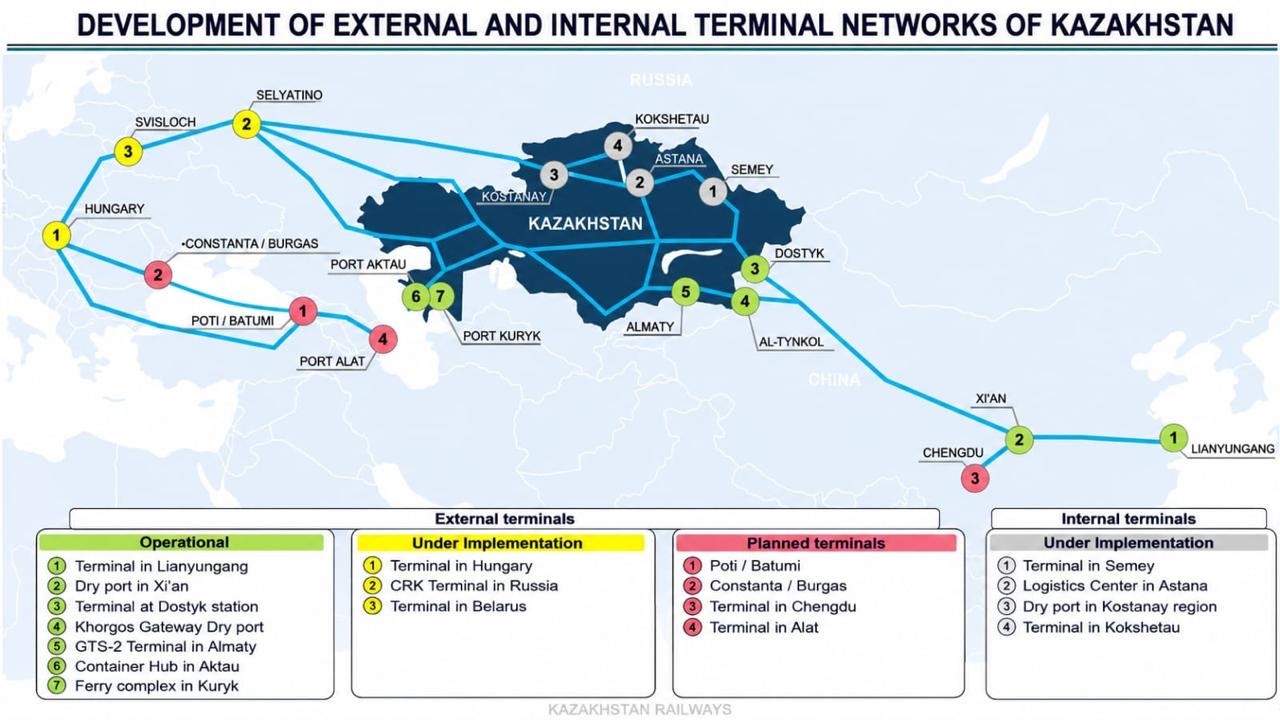
Although Kazakhstan is landlocked, companies based in the country already hold stakes in logistics terminals at Lianyungang on China’s Yellow Sea coast and in Poti on the Black Sea. Projects farther west are at various stages of development. The strategy allows Kazakhstan-based operators to remain involved as freight travels between Asian ports and European markets, including beyond Kazakhstan’s borders.
One of the main facilities is at the Chinese port of Lianyungang. The China-Kazakhstan Logistics Cooperation Base began operating in May 2014. It was jointly developed by Lianyungang Port and Kazakhstan Temir Zholy (KTZ), Kazakhstan’s national railway operator. Cargo arriving by sea can be transferred to rail for shipment through Kazakhstan toward Central Asia and Europe.
In a written response to The Times of Central Asia, Kazakhstan’s Ministry of Transport said the Lianyungang terminal handled 2.39 million twenty-foot equivalent units (TEU) from 2015 through 2025. Annual throughput rose from 167,000 TEU in 2015 to 271,700 TEU in 2025. A further 140,100 TEU passed through the terminal during the first half of 2026, down 3.2% year on year.
According to Samruk-Kazyna, the network extends inland to a terminal in Xi’an and includes Khorgos Gateway at the Kazakhstan-China border. The fund said a dry port in Chengdu would be added in 2027.
At the western end, Kazakhstan-based PTC Holding and Georgian partners developed a multimodal terminal that opened in Poti in June 2025 after investment of more than $30 million. The operator currently lists annual throughput capacity at up to 100,000 TEU.
Between the terminals in China and Georgia lies Kazakhstan’s rail network, which carries cargo to the Caspian ports of Aktau and Kuryk. These links form Kazakhstan’s section of the Trans-Caspian International Transport Route, known as the Middle Corridor. The route connects China with Europe across the Caspian Sea and the South Caucasus.
Kazakhstan is pursuing further terminal projects along the route. In July 2026, Kazakhstan and Azerbaijan were preparing to begin construction of a joint intermodal terminal at Alat. Work was awaiting completion of the Port of Baku’s updated master plan.
In June 2026, Kazakhstan’s government said work would begin on terminals in Budapest and Constanța. Later that month, KTZ Express signed an agreement with Midia Marine Terminal for a joint project at Romania’s Port of Midia. The European projects have yet to reach the operating stage.
The value of this terminal network becomes clearer from the way the Middle Corridor operates. Containers must move between rail and ships for the Caspian crossing, so faster transit across Kazakhstan cannot determine the total journey time. The World Bank has identified the Caspian and Black Sea crossings as bottlenecks requiring greater vessel availability and higher port productivity.
Transit times vary by destination. Turkish officials reported in August 2025 that a freight train from China had reached Turkey in 15 days, while earlier journeys often took more than 20 days because of customs procedures and weather on the Caspian Sea. A 15-day journey should therefore be treated as a benchmark rather than a guaranteed schedule.
The route handled 4.5 million metric tons in 2024, an increase of 62%. According to 2025 government figures, total freight fell 8.9% to 4.1 million metric tons, while container traffic rose 36% to 77,000 TEU.
Overseas terminals allow operators from Kazakhstan to handle freight before it enters the country and after it leaves. Lianyungang connects the rail network with maritime routes in East Asia, while Poti extends its reach to the Black Sea. Projects in Azerbaijan and Europe could keep KTZ and other Kazakhstan-based operators involved farther along the route if completed. This would extend potential revenue beyond Kazakhstan’s railway network and give its companies a commercial presence at maritime gateways on both sides of the route.