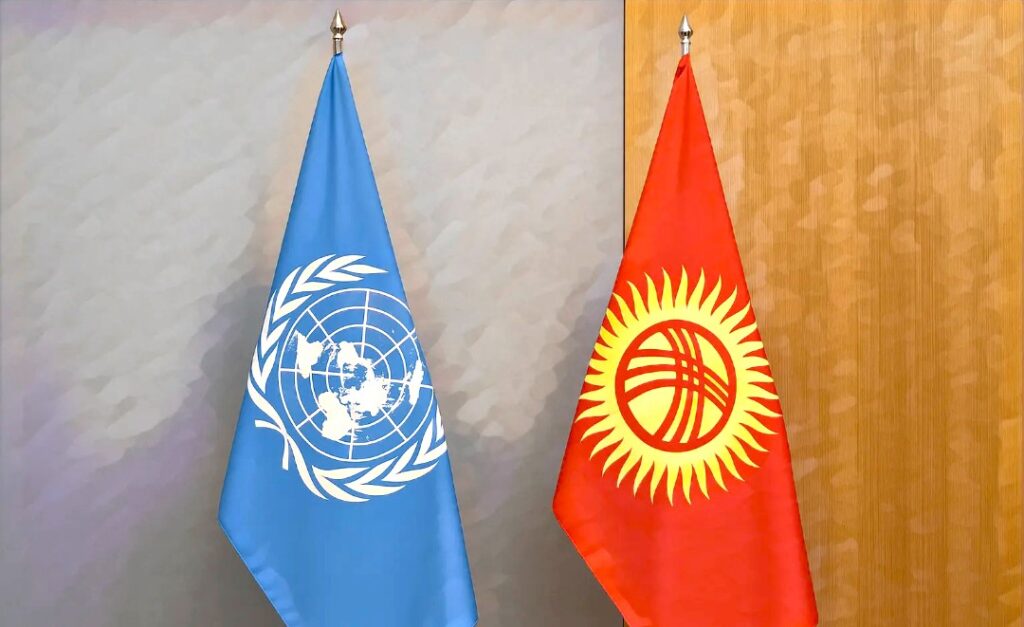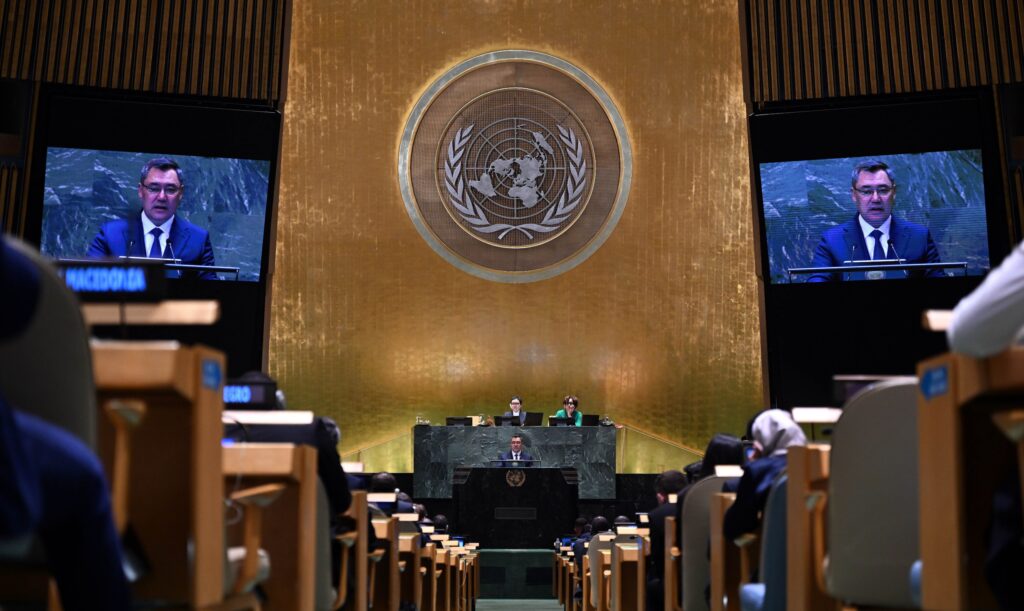
Kyrgyzstan’s election to the United Nations Security Council for the 2027-2028 term is more than a diplomatic milestone. It is a case study in how a small state can create political weight without possessing a large economy, military power, or a dominant regional position.
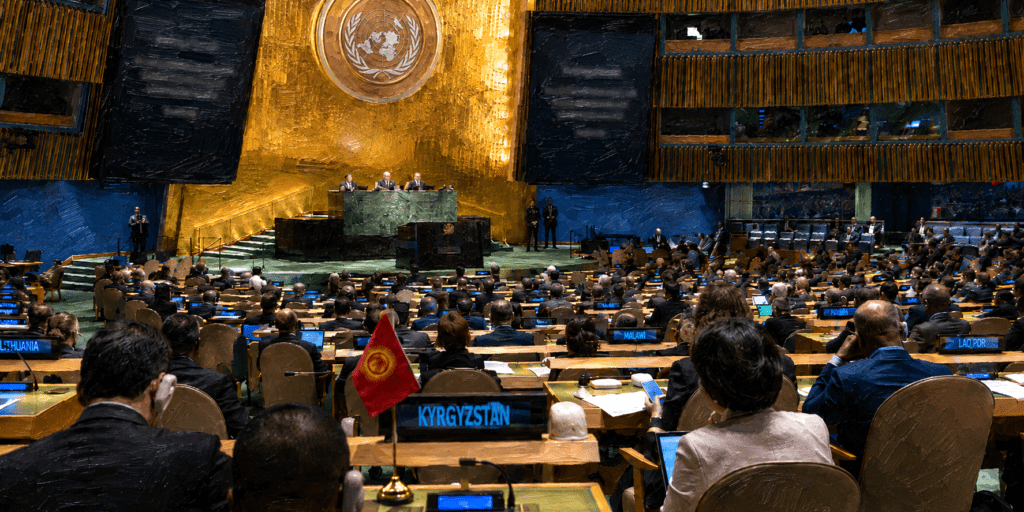
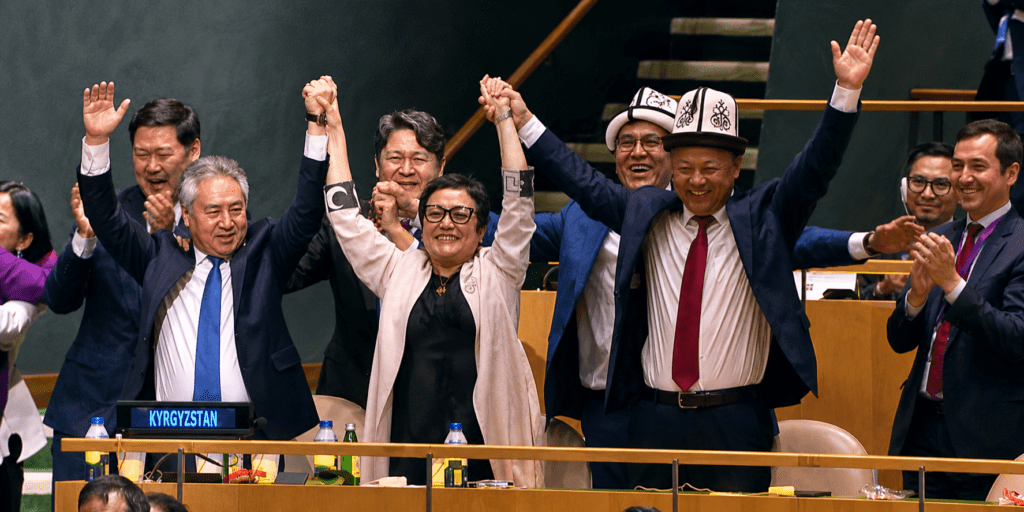
On June 3, Kyrgyzstan won its first-ever seat on the Security Council after a competitive four-round contest with the Philippines for the Asia-Pacific Group vacancy. Bishkek led from the first round, with 105 votes against Manila’s 85, and increased its support through each subsequent ballot. It finished with 142 votes to 49.
The result is significant because this was not an uncontested regional rotation. Kyrgyzstan had to assemble a qualified two-thirds majority across the wider UN General Assembly. That required more than support from its immediate neighbors. Bishkek had to build support across regions, institutions, and political blocs.
The deeper lesson is that small-state agency should not be measured only by material resources. It should also be measured by the ability to assemble coalitions.
A Campaign Larger Than Kyrgyzstan
Kyrgyzstan’s campaign was not presented simply as a request for national recognition.
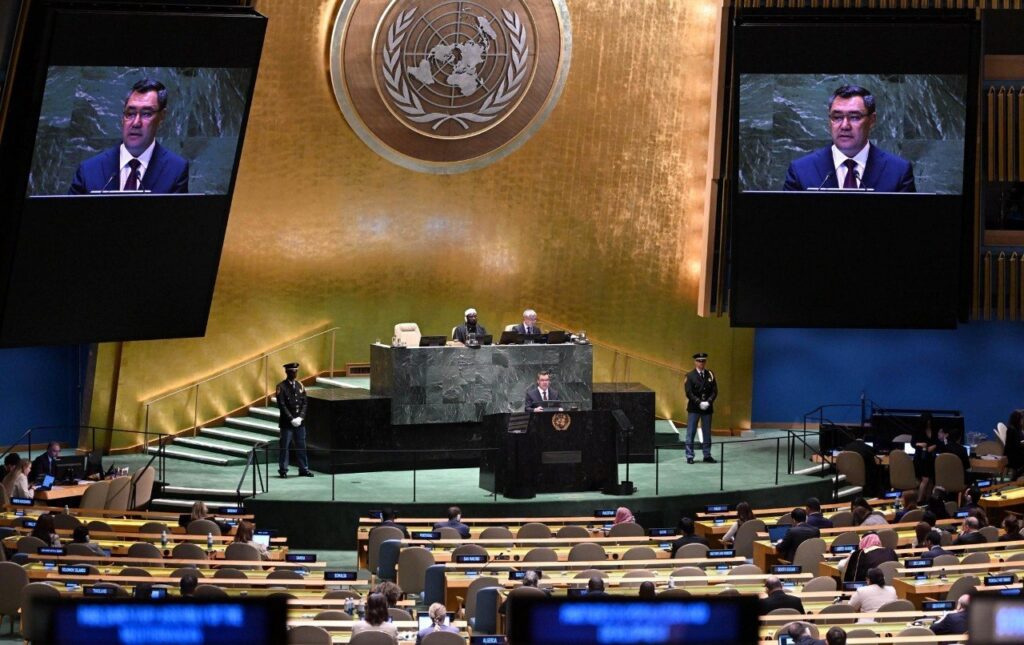
President Sadyr Japarov framed the bid as a question of representation. When Kyrgyzstan intensified its campaign in 2024, he drew attention to the number of UN member states that had never served on the Council and argued for broader representation, particularly for African countries. Bishkek also positioned itself as a voice for small, developing, landlocked, and mountainous states facing security, climate, and connectivity challenges.
That framing gave the vote wider political weight. Kyrgyzstan could not outspend larger states; it could not offer a large domestic market or a major security umbrella. But it could translate its limitations into a broader political language: underrepresentation, sovereign equality, regional balance, and the need for smaller states to have a voice in global decision-making.
The campaign also received visible regional backing. In December 2025, all five Central Asian presidents endorsed Kyrgyzstan’s candidacy, presenting the bid as a regional effort rather than a purely national one.
That was the first layer of the coalition. The second was broader.
In May 2026, the African Group at the United Nations received a dedicated briefing on Bishkek’s candidacy from Edil Baisalov, Kyrgyzstan’s newly appointed ambassador to the United States and a special envoy of the president. This followed Kyrgyzstan’s public support for wider African representation in the Security Council.
Because the UN ballot was secret, it would be impossible to claim that African votes delivered Kyrgyzstan’s victory. Nor would it be accurate to reduce the campaign to a simple exchange of support. But the African track was an observable part of a wider coalition strategy.
Bishkek aligned its own candidacy with an issue that mattered to a much larger group of states: the imbalance of representation inside the Security Council.
From Multivectorism to Coalition Brokerage
Central Asian foreign policy is often described through the language of multivectorism. The term usually refers to balancing among Russia, China, the West, Turkiye, and other external powers without becoming dependent on any single patron. It is useful, but it is no longer sufficient.
Kyrgyzstan’s Security Council campaign points to something more active. Bishkek did not merely balance among large powers. It tied Central Asian regional solidarity to wider arguments about small and landlocked states, developing countries, African underrepresentation, and demands for a more inclusive international order.
This was not passive balancing. It was active coalition-building.
A small state acts as a broker when it can translate its national interest into several political languages at once, without allowing any single patron to own the campaign.
That is what Kyrgyzstan achieved. It presented itself simultaneously as a Central Asian state, a landlocked mountainous country, a member of the Global South, a supporter of African representation, and a pragmatic actor able to engage across geopolitical divides. The campaign worked because these identities were not mutually exclusive. They overlapped.
The African Track
The result also gives more context to Kyrgyzstan’s recent outreach to Africa.
Earlier this year, Bishkek intensified engagement with African states, including the high-profile visit of Togo’s leader Faure Gnassingbé. That visit was easy to read as an isolated diplomatic curiosity, but the Security Council campaign suggests a broader pattern.
Smaller Central Asian states are not only looking vertically toward great powers. They are also building horizontal relationships with states in Africa, Latin America, the Middle East, and other parts of the Global South.
These relationships may be economic, logistical, diplomatic, or normative.
In economic terms, they can create new routes and markets. In diplomatic terms, they can create voting coalitions inside international organizations. In normative terms, they allow small states to position themselves around shared issues: representation, development, connectivity, sanctions exposure, climate vulnerability, or sovereign equality.
Kyrgyzstan’s Security Council bid demonstrates the diplomatic version of this horizontal agency.
Central Asian Agency Is Not Hierarchical
The Kyrgyz case also complicates a common simplification about Central Asia.
Regional agency is often measured hierarchically. Kazakhstan is treated as the primary regional actor because of its economy, energy resources, diplomatic visibility, and institutional weight. Uzbekistan is increasingly recognized for its population, reform trajectory, and central geographic position.
Those assessments are reasonable. But they are incomplete.
Agency is not concentrated in only one regional capital. It is distributed across arenas.
Kazakhstan may carry greater economic weight and play a larger role in energy, trade, and middle-power diplomacy. Uzbekistan may be the most important demographic and reform story in the region. But Kyrgyzstan has now demonstrated a separate competence: the ability to assemble support across regions in a competitive multilateral contest.
This suggests a more accurate way to read the region: influence is not held by one capital alone. Different Central Asian states can matter in different arenas.
Different states can become consequential in different fields.
A country that is small in GDP terms may still become important in corridor politics, multilateral diplomacy, water negotiations, digital governance, sanctions-era adaptation, or Global South coalition-building.
The Security Council vote makes that visible.
A Diplomatic Win, Not a Blank Check
A Security Council seat does not automatically give Kyrgyzstan major power.
Non-permanent members do not have veto rights. They must navigate conflicts shaped by larger states. Their room for maneuver is real but limited.
The practical test will begin in January 2027.
Kyrgyzstan will have to vote on sanctions, peacekeeping mandates, conflicts, humanitarian crises, and statements involving major powers. It will also hold the rotating presidency of the Council for one month during its two-year term.
The campaign demonstrated coalition-building skill. Membership will test whether Bishkek can convert that skill into a coherent diplomatic position.
The Real Question
Kyrgyzstan’s victory is significant because it challenges the standard way of looking at small states. The usual question is: Which great power is Kyrgyzstan moving closer to — Russia, China, the West, or Türkiye? But the Security Council campaign suggests that this may be the wrong question.
Kyrgyzstan did not choose one center of power – it worked across dividing lines.
It used regional solidarity without becoming only a regional candidate. It engaged the African Group without claiming to represent Africa. It appealed to small states without limiting itself to one institutional bloc. It positioned itself inside the Global South while maintaining pragmatic relations with larger powers.
This is more than multivectorism. It shows how a small state can gain room for maneuver by working across systems it does not control.
That may be the deeper meaning of Kyrgyzstan’s Security Council win. A small country did not become powerful in the conventional sense. But it demonstrated that diplomatic relevance can be assembled — one coalition, one constituency, and one overlapping political world at a time.