Kazakh scientists have developed BioDrop, a system in which drones scatter biodegradable capsules containing beneficial insects over fields to combat agricultural pests. According to the Ministry of Agriculture, tests showed that the treatment takes several times less time than manually releasing entomophagous insects, while biological control effectiveness reaches 81%-83%. The technology is already being used by four farms.
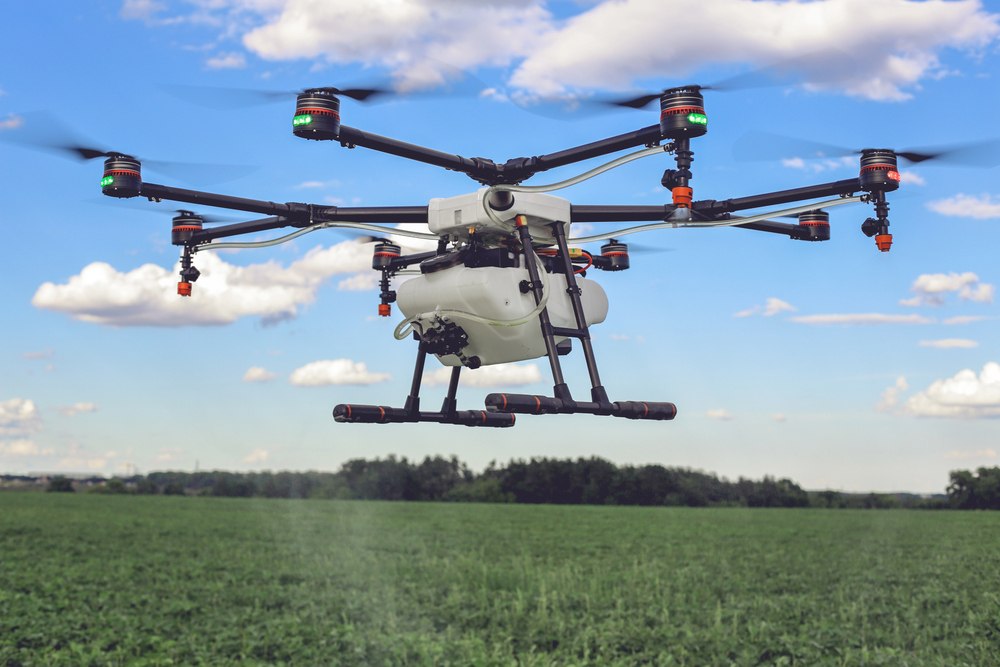
The system was developed by specialists at the Zhazken Zhiyembayev Kazakh Research Institute of Plant Protection and Quarantine. It consists of a drone, an automated dispensing device, and biodegradable spherical capsules.
Inside the capsules are entomophagous insects — natural enemies of agricultural pests. BioDrop uses Trichogramma, microscopic parasitoid wasps that attack pest eggs, and Habrobracon hebetor, which targets pest larvae. The insects pose no danger to people or plants.
The drone follows a predetermined route across a field and automatically releases the capsules. Their design protects the biological material when they land, after which the insects emerge and begin searching for pests.
According to the Ministry of Agriculture, 14 days after entomophagous insects were released manually, biological control effectiveness stood at 70%-73%. BioDrop achieved 81%-83%. Treating the experimental plot manually took 1-1.5 hours, while the drone completed the same work in 10-15 minutes, including equipment preparation.
The Kazakh system follows an increasingly visible international trend in agriculture. Researchers in China previously developed an automated drone-based system for releasing Trichogramma. In field trials, it achieved more than 99% effective coverage of the target area and an average pest-control effectiveness of about 84%.
Similar experiments have been conducted in Canada, where drones were used to release Trichogramma against pests affecting corn and forests. Researchers noted that traditional manual placement of biological control agents is time-consuming, while aerial application can be expensive.
Kazakhstan has also been testing drones for biological crop protection for several years. Researchers from the same institute have used biological preparations on several crops and UAVs to release entomophagous insects against cotton bollworm. The Food and Agriculture Organization of the United Nations (FAO) has included this work in its repository of green agriculture practices. The FAO says UAV releases achieved biological effectiveness of 70% against the second generation of cotton bollworm and 82.6% against the third.
BioDrop develops this work into an integrated delivery system. A study by Kazakh researchers published in June 2026 describes biodegradable capsules produced using 3D printing and field trials in which biological effectiveness ranged from 69.5% to 82.8%.
Practical use of BioDrop is still limited to four farms. The ministry has not provided details about the scale of its use on those farms, leaving its performance over larger commercial areas unclear.
Drones are already being used in Kazakhstan’s agriculture to monitor soil and crop conditions. In the East Kazakhstan Region, researchers are combining drone imagery with artificial intelligence to assess fields and plan agricultural operations.