How does an artist born in a remote village in Kazakhstan become one of the country’s most recognized artists? “I realised that if I put in the work, I can achieve everything,” says Batima Zaurbekova, a pioneer of Kazakh tapestry, as she walks through Threads of Heritage at the Abylkhan Kasteyev National Museum of Arts in Almaty. The exhibition runs from September 25 to November 8, 2026.
An energetic lady with a strong personality and a playful attitude, Zaurbekova is the subject of a retrospective marking her 80th birthday and consecrating a lifetime of artistic production, at a time when Kazakhstan, event after event, is gaining ever greater international cultural recognition.
Video: TCA. Narration: Naima Morelli.
It is indeed a momentous time to be in the art world in Kazakhstan. At the forefront of the discourses on de-coloniality in the arts, and among those contributing to a new canon of contemporary art, Kazakh artists like Zaurbekova embody what is truest to their culture and local specificity, letting it flow in the global discourse.
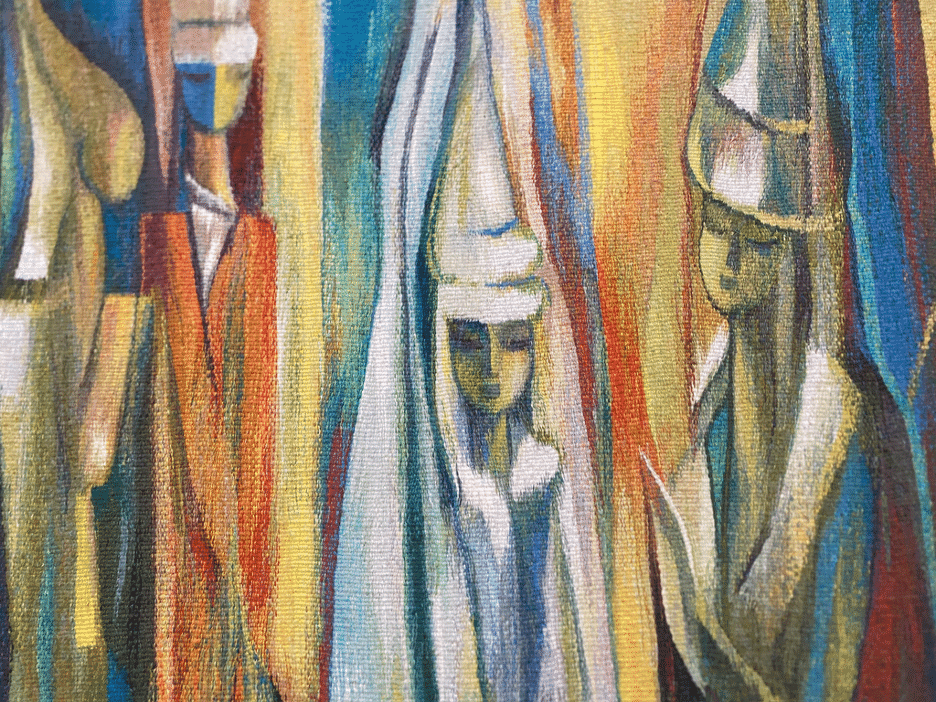
Detail of Batima Zaurbekova’s The Bride’s Farewell (2003). Credit: Naima Morelli.
The passion with which Zaurbekova describes even the smallest technical details reveals her deep love for weaving. That devotion is also a political stance in the face of the Western canon of art history. The reclamation of an art canon which would belong to Central Asia started in the second half of the 20th century, when artists worldwide challenged the relegation of textiles to the category of craft.
Starting from the very local arts of felt and weaving, and against the canon of Soviet painting, a generation of artists recovered something that was truly theirs and called it by its name: not simply craft, but art in its own right, with Zaurbekova at the heart of that movement.
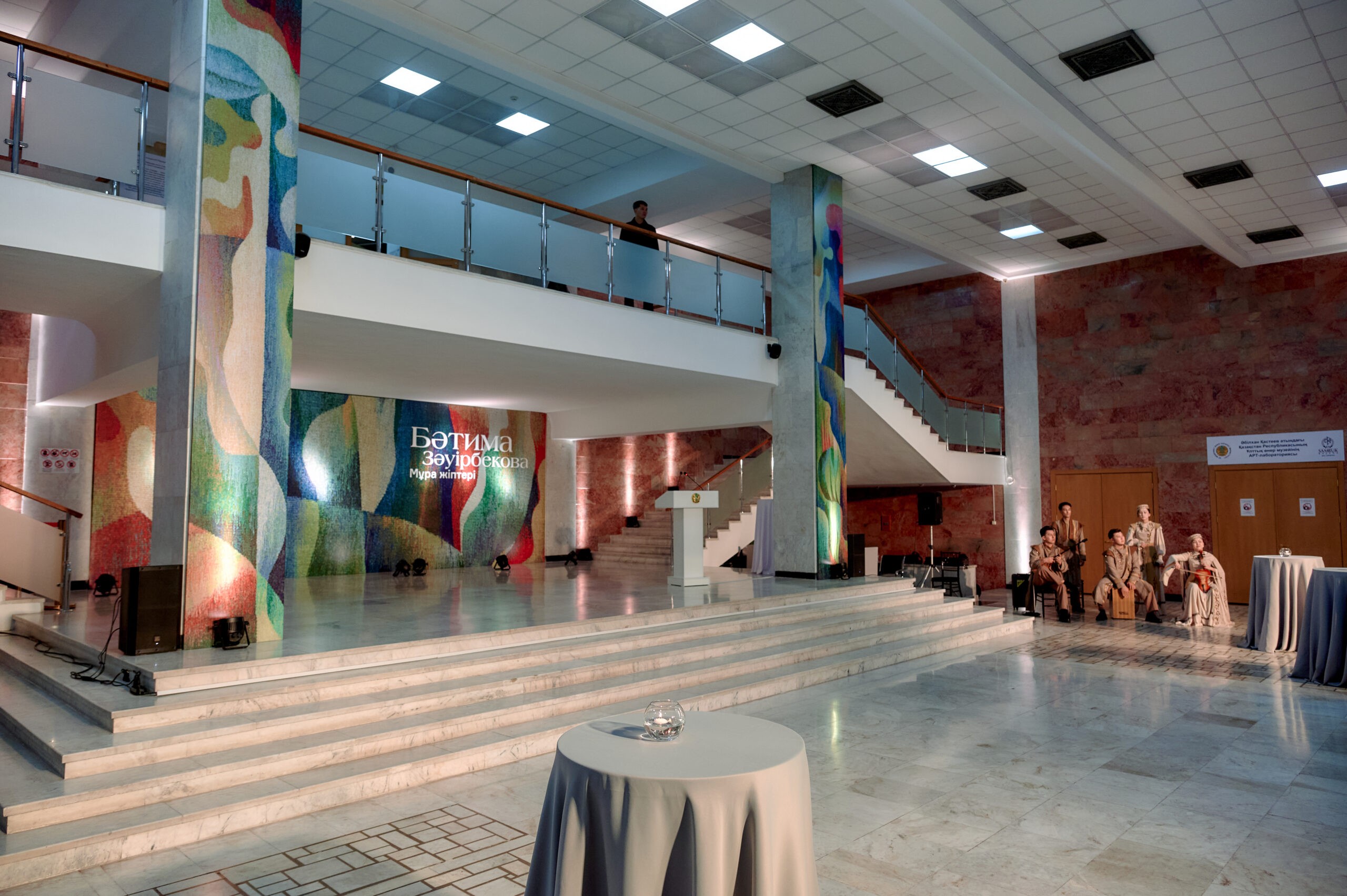
Entrance display for Threads of Heritage at the Abylkhan Kasteyev National Museum of Arts in Almaty. Credit: Kirill Fedorov.
A matriarchal line
While today biennales and fair around the world look for those artists whose cultural background is legible in their art, it wasn’t always like that. When Zaurbekova began weaving in the late 1960s, her teachers strongly discouraged her from devoting herself to weaving.
Her teachers, many of whom had trained in Leningrad and Moscow, saw her as a painter, at a time when textiles were still considered a “lower” type of art, and far too slow and demanding. “I’d spend fifteen hours every day for days on end working on just one tapestry, and my teachers would tell me: ‘It’s so slow! In the same amount of time you could have painted three paintings already!” she tells me, laughing. They used to scold her with a Kazakh saying for it: “You’re digging a huge well with a small needle.”
Zaurbekova was born in 1946 in Furmanovka, in the Moiynkum district of the Jambyl region, and grew up in Merke, where her family moved when she was in fifth grade. Her mother, Bibikhan, was a gifted craftswoman who wove carpets and sewed dresses and national costumes in vivid colours, and she introduced her daughter to needlework early on.
As a child, Zaurbekova played the bayan, a button accordion, and dreamed of becoming a composer. She still puts on music before starting work, and her works have a musicality and a rhythm to them. It was her mother who steered her toward the visual arts, after spotting a celebrated woman artist in a magazine she subscribed to. “Look at this artist, she’s so beautiful,” her mother told her. “I want you to be an artist as well.”
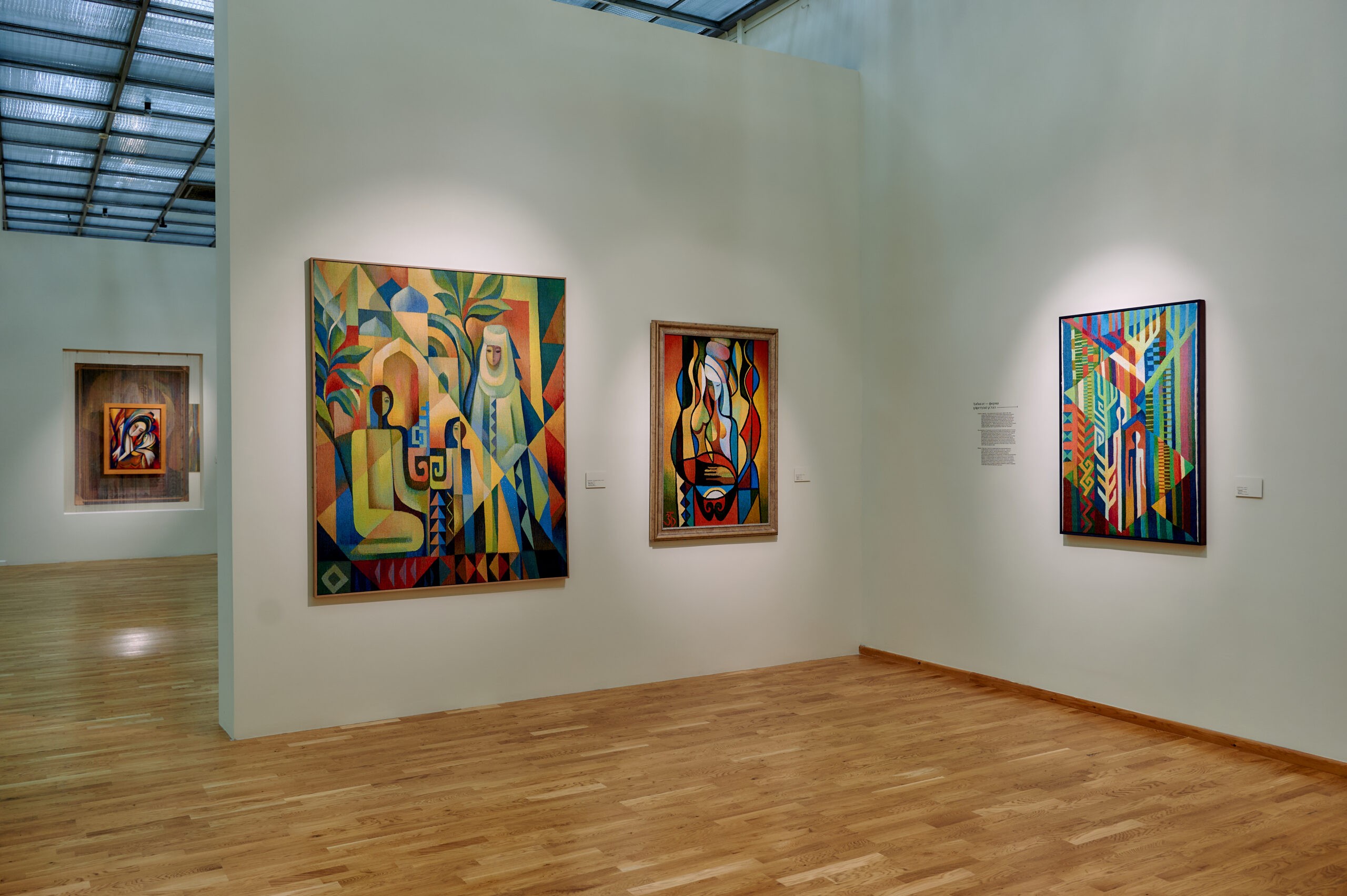
Entrance display for Threads of Heritage at the Abylkhan Kasteyev National Museum of Arts in Almaty. Credit: Kirill Fedorov.
It was unusual in 1964 for a young woman to hop on a train to go from a small village to the big city, but that’s what Zaurbekova did: “No one was free on that day to come with me, so they just gave me a suitcase and put me on a train to Almaty, all by myself, to become an artist.”
She enrolled in the decorative arts department of the Alma-Ata Art School, today the Oral Tansykbayev Almaty College of Decorative and Applied Arts, graduating in 1969. “In my hometown there was no studio where you could practise art,” she says. “The other kids came from the city, and they were so confident sitting there painting. I looked at them, and I felt a bit inexperienced. I was really scared, asking myself what I was doing there.”
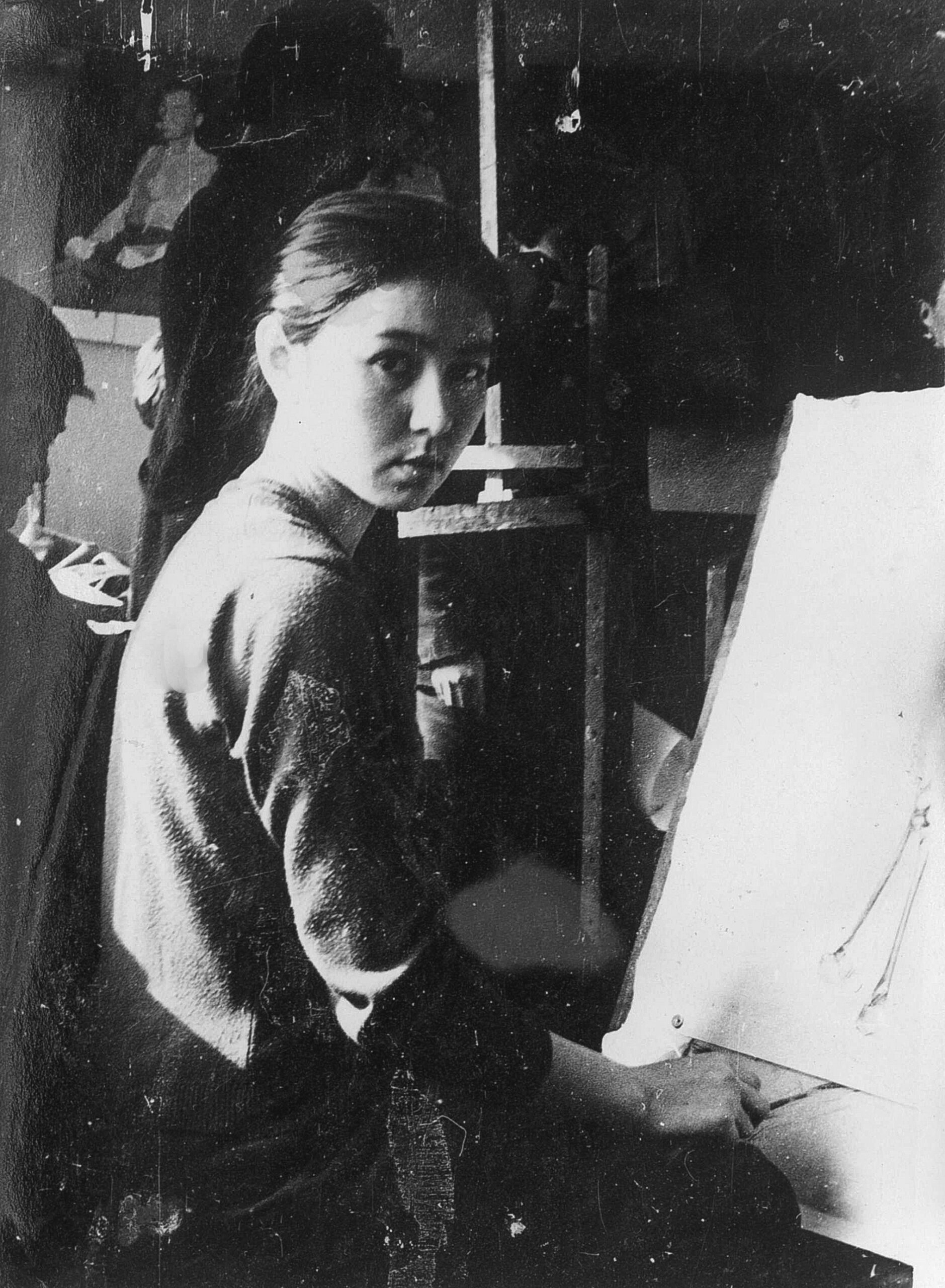
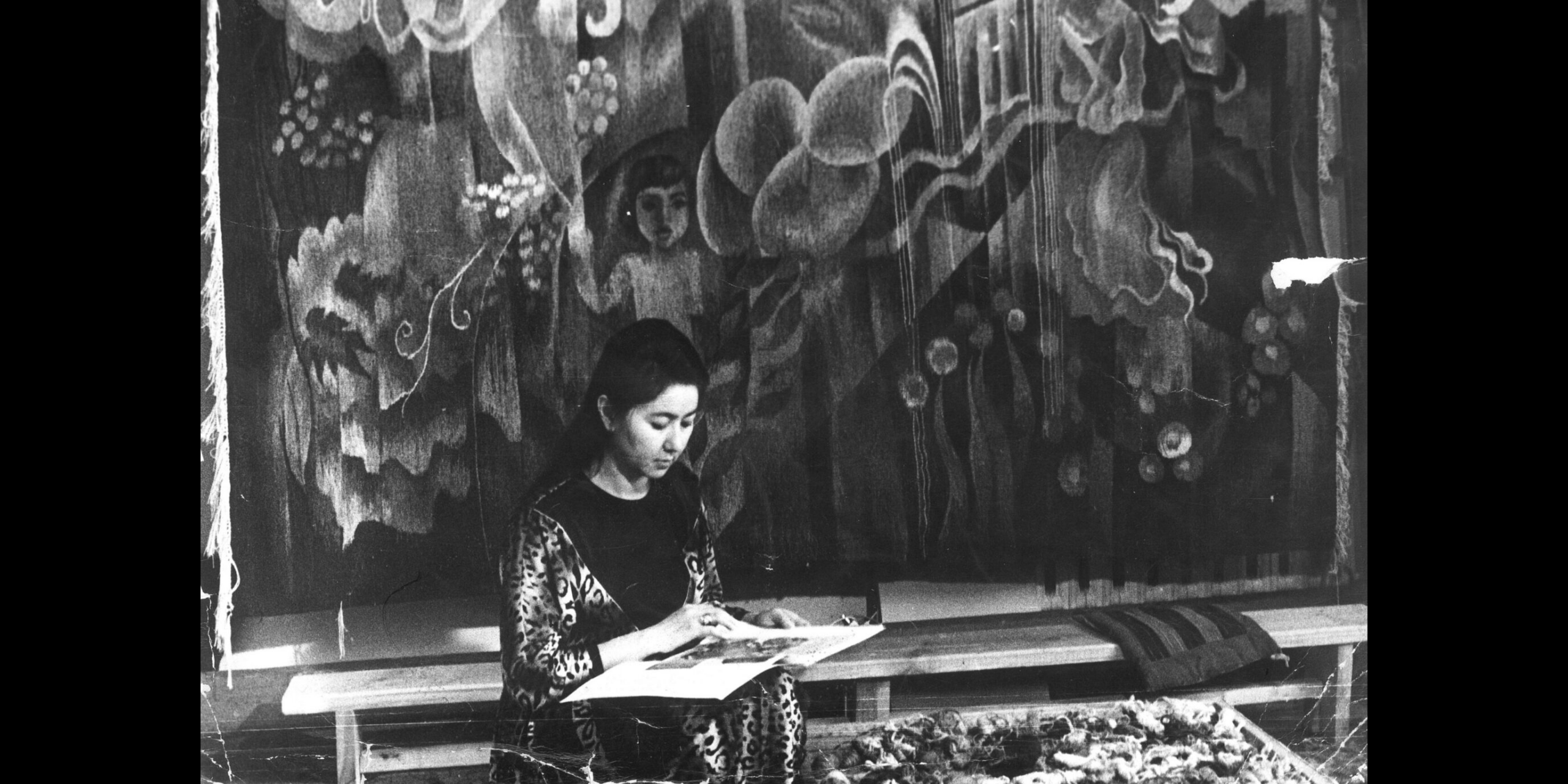
Batima Zaurbekova at her easel during her studies at the Alma-Ata Art School in the 1960s. Courtesy of the artist.
Her answer was work. “I realised that in order to reach their level, I had to put in the hours, and I spent day and night at the studio, working and working, because I wanted to improve quickly,” she says. Encouraged by her teachers, at the end of the first semester she had already caught up with her fellow students.
After graduating, she took a job at a state art workshop producing commissioned works, although her ambition was to participate in proper exhibitions. “But I had to make a living as an artist, so at the time I had no choice.”
When Kurasbek Tynybekov, the founding figure of Kazakh tapestry, saw her sketches, he was captivated and took her under his wing. “He taught me how to select the thread, how to weave it in a frame that he constructed for me.”
Zaurbekova works mainly in traditional flat-woven Gobelin, a form of tapestry densely woven on a vertical loom. “Because I have a foundation as a painter, my tapestry work reflects that, especially in the way I use colour and shades.” The difference from painting lies in the pace and the margin for error. “It takes a lot of time, and it’s very meticulous work. You cannot make any mistakes. If you do any, you can’t go back,” she says. “It is a different approach, but I still approach textile as I approach painting.”
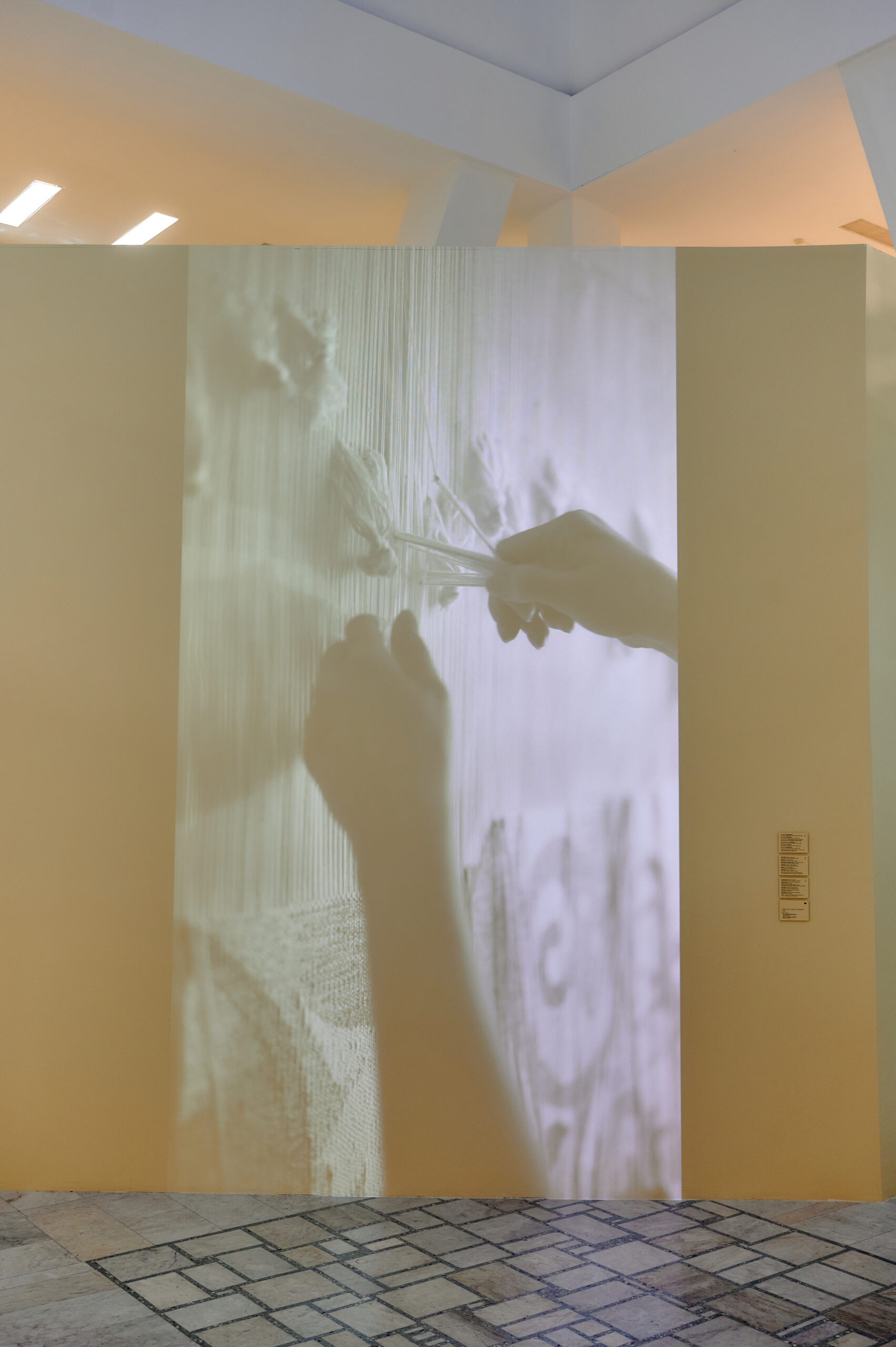
Documentary footage of Zaurbekova weaving, projected as part of Threads of Heritage. Credit: Kirill Fedorov.
As her success as an artist grew, she joined Tynybekov, Irina Yarema and Yelena Nikolayeva in a group of four. “We kept working together, and we kept receiving commissions,” she says. Among these is the monumental tapestry Rainbow (1977–79), for the Hotel Kazakhstan in Almaty, which earned her the Kazakh SSR’s Shokan Valikhanov State Prize in 1980.
Threads of Heritage
Curated by Alina Fedorovich, the show Threads of Heritage gathers more than 80 tapestries, paintings, sketches and archival materials across three halls of the museum, which marked its 90th anniversary in 2025 and reopened in January 2026 after renovations.
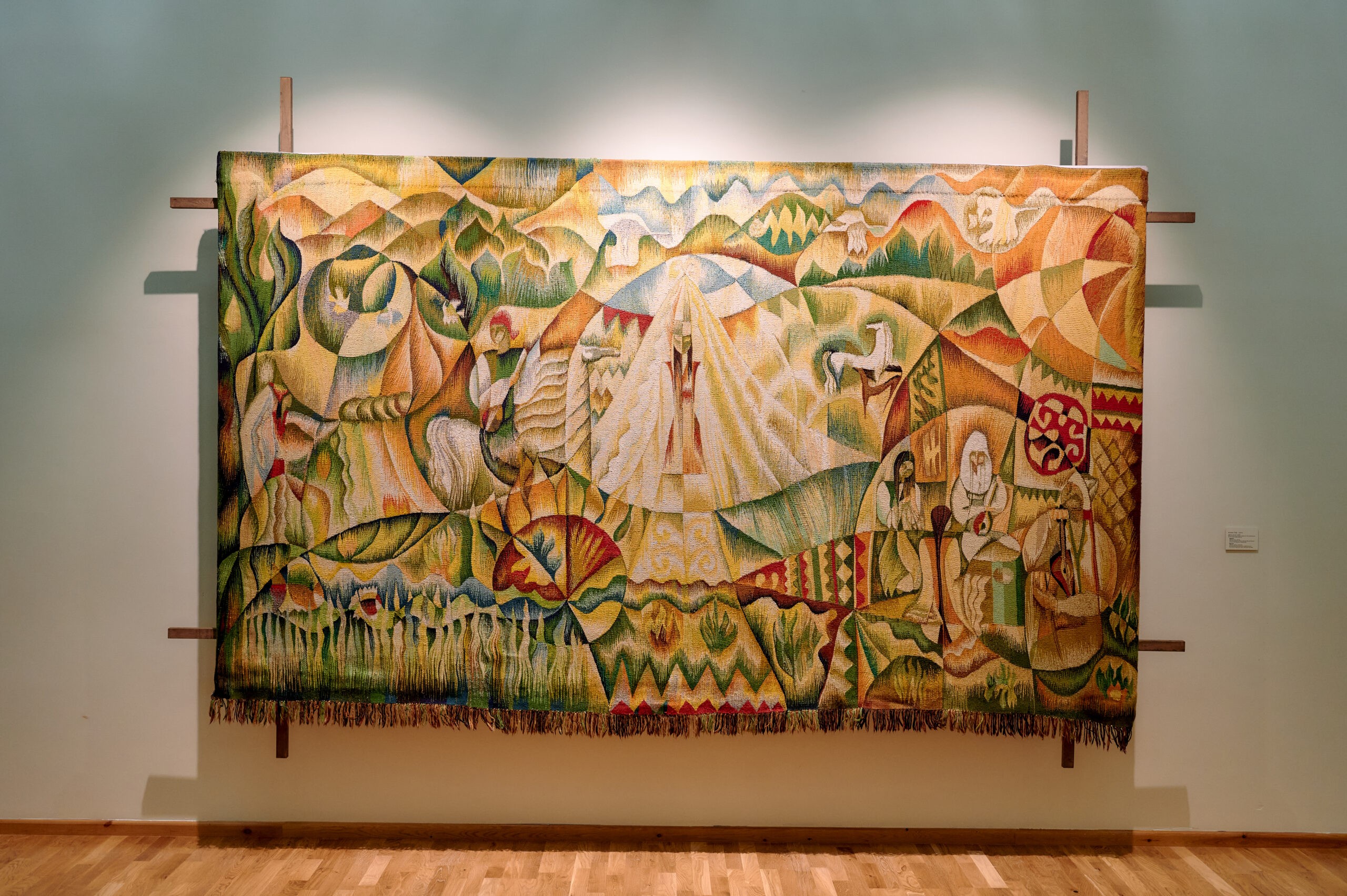
Batima Zaurbekova’s Melody (1976), on display at Threads of Heritage. Credit: Kirill Fedorov.
The show is in line with what museums, from the Louvre Abu Dhabi and the forthcoming Guggenheim Abu Dhabi to the National Gallery Singapore and, closer to home, the Almaty Museum of Arts, are doing: rewriting narratives to include artists from beyond the Euro-American centre.
The show opens in the museum’s first room, dedicated to traditional Kazakh tapestry, introducing Zaurbekova’s lineage. The exhibition pavilion evokes the Yasawi mausoleum, a monumental UNESCO World Heritage Site in the city of Turkestan in southern Kazakhstan, a recurring image in her work.
The central hall groups her works by theme in an open layout. The soundtrack is a curatorial choice in its own right: Arnold Schoenberg’s Six Little Piano Pieces, Op. 19, in Glenn Gould’s recording, suits a body of work so attuned to rhythm.
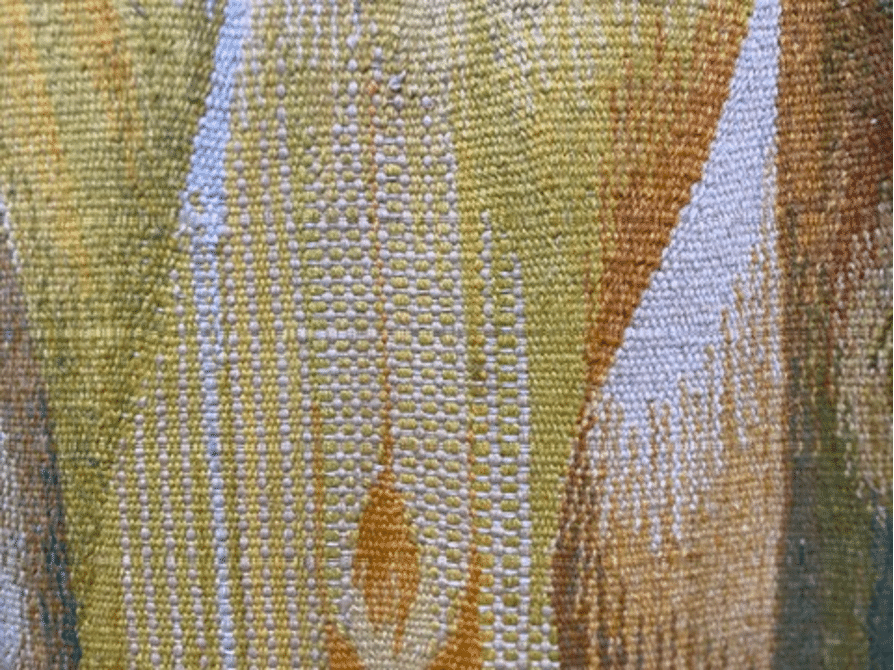
Detail of Batima Zaurbekova’s Madonna of the Steppe (1980), showing its intricate woven texture. Credit: Naima Morelli.
From a distance, her tapestries look remarkably like modernist paintings. Geometric areas of colour converse like the panels of a comic strip, and recurring rounded forms are at once symbols and landscapes: the earth, a field, a bounded plot.
Up close, a whole world of colour opens up. Each shade breaks down, like fine rain, into tiny points of thread that read almost as pixels. The works shouldn’t be touched, yet they are almost insistently tactile.
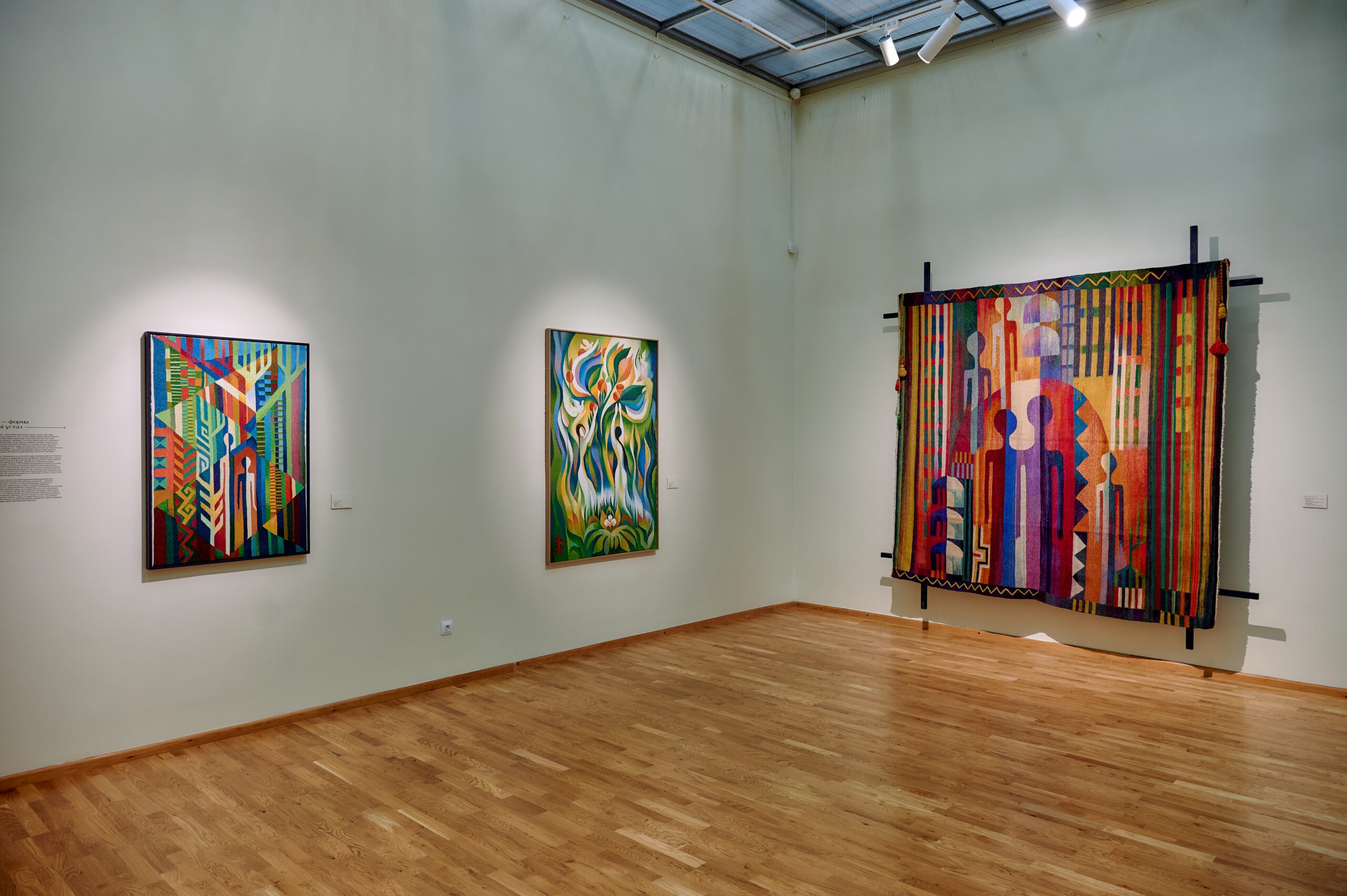
Tapestries by Batima Zaurbekova on display at Threads of Heritage. Credit: Kirill Fedorov.
Tapestries by Batima Zaurbekova on display at Threads of Heritage. Credit: Kirill Fedorov.
In the 1980s, Zaurbekova moved to monumental formats, and her language became more symbolic, drawing on nomadic heritage, ceremonial imagery and ancient rock carvings, particularly the Bronze Age petroglyphs of Tamgaly, near Almaty. Mother Earth (1984), among the decade’s most impressive works, shows how restless her approach was: technique, composition, even borders never repeat.
Archaeology remains a source. In Voices of the Ages, series I & II (2017), she returns to prehistoric rock art, and its abstract figures speak as if the ancient and the modern shared a language.
In the 1990s, the decade of Kazakhstan’s independence, she wove a series devoted to the Silk Road, especially to the aforementioned mausoleum of the Sufi poet Khoja Ahmed Yasawi.
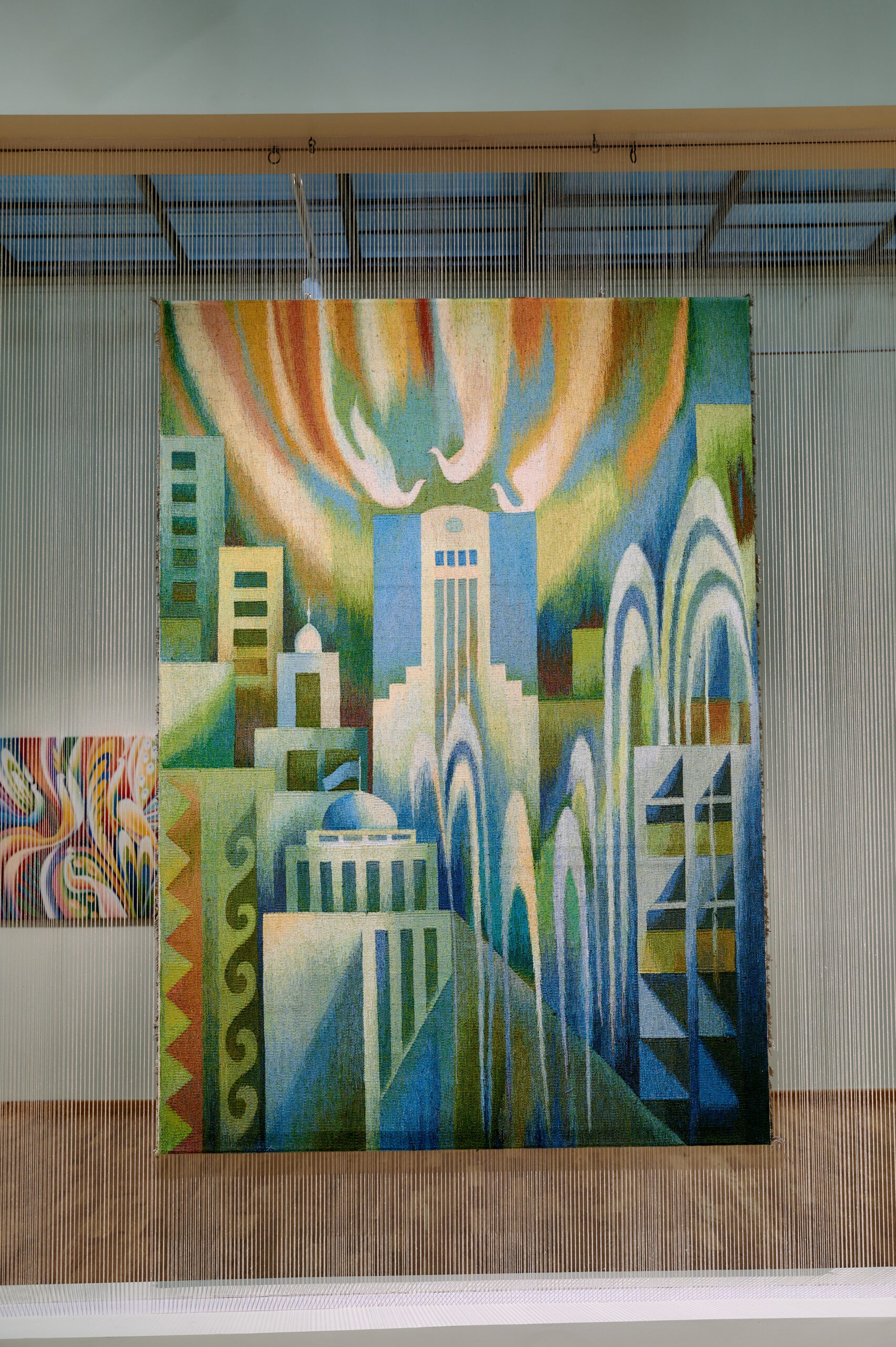
Batima Zaurbekova’s Astana (2006). Credit: Kirill Fedorov.
Contemporary subjects sit alongside them. Astana (2006) shows the capital with three doves hovering above it.
The skyscrapers become abstract geometric shapes rising like the jets of a fountain: tradition and modernity meet in a spiritual image. Her mountains around Almaty are transformed the same way, through an essentially musical sensibility, reminiscent of her childhood dream of being a musician.
The final gallery is devoted to her vision of womanhood. At its centre hangs a shanyrak, the crown of the Kazakh yurt, surrounded by portraits of women in national costume. The Bride’s Farewell (2003) shows a bride being dressed by friends and family before her wedding.
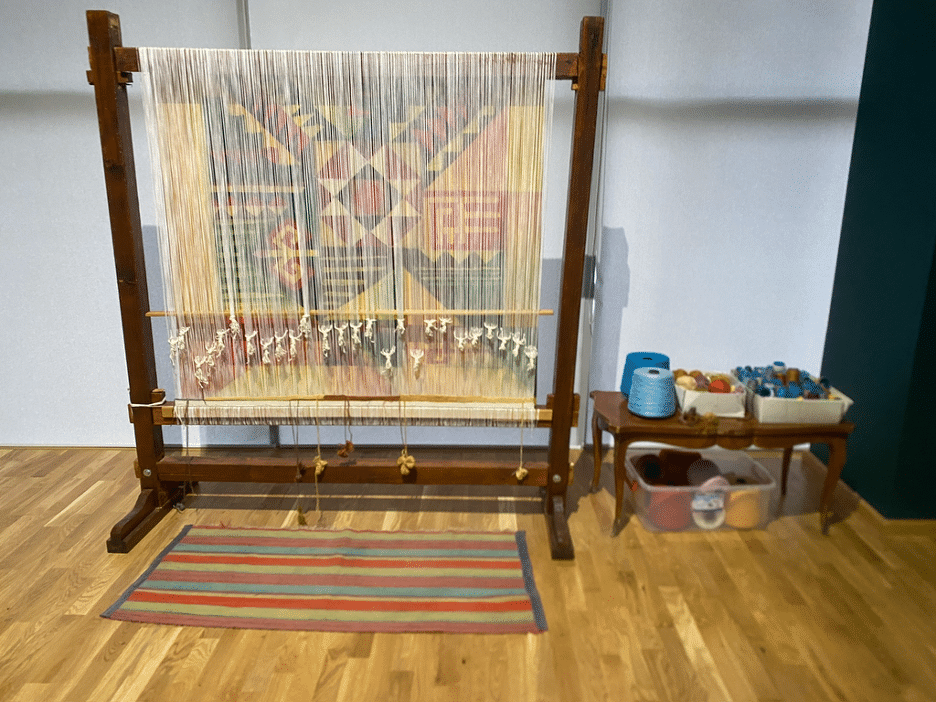
Batima Zaurbekova’s loom on display at Threads of Heritage. Credit: Naima Morelli.
Zaurbekova’s women move within a traditional destiny, yet are no less fierce for it. In Girl with a Bird (2002), the birds are white doves, their shapes flickering almost like flames.
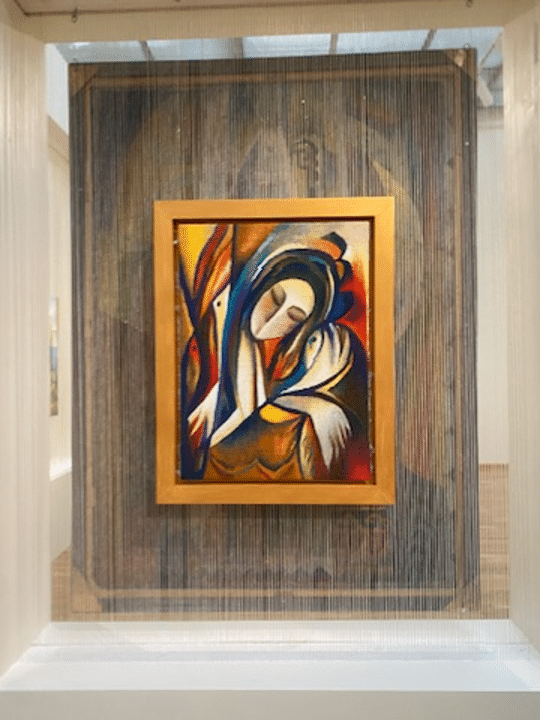
Batima Zaurbekova’s Girl with a Bird (2002). Credit: Naima Morelli.
Some tapestries break out of the flat plane and move toward sculpture. In Madonna of the Steppe (1980), a monumental piece from the Kasteyev collection, the lower edge is braided, and the threads hang loose in all their colours, revealing the magic trick. A film of the artist at the loom, archival photographs and an actual working loom where visitors can try weaving complete the show. Threads of Heritage shows an artist who was ahead of her time, and fully of it.
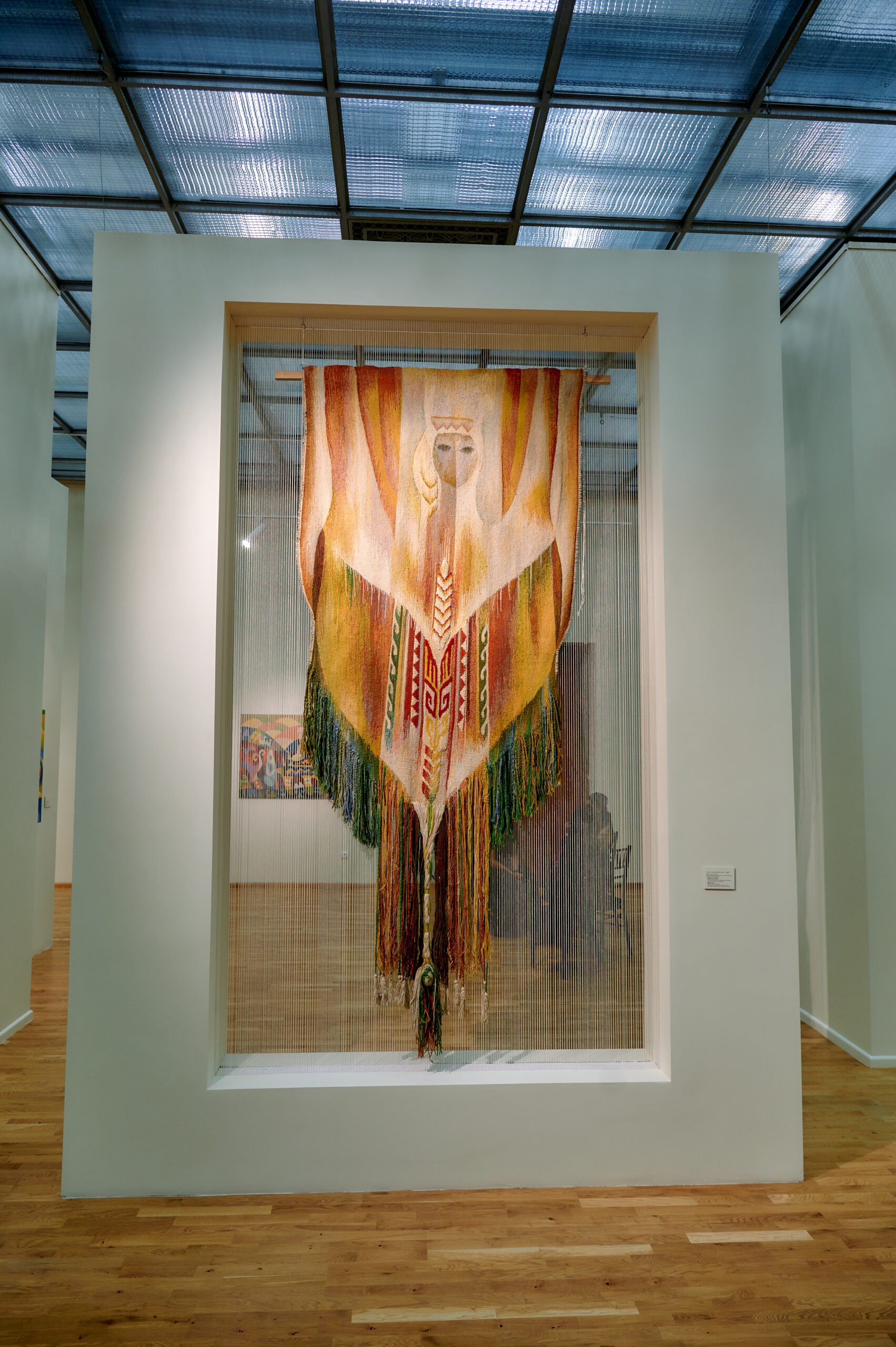
Batima Zaurbekova’s Madonna of the Steppe (1980), with its braided lower edge and hanging threads. Credit: Kirill Fedorov.
One colour keeps surfacing: a bright yellow pushed toward green, woven with minute precision into other shades. “It’s about knowing what colours fit together; that’s the whole point,” Zaurbekova says. “The colour can reflect everything: your soul, how you feel.” You leave the exhibition with shades of emotion you can now see and name. All beautifully woven together.
For more information about Batima Zaurbekova and her work, visit batima.art