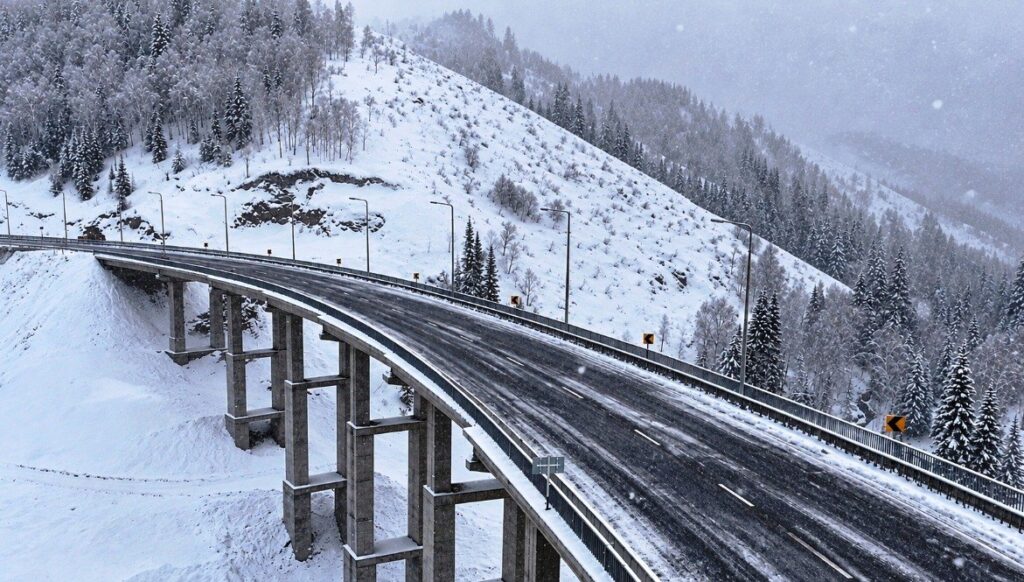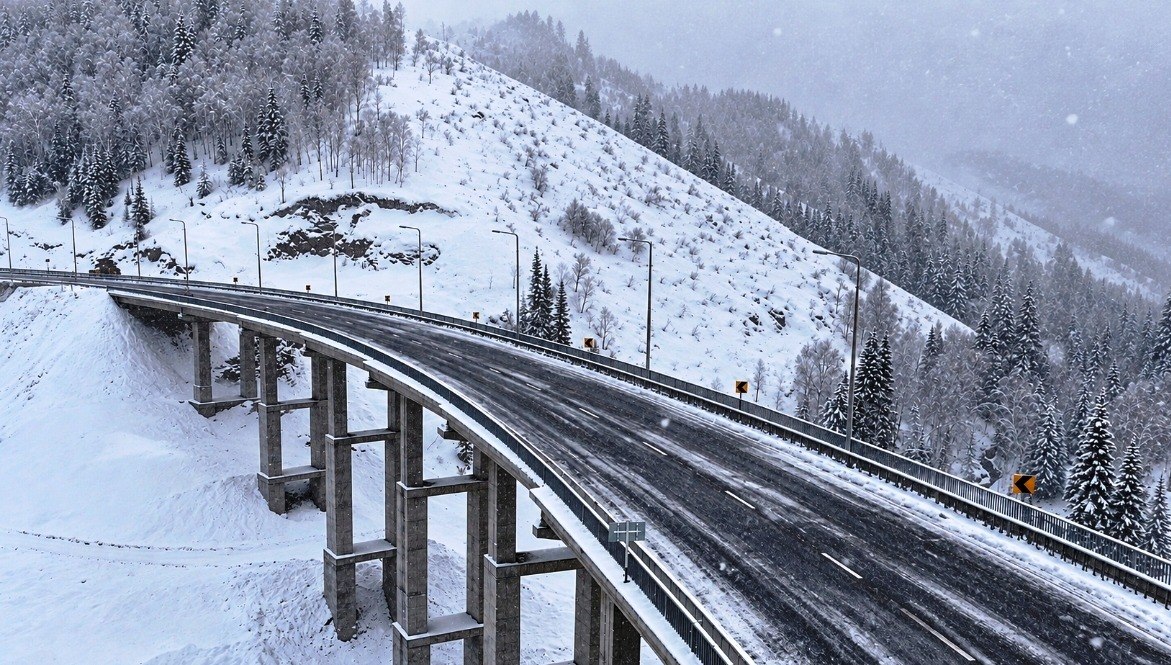
A new road bypassing the Osinovsky Pass in eastern Kazakhstan opened to traffic on October 30, offering motorists an alternative to a route frequently subject to winter travel restrictions. The bypass’s centerpiece is a 175-meter bridge across the Pikhtovka River, rising up to 45 meters above a gorge. The construction and reconstruction project is valued at 20.9 billion tenge, approximately $46 million.
The new bypass, approximately 12 kilometers long, allows motorists to avoid a dangerous winding section of the highway from Oskemen (Ust-Kamenogorsk), the administrative center of the East Kazakhstan region, toward Altai and Katon-Karagay. It forms part of a 28-kilometer section where the main reconstruction work has been completed.
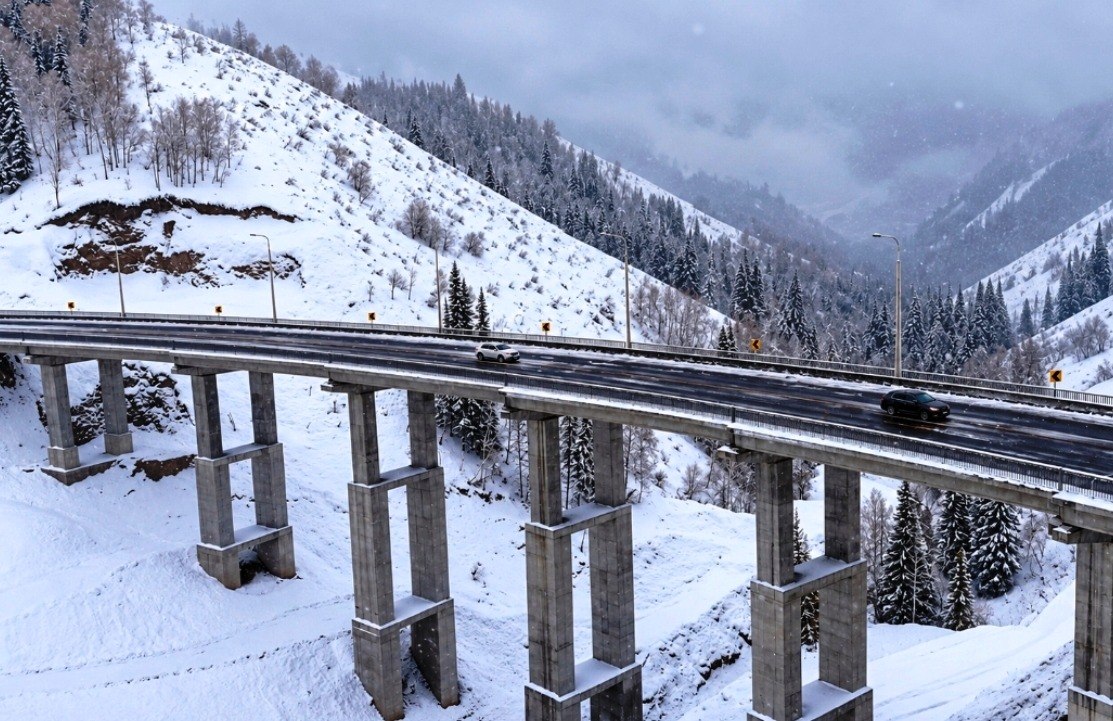
The previous route ran along a narrow mountain road with sharp turns. Built in the 1940s, it was closed to trucks with trailers and semitrailers during winter. Snowstorms and avalanche prevention operations could lead to complete road closures, while rockfalls posed a danger in summer.
Darkhan Imanashev, chairman of the national road company KazAvtoZhol, told journalists that the bypass shortens the journey and would allow trucks to use the route in winter.
The new road is 13 meters wide, compared with approximately six meters on the previous section. The extra width will make it easier for large vehicles traveling in opposite directions to pass each other.
The bridge follows a curved alignment designed to accommodate the mountainous terrain. It has seven spans and eight supports, with 79 reinforced concrete beams installed across the structure.
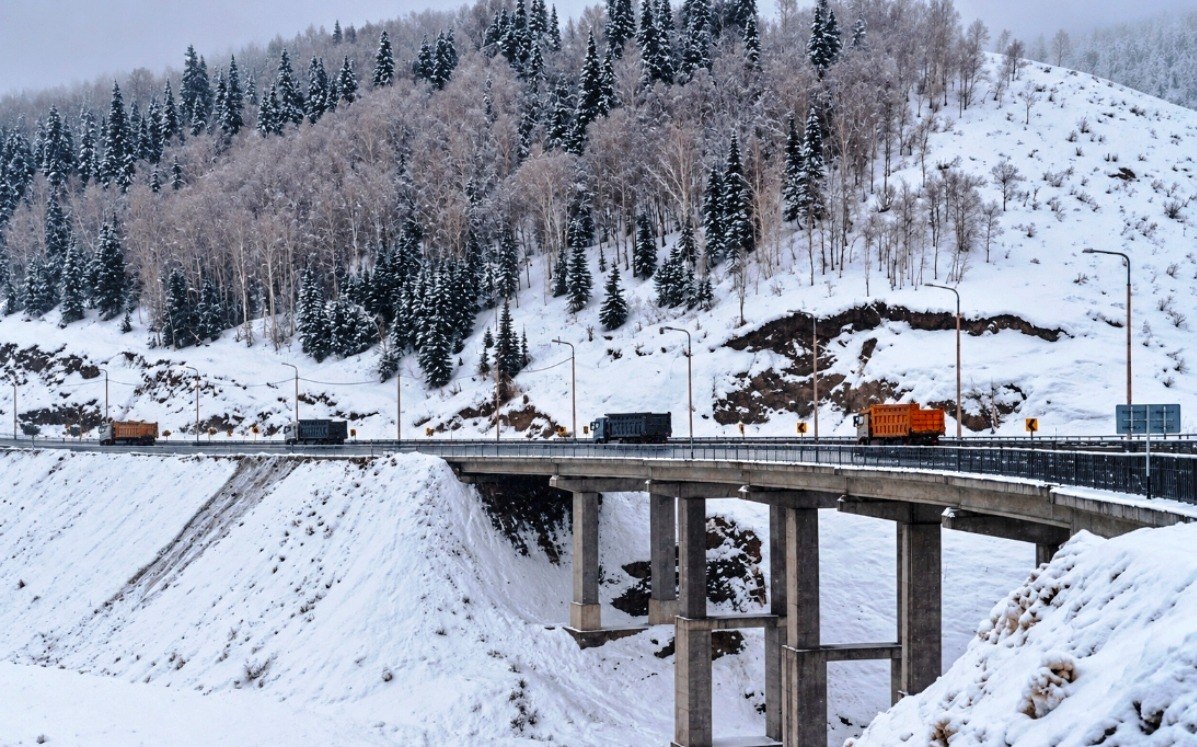
Construction work along the route began in 2017. The project was repeatedly delayed, with work suspended over land-use issues before resuming in 2023. Previous contractors also failed to complete the project, leading to legal disputes, Imanashev told Ulysmedia.kz. Crews had to cut a road through rocky terrain, prepare sites for heavy machinery, and transport materials along temporary dirt access roads. These routes often became difficult to navigate after rainfall.
Nigmatulla Abdulkhakov, deputy director for bridge construction at contractor OblShygysZhol, described the scale of the excavation work beneath the bridge.
“The mountainous terrain here is extremely challenging. We had to move around 100,000 cubic meters of earth just beneath the bridge. This involved excavating foundation pits, removing soil, backfilling, and preparing foundations for the supports. We also had to create special platforms to install the structures, then clear those areas to prepare for the next stages of construction,” Abdulkhakov explained.
Engineers considered filling the gorge with an earth embankment instead of building a bridge. According to Abdulkhakov, that option would have required moving several million cubic meters of earth. It would also have involved installing a drainage culvert several hundred meters long beneath the embankment.
“The question immediately arose of how such a culvert would be maintained and cleaned. That is why building a bridge proved to be the best option. Yes, it was a complex project that required considerable effort, but we managed to complete it,” Abdulkhakov said.
The final bridge span was installed on September 20, followed by concreting and road paving. According to the contractor’s representative, teams worked in two shifts, almost around the clock, to open the road before winter.
During reconstruction of the 28-kilometer section, crews moved 545,000 cubic meters of earth and carried out drilling and blasting work totaling 603,000 cubic meters. In addition to the Pikhtovka bridge, another bridge and 38 culverts were built, including two livestock crossings.
Road authorities said some work would continue after the opening. In the days beforehand, crews were still installing guardrails and road signs along certain sections.
The old winding road will remain open as a secondary route.
The new highway provides access to Katon-Karagay National Park, one of Kazakhstan’s largest protected natural areas, located in the Kazakh section of the Altai Mountains near the borders with Russia and China. The same route leads to Rakhmanov Springs, a mountain resort known for its thermal mineral waters.
For residents of remote districts, the road promises more reliable access to Oskemen, especially in winter. For tourists, the new route makes the Altai’s natural attractions easier to reach, although mountain weather can still disrupt travel.