London-listed Ferro-Alloy Resources (FAR) is developing a large vanadium deposit in Kazakhstan, as The Times of Central Asia reported in July, and operates a smaller concentrate-processing plant that recovers vanadium, molybdenum and nickel from purchased concentrates. The project could supply growing markets for vanadium and other critical materials.
Beyond its core business, FAR has found additional value in by-products already present in the ore. These include its proprietary Carbon Black Substitute (CBS), a rubber-reinforcing filler that the company says is commercially viable, as well as uranium and rare earth minerals, which are not yet in the project economics and could add to future earnings if they prove profitable.
Nicholas Bridgen, FAR’s CEO until October 26 and now its non-executive deputy chairman, told TCA: “Our ore gives us multiple sources of revenue. The vanadium pays for the mine and much else, while the carbon and silica left behind, not to mention rare earth metals, become products in their own right.”
At an 8% post-tax discount rate, FAR’s Phase 1 delivers a $748 million net present value (NPV) and a 22% internal rate of return (IRR), the company reports, rising to US$931.6 million and 31% on lower capex (November 2025). These figures already include the original CBS, made from vanadium-plant tailings; FAR’s New CBS, made from waste rock, is excluded and would be additional.
Rubber manufacturers represent 93% of carbon black demand, making them a potential market for CBS. FAR estimates that the product could sell for about 60–74% less than the conventional carbon black prices cited below and have approximately 90% lower production emissions.
Carbon black
Carbon black is a reinforcing filler found in most rubber goods, including tires, hoses, conveyor belts, and shoe soles. Its primary particles, only tens of nanometers wide, fuse into aggregates with very high surface area, and rubber chains attach to that surface through both physical and chemical bonds. This makes the rubber stronger, harder, and more resistant to wear. Amorphous silica performs a comparable role, with its surface silanol groups linked to the rubber by silane coupling agents, and it is frequently used alongside carbon black.
Unlike graphite, a naturally occurring, highly ordered crystalline carbon prized for conductivity, lubrication and batteries, carbon black is an engineered, near-spherical amorphous carbon made in a furnace for rubber reinforcement.
The global carbon black market stood at 15.15 million tonnes in 2025 and is forecast to reach 21.83 million tonnes by 2034, expanding at a CAGR of 4.14%. Rising demand for tires and automotive products is driving much of the growth.
Why it is costly
Barry Angeline, chemical engineer and polymer physicist, explains that “more than 95% of carbon black is manufactured through the oil-furnace process, which heats and decomposes hydrocarbon feedstocks at high temperatures. The resulting microscopic carbon particles,” he continued, “are quenched, separated from exhaust gases, then processed into pellets for use primarily as a reinforcing agent in rubber. Roughly 1.5 tonnes of fossil feedstock is consumed per tonne of carbon black, and 2.5 tonnes or more of CO2 is emitted, alongside sulfur dioxide, nitrogen oxides, and particulates in the tail gas.”
Crude-linked carbon black feedstock faces continued price volatility and upward pressure as geopolitical instability disrupts markets. ChemAnalyst reports North American carbon black averaged about US$1,639/tonne in Q3 2026; its September 2026 general U.S. carbon black index was around US$1,880/tonne. These prices are not specific to N550, an industrial-grade carbon black used primarily to reinforce rubber.
How CBS is made
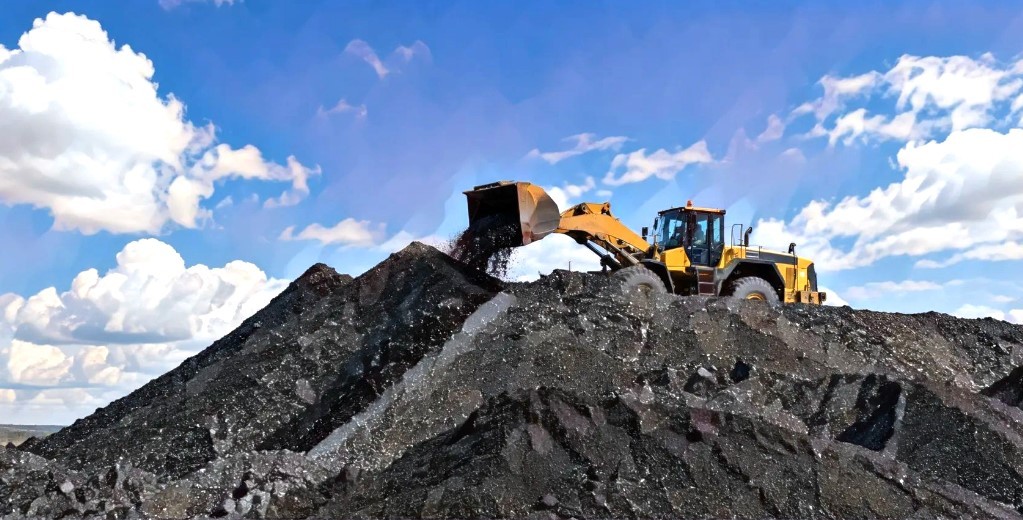
FAR’s deposit contains vanadium, other metals, and more than 8% carbon derived from organic matter deposited roughly 500 million years ago. Geological heat and pressure transformed the material into amorphous carbon resembling carbon black.
Under FAR’s proposed full-scale process, the ore would be crushed and milled, then leached to recover vanadium and other metals for sale. The remaining residue would consist mainly of carbon and amorphous silica, the two valuable fillers used in rubber compounds. FAR would then concentrate the carbon and mill the material finely to a particle size suited to rubber, producing its CBS, which is designed to replace both conventional carbon black and amorphous silica.
Tested, with supply planned
In 2024, FAR commissioned Smithers, a global rubber consultancy, to test CBS in rubber compounds. Rubber made with 90% carbon black and 10% CBS performed as well as rubber made with 100% carbon black for passenger vehicle tires. Earlier work indicated inclusion rates of up to about 20% of N550. In January 2026, FAR signed a non-binding memorandum of understanding with Qingdao Master Tyre for up to 360,000 tonnes a year of New CBS, a product not included in the feasibility study; the parties aim to agree a binding contract within three years.
Supply is backed by a completed feasibility study (October 2025) projecting 247,000 tonnes of CBS a year from Phase 1, alongside 8,500 tonnes of vanadium pentoxide a year over a 20-year mine life. Phase 2 would raise output by over 300%, to about one million tonnes, or 7% of world carbon black tonnage. At inclusion rates of 10–20%, the addressable market is some 1.4–2.8 million tonnes a year, so Phase 1 would meet only 9–18% of it. CBS is co-produced with metals, with no furnace and no oil feedstock.
Freight costs and available transport capacity will affect CBS shipments. According to Kazakhstan’s Ministry of Transport, corridors out of Central Asia are developing rapidly, with Kazakhstan–China rail freight up 9% to 18.7 million tonnes in the first half of 2026.
“I’ve been working in Kazakhstan for nearly three decades. Kazakhstan has been a dependable partner, with established rail links, a skilled workforce and a government that wants to be a reliable supplier to global markets,” Bridgen says.
Competition
A competitor to CBS is shungite, a carbon-rich material occurring in other sedimentary rocks. Deposits in Karelia, Russia, and Kazakhstan (Bakyrchik, Koksu) have been studied for years, and tests show that partly replacing carbon black with shungite can improve strength, processing, and frost resistance, but, according to FAR, its CBS has superior reinforcing characteristics.
In 2023, Cabot Corporation, a U.S.-based global specialty chemicals and carbon black producer, reported the launch of reinforcing carbons made partly from end-of-life tires. One product, STERLING SO-RC110, contains 10% recovered carbon and is designed to perform like N550 carbon black, supporting the feasibility of integrating FAR’s CBS into rubber compounds. In January 2026, Dunlop, part of Sumitomo Rubber Industries, signed a memorandum of understanding with Cabot to test and commercialize recycled reinforcing carbon from end-of-life tires in its tire production.
FAR’s edge is a roughly 40% carbon concentrate, planned output at scale, and consultancy testing. Recovered carbon black from scrap tires also competes, but, unlike CBS, it depends on scrap-tire supply and pyrolysis.
The price gap
FAR’s feasibility study assumed a price for CBS of around $500 per tonne for the tire market. Carbon black costs far more. Procurement Resource’s Q3 2026 price tracker puts it at about US$1,240–1,950 per tonne in July and August across China, India, the U.S., Brazil, and Japan, so CBS at US$500 would be roughly 60–74% lower (table below). Prices are free on board (FOB) except Japan, which is cost, insurance, and freight (CIF). The comparison is not like-for-like: CBS is a roughly 40% carbon concentrate that partly replaces carbon black in rubber compounds, and the tracker does not specify a carbon black grade.
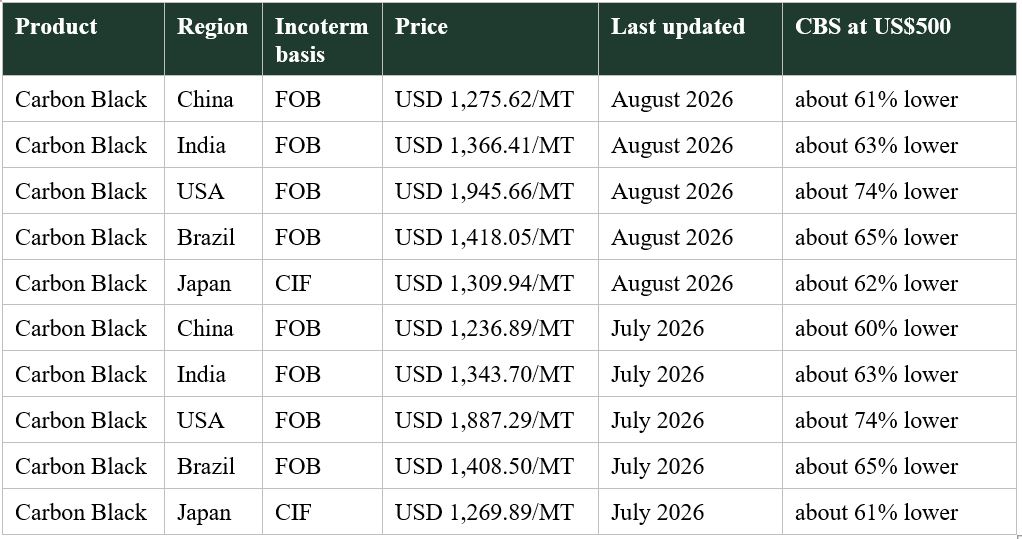
Source: Procurement Resource, Carbon Black Price Trend Q3 2026. The “CBS at US$500” column is calculated at the feasibility study’s assumed price.
Cost pressure has been building on the carbon black side. In March 2026, Orion S.A., a Luxembourg-incorporated global carbon black manufacturer headquartered operationally in Texas, announced price increases of up to 25% for its specialty-grade carbon black products, alongside a variable surcharge. The company cited rising costs, supply-chain disruptions and feedstock price volatility linked primarily to the Middle East conflict. The increase covers specialty grades rather than the rubber grades used mainly in tires.
Climate and pollution
FAR puts CBS’s embedded emissions at about a tenth of carbon black’s 2.5 tonnes or more of CO2 per tonne (a comparison of carbon sources, not a full lifecycle figure), because the carbon is mined rather than manufactured. Actual emissions savings would depend on processing energy and the share of conventional carbon black replaced in each rubber compound. Furnace emissions of sulfur dioxide, nitrogen oxides and particulates are avoided too. Bridgen says: “Rubber makers want lower costs and lower emissions at the same time. CBS is built to deliver both, from a material nature has already made.”
A potentially lower-cost alternative
CBS is a by-product of FAR’s vanadium operations that could offer a lower-cost, lower-emission alternative to conventional carbon black. FAR expects to enter the market at a price well below prevailing carbon black prices and estimates embedded emissions will be roughly 90% lower. The product requires no extensive additional capex, has attracted interest from tire makers, and has undergone performance testing by Smithers.
FAR reports a Phase 1 NPV of US$748 million and an IRR of 22%, rising to US$931.6 million and 31% under a lower-capex scenario; neither figure includes Phase 2 or rare earths. CBS therefore represents potential additional value, although its ultimate contribution will depend on commercial execution and market acceptance.
Disclaimer: The author has no financial or other interest in Ferro-Alloy Resources (FAR): no shareholding, options, or other position in its securities, no employment, consulting or other relationship with it, and no payment or compensation from FAR or any related party for this article. This article is for information only and is not investment advice or a recommendation to buy or sell any security.