Central Asian financial technology companies are seeking to connect national payment systems and bring AI into banking. Those plans require regulatory coordination and computing infrastructure that remains in short supply. Investors, meanwhile, want evidence that the businesses can generate sustainable returns.
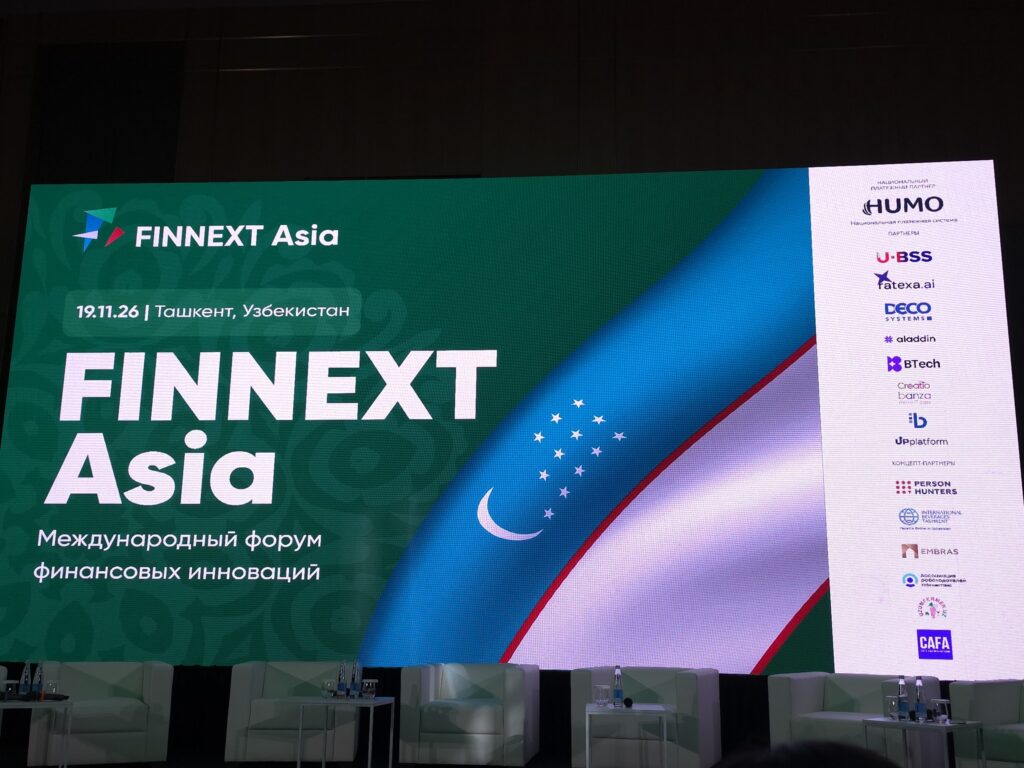
These issues were discussed at the third international FINNEXT Asia forum, held in Tashkent on November 19.

Connecting Central Asia’s Payment Systems
Growing cross-border trade and travel, including tourism and labor migration, are increasing demand for faster, less expensive money transfers.
“I do not believe that Central Asia needs to create a single regional payment system. Each country already has its own infrastructure, experience and specific market requirements. A more practical approach would be to connect existing national systems while allowing them to retain their independence,” said Alexey Maslov, advisor to the chairman of the management board of Uzbekistan’s national payment system, HUMO.

Alexey Maslov of Uzbekistan’s HUMO National Payment System, right.
Such connections would require coordination among central banks, governments, financial institutions, and payment system operators. They would need to agree on currency settlements and consumer protection, with common rules for resolving disputes.
“The main objective should be to make cross-border payments as simple, fast and convenient as domestic transactions,” Maslov said.
Connecting national systems could reduce reliance on intermediaries and lower transaction costs. But Maslov stressed that customers must also understand exchange rates and fees.
“Public trust in payment infrastructure depends on the reliable protection of funds and personal data, effective fraud prevention and transparent procedures for resolving disputes,” he said.
In a separate interview, he identified financial fraud as a major challenge for Uzbekistan’s payment industry. Regulators and the industry, including professional associations, “need to combine forces to make sure that we do our best to fight fraud,” he said.
Maslov cautioned against treating regional integration as a reason to abandon international payment networks.
“The more options countries have, the more resilient and flexible their financial infrastructure becomes,” he added.
He cited payment links in Southeast Asia, including Singapore’s connections with Thailand and Malaysia, that allow travelers to use familiar banking applications and quick response (QR) codes abroad. The European Union’s Single Euro Payments Area, meanwhile, demonstrates how common rules can support payment integration without requiring countries to build identical banking infrastructure.
HUMO’s partnership with Alipay+ now works in both directions. Users of participating international wallets can make QR payments in Uzbekistan, while HUMO cardholders can access payment services abroad.
In August 2026, HUMO signed an agreement with NPCI International Payments Limited, the international arm of the National Payments Corporation of India, to develop cross-border QR payments. The proposed connection would allow Indian users to pay in Uzbekistan through applications supporting the Unified Payments Interface.
Through cooperation with Kazakhstan’s Halyk Bank, HUMO cardholders can now pay at participating businesses using the bank’s terminals.
According to Maslov, the central banks of Kazakhstan, Kyrgyzstan, Tajikistan, Uzbekistan, and Azerbaijan have agreed to establish a working group on cross-border QR payments. HUMO cards are also accepted in Kyrgyzstan.
He welcomed the October 27 launch of Apple Pay and Google Pay in Uzbekistan as a sign of technological progress, although he cautioned against complacency. He sees the country as a potential economic center for Central Asia, with a market reaching into the Middle East and North Africa.
AI in Banking: Computing Power, Local Languages, and Security
While payment companies work on international connectivity, banks are examining how AI can reduce the cost of routine operations.
Andrey Fazlyev, co-founder of Bitmanager, headquartered in the United Arab Emirates, said his company develops voice AI agents deployed within organizations’ own infrastructure. It works with banks, fintech companies, healthcare providers, and government agencies. Alongside its operations in Uzbekistan, the company is active in Egypt and Saudi Arabia.
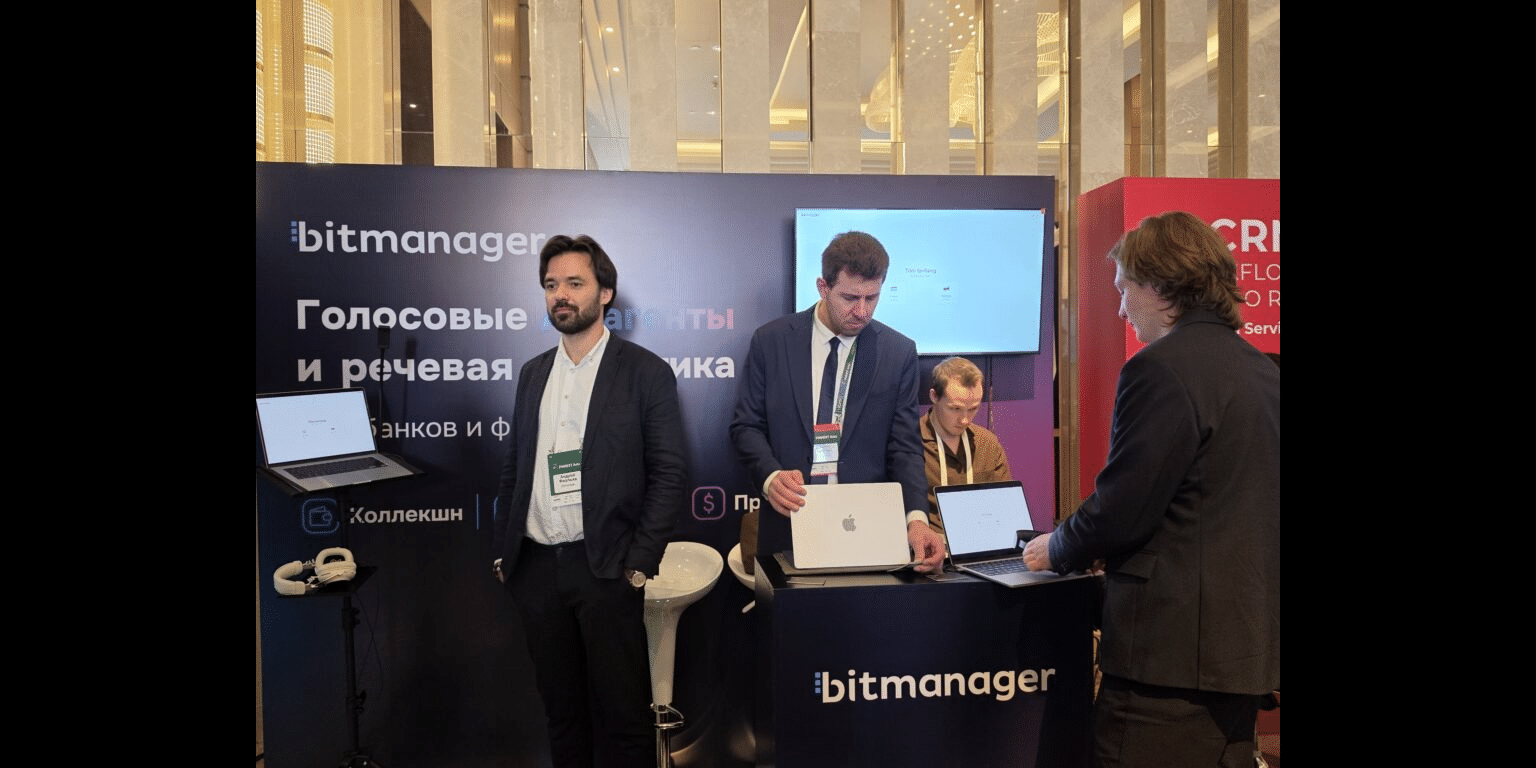
Andrey Fazlyev, co-founder of Bitmanager
Fazlyev distinguished between building a large language model (LLM) from scratch and adapting existing models for specific business applications.
“Building a fundamental LLM is extremely expensive,” he said, arguing that developing such models from scratch is largely out of reach for Central Asian companies.
Open-source models offer an alternative, allowing information technology (IT) engineers to adapt existing technology to business needs.
“In Central Asia there are good IT engineers who can train models,” Fazlyev said.
Graphics processing units (GPUs) are used to train and run AI models. Banks need sufficient computing capacity to run AI within their own systems, an approach Fazlyev recommended to keep sensitive information under their control rather than rely on general-purpose cloud services.
“What we see here in Uzbekistan, for example, is a lack of hardware. So it’s really hard here to get the GPUs which are necessary for on prem deployment of AI agents in the bank perimeter or for training the models,” he said.
Language presents another challenge. Fazlyev said Uzbek-language speech recognition and text-to-speech systems must account for regional dialects and differences in pronunciation. Developing reliable models requires research and sufficiently large datasets, not simply software engineering.
Bitmanager has established an AI research laboratory involving international scientists. According to Fazlyev, its researchers recently presented several papers at the Interspeech conference in Sydney, focusing on speech technologies.
A year ago, “voice agents in Uzbek language were not good enough,” he said. Now, “the competition is growing, and the models are constantly developing. The datasets are getting bigger.”
Fazlyev believes some of these systems are approaching the quality needed for commercial applications, but banks should not expect a single AI assistant to perform every task.
“It should do several tasks good enough to increase the efficiency of the business process,” he said.
He pointed to debt collection and sales as suitable applications. For first-level customer support, AI agents could answer routine questions and reduce the time customers spend waiting for an operator.
Reliability remains a concern when automated systems interact directly with customers. Unlike conventional software, generative AI does not always produce predictable responses. When an AI agent talks to a customer, “we don’t know what exactly it will reply,” Fazlyev said.
An inaccurate response can create problems for any business. For a bank, it may also involve confidential account information or financial transactions. Fazlyev stressed the need to verify a customer’s identity before disclosing payment details or other personal financial information.
Investors Are Becoming More Selective
As fintech companies expand their technological capabilities, venture investors are paying closer attention to whether their products can become profitable businesses.
Abdulazal Toshkhujaev, investment director and managing partner at the National Venture Capital Fund of Uzbekistan (UzVC), the country’s first such fund, described how enthusiasm for emerging technologies can push investment decisions toward speculation and fear of missing out. When a new sector attracts attention, investors may struggle to assess startup valuations.
“As interest shifts towards earning money, it means that the hype is beginning to fade and investors are literally starting to count the money they can get in return,” he said.
For Toshkhujaev, this is a natural stage in the technology sector’s development.
“Startup should not always remain in the startup sphere. It should become a business. And any startup or any technology company that existed before eventually becomes an ordinary company,” Toshkhujaev said.
He pointed to Kazakhstan’s venture capital market, where fintech was among the sectors that attracted early startup investment, including companies developing financial scoring technologies. Investors were initially cautious because failed investments could undermine confidence in the startup sector, he said, while successful businesses helped attract additional capital.
He described fintech as a comparatively practical area for investment because its products are tied to financial transactions. Investors can assess operating costs and business performance more directly than expectations surrounding an emerging technology, he said.