Central Asia is increasingly being drawn into the global competition for critical minerals. To the south lies Afghanistan, where much of the country’s substantial mineral wealth remains undeveloped. Kabul is now trying to turn those resources into an economic and diplomatic asset.
Amir Khan Muttaqi, foreign minister in the Taliban government, told the Financial Times that Afghanistan would “definitely” welcome U.S. investment in mining, infrastructure, agriculture, and trade. Relations between the two countries, he said, should be viewed through the opportunities for future cooperation rather than the lens of 20 years of war. At the same time, Muttaqi invited the United States to reopen its embassy in Kabul while ruling out a return of U.S. control over Bagram Air Base.
This was not an isolated overture. In mid-August, Muttaqi told The New York Times that the United States could reopen its embassy and invest in Afghanistan’s mineral resources, dams, and roads.
On August 30, he told Kyodo News that Kabul was seeking to normalize relations with the United States on the basis of mutual respect and shared interests, while formal recognition remained “a matter for the next stage.”
Taken together, these statements amount to a consistent diplomatic approach. Mineral resources are becoming one of the enticements the Taliban is using to offer Washington a new basis for bilateral relations: economic interests could open the way to broader engagement.
Kabul Offers Resources, Washington Rejects the Pitch
The timing of the offer is no coincidence. The Trump administration has significantly increased its focus on critical minerals and the resilience of supply chains.
On July 30, the White House described U.S. dependence on foreign sources of critical materials as a growing risk to national security and authorized the use of Defense Production Act powers to restrict exports of certain recoverable critical minerals and materials.
Ten days earlier, Trump signed an executive order aimed at strengthening defense supply chains and increasing reliance on critical materials and components sourced domestically or from allied countries.
Kabul is trying to make itself relevant to this debate by presenting Afghanistan as a potential source of minerals and a destination for U.S. investment.
The U.S. response, however, immediately demonstrated the limits of that strategy. On September 2, the State Department said in a written response to Voice of America that it had no plans to engage with the Taliban on developing critical mineral resources. The department pointed to the Taliban’s sanctions status and said U.S. investment could increase the financial resources available to Afghanistan’s current authorities.
For Washington, the attractiveness of Afghanistan’s mineral resources cannot, for now, be separated from the political status and policies of those who control them.
“$1 Trillion in Mineral Wealth”
In 2007, the U.S. Geological Survey (USGS), working with the Afghanistan Geological Survey, conducted a major assessment of the country’s mineral resources. Researchers compiled data on known deposits and assessed the potential for undiscovered resources, covering commodities including copper, iron, gold, lithium, and rare earth elements.
In 2010, a Pentagon task force put the gross value of Afghanistan’s mineral wealth at around $1 trillion, a figure that quickly made international headlines. The calculation drew on geological data gathered by USGS but was not itself a USGS estimate. USGS representative Jack Medlin later publicly explained that the agency had sought to distance itself from the widely circulated $1 trillion figure: it represented a gross valuation of potential resources and did not account for the cost of extracting them and bringing them to market.
It is therefore more accurate to speak of Afghanistan’s enormous geological potential rather than proven reserves worth $1 trillion. Exploration must first establish what is actually present and whether it can be mined economically. Even then, a commercially viable project requires infrastructure, financing, workable regulation, and access to markets.
This is where Central Asia enters Afghanistan’s mineral story.
Why Central Asia Is Already Ahead
Central Asian states are also seeking to use their mineral resources to attract U.S. capital and technology. But an institutional framework for cooperation is already being built around those resources.
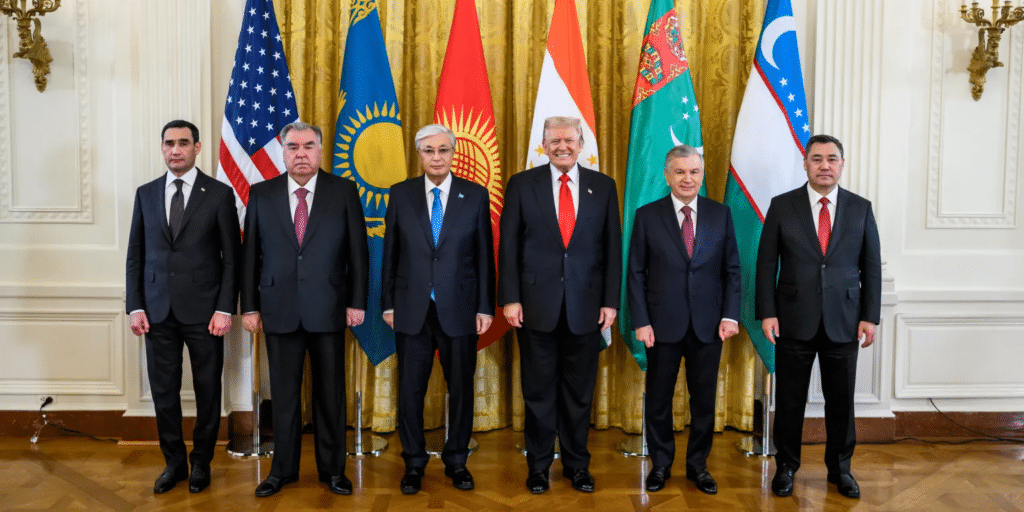
The first in-person C5+1 Critical Minerals Dialogue involving the United States and all five Central Asian countries was held in Astana on June 10. The talks covered the critical-minerals supply chain from geological exploration and mining to processing, technology, and transport.
Central Asia’s advantage therefore goes beyond what lies underground. Its governments are already creating a framework in which U.S. officials and companies can discuss geological data, investment, processing, and transport.
Afghanistan is at a different stage. The USGS notes that the country already produces talc, chromite, fluorite, precious and semiprecious stones, and other minerals. Major exploration projects in recent years have been associated primarily with Chinese companies. Yet large-scale development of Afghanistan’s most valuable prospective deposits remains limited, while access to major Western investment remains politically and legally difficult. Some mineral trade with Central Asia already exists: the USGS says Afghanistan exported talc to Uzbekistan in 2024.
At the same time, Kabul is already seeking closer institutional ties with Central Asia. On April 5, the first Afghanistan-Central Asia Consultative Dialogue was held in the Afghan capital with representatives from Kazakhstan, Kyrgyzstan, Tajikistan, Turkmenistan, and Uzbekistan, with economic cooperation and regional connectivity high on the agenda.
Minerals were not a central focus of the April meeting, but the format could become relevant to future mining projects. Large-scale development in Afghanistan would depend not only on what is underground, but also on power, transport, processing, and access to markets across its borders.
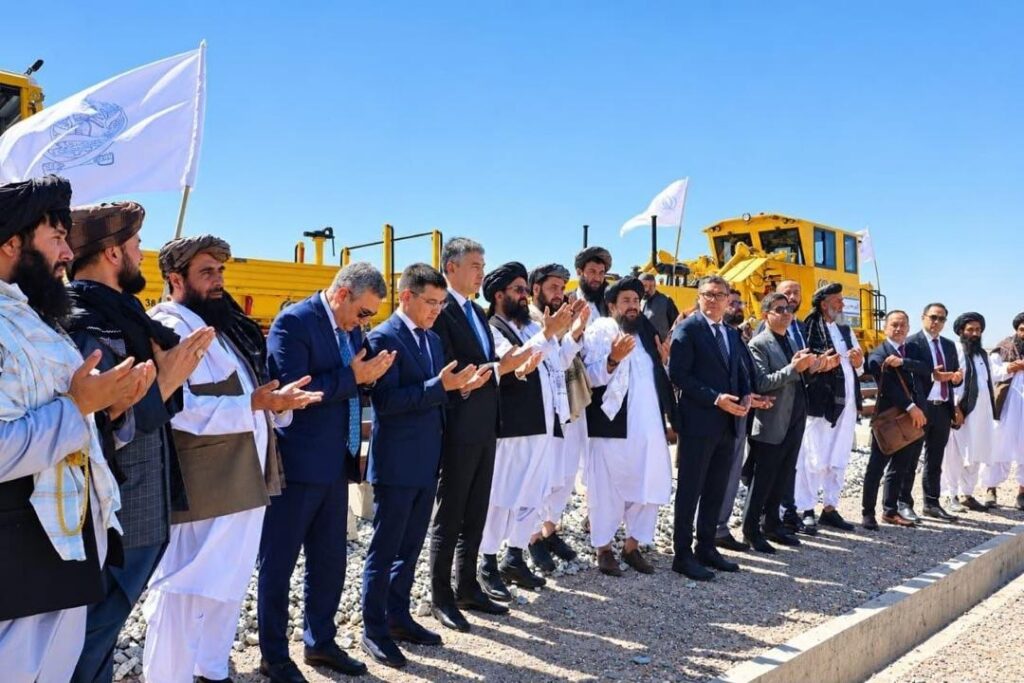
Central Asia is already building relations with Afghanistan’s current authorities along precisely these pragmatic lines – through trade, transportation, and infrastructure projects without formal diplomatic recognition.
Geology Does Not End at the Border
Geography also gives Afghanistan a potential advantage.
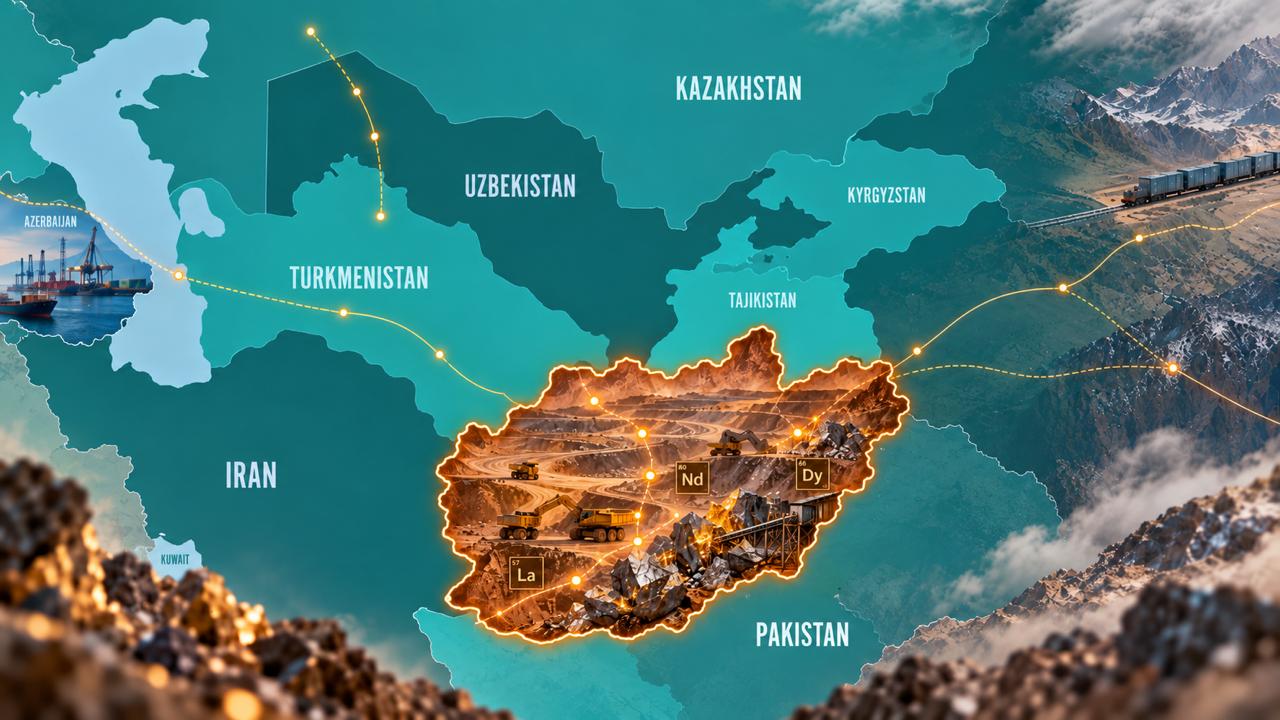
In the C5+1 political framework, Central Asia ends at Afghanistan’s northern border. On a geological map, there is no such clear dividing line.
In August, the USGS published a new assessment of the oil and gas potential of the Amu Darya and Afghan-Tajik basins. The study examines geological systems extending across Turkmenistan, Uzbekistan, Tajikistan, Afghanistan, and Iran. Its mean estimate of undiscovered, technically recoverable conventional resources is 442 million barrels of oil and 218 trillion cubic feet of natural gas. Those figures apply to the basins as a whole, not to Afghanistan alone.
Oil and gas geology, of course, says nothing about the distribution of rare earth elements or other critical minerals. It illustrates a different point: modern national borders do not coincide with the boundaries of geological systems.
For the economics of mineral projects, this matters for another reason. Processing does not necessarily have to take place next to a mine – energy can come from a neighboring country, and profitability depends on the transport corridor through which raw materials or finished products can reach global markets.
From this perspective, Central Asia could become part of the infrastructure needed to make Afghanistan’s resources economically viable.
For now, that remains a prospect. Afghanistan still has to demonstrate that it can provide the level of legal and investment certainty required for major projects. Washington’s refusal to discuss critical-minerals cooperation with the Taliban shows how high that barrier remains.
But Afghanistan’s long-term resource question is broader than whether an individual U.S. mining company enters the country. The central question is whether Afghanistan can integrate its mineral resources into the value chains already taking shape around it.
If it can, Central Asia’s mineral map may one day extend beyond its political borders.