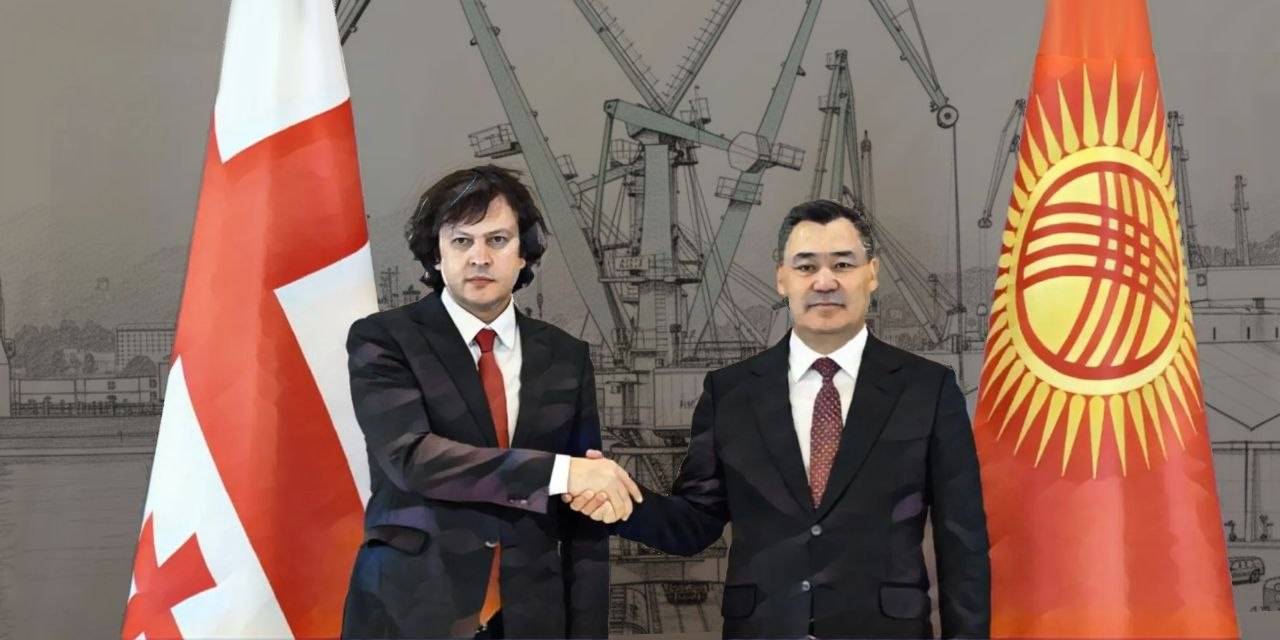
Kyrgyzstan and Georgia placed Black Sea access at the center of their transport agenda during Georgian Prime Minister Irakli Kobakhidze’s official visit to Bishkek on June 11-13. In talks with President Sadyr Japarov at Yntymak Ordo, the new presidential palace complex, on June 12, the two sides linked their cooperation to the China-Kyrgyzstan-Uzbekistan railway, known as CKU, and to Georgia’s role in the Trans-Caspian route between Central Asia and Europe.
The visit was the first official trip to Kyrgyzstan by a Georgian head of government since the two states established diplomatic relations 34 years ago.
“Special attention was paid to linking the China-Kyrgyzstan-Uzbekistan railway with Georgia’s port infrastructure,” Japarov said after the talks. He called cooperation in this sector “one of the priority areas” in relations between the countries.
That focus gave the visit a wider regional dimension, as landlocked Kyrgyzstan still lacks a direct rail link with China. Georgia offers access to Black Sea ports and sits on the South Caucasus section of the Middle Corridor. If the CKU line becomes operational, Bishkek wants cargo moving from China through Kyrgyzstan and Uzbekistan to connect with routes across the Caspian Sea, Azerbaijan, and Georgia.
Kobakhidze linked the same issue to Tbilisi’s transit goals. “We emphasized the importance of developing the Middle Corridor,” he said, adding that the route needs more cargo flows. He said Georgia was closely following the CKU and was pleased that the project was “progressing rapidly,” because it would strengthen links between Central Asia and the South Caucasus.
The two sides signed a joint statement and a package of bilateral documents after the talks. The agreements covered aviation authorities, state property management, veterinary cooperation, education, justice, sport, radiation safety, foreign ministry cooperation for 2027-2028, and customs cooperation. The customs document provides for advance exchanges of information about goods and vehicles moving between the two countries. That aspect may prove the most practical for freight, since cargo routes depend on data exchange, border processing, and predictable clearance times.
The CKU railway has moved from a decades-long plan to active construction. The financing agreement signed in Bishkek set the project cost at $4.7 billion. About half will be financed through a 35-year Chinese loan to the joint project company. China holds a 51% stake in the company, while Kyrgyzstan and Uzbekistan each hold 24.5%. The planned line runs from Kashgar in China through Kyrgyzstan to Andijan in Uzbekistan.
The Kyrgyz section represents the most difficult part of the route. It is about 305 kilometers long, with 50 bridges and 29 tunnels planned. More than 5,000 people and about 5,600 pieces of specialized equipment were involved by late March, with tunnel excavation, earthworks, and bridge construction already under way. Transport Minister Talantbek Soltobaev said on June 10 that work was in progress on sections totaling up to ten kilometers. Japarov has outlined 2030 as a target for the launch.
The project would give Bishkek a rail role it has never had. Kyrgyzstan has no through rail route linking China with Uzbekistan, and the new line would make the country a direct part of east-west freight traffic rather than being bypassed by it.
For Uzbekistan, the CKU would add a route to China and another path toward western markets. For China, it would open a southern rail route into Central Asia and reduce dependence on Kazakhstan as the main overland rail gateway. For Georgia, the line could feed additional cargo into the Middle Corridor, which connects Central Asia with the South Caucasus, the Black Sea, and Europe.
Georgia is investing in that role. On June 2, the World Bank approved $372 million for the Trans-Caspian Transport Corridor Georgia Accessibility and Transport Enhancement project. The full program is worth more than $750 million, with co-financing from the Asian Infrastructure Investment Bank and the Asian Development Bank. It is designed to support rail freight upgrades, road modernization, and institutional reforms on Georgia’s section of the corridor.
Trade figures highlight why both governments are looking beyond current bilateral flows. Kyrgyzstan’s Ministry of the Economy put trade with Georgia at $5.7 million in January-March 2026, down almost fourfold from the same period in 2025. Imports from Georgia reached $4.4 million, while Kyrgyz exports to Georgia were $1.3 million. In 2025, bilateral trade reached $54.4 million, down 39.4% from 2024.
Georgia’s export data shows why Bishkek is important to Tbilisi. In January-April 2026, Kyrgyzstan was Georgia’s top export destination at $272.8 million. Over the same four-month period, motor cars were Georgia’s biggest export overall, worth $537.4 million, or 22% of total exports. Vehicle re-exports have become a major part of Georgia’s trade with Central Asian markets, and Kyrgyzstan is now one of the main destinations for that flow.
Aviation also appeared in the Bishkek package. Kobakhidze said the sides discussed direct flights, and the signed documents included cooperation between aviation authorities. Regular flights would support tourism and business travel, but freight remains the larger strategic focus.
The Bishkek visit did not settle the commercial limits of the route. Rail construction, Caspian shipping capacity, border procedures, port handling, and prices will decide how much freight uses it. But it did join two active projects in one political frame: Kyrgyzstan’s effort to reach China by rail and Georgia’s effort to draw more Central Asian cargo toward the Black Sea.