Kazakh filmmaker and writer Alina Mustafina moved from Almaty to Dubai before relocating to Barcelona with her husband. There, she studied film directing after working as a journalist, a career change she recounts in her second book, Between Heaven and Cinema: When a Dream Changes the Route.
Her debut feature documentary, Gingerbread for Her Dad, premiered at the Busan International Film Festival in 2024 and competed at the Torino Film Festival later that year. Those screenings give her firsthand experience of taking a film made in Kazakhstan to international audiences.
The Times of Central Asia spoke with Mustafina about her new book and the prospects for Kazakh filmmakers abroad. She discusses life in a Spanish film school and the challenge of explaining Central Asian humor to foreign collaborators.
TCA: How did the idea for Between Heaven and Cinema come about?
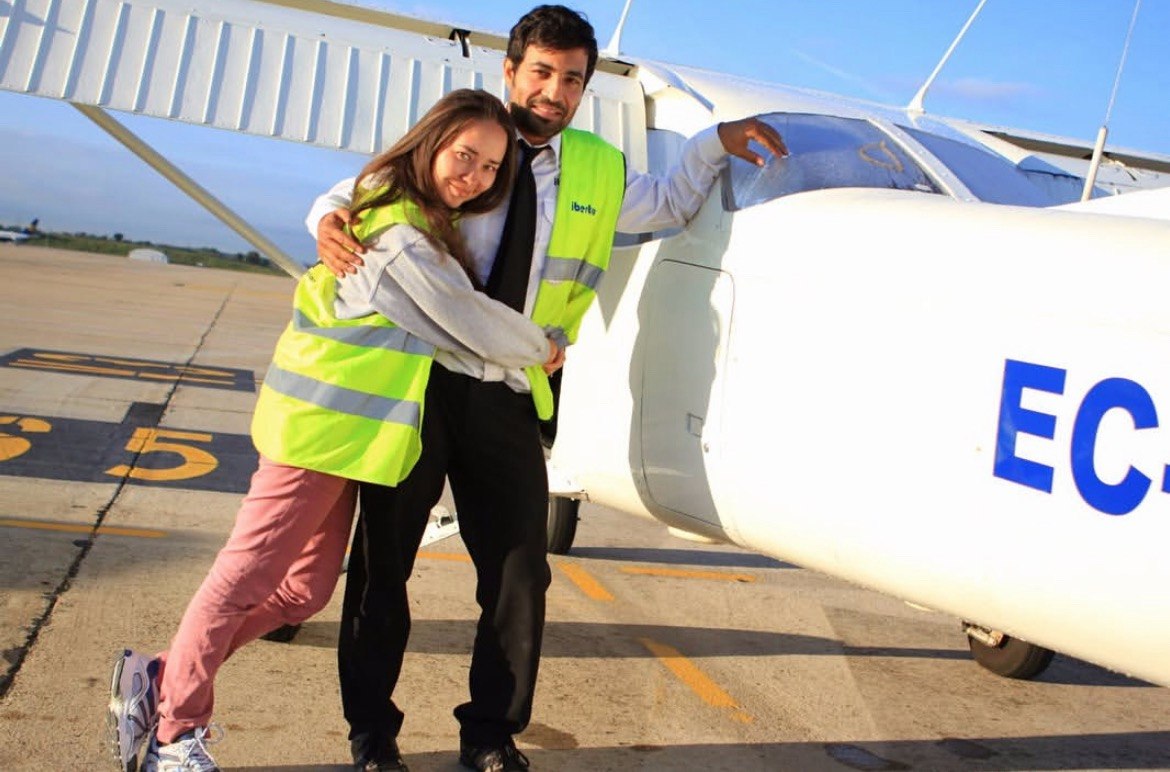
Alina Mustafina: This is my second book. It’s about how my husband and I decided to change our lives when we were already in our thirties. We moved from the Emirates to Spain. I retrained as a filmmaker after working as a journalist, and he went from being an engineer to a pilot. I describe the book as “a story about a pilot’s wife and a filmmaker’s husband.”
I started writing it back in 2021, still excited about the publication of my first book, How to Move to Dubai and Stay There, which had become quite popular. In about seven months, I wrote the section about Spain, then put the manuscript aside. I no longer had time for books, and it sat there for several years.
TCA: What prompted you to return to the manuscript?
Alina: The book is dedicated to my son Ander, who, sadly, passed away last year. In it, I write about the time when we found out we were going to become parents and have a son. That happened in Spain. It was important for me to reflect on that difficult period in my life.
I decided to contact the same editor I’d worked with on How to Move to Dubai. I sent him the manuscript and suggested that if the publisher was interested, I would finish the book and we could publish it. If not, I wanted them to tell me right away. I decided that a positive response would give me the push to finally finish what I’d started. It would also give me a firm deadline.
TCA: Was working on the book therapeutic for you in some way?
Alina: In a sense, probably, yes. At the very least, it helped me look back at my journey in detail, feel grateful for it, and see how much my husband and I had been through together and how we’d supported each other.
Besides, the book had been hanging over me as unfinished business all those years. I kept thinking about what I’d written, sitting in a drawer somewhere. If the publisher had turned it down, the manuscript would have stayed there. I wouldn’t have had the resolve to do anything with it. But they said yes, and after that I got back to work quite quickly.
TCA: What was the initial print run of the new book, and what do you know about sales so far?
Alina: The first print run was 2,000 copies. We’ll see how sales go, and if there’s demand, we’ll print more. I don’t have sales figures yet. Publishers usually provide reports once a quarter, and my book has only just reached stores. But there is interest. From the tags I see on Instagram Stories, I can tell that quite a few of my followers are buying it.
TCA: How did your first book about moving to Dubai find its way into print?
Alina: I initially published it myself, with a print run of just 500 copies. They all sold through Meloman, Flip.kz, and other outlets. After that, I approached the Kazakh blogger Beibit Alibekov, who helped me publish a second print run. I think it was 1,000 or 1,500 copies; I don’t remember exactly.
Then I approached a Russian publisher, and to my surprise, they agreed to publish the book, even though it would be the third print run. They produced a proper hardcover edition with illustrations. In 2021, the book became a bestseller in Kazakhstan.
I remember seeing it on a bookstore shelf between a book about Elon Musk and Bill Gates’s book about climate change. That really amused me, and I even used it in the publicity: my book is between Musk and Gates!
TCA: In your documentary Gingerbread for Her Dad, three generations of women in your family travel from Kazakhstan to Poland to find the grave of your great-grandfather, who died during World War II. But you’re also a journalist and a writer. How do you introduce yourself these days?
Alina: I’m a filmmaker. I used to introduce myself as a writer and journalist. If you’d asked me in 2016 or 2017, when the first print edition of my book came out, that’s what I would have said. But now I see myself primarily as a filmmaker.
For me, books are more a way of reflecting on my life in writing. Much of the new book had been written a long time ago: the chapters on Spain and Qatar were already finished. I just needed to update them to reflect what had happened in my life over the past few years, including in film. It took me a couple of months to finish the manuscript. Right now, I don’t have the time, ideas, or energy for more books. But I wouldn’t rule them out someday. For now, I’m focused on filmmaking.
TCA: How has living in Europe and the Middle East changed your outlook?
Alina: I think it’s changed it quite a bit. First, I’ve grown older. I left Almaty as a young woman, and now I’m a mature adult. Second, meeting people from all over the world has made me much more easygoing about people. I’ve learned to accept them with all their quirks.
That doesn’t mean I’m ready to be friends with everyone or let people cross my personal boundaries. I simply understand that one person is a certain way, and someone else is completely different. We may not have much in common, but at least I won’t get upset because someone doesn’t match my idea of who they should be. I’ve always been interested in people whose life experiences are different from mine.
TCA: Which cultural differences surprised you most?
Alina: There were a lot. Spanish people, for example, discuss their private lives quite openly. They might ask very personal questions even of someone they’ve known for only a couple of weeks. Sometimes they deliberately try to embarrass you and see how you react. Coming from an Asian culture, I found that a little strange, but I got used to it.
They also use slang all the time, including some pretty crude expressions. For them, it’s perfectly normal. For example, you can casually say “fuck” or its Spanish equivalents when talking to a teacher, and no one will think anything of it.
TCA: So the formal hierarchy between teachers and students that we’re used to is almost absent?
Alina: Almost entirely. You can go out for a beer or coffee with your instructor, go to a club together, or just call and ask how they’re doing. You can talk completely freely, without worrying about the fact that they’re the teacher and you’re the student.
TCA: Did you like that approach?
Alina: Very much! At first, it was a little strange and even intimidating. But I liked that no one paid much attention to age or status. Whether you were a teacher or a student, you could interact as equals. I thought that was really cool.
In Doha, where I live now, it’s a little different. Of course, a lot depends on where the teacher comes from. If the mentor is European, the relationship with students can be quite informal, too. But if they’re from the Arab world, there are certain boundaries. For example, you wouldn’t use profanity in conversation, especially if the teacher is a woman. There’s much more restraint about what you say and how you say it.
TCA: What subjects interested your classmates in Spain?
Alina: There were lots of coming-of-age stories. LGBTQ themes came up often. None of the students in our group were LGBTQ, but they still made films on the subject. There were also many stories about relationships between parents and children. I think that’s a universal theme in cinema, wherever you are.
But there were also completely different films: bold, brash works that seemed to defy every rule of dramatic storytelling. The filmmaker’s attitude was simply: I don’t care about your rules; I want to make a film to have fun. To my surprise, those were the films I liked best. They were distinctive and unexpected, and you could feel the freedom in them.
TCA: Are they less afraid to experiment?
Alina: Absolutely. No one was afraid to experiment with style. You didn’t get everyone trying to make films like iconic directors, as tends to happen among our film students.
Someone made a short about a girl who pops a pimple, photographs it, and posts it on Instagram. That’s it – the end! And that short won lots of awards. Essentially, it was just a joke, but they made a film out of it.
TCA: Do you think young Spanish filmmakers’ work is lighter, while emerging Kazakh directors more often make social dramas?
Alina: That’s partly true. A lot probably depended on who was studying filmmaking. Almost all my classmates had their tuition paid by their parents. There were just three exceptions: a woman over fifty, a man of about thirty whose company had sent him to study, and a young man who’d earned the money himself.
Everyone else came from fairly comfortable families, mostly middle-class. Some were very wealthy, though. For example, my editor’s family owned an entire section of an apartment building in Barcelona. Imagine, about ten apartments in one building, all belonging to the same family! That’s an enormous amount of wealth, given what property costs in Barcelona.
TCA: Were they not interested in socially engaged films?
Alina: No, we explored social issues, too. The focus was just different. Homelessness and migration, for example, are always relevant subjects. When I lived there, the crisis was only beginning. People were gradually losing their jobs, the economy was getting worse, and taxes were high.
My husband Emre and I ran into this even when looking for a place to live. Landlords didn’t want to rent to us unless we paid six months in advance. They saw us as potentially troublesome immigrant tenants who might stop paying and occupy the property illegally.
But overall, I had the impression that before the 2008 crisis, Spanish people had lived quite comfortably. They had a good education and a fairly high standard of living. Then things gradually began to deteriorate.
TCA: Do you think young people there are interested in different kinds of films now?
Alina: Judging by France today and the protests that have broken out, I think so. When you go to Europe now, you notice far more homeless people, higher taxes, and people with a fraction of the money they used to have. You can feel that people are cutting back. Apparently, that breeds discontent.
But when we were studying there and traveling around Spain, I was struck by how carefree the young people were. It seemed that all they dreamed about was partying harder, getting drunk, and going to clubs. Emre and I found that strange. We’d come from another country, we were already adults and had worked, while they continued to live without a care, even though the country’s economy was far from ideal.
TCA: In the book, you say your classmates nicknamed you “Kazakita.” What impression of Kazakhstan do you think they got from knowing you?
Alina: Oh, I have no idea! Maybe I embarrassed the whole nation! [Laughs.] Or maybe they now think: we knew one Kazakita, and she was so cool! Everyone liked me, so I hope it was the latter.
I certainly didn’t showcase any particular traditions. I was just myself: open, cheerful, and interacting with them as equals. In other words, just like them. People often complimented my looks, so perhaps they at least came away thinking Kazakh women are beautiful. If so, that’s something! [Laughs.]
TCA: Not all your classmates became film directors. Some make commercials; others moved into different fields. Is it harder to break into the film industry in Spain than in Kazakhstan?
Alina: There’s enormous competition there. And I think we Kazakh filmmakers actually have an advantage in some ways. Kazakh cinema isn’t all that well known internationally. When it comes to arthouse cinema, it’s mostly the films of Darezhan Omirbayev or Adilkhan Yerzhanov.
When a film from Kazakhstan appears at an international festival, that alone can spark curiosity: imagine, a film from a country we know almost nothing about! In Spain, things are completely different. It has an established film industry, Netflix operates in Madrid, films are being made all the time, and huge numbers of directors are trying to get their projects off the ground. So it’s much harder to stand out.
TCA: Does that mean it’s easier for a young director to start a career in Kazakhstan?
Alina: No, I actually think it’s much harder to get started at home. But then, if you’ve somehow managed to make a film, it’s easier to get into an international festival. It doesn’t matter whether you made it against the odds, received financing from a fund, or found some other way.
Spain, however, offers much better conditions for professional growth. There are more opportunities to study, develop, read, and immerse yourself in art. The surroundings themselves encourage it; the architecture, history, museums, libraries, and cultural institutions. People are generally very well educated. There are also huge numbers of labs, workshops, training programs, and regional funds that can provide financing for films.
TCA: You’ve taken part in international film labs and worked with foreign mentors. Have you had to explain aspects of Kazakh culture to them?
Alina: Of course, all the time! You have to explain the context in great detail. For example, when we discuss my series about women in Central Asia, I explain to the mentors how life works in our patriarchal society and how important marriage, family, and the role of men are. I explain why a particular situation or line would be funny specifically to our audience.
In France, for example, that humor might not register at all. Someone looks at a situation and doesn’t understand what’s funny about it. Then, once you explain the cultural context, they suddenly say: “Oh, now I get it! Yes, that really is funny!”
It’s a very useful experience. You learn to see your own culture from the outside and explain things that seem obvious to you. Along the way, you also come to understand better what makes your story unique.
TCA: Let’s return to the book. Your husband said it’s about hope. I think it’s also about the courage to give up a comfortable life and start over. Did you want to inspire readers to make changes?
Alina: No, it isn’t meant as a motivational book. It tells the story of our lives. It all happened naturally, because that’s how we actually lived. Readers decide for themselves what to do with that story and how to live their lives. Sooner or later, everyone faces a choice: leave things as they are, or take a risk and try something new.
A few years after my first book, How to Move to Dubai and Stay There, came out, readers started writing to me: “Alina, we moved to Dubai because of you,” or “Your book gave me the courage to change my life.” I remember thinking: wow, it turns out I’ve somehow influenced other people’s lives!
TCA: Is that responsibility frightening?
Alina: Yes, but everyone makes the final decision for themselves. Personally, I’m always in favor of giving it a try. Even if it doesn’t work out, you can give up the idea and go back to where you started. That’s much better than spending the rest of your life regretting that you never dared, never took the risk, never seized the opportunity.
There will be difficulties whichever path you choose. I’ve never written my books to say, “Everyone, do what we did!” I simply described what we did, and everyone is free to draw their own conclusions.
TCA: The book is an easy read, but your life has hardly been trouble-free.
Alina: Yes, we live like everyone else, there are joys and difficulties. For example, we’re living in Qatar now, although I personally don’t like it very much. I’d happily move to Paris. But right now, we can’t simply change everything. So even we, with all our love of adventure and change, sometimes find ourselves in circumstances where we have to stay put.
TCA: What are your plans?
Alina: As grand as it may sound, to live. And, along the way, to keep writing, making films, and looking for the money to do it. I’m currently working on a new documentary series and writing a series through an international film lab. I hope to find funding for that series in Kazakhstan.