The widening war centered on Iran is reverberating far beyond the Middle East, exposing a structural vulnerability in Central Asia’s economic geography: the region’s reliance on transport corridors that pass through or near Iran and the Persian Gulf.
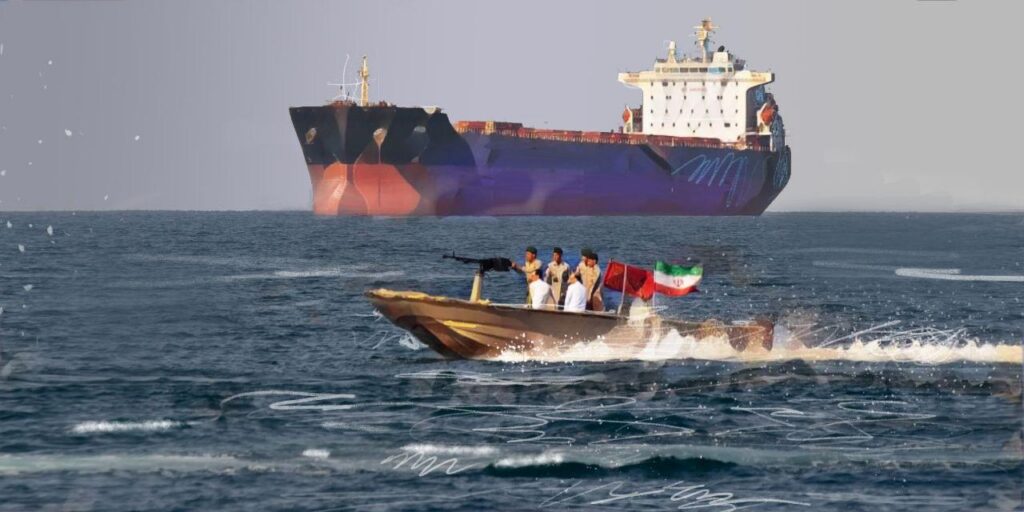
As fighting escalates and shipping risks spread across the region, insurers, shipping companies, and logistics firms are reassessing operations across the Gulf. War-risk insurance premiums have surged while some commercial carriers have scaled back bookings to parts of the region amid growing security concerns. Tensions around the Strait of Hormuz have already pushed shipping costs higher as governments and logistics firms weigh the risks of operating in one of the world’s most important maritime chokepoints.
For Central Asia’s landlocked economies, the crisis highlights how much regional connectivity strategies still depend on southern access routes linking the region to global markets.
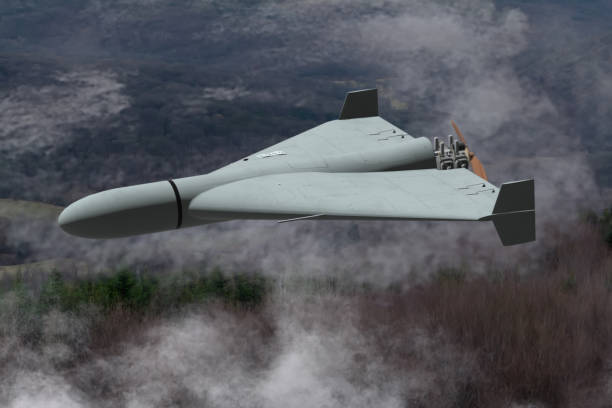
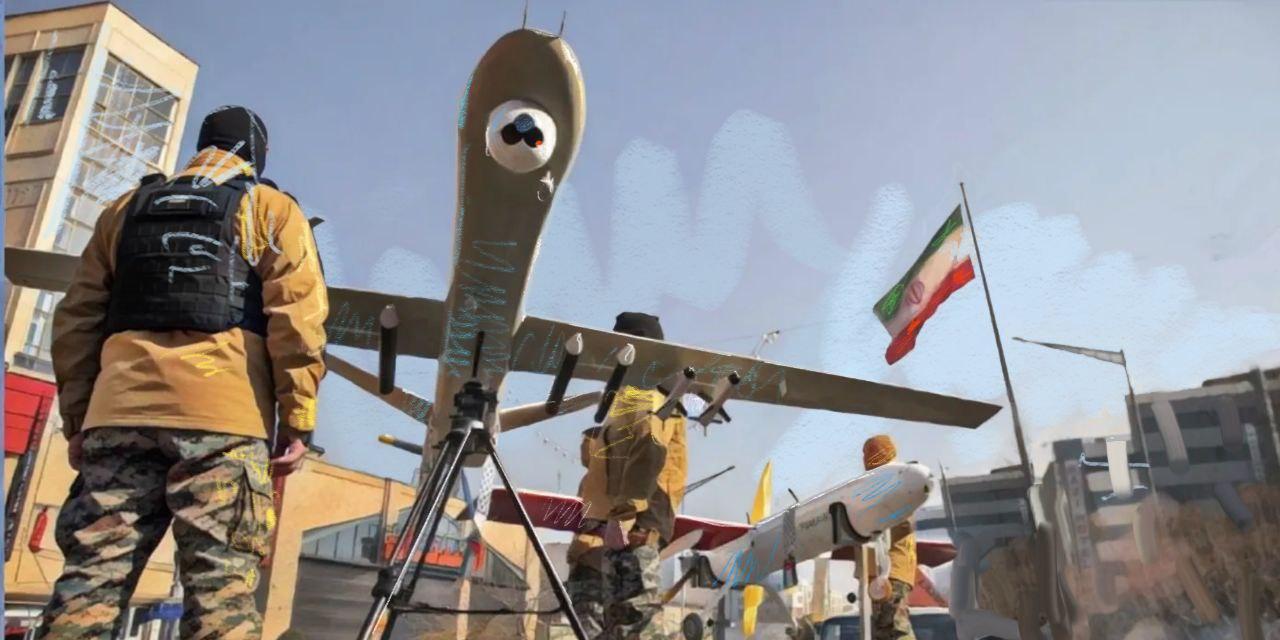
The conflict has also edged closer to the transport routes linking Central Asia with Europe after what were alleged to be Iranian drone strikes on Azerbaijan’s Nakhchivan region, damaging facilities at the exclave’s airport and prompting diplomatic protests from Baku. While the strike did not directly disrupt trade corridors, it underscored how quickly the conflict could spill over into the South Caucasus, a key segment of the Middle Corridor. Nakhchivan is a landlocked Azerbaijani exclave bordering Iran and Turkey, separated from mainland Azerbaijan by Armenia, and lies at the frontier where Iranian territory meets the transport networks of the South Caucasus.
The South Caucasus also hosts energy infrastructure with wider geopolitical significance. The Baku–Tbilisi–Ceyhan (BTC) pipeline transports mostly Azerbaijani crude through Georgia to the Turkish Mediterranean port of Ceyhan, from where it is shipped to global markets. In 2025, Azerbaijani oil accounted for 46.4% of Israel’s crude imports, most of it moving through this supply chain before being shipped onward by tanker. The pipeline also carries limited volumes of Kazakh crude – 2-3% of Kazakhstan’s overall exports – making it far more significant for Israel’s energy supply than for Kazakhstan’s export system.
Iran’s armed forces have denied responsibility for the drone incident, instead accusing Israel of attempting to provoke tensions and disrupt relations between Muslim countries.
The Geography of Connectivity
Since independence, Central Asian governments have sought to overcome the constraints of geography. Landlocked and long dependent on Soviet-era transport networks running north through Russia, the region has spent three decades developing alternative corridors in multiple directions. Routes leading south have held particular appeal, offering the shortest overland access to ports on the Persian Gulf and the Indian Ocean.
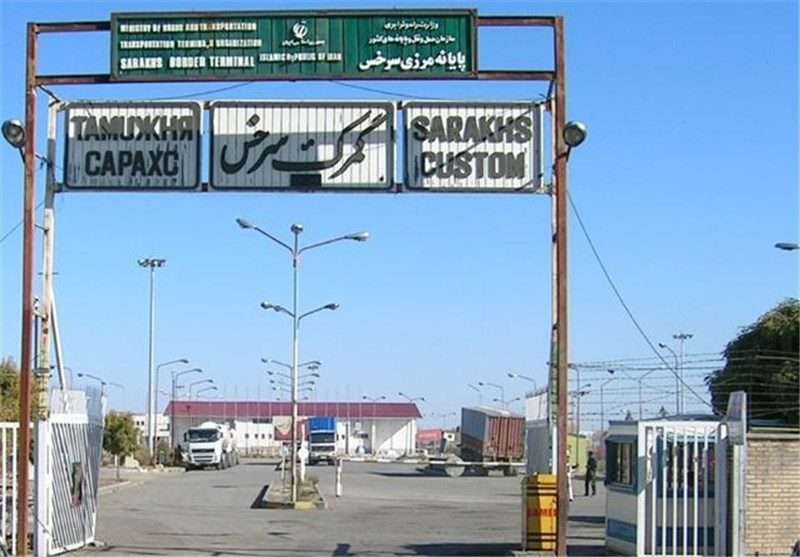
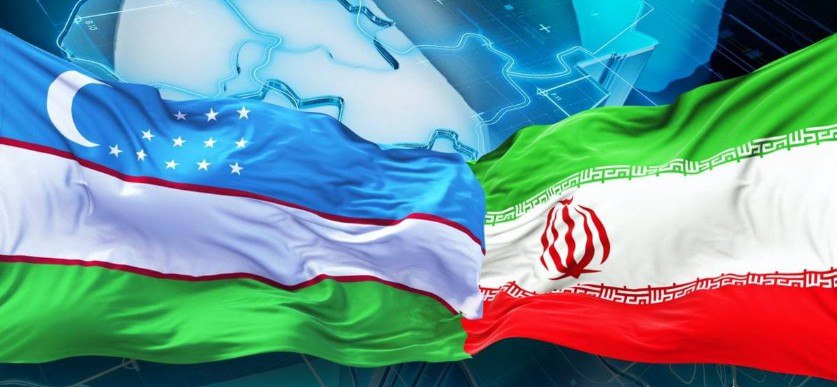
Iran sits at the heart of several connectivity initiatives designed to connect Central Asian rail networks to ports on the Persian Gulf and the Indian Ocean. The Ashgabat Agreement — a multimodal transport framework linking Iran, Oman, Turkmenistan, and Uzbekistan and designed to connect Central Asia with ports on the Persian Gulf and the Gulf of Oman — was created specifically to facilitate international trade and transit between Central Asia and global shipping routes.
For countries such as Turkmenistan and Uzbekistan, rail routes running south through Iran provide one of the shortest overland connections to maritime trade. The Kazakhstan–Turkmenistan–Iran railway, opened in 2014 and linking Uzen in western Kazakhstan with Iran’s rail network via Bereket and Gorgan, created a continuous north–south corridor connecting Central Asia to ports on the Persian Gulf. The line forms part of a broader network of transit routes intended to move Central Asian commodities and manufactured goods toward Iranian ports and onward to global shipping lanes.
Iran’s port of Chabahar has long been promoted as a potential gateway for Central Asian trade, providing access to the Indian Ocean while bypassing some of the more congested maritime routes further west. In May 2024, India signed a long-term deal with Iran to develop and operate the port, which New Delhi views as a strategic link connecting Central Asia and Afghanistan to global shipping lanes. The port previously received limited exemptions from U.S. sanctions because of its role in facilitating trade with Afghanistan and Central Asia, allowing India to continue with the project despite broader restrictions on Iranian infrastructure.
The current war is now casting doubt on how reliable those routes may be during periods of geopolitical crisis.
Trade Routes Under Pressure
Even without a formal closure of the Strait of Hormuz, conflict in and around the Gulf is already altering shipping patterns. Rising insurance premiums and heightened security concerns are prompting vessels to reroute, delay voyages, or avoid the area altogether.
Roughly a fifth of the world’s oil normally passes through the Strait of Hormuz, making instability in the waterway a major risk for global energy markets and freight costs. Tensions in the strait have already led major importers such as China to call for additional security protections for vessels operating in the area, as concerns grow about the safety of commercial shipping.
For Central Asian exporters, the effects are indirect but significant. Freight moving across Eurasia ultimately depends on maritime shipping once cargo reaches ports, meaning instability in the Gulf can quickly ripple back into rail corridors thousands of kilometers away. This vulnerability is particularly acute for landlocked economies. Unlike coastal exporters that can shift cargo between nearby ports, Central Asian states must move goods across long overland routes before reaching maritime shipping lanes. Any disruption at the maritime end of those corridors, therefore, magnifies logistical uncertainty across the entire supply chain.
The Limits of Diversification
For more than a decade, Central Asian governments have sought to mitigate such vulnerabilities by investing in alternative transport corridors that connect the region with global markets in multiple directions.
The most prominent of these initiatives is the Trans-Caspian International Transport Route, widely known as the Middle Corridor. The route links Central Asia to Europe through the Caspian Sea, Azerbaijan, Georgia, and Turkey, creating an east-west connection that bypasses both Russia and southern maritime chokepoints. Cargo volumes along the corridor have increased significantly since 2022, but the route still faces logistical bottlenecks, particularly limited shipping capacity across the Caspian Sea and congestion at ports such as Aktau. Freight moving along the route typically travels by rail across Kazakhstan to ports such as Aktau or Kuryk before crossing the Caspian Sea to Azerbaijan and continuing toward Georgia and Turkey.
Kazakhstan has played a particularly active role in promoting the corridor as part of its broader connectivity strategy. As previously reported by The Times of Central Asia, governments and investors have accelerated efforts to expand capacity along the route as geopolitical tensions reshape Eurasian logistics networks and encourage companies to diversify supply chains.
The corridor has also attracted increasing attention from Western governments seeking more resilient transport links between Asia and Europe as companies attempt to diversify supply chains away from routes disrupted by geopolitical tensions. Cooperation between the United States and Central Asian countries has expanded in areas such as infrastructure development, critical minerals supply chains, and regional transport connectivity, as reflected in growing engagement through frameworks such as the C5+1 partnership.
A Reminder of Geography
Even as investment in the Middle Corridor expands, southern routes through Iran continue to occupy an important place in the region’s connectivity landscape. Iran’s geography gives it a unique position linking Central Asia with the Middle East, South Asia, and the Indian Ocean. In stable conditions, that location offers Central Asian states a comparatively direct path to global maritime trade.
The current conflict underscores the geopolitical risks that accompany transport corridors crossing politically volatile regions. Infrastructure projects designed to shorten trade routes can also expose supply chains to geopolitical shocks when tensions escalate.
Central Asian governments have therefore pursued a multi-vector connectivity strategy, developing transport links in multiple directions to avoid overreliance on any single corridor. Southern routes through Iran remain a valuable component of that network. At the same time, uncertainty created by the conflict reinforces the rationale behind expanding alternative corridors across the Caspian and toward Europe.
The war has not closed Central Asia’s southern trade routes, but it has exposed the strategic fragility that can emerge when geography, logistics, and geopolitics collide.