Singapore-based venture capital firm Golden Gate Ventures plans to launch a two-year program in Uzbekistan for 20 startup founders from across Central Asia, giving them access to mentors and the fund’s international network.
Michael Lints, MENA founding partner at Golden Gate Ventures, announced the initiative during ICT Week Uzbekistan 2026, held in Tashkent from September 22 to 25. The program will be launched with IT Park Uzbekistan, while details of the application and selection process are expected later.
Lints told The Times of Central Asia that Golden Gate Ventures had also opened an office in Tashkent in June and now plans to invest in Uzbek startups.
“We have strong confidence in the potential of your country, the startup founders we are meeting here, and the companies they are building,” he said. “Last year, IT Park invited us, and one year later, we have our own office here.”
The two-year program will connect the selected founders with Golden Gate Ventures’ network in Asia, the Middle East, the United States, and Europe. Lints said the fund sees Uzbekistan developing into an important startup center in Central Asia.
Startups featured prominently at ICT Week this year. The event was promoted under the “Land of Startups” concept, with more than 50 startups presenting their products to investors and potential partners.
ICT Week’s official program also brought venture investors, including Golden Gate Ventures, Gobi Partners, 500 Global, SparkLabs, and other funds to its Startup & Venture Summit.
Farrukh Erkinov, Director of Startup and Venture Ecosystem Development at IT Park Uzbekistan, told TCA that the number of international investors and startup organizations attending events in Tashkent has changed considerably in recent years.
“A conversation at a stand can later turn into an order, while a presentation can become an investment partnership,” Erkinov said. “A team that has created a product can meet, right here, the people who can help them develop it.”

Alif, an international fintech company in Central Asia with projects in Uzbekistan, Tajikistan, and Pakistan, has a banner where visitors write their names or the names of their projects; image: ТСА
Among the regional participants was AI Academy from Kyrgyzstan. Product manager Emir Satykenov said the academy trains students in data engineering, data analytics, data science, machine learning, and AI engineering.
According to Satykenov, more than 1,000 students have studied at the academy, while its wider AI community includes more than 2,500 people. Some courses are free, including programs for women and people who cannot afford tuition, with grants provided by Kyrgyzstan’s High Technology Park.
The academy is also connected with Kyrgyz AI Research, whose developers are building open-source AI models for Kyrgyz, Kazakh, and other Central Asian languages.
“Our AI model can work in Kazakh, Kyrgyz, and other Central Asian languages,” Satykenov said. “We also have an LLM model for text-to-text and image generation, and we are creating many open-source models in Kyrgyzstan.”

The Huawei exhibition stand at ICT Week Uzbekistan 2026. Image: TCA
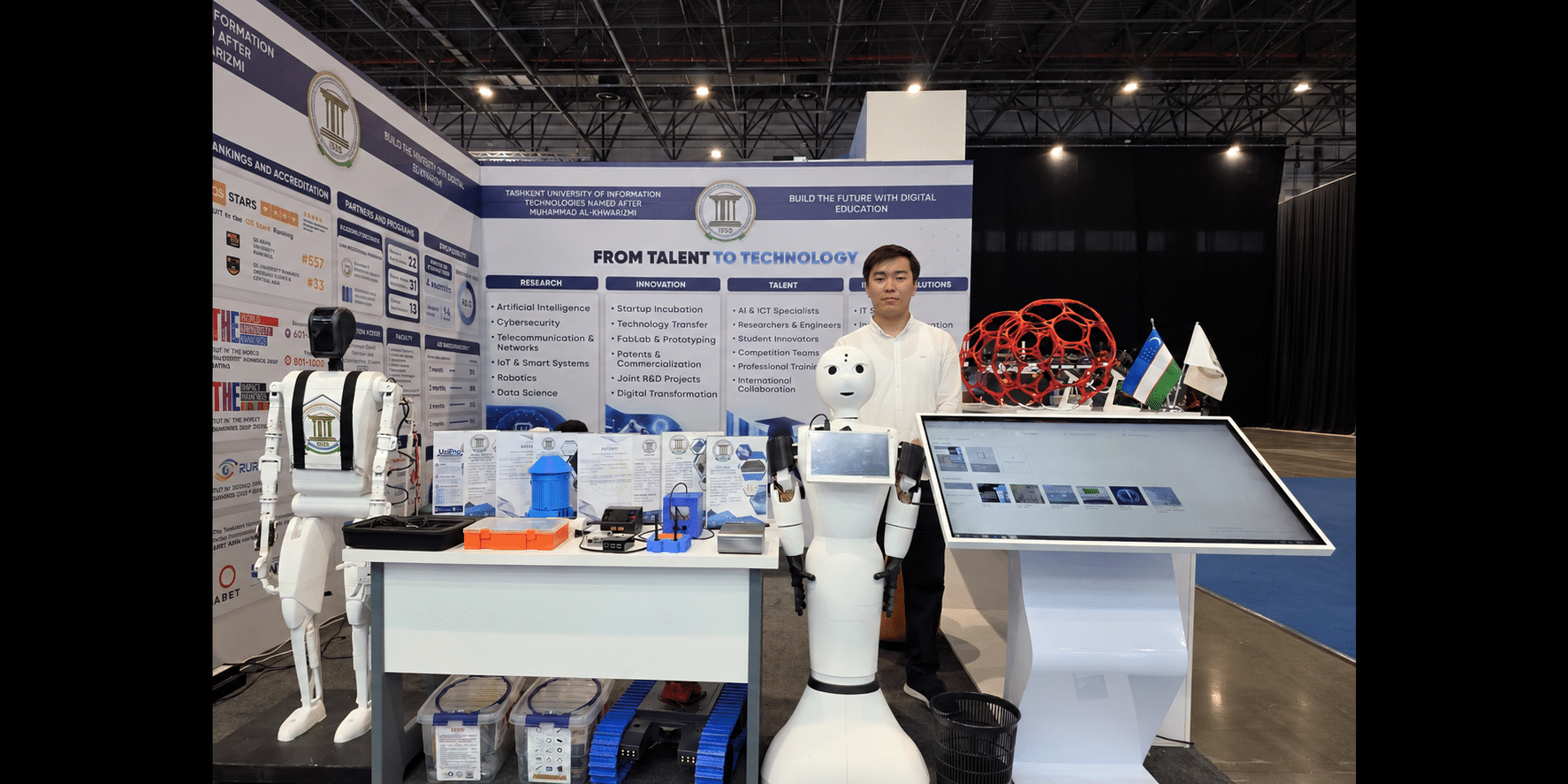
Elsewhere at the exhibition, students from Tashkent University of Information Technologies (TUIT) showed drones and robots developed through university laboratories.
Third-year student Ruslan Burkitbayev said students can receive equipment and other resources from the university to build their projects. Some drones are assembled from imported components, while others are designed by students themselves.
The largest model displayed at the stand can carry up to 23 kilograms, according to Burkitbayev, and reach speeds of up to 160 kilometers per hour. A smaller sports drone can reach 220 kilometers per hour.
Some models are already offered for sale. Burkitbayev put the price of the larger drone at about 25 million Uzbek soums ($2,112), compared with around 12 million soums ($1,013) for a smaller model and 8 million soums ($676) for a sports drone.
Students also displayed a humanoid robot that Burkitbayev said could perform basic household tasks.
“You can sit at home and tell it, ‘Bring me coffee,’ ‘Bring me water,’ or ‘Clean the house,’” Burkitbayev said.
Artificial intelligence was also the subject of the Future Intelligence Forum, held during ICT Week on September 23. Huawei organized the event with Uzbekistan’s Center for Artificial Intelligence and Digital Economy Development, in cooperation with the IT Education Association and with support from the Ministry of Digital Technologies.
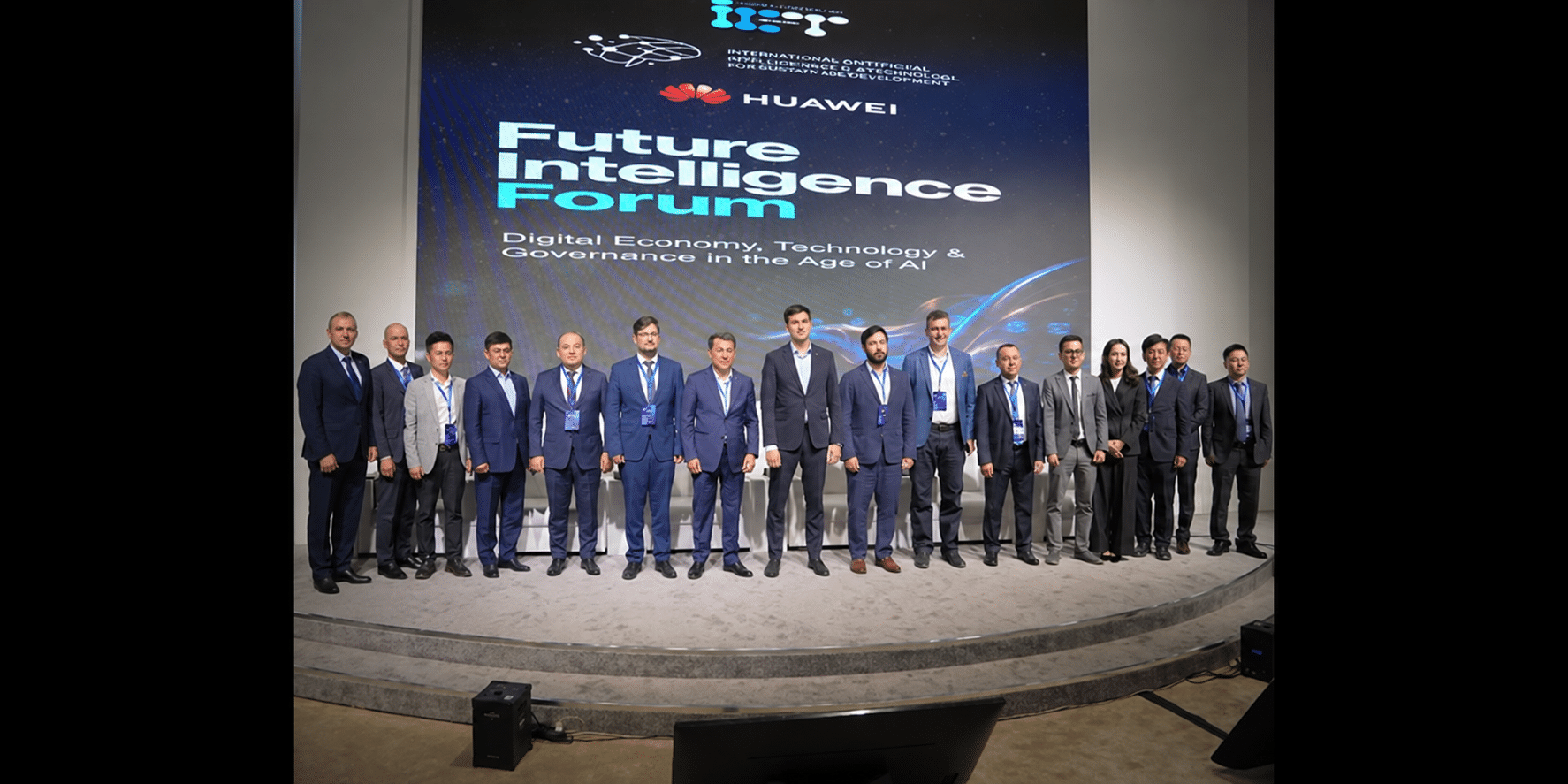
Participants at the Future Intelligence Forum during ICT Week Uzbekistan 2026. Image: TCA
Uzbekistan has adopted an AI development strategy through 2030, covering computing infrastructure, the use of AI in government and the economy, specialist training, and support for technology companies.
For the startups gathered in Tashkent, however, the immediate issue was more concrete: finding investors, customers, and access to markets outside their home countries. Golden Gate Ventures’ planned program is aimed at 20 founders. Who they will be, how they will be selected, and whether investment will accompany the mentorship program have yet to be announced.