
• KGS/USD = 0.01143 -0%
  • KZT/USD = 0.00192 -0%
  • TJS/USD = 0.10820 0.19%
  • UZS/USD = 0.00008 0%
  • TMT/USD = 0.28575 0%
  • KGS/USD = 0.01143 -0%
  • KZT/USD = 0.00192 -0%
  • TJS/USD = 0.10820 0.19%
  • UZS/USD = 0.00008 0%
  • TMT/USD = 0.28575 0%
  • KGS/USD = 0.01143 -0%
  • KZT/USD = 0.00192 -0%
  • TJS/USD = 0.10820 0.19%
  • UZS/USD = 0.00008 0%
  • TMT/USD = 0.28575 0%
  • KGS/USD = 0.01143 -0%
  • KZT/USD = 0.00192 -0%
  • TJS/USD = 0.10820 0.19%
  • UZS/USD = 0.00008 0%
  • TMT/USD = 0.28575 0%
  • KGS/USD = 0.01143 -0%
  • KZT/USD = 0.00192 -0%
  • TJS/USD = 0.10820 0.19%
  • UZS/USD = 0.00008 0%
  • TMT/USD = 0.28575 0%
  • KGS/USD = 0.01143 -0%
  • KZT/USD = 0.00192 -0%
  • TJS/USD = 0.10820 0.19%
  • UZS/USD = 0.00008 0%
  • TMT/USD = 0.28575 0%
  • KGS/USD = 0.01143 -0%
  • KZT/USD = 0.00192 -0%
  • TJS/USD = 0.10820 0.19%
  • UZS/USD = 0.00008 0%
  • TMT/USD = 0.28575 0%
  • KGS/USD = 0.01143 -0%
  • KZT/USD = 0.00192 -0%
  • TJS/USD = 0.10820 0.19%
  • UZS/USD = 0.00008 0%
  • TMT/USD = 0.28575 0%
14 December 2025

Kazakhstan Plans to Export Up to a Third of Its Fuel Production by 2040

The government of Kazakhstan has approved a long-term development strategy for the oil refining industry for the period 2025-2040, significantly increasing its forecast for petroleum product exports. The new plan triples previous export projections, aiming for exports to account for 30% of total production by 2040.

According to the strategy, key priorities include expanding refining capacity and boosting exports to China, India, and neighboring Central Asian countries.

By comparison, in May 2024, the Ministry of Energy had presented a separate draft strategy looking toward 2050, which proposed limiting fuel exports to 10%, and only in cases where domestic supply exceeded demand.

Refinery Modernization and Capacity Goals

The new strategy builds on recent progress. Following the modernization of Kazakhstan’s three largest refineries, Atyrau, Pavlodar, and Shymkent, total oil processing capacity reached 17 million tons per year. The plan envisions boosting this figure to 39 million tons annually by 2040.

“The refining depth has already reached 89%, and the motor fuel produced now meets Euro-4 standards and higher. These improvements have allowed us to meet 90-95% of domestic demand and created favorable conditions for the export of high value-added products,” the Ministry of Energy stated.

The strategy calls for expanding existing facilities and constructing a new petrochemical complex to raise refining depth to 94%. This will ensure full domestic fuel coverage amid projected annual demand growth of 1.5-2%, driven by urbanization and industrial development.

A major focus will be the advancement of Kazakhstan’s oil and gas chemical industry, including the production of polymers, fertilizers, and other high-value products. Up to $5 billion is expected to be invested in this sector.

“The strategy is designed to attract foreign investment, particularly given the country’s reserves of 30 billion barrels of oil. In the context of the global energy transition, this will position Kazakhstan as a regional leader in hydrocarbon processing and enhance economic resilience to global commodity price fluctuations,” the ministry emphasized.

Implementation is scheduled to begin in 2025 with pilot projects for refinery digitization.

Current Production and Export Landscape

In 2024, Kazakhstan’s refineries produced 13 million tons of petroleum products, 1% more than in 2023, according to national oil and gas company KazMunayGas. This included 4.3 million tons each of gasoline and other fuels, and 4.4 million tons of diesel.

Kazakhstan also imported 1.2 million tons of fuel from Russia. Prior to the reintroduction of export restrictions in 2024, the country exported 13,500 tons of motor fuel. Similar bans were in place in 2021, 2023, and 2024, meaning Kazakhstan’s fuel exports effectively occurred only in 2020 (nearly 120,000 tons) and 2022 (1,800 tons).

As previously reported by The Times of Central Asia, Kazakhstan is planning to invest $15 billion in its oil and gas chemical sector as part of six major projects aimed at strengthening downstream capacity and export potential.
Kazakhstan Deports 10,000 Foreigners Amid Crackdown on Migration Violations

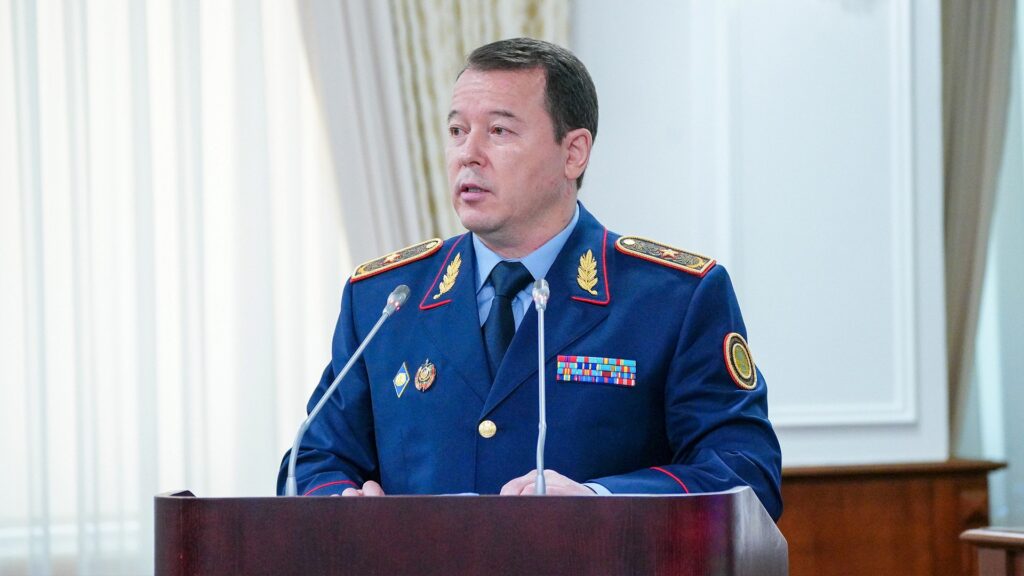
Nearly 10,000 foreign citizens have been deported from Kazakhstan since the beginning of 2025, according to First Deputy Minister of Internal Affairs Baurzhan Alenov. The announcement was made during a recent government meeting addressing migration trends and enforcement measures.

Alenov noted a consistent rise in the number of foreign arrivals to the country. In the first half of 2025 alone, more than 7.5 million people entered Kazakhstan, while 7.2 million departed, a net increase of 600,000 compared to the same period in 2024. Approximately 90% of those arriving are citizens of post-Soviet states.

“It is important to note that 97% of foreign citizens comply with migration laws. However, more than 200,000 individuals have faced administrative penalties,” Alenov stated. “Of these, 46,000 were fined for violating residency rules, and nearly 10,000 have been deported with a five-year ban on re-entry.”

In addition, over 2,000 employers were fined for the illegal employment of foreign workers. Seven criminal cases have been opened against repeat offenders.

Migration Patterns and Permanent Residency

As of mid-2025, approximately 212,000 foreign nationals reside in Kazakhstan on a permanent basis. The largest concentration is in Almaty (42,000), followed by the Almaty region (32,000), and both Astana and the Karaganda region (17,000 each). Over the past three years, the number of permanent foreign residents has risen by 42%.

Kazakhstan also hosts around 430,000 temporary foreign residents. Of these, 360,000 are labor migrants, 17,000 arrived for family reunification, 8,000 for educational purposes, and 44,000 for tourism or private matters.

Government Response and New Initiatives

Prime Minister Olzhas Bektenov emphasized the need for stricter enforcement of migration laws. He highlighted that over 7,000 violations were detected in May alone during nationwide operations.

“Such incidents must be addressed promptly. We need to actively implement digital tools. The introduction of migrant ID cards, issued at border entry points, must be accelerated to improve monitoring and regulation,” Bektenov said.

He instructed the Ministry of Internal Affairs to tighten administrative oversight and called on the Ministry of Labor and Social Protection to enhance regulation of private agencies involved in sending Kazakh citizens abroad for work.

“These agencies currently operate without accountability or oversight. By year’s end, legislative amendments must be proposed to require licensing of such activities. Additionally, I instruct the Ministry of Labor to submit a draft Concept of Migration and Demographic Policy by October 1. This document should align with the Concept of Regional Policy being developed through 2030,” Bektenov concluded.

As previously reported by The Times of Central Asia, the majority of foreign labor migrants in Kazakhstan in 2025 have come from China, Uzbekistan, Turkey, and India, working primarily in the construction sector.

Secret 450-Meter Smuggling Tunnel Uncovered on Kazakhstan-Uzbekistan Border

Kazakhstan’s Financial Monitoring Agency has uncovered a secret underground tunnel used to smuggle petroleum products across the border with Uzbekistan.

The tunnel, discovered in the Turkestan region, extended 450 meters underground. According to the agency, a transnational criminal group operated the tunnel for approximately two months, using it to illegally transport fuel and lubricants. The scheme reportedly involved foreign financing and a carefully organized logistics network to facilitate cross-border smuggling.

The operation to dismantle the network was coordinated by the Prosecutor’s Office of the Turkestan region and the Department of Financial Monitoring, with assistance from Uzbek law enforcement. Authorities have identified all members of the group, including several Uzbek nationals. Five Kazakh citizens have been formally named as suspects. Officials confirmed that the investigation is complete and the case has been referred to court.

This is not the first such case. In December 2024, a similar tunnel was discovered under joint operations between Kazakhstan and Uzbekistan. That tunnel also measured around 450 meters and was used to move an estimated 5 to 7 tons of fuel daily.

In April 2024, Kyrgyz authorities uncovered a separate underground passage in the Jalal-Abad region along the border with Uzbekistan. That tunnel was reportedly used for smuggling both people and goods. According to Kyrgyzstan’s Osh regional police department, officers arrested a woman from Uzbekistan who had illegally entered Kyrgyz territory through the tunnel.

These repeated discoveries highlight the persistence and complexity of smuggling operations across Central Asia’s borders. Authorities in Kazakhstan, Uzbekistan, and Kyrgyzstan have intensified joint efforts to locate and dismantle underground smuggling routes used by organized criminal groups.

Kazakhstan’s Financial Monitoring Agency emphasized that cross-border cooperation will continue in order to prevent similar incidents and strengthen regional border security.

Tajikistan Confirms Deportation of Afghan Refugees

Tajikistan has officially confirmed the deportation of Afghan refugees residing in the country, according to a statement issued by the Press Center of the Border Troops of the State Committee for National Security.

As previously reported by The Times of Central Asia, Tajik authorities launched a large-scale campaign to expel Afghan nationals, giving them just 15 days to leave the country. The move, which has been verified by the United Nations refugee agency (UNHCR), has sparked fear and confusion among thousands of Afghan refugees, including those holding valid residence permits and asylum documents.

Tajik officials justified the decision by citing what they described as a “difficult political and economic situation in the region and worldwide.” The statement emphasized that while many foreign citizens reside legally in Tajikistan for various reasons, some have entered the country illegally or committed serious violations of local laws.

According to the authorities, inspections revealed multiple infractions, including illegal drug trafficking, the promotion of extremist ideologies, submission of false documentation for refugee status, violations of migration rules, possession of citizenship from third countries, and the use of Tajikistan as a transit route.

“As a result, actions are being taken in accordance with national legislation to deport these individuals,” the statement read. “In particular, the deportation of a number of Afghan citizens is linked to these violations.”

In January 2025, UNHCR publicly called on Tajikistan to halt the deportations, following reports that dozens of Afghan refugees were expelled in December 2024. The agency said that at least 80 Afghans were deported, many of whom had valid refugee documentation. UNHCR warned that such actions contravene international law and place individuals at risk.

By the end of 2024, approximately 9,000 Afghan refugees were residing in Tajikistan.

The Caspian Sea Hits Historic Low

The Caspian Sea has dropped to its lowest recorded level, now sitting at less than 29 meters below sea level. The northern basin, bordering Russia and Kazakhstan, is shrinking particularly rapidly. As the water recedes, the exposed seabed is threatening key marine ecosystems. Experts warn the decline is already causing serious disruption to biodiversity in the region.

Declining Volga Flow and Climate Change

The downward trend in sea levels began in the 1990s and has accelerated since 2020, with a nearly 80-centimeter drop in the past four years. The primary factor is a decrease in the annual flow of the Volga River, which supplies approximately 80% of the Caspian’s inflow and contributes 64% to the lake’s total water balance.

In recent years, the Volga’s annual discharge has ranged between 210 and 232 cubic kilometers, well below the historical average of around 250 cubic kilometers. At the same time, rising air temperatures are increasing evaporation rates, further depleting water levels. Scientists link these changes to global climate change and the ongoing rise in greenhouse gas emissions.

Ecological and Economic Impact

Human activity is compounding the problem. Significant water extraction from rivers for agriculture, industry, and municipal use is reducing the volume of water reaching the sea.

Russia’s Ministry of Natural Resources is currently developing a comprehensive program to adapt to these shifting environmental conditions. The initiative aims to enhance forecasting, mitigate the consequences of shallowing, and adjust economic activities to reflect the new hydrological realities.

Experts suggest that only a sustained annual inflow of around 270 cubic kilometers, comparable to levels recorded in the 1970s and 1990s, can halt the lake’s ongoing decline.

Changing Coastlines and Public Concern

A recent video by Kazakh filmmaker Adai Myrzatay has stirred widespread attention on social media. The footage juxtaposes images of the Caspian coastline in 2013 and 2025. Twelve years ago, the pier was surrounded by open water and untouched shoreline. Today, the water has receded dramatically. Bushes now encircle the pier, and high-rise buildings stand where the shoreline once lay. The video has been viewed over 1.5 million times.

The falling water level is leading to the loss of biological diversity and shrinking spawning grounds for species such as the Caspian seal and sturgeon. The shallowing is also disrupting shipping and fishing operations and raising the risk of international disputes over increasingly scarce water resources.

A Shared Challenge for Five Nations

The Caspian Sea, the world’s largest enclosed inland body of water, receives inflow from more than 130 rivers, including the Volga, Ural, Terek, Sulak, and Samur. Its coastline is shared by five countries: Russia, Kazakhstan, Turkmenistan, Azerbaijan, and Iran.

While the Volga’s inflow increased slightly to 232 cubic kilometers in 2024, it remains insufficient to reverse or even stabilize the sea’s decline.

Experts agree that regional cooperation and a coordinated, long-term strategy for water resource management are essential to confronting this environmental crisis.

Kazakhstan and China to Build Ground Satellite Station in Almaty

Kazakhstan and China have agreed to jointly construct a ground satellite station in Almaty, a $3 million initiative, aimed at enhancing scientific cooperation and strengthening regional satellite data infrastructure.

The station will be located on the campus of Al-Farabi Kazakh National University and developed in partnership with China’s Hainan Satellite Data and Application Research Center and Northwestern Polytechnical University. According to Kazakhstan’s Ministry of Science and Higher Education, the station will operate in the X-band frequency, enabling it to receive and transmit data from both Kazakh satellites and foreign spacecraft.

The project was formalized during a recent visit by a delegation from China’s Hainan Province, where officials signed a protocol confirming the station’s placement at the Kazakh branch of Northwestern Polytechnical University.

“This initiative builds on last year’s cooperation agreement between Al-Farabi Kazakh National University and China’s Northwestern Polytechnical University to conduct joint research using a microsatellite,” said Margulan Ibraimov, Vice-Rector for Research and Innovation at the university.

“That agreement directly followed the joint statement made by President Kassym-Jomart Tokayev and President Xi Jinping during the latter’s state visit to Kazakhstan. Our researchers are currently working together on the NKSAT project, a next-generation microsatellite that will be the first of its kind in the region,” Ibraimov added.

The satellite ground station is expected to play a key role in the collection, sharing, and practical application of satellite data across Kazakhstan and neighboring regions of China. It also reflects a broader expansion of Kazakh-Chinese collaboration in advanced technology sectors, including aerospace, digital infrastructure, and academic research.

This initiative aligns with Kazakhstan’s long-term strategy to build domestic capabilities in space science and data-driven technologies, and to position the country as a regional hub for satellite-based services and innovation.



