• KGS/USD = 0.01144 0%
  • KZT/USD = 0.00213 0%
  • TJS/USD = 0.10456 0.19%
  • UZS/USD = 0.00008 0%
  • TMT/USD = 0.28490 0%
  • KGS/USD = 0.01144 0%
  • KZT/USD = 0.00213 0%
  • TJS/USD = 0.10456 0.19%
  • UZS/USD = 0.00008 0%
  • TMT/USD = 0.28490 0%
  • KGS/USD = 0.01144 0%
  • KZT/USD = 0.00213 0%
  • TJS/USD = 0.10456 0.19%
  • UZS/USD = 0.00008 0%
  • TMT/USD = 0.28490 0%
  • KGS/USD = 0.01144 0%
  • KZT/USD = 0.00213 0%
  • TJS/USD = 0.10456 0.19%
  • UZS/USD = 0.00008 0%
  • TMT/USD = 0.28490 0%
  • KGS/USD = 0.01144 0%
  • KZT/USD = 0.00213 0%
  • TJS/USD = 0.10456 0.19%
  • UZS/USD = 0.00008 0%
  • TMT/USD = 0.28490 0%
  • KGS/USD = 0.01144 0%
  • KZT/USD = 0.00213 0%
  • TJS/USD = 0.10456 0.19%
  • UZS/USD = 0.00008 0%
  • TMT/USD = 0.28490 0%
  • KGS/USD = 0.01144 0%
  • KZT/USD = 0.00213 0%
  • TJS/USD = 0.10456 0.19%
  • UZS/USD = 0.00008 0%
  • TMT/USD = 0.28490 0%
  • KGS/USD = 0.01144 0%
  • KZT/USD = 0.00213 0%
  • TJS/USD = 0.10456 0.19%
  • UZS/USD = 0.00008 0%
  • TMT/USD = 0.28490 0%

Rails Through the Mountains: Kyrgyzstan Expanding Network in All Directions

On August 25, in the remote village of Kosh-Dobo in central Kyrgyzstan, construction finally started on Kyrgyzstan’s section of a railway that will connect the country to China and Uzbekistan.

It is one of the most important projects in Kyrgyzstan’s 34 years of independence. And it is not the only railway project in Kyrgyzstan, as the country is at last moving to better connect by rail, both internally and with its neighbors.

Three Dormant Decades

For the first 30 years of independence, no new railway tracks were laid in Kyrgyzstan, but that is now changing. Kyrgyzstan is about 90% mountainous. When Kyrgyzstan became independent in late 1991 after the collapse of the Soviet Union, there were two railways leading into Kyrgyzstan. Both came from Uzbekistan to the west.

A northern line connected Uzbekistan’s capital, Tashkent, through southern Kazakhstan to Kyrgyzstan’s capital, Bishkek, and from there continued eastward to Issyk-Kul, a large lake and tourist area in the northeastern corner of the country. The other railway extended only a few dozen kilometers from the Uzbek border to Osh in southern Kyrgyzstan. The length of the two railways combined amounted to some 320 kilometers.

Work started on the 186-kilometer Balykchy-Kochkor-Kara-Keche railway at the end of March 2022. Balykchy is located at the western tip of Issyk-Kul. Since Soviet times, it has been the last stop on the train that originates in Uzbekistan and travels through Bishkek.

Kochkor is a village in Naryn Province, about 63 kilometers southwest of Balykchy. Some 120 kilometers further to the southwest is Kara-Keche, one of Kyrgyzstan’s primary coal-mining sites and the source of much of the coal used in the thermal power plant that supplies heat and electricity to Bishkek.

Chairman of Kyrgyzstan’s Cabinet of Ministers Adylbek Ksaymaliyev said in May 2025 that there are already plans to connect this railway line to the China-Kyrgyzstan-China line being built through southern Naryn Province.

The Eurasian Development Bank recently agreed to fund a feasibility study for extending the railway from Balykchy to the town of Cholpon-Ata, the main tourist town on the north shore of Issyk-Kul, with a stop at the Issyk-Kul airport at Tamchy. As it stands now, people headed to Cholpon-Ata by rail must switch from the train to car or bus at Balykchy to travel the remaining 80 kilometers to Cholpon-Ata.

In May 2024, President Sadyr Japarov called for that railway line to eventually reach the town of Karakol, at the eastern end of Issyk-Kul, some 140 kilometers from Cholpon-Ata.

Naryn is the biggest province in Kyrgyzstan in terms of territory, but its connections to the rest of the country are tenuous, particularly in the northeastern part of the province where Kochkor and Kara-Keche are located.

Kosh-Dobo is in the southern part of Naryn Province, near the borders of the Jalal-Abad and Osh provinces. The village is located on the route of the long-awaited China-Kyrgyzstan-Uzbekistan (CKU) railway that will run from Kashgar in China’s Xinjiang region to Andijan, Uzbekistan.

The project was first proposed some 30 years ago, but remained in the discussion stages until recently. Eastern and southeastern Kyrgyzstan are covered by the high mountains, the Tien-Shan and Pamir mountains, respectively. That has restricted Kyrgyzstan’s trade routes to Kazakhstan, in the north, and Uzbekistan, in the west.

The 486-kilometer CKU railway will be the first significant eastern route for Kyrgyzstan (there are two roads connecting to China). Ultimately, the railway puts Kyrgyzstan on a China-Europe route that should bring Kyrgyzstan substantial revenue from transit fees, as well as allowing Kyrgyzstan to develop mining sites with critical minerals in hitherto remote areas that will be near the 312 kilometers of the railway line that passes through Kyrgyzstan and transport them to processing plants and markets.

The Kyrgyz section of the railway offers some formidable challenges as it requires the construction of 46 bridges with a combined length of some 120 kilometers, as well as 27 tunnels. China is helping with construction and loaning Kyrgyzstan some $2.35 billion to help with costs for its section of the railway.

In March this year, Kyrgyzstan announced plans to build a railway from the southern city of Batken, some 60 kilometers northeast to Kokand in Uzbekistan. Kokand has links to other cities in Uzbekistan’s section of the Ferghana Valley, as well as to the Uzbek capital, Tashkent.

Riding the Rails

Kyrgyzstan’s government plans to have all these new routes operating by 2030. These lines would add more than 700 kilometers of new railway.

Timing is everything, and the geopolitical situation in Central Asia, in general, and in Kyrgyzstan in particular, has changed in the last decade. For most of the first 25 years of independence, Kyrgyzstan had poor ties with Uzbekistan, limiting the use of existing railways connecting the two countries and precluding any possibility of building new rail links, including the CKU.

Uzbek-Kyrgyz relations have grown much warmer since Shavkat Mirziyoyev became Uzbekistan’s president in 2016. The Kyrgyz-Uzbek border was finally demarcated, and Uzbekistan is participating in projects inside Kyrgyzstan, such as the construction of the Kambarata-1 Hydropower Plant.

When Russia launched its full-scale war on Ukraine, China’s trade with Europe was hampered by EU sanctions on goods transiting Russian territory, which led China to expand the Middle Corridor through Central Asia. Beijing’s decision to finally move forward with the CKU railway after all these years was no doubt prompted by the restrictions on moving goods through Russia.

Development of the domestic railway network was long overdue. Outside cities and towns, most of the roads are gravel or dirt.

Kyrgyzstan’s wealth lies in the mining industry, and the expansion of railways will help the country open and take advantage of mineral deposits. Remote communities in eastern Kyrgyzstan will benefit from being on or near the railways, as they should have better access to food and other goods.


Kyrgyzstan Begins Building Strategic Highway to China’s Xinjiang

Kyrgyzstan has begun construction on the Barskoon-Bedel highway, a key section of the future Barskoon-Uchturfan-Aksu corridor that will link the Issyk-Kul region with China’s Aksu prefecture in Xinjiang via the Bedel Pass.

The new road is expected to shorten the distance between Aksu and Kyrgyzstan by 500 kilometers, saving at least 12 hours of travel time for freight carriers.

Route and Infrastructure

The highway will cross the Barskoon and Soek passes, the Kara-Sai valley, and the Ashuu-Suu pass. To ensure year-round use, the project includes construction of a 5.5 km tunnel under the Soek pass and a 3.8 km tunnel beneath the Ashuu-Suu pass, both areas prone to heavy winter closures.

Timeline and Contractor

Construction is being carried out by China Road and Bridge Corporation (CRBC). The main roadworks are scheduled for completion in September 2029, with full commissioning of the highway and supporting facilities expected by September 2030.

The Bedel checkpoint, first opened under a simplified regime in September 2024, lies in a remote mountain zone roughly equidistant from Karakol in Kyrgyzstan and Aksu in China. Its full-scale development with international-standard infrastructure is slated for completion by 2027.

Trade and Regional Connectivity

Once finished, the Barskoon-Bedel corridor will become Kyrgyzstan’s third road crossing with China, alongside the Irkeshtam (Osh region) and Torugart (Naryn region) passes. Unlike the older routes, which are frequently closed during winter, the new corridor is designed to provide a more reliable and time-efficient link.

The project is expected to strengthen Kyrgyzstan’s role as a transit hub for Chinese goods heading to third-country markets. Bilateral trade between Kyrgyzstan and China reached $23 billion in 2024, an eightfold increase in recent years.

Chinese Support

Speaking at the ceremony, Chinese Ambassador Liu Jiangping said the new highway is part of a wider set of strategic projects advancing between the two countries, aimed at accelerating cargo flows and expanding trade, investment, and economic cooperation.

EU Opens First Migrant Resource Center in Uzbekistan as Russia Moves to Tighten Control

The European Union has launched Uzbekistan’s first Migrant Resource Center in Tashkent, while Russia is preparing to roll out a mobile application to monitor foreign workers starting September 1.

Migrant Resource Center in Tashkent

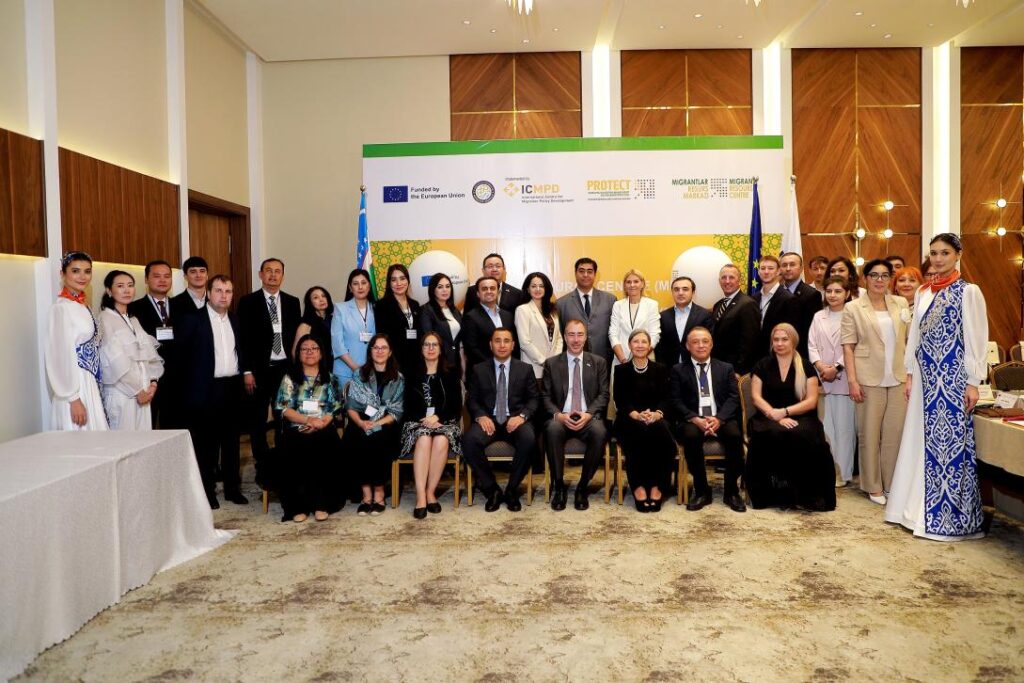
The EU Delegation in Uzbekistan announced that the centre opened on August 26 as part of the EU-funded PROTECT program: Improving Migration Management and Migrant Protection in Selected Silk Routes and Central Asian Countries. The initiative is implemented by the International Centre for Migration Policy Development (ICMPD) in partnership with Uzbekistan’s Migration Agency.

The Center will provide information on legal employment opportunities abroad, raise awareness about the risks of irregular migration, and support the reintegration of returning migrants. Similar centers already operate in Tajikistan and Kyrgyzstan.

At the opening ceremony, EU Ambassador Toivo Klaar said the centers “play a crucial role in providing people with the information they need to make informed decisions about migration.” ICMPD Deputy Director General Sedef Dearing added that the new facility will be “practical and timely for those considering migrating and returning.”

Russia’s Mobile Application for Migrants

Meanwhile, Russia will begin testing a new digital monitoring system in Moscow and the Moscow region on September 1, according to the Multifunctional Migration Centre in the Russian town of Sakharovo.

Citizens from Uzbekistan, Tajikistan, Kyrgyzstan, Armenia, Kazakhstan, Georgia, Azerbaijan, Moldova, and Ukraine will be required to install a mobile application called Amina. The app will handle residence registration, address updates, work permit payments, and appointment scheduling.

The Ministry of Internal Affairs will also have access to users’ geolocation data. Migrants who fail to confirm their location within three working days risk being removed from the registration system and placed on a monitoring list.

Migration Management in Focus

The launch of the EU-backed center in Tashkent reflects Europe’s emphasis on support services and informed choice for migrants, while Russia’s mobile app signals a shift toward stricter surveillance and control. Together, these measures highlight the growing importance of migration management across Central Asia and Eurasia.

Domestic Abuse Back in Spotlight After Self-Immolation, Hostage Cases in Kazakhstan

Two shocking incidents at Almaty airport this year, one involving self-immolation, the other a hostage-taking, have once again led to discussions about gender issues in Kazakhstan.

Two Tragedies at Almaty Airport

On August 25, CCTV cameras recorded a man pouring gasoline over himself at an airport ticket counter after a “personal conflict with his common-law wife,” before setting himself alight. Police extinguished the fire, but the man remains in critical condition in hospital, according to the Transport Police Department. The airport chief of police stated that “according to preliminary data, the man committed this offense because of domestic relations.” Although internet platforms have been rife with speculation about what lies behind the incident, no further information is currently available.

Earlier, on March 7, Mashrapbek Baratov assaulted a female security officer at the same airport, dragging her by the hair and threatening her with a knife while claiming to be carrying a bomb. He was disarmed by a bystander, Musa Abdraim, who was later awarded a medal for bravery by President Kassym-Jomart Tokayev. Baratov, who had a history of violence against women, was sentenced to 11 years in prison in July.

The Bishimbayev Case and “Saltanat’s Law”

These cases reflect a wider pattern of violence against women. The most infamous case involved former Minister of National Economy Kuandyk Bishimbayev, who beat his partner, Saltanat Nukenova, to death in November 2023. The trial, broadcast live, shocked the country and drew international attention. Bishimbayev was sentenced to 24 years in prison in May 2024.

The case coincided with the introduction of new legislation, the Law on Ensuring Women’s Rights and Child Safety, signed by Tokayev in April 2024. Publicly dubbed “Saltanat’s Law,” it toughened penalties for domestic abusers and marked a turning point in public awareness of gender-based violence.

High-profile prosecutions continue. On July 18, former diplomat Saken Mamash was sentenced to six years in prison for psychological and physical abuse of his ex-wife.

Progress and Persistent Gaps

Officials report cautious progress. State Councilor Yerlan Karin announced in June 2025 that domestic violence reports had dropped by 20.5% year-on-year. Serious domestic crimes fell by nearly one-third, and crimes against minors also declined. Overall, the number of crimes against women has halved in five years.

Yet experts warn the problem is far from solved. Kazakhstan still lacks trained police officers, shelters, and support services for victims. Civil society groups stress that legal reforms must be accompanied by education campaigns to challenge entrenched attitudes that relegate women to a secondary role within families.

Despite women’s growing participation in business and public life, traditional norms often leave them vulnerable. Many abusers justify violence as a way of “correcting” women who fail to meet domestic expectations. High levels of objectification and sexualization further reinforce inequality.

A Continuing Struggle

While Saltanat’s Law has signaled a strong state response, the Almaty airport tragedies reveal the dangers of ignoring early warning signs of violence. Until legal measures are matched with deeper cultural change and expanded support networks, Kazakhstan’s women remain at risk.

Yacht Fleet Launched on Lake Issyk-Kul to Boost Tourism and Sports

On August 26, Kyrgyzstan’s resort city of Cholpon-Ata inaugurated the first monotype yacht fleet on Lake Issyk-Kul, marking a new stage in the development of the region’s tourism infrastructure.

The project was spearheaded by Evgeny Kotov, a Russia-born entrepreneur, international business trainer, and founder of the Practicum business school.

At the opening ceremony, Kyrgyzstan’s Minister of Economy and Commerce Bakyt Sydykov highlighted the significance of the initiative, noting that tourism is defined as a strategic sector of the national economy under the National Development Program until 2030.

According to Sydykov, the yacht fleet will help diversify Issyk-Kul’s tourism offerings by developing water sports and recreation, attracting visitors year-round, creating new jobs, and strengthening Kyrgyzstan’s international image and investment appeal.

The new sailing infrastructure also opens opportunities for training athletes and hosting international competitions. Earlier this year, the ministry backed a proposal from the Sailing Federation of the Kyrgyz Republic to exempt sports equipment, including sailing yachts, from customs duties and to simplify procedures for the temporary import of vessels participating in competitions.

Discovery in Uzbekistan Reveals Early Steps Toward Agriculture 9,200 Years Ago

An international team of archaeologists has uncovered evidence that hunter-gatherer communities in southern Uzbekistan were harvesting wild barley as far back as 9,200 years ago, reshaping current understanding of how agriculture first emerged.

Until now, scholars largely believed that the domestication of crops such as barley and wheat began in the Fertile Crescent about 10,000 years ago, particularly among the Natufian people. But new findings from Uzbekistan’s Surkandarya Valley indicate that the cultural practices leading to farming extended much further afield. Researchers argue this challenges long-held assumptions that agriculture arose only once, in response to climate change or population pressures, in a single geographic cradle.

Excavations at Toda Cave

The discovery was made at Toda Cave, excavated under the direction of Xinying Zhou of the Institute of Vertebrate Paleontology and Paleoanthropology in Beijing, with oversight from Farhad Maksudov, director of the Institute of Archaeology in Samarkand.

From the cave’s oldest layers, the team recovered stone tools, charcoal, and plant remains. Archaeobotanical analysis by Robert Spengler of the Max Planck Institute of Geoanthropology confirmed the presence of wild barley, along with pistachio shells and apple seeds, suggesting a diverse diet.

Stone blades and flakes, mostly made from limestone, showed clear use-wear patterns consistent with cutting grasses and plants. These tools closely resemble those found at early farming sites elsewhere.

Rethinking the Origins of Agriculture

“This discovery should change the way scientists think about the transition from foraging to farming,” Zhou said. Spengler added that repeated harvesting of wild plants may have led to unintentional domestication, with early foragers gradually shaping the plants they relied on.

The researchers suggest that the behaviors seen in Toda Cave could represent either an independent experiment in cultivation or evidence of an earlier-than-assumed eastward spread of farming traditions from the Fertile Crescent. Either way, the findings highlight the role of Central Asia in the global story of agriculture.

Next Steps

The team plans to expand excavations in the region to determine whether similar practices existed among other communities. “These ancient hunters and foragers were already tied into the cultural practices that would lead to the origins of agriculture,” Spengler noted.

The discovery underscores that Central Asia, long overlooked in studies of agricultural origins, may have played a crucial role in humanity’s shift from foraging to farming.