• KGS/USD = 0.01144 0%
  • KZT/USD = 0.00213 0%
  • TJS/USD = 0.10456 0.19%
  • UZS/USD = 0.00008 0%
  • TMT/USD = 0.28490 0%
  • KGS/USD = 0.01144 0%
  • KZT/USD = 0.00213 0%
  • TJS/USD = 0.10456 0.19%
  • UZS/USD = 0.00008 0%
  • TMT/USD = 0.28490 0%
  • KGS/USD = 0.01144 0%
  • KZT/USD = 0.00213 0%
  • TJS/USD = 0.10456 0.19%
  • UZS/USD = 0.00008 0%
  • TMT/USD = 0.28490 0%
  • KGS/USD = 0.01144 0%
  • KZT/USD = 0.00213 0%
  • TJS/USD = 0.10456 0.19%
  • UZS/USD = 0.00008 0%
  • TMT/USD = 0.28490 0%
  • KGS/USD = 0.01144 0%
  • KZT/USD = 0.00213 0%
  • TJS/USD = 0.10456 0.19%
  • UZS/USD = 0.00008 0%
  • TMT/USD = 0.28490 0%
  • KGS/USD = 0.01144 0%
  • KZT/USD = 0.00213 0%
  • TJS/USD = 0.10456 0.19%
  • UZS/USD = 0.00008 0%
  • TMT/USD = 0.28490 0%
  • KGS/USD = 0.01144 0%
  • KZT/USD = 0.00213 0%
  • TJS/USD = 0.10456 0.19%
  • UZS/USD = 0.00008 0%
  • TMT/USD = 0.28490 0%
  • KGS/USD = 0.01144 0%
  • KZT/USD = 0.00213 0%
  • TJS/USD = 0.10456 0.19%
  • UZS/USD = 0.00008 0%
  • TMT/USD = 0.28490 0%

South Korea to Support Health and Nutrition in Kyrgyz Schools

The Korea International Cooperation Agency (KOICA), in partnership with Kyrgyzstan’s Ministry of Education, has launched a new initiative aimed at improving health and nutrition in schools by incorporating locally produced agricultural products into school meals.

According to KOICA’s Kyrgyzstan office, the project will directly benefit approximately 16,000 students and local farmers across the regions of Osh, Jalal-Abad, Chui, Naryn, and Batken.

The project aims to enhance children’s health through fortified school meals, upgraded school infrastructure, and capacity-building programs for school personnel.

With a total budget of $10 million, the program will run until 2028. It will support the renovation of kitchens and dining areas, the construction of toilets, the installation of handwashing stations, and the delivery of educational programs on healthy eating, meal procurement, health, and hygiene in approximately 40 schools.

In addition, the project includes training for local agricultural cooperatives on crop cultivation, post-harvest handling, and operational management, alongside the development of model farms.

A key component of the initiative is expanding access to clean water and ensuring that hygiene and sanitation services are adequate, inclusive, and gender-sensitive.

This is not KOICA’s first investment in Kyrgyzstan’s development. Earlier, The Times of Central Asia reported on a separate $10 million project launched by KOICA to improve air quality in the country, with a particular focus on Bishkek.

Rising Cost of Private Education in Central Asia Widens Wealth Gap

The cost of private education in Central Asia continues to rise sharply, increasingly making it an option reserved for the region’s wealthiest families, according to a report by Akchabar.

Once a rarity, private schools have proliferated across the region over the past decade, driven by parental demand for smaller class sizes, enhanced discipline, improved safety, and individualized learning. Many institutions now offer full-day programs that include lessons, supervised homework, and extracurricular activities ranging from robotics and IT to sports and languages. In cases of academic decline, private tutors are assigned to help students catch up, services rarely available in the public sector.

Kyrgyzstan

The number of private schools in Kyrgyzstan has risen from 152 in 2020 to 224 in 2024. Annual fees vary widely: Smart School charges approximately $2,861 per year, while Indigo Sapat starts at $4,500. Tensai International School costs up to $9,600 annually, and BIS ranks among the most expensive at $15,000. More affordable options include Avenir International, with monthly fees between $423 and $480.

To address overcrowding in public schools, particularly in Bishkek and Osh, the government has begun easing licensing procedures for private institutions.

Kazakhstan

In Almaty, tuition rates also span a wide range. Baiterek School charges $274 per month, while Koula.kz costs $443. Tamos Space School offers an annual program for nearly $4,900. Premium institutions such as Miras International School Almaty charge between $9,600 and $12,927 per year, while Galaxy International starts at $8,319.

Uzbekistan

Uzbekistan’s private education market is expanding rapidly. Artel TS charges $358 per month, while Diplomat International reaches up to $628. Wise School costs $437 per month, and Oxbridge International remains among the most affordable at $752 per year for primary classes. At the top end, CIS Tashkent stands as the region’s most expensive school, with tuition ranging from $19,000 to over $24,000 annually.

Tajikistan

Private school fees are particularly high relative to average incomes. At Empire of Knowledge, annual tuition starts at $2,362 for lower grades and rises to $2,545 for upper grades. Ruyo School offers separate programs: English-language instruction costs $2,899 per year, while the Russian-language track is around $2,577. Meanwhile, Shakhsiyat School charges approximately $1,610 annually for Tajik- or Russian-language instruction, and nearly $1,933 for the English-language track.

A Growing Divide

Despite the range of offerings, private school costs remain out of reach for most families. In Uzbekistan, where the average monthly wage is about $476, even mid-tier private schools amount to several months of income, while top schools charge more than $20,000 per year. In Tajikistan, where average monthly wages stand at around $279, tuition starting at $1,600 is unaffordable for the vast majority of households.

For wealthier families, however, private education has become both an investment and a marker of social status, with the choice of school often carrying as much weight as profession or income.

Uzbekistan Eyes Paulo Bento as National Team Coach Amid Ambitious Football Reforms

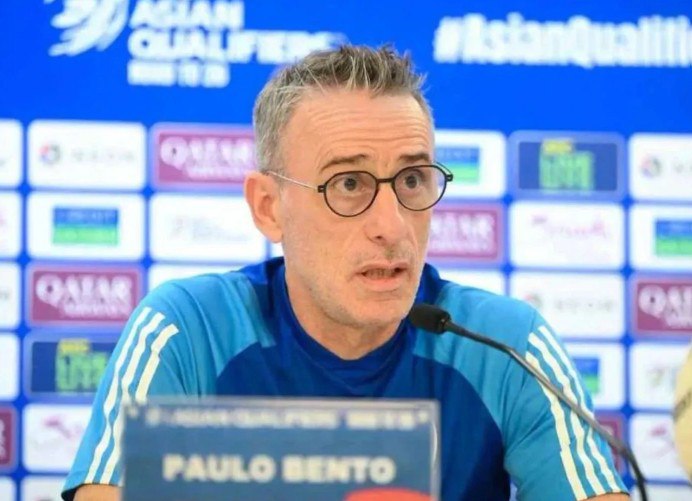
Reports regarding Uzbekistan’s search for a new head coach for its national football team have taken a significant turn, with Paulo Bento, former manager of South Korea and Portugal, emerging as a leading candidate, according to Football-Asian.

The Uzbekistan Football Association (UFA) is seeking a seasoned tactician to lead the team during its landmark debut at the 2026 FIFA World Cup. Initial approaches to high-profile names such as Germany’s 2014 World Cup-winning coach Joachim Löw and veteran Turkish manager Fatih Terim failed to yield results. Attention has since shifted to Bento, a 56-year-old Portuguese coach with a strong international and club-level résumé.

Bento previously guided Portugal to the semi-finals of Euro 2012 and led South Korea to the Round of 16 at the 2022 World Cup in Qatar. His coaching career also includes stints with clubs in Portugal, Brazil, Greece, and China, as well as a recent tenure with the UAE national team. For Uzbekistan, which qualified for the World Cup for the first time this year, Bento’s tournament experience and tactical acumen are considered valuable assets.

“Whether Bento accepts the challenge of leading Central Asia’s standard-bearers remains to be seen, but the very fact he is in the frame underlines Uzbekistan’s determination to think big,” Football-Asian reported.

Current manager, Timur Kapadze, who led Uzbekistan to their first World Cup finals appearance, has dismissed rumors that he is to be replaced. “No one from the Football Association has informed me of anything. There was no talk about bringing someone in. It’s hard for me to comment on this news,” Kapadze stated.

Domestic Football Reforms Underway

In parallel with their reported search for a new coach, Uzbekistan is undertaking structural reforms to strengthen its football development pipeline. A recent presidential decree mandates the creation of a “Legionnaires’ Club” under the UFA, aimed at uniting Uzbek footballers and specialists with experience abroad.

These members will collaborate with local academies and football schools to share their expertise. In support of these efforts, state-owned land plots will be allocated under public-private partnerships to help them establish football academies and clubs throughout the country.

Tajikistan Average Salary Rises but Trails Behind Central Asia

Tajikistan has recorded a rise in both nominal and real average wages, yet the country continues to report the lowest salary levels in Central Asia. The income gap with Kazakhstan and Russia remains especially pronounced.

Nominal and Real Wages

In June 2025, the average nominal monthly wage in Tajikistan reached 3,136.12 somoni ($314), marking a 21.4% year-on-year increase, according to the Statistics Agency under the President of Tajikistan. However, the minimum wage remained unchanged at 800 somoni ($88).

Adjusted for inflation and purchasing power, real wages grew by 17.2% compared to June 2024.

Economists stress the importance of distinguishing between nominal and real wages: while nominal wages reflect contractual earnings, real wages indicate actual purchasing capacity.

Agricultural workers remained the lowest-paid group, with an average income of 1,082.31 somoni ($119). In contrast, employees in financial intermediation and insurance earned the highest wages, averaging 7,703.32 somoni ($847) per month.

Regional Comparisons

Despite the wage increases, Tajikistan lags behind its neighbors.

In Kyrgyzstan, the average salary between January and June 2025 was 42,020 soms ($481), a 19.6% increase over the previous year.

In Uzbekistan, the average wage reached 5.98 million soums ($484) by mid-year, up 17.2% from the same period in 2024.

Kazakhstan reported an average monthly salary of 423,133 tenge ($790) in the first quarter of 2025, reflecting a 10.7% increase.

Meanwhile, in Russia, average wages stood at 99,422 rubles ($1,231) as of May 2025.

Tajikistan’s average salary is nearly four times lower than Russia’s and less than half of Kazakhstan’s, highlighting its continued economic disparity within the region.

Russian Climber Stranded on Kyrgyzstan’s Pobeda Peak is Feared Dead

In 2021, Russian climber Natalia Nagovitsina stayed with her sick husband overnight on one of Kyrgyzstan’s highest mountains and later recounted the ordeal in which he died in a documentary titled  “Stay with Khan Tengri: Tragedy on the Mountain.”

Now rescue workers and experienced climbers believe it is likely that Nagovitsina is dead after she became immobilized with a broken leg on the upper reaches of another mountain in Kyrgyzstan and efforts to bring her down in bad weather failed. Her story, and the deaths of others who scaled Pobeda Peak this year, have made for a grim high-altitude climbing season within the Central Asian country, which is celebrating its best-known climber, Eduard Kubatov, for recently reaching the summit of K2 in Pakistan without supplementary oxygen.   

Various accounts have described Nagovitsina’s ordeal since she broke a leg on August 12 on Pobeda, Kyrygzstan’s highest mountain at 7,439 meters above sea level. It lies on the border between Kyrgyzstan and China and is also known by the Kyrgyz name Jengish Chokusu (Victory Peak).

Italian climber and friend Luca Sinigaglia helped to bring food, a tent and a sleeping bag to Nagovitsina several days later, but he then fell ill and died. Subsequently, on August 16, a Kyrgyz helicopter involved in rescue operations made a hard landing, injuring some on board. On August 19, a drone filmed movement at Nagovitsina’ sleeping bag on the ridge where she was stranded, but few climbing veterans believe she could have since survived extended exposure to the brutally cold conditions on the mountain. 

“There is practically no chance” that Nagovitsina is alive after nearly two weeks on the mountain, wrote Anna Piunova, editor of Mountain.RU, a Russian website that covers climbing news.

Some climbers, including Bishkek-based Kadyr Saydilkan, bristled at any online commentators who suggested that Nagovitsina, who was in her late 40s, was to blame for the disaster, or didn’t deserve to be rescued, or shouldn’t have been on the mountain in the first place because she was a woman. 

Nagovitsina, Saydilkan said on Facebook, “fought with death for ten days and survived as long as she could. She dreamed, set goals, lived freely, with love, and pursued her dream!!! And you?”

Melon Pyramids and Empty Pantries: Tajik and Turkmen Feasts Amid Everyday Shortages

Pyramids of various kinds of melons, fruits laid across the ground to form intricate, traditional patterns, as well as an abundance of fruit, dried fruit, nuts, and bread overflowing from tables, and even fountains, surrounding the edible ground arrangement, and grapes hanging from poles.

As an advertisement for national products, a background for international events, or a gift for an ally, Tajikistan is gaining fame for elaborate displays of fruit. It is an amazing sight, with fruits and nuts arranged in patterns that cover large areas of the pavilions and gardens where foreign guests are being entertained.

However, as good as these lavish presentations look and taste, these cornucopias are being exhibited in some of Central Asia’s poorest countries, and, unsurprisingly, there has been some discontent and some scandals.

For Sale

On August 16-17, there was an exhibition of Tajikistan’s products and crafts in the Kazakh capital, Astana, with melon pyramids taking center stage in an exhibition that also featured “over a thousand tons of products: fresh fruits and vegetables, nuts, [and] dried fruits.“It was a return performance for the Tajik “masters” who arrange the exhibitions. Astana hosted a fair of Tajik products in August 2023 that drew a big crowd, some of whom were overly anxious to get their hands on the goods. Dozens of people started taking melons and grapes from the pyramids, breaking shelves and decorations in the process.
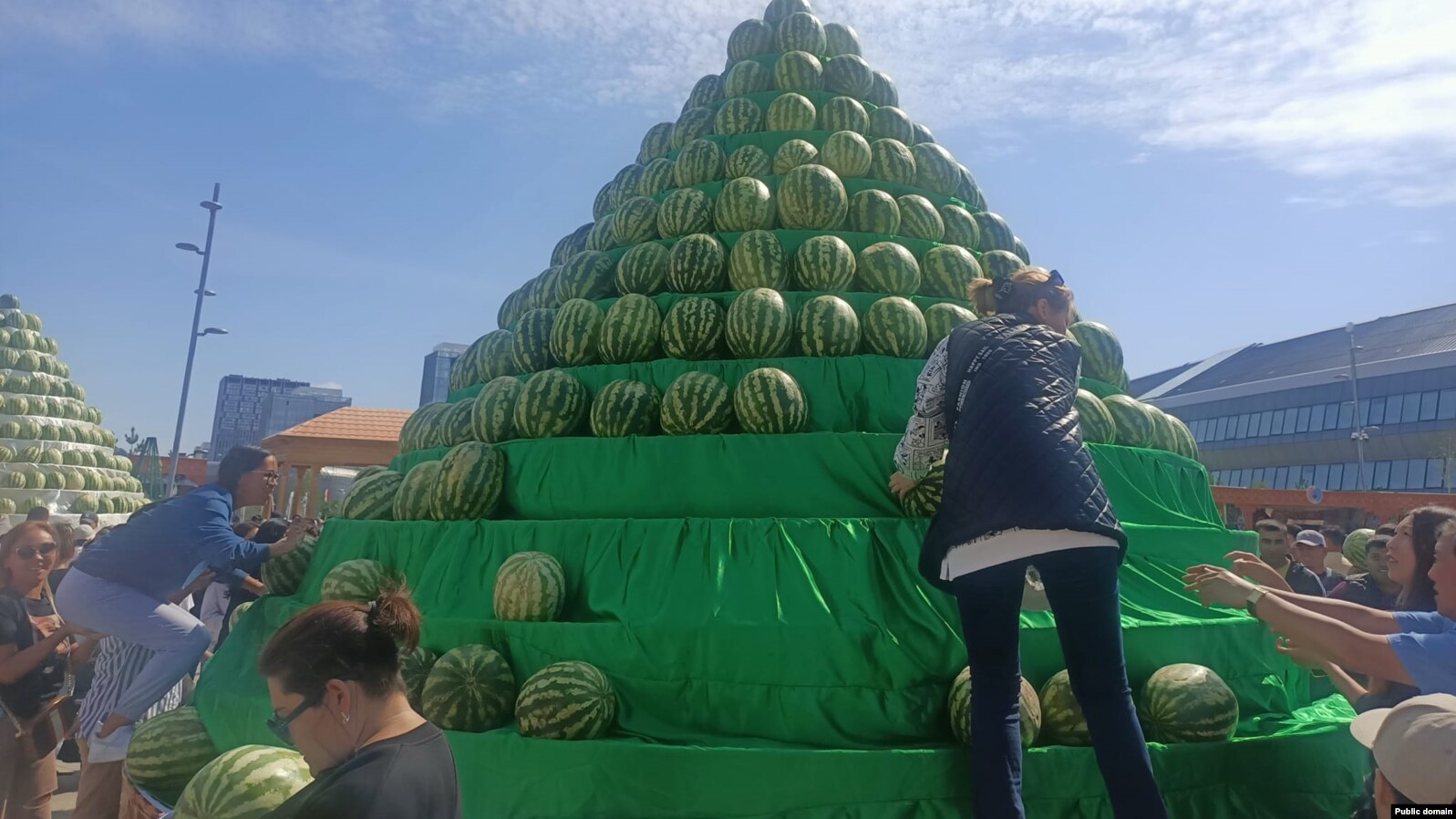
Tajik fair in Astana, 2023; image: public domain

Impress the Guests

One of the most memorable grand displays of fruit occurred when Tajikistan hosted the summit of leaders from the Commonwealth of Independent States (CIS) on September 27, 2018. On the eve of the summit, Tajik President Emomali Rahmon walked his guests through a garden flanked by enough food to feed a small town for a month. It was the first time such a spread had been laid out for guests at an international gathering, with Rahmon seeming to appreciate having an agricultural background when hosting a diplomatic event.

In July 2019, Rahmon met with then-Kyrgyz President Sooronbai Jeenbekov in the northern Tajik town of Isfara. Conflicts along the Kyrgyz-Tajik border were becoming increasingly deadly, and the two presidents met to discuss ways to ease tensions and resolve the festering problems along the frontier.

While the two presidents talked, Rahmon guided Jeenbekov through “6 pyramids… of watermelons and melons, as well as almost 20 types of national breads.“

Sooronbay Jeenbekov and Emomali Rahmon in Isfara; image: press service of the President of the Republic of Tajikistan

When Dushanbe hosted the Shanghai Cooperation Organization (SCO) summit in September 2021, the feast on the eve of the summit was every bit the equal of the CIS summit in 2018 and featured “huge pyramids of fragrant melons and watermelons, carpets of fresh fruit, grapes cascading like a waterfall, and even fountains of melons.”

Rahmon brought his fruit feast to St. Petersburg in October 2022 when CIS leaders gathered for an informal CIS summit that coincided with Russian President Vladimir Putin’s 70th birthday. The colorful and edible display was again present when Tajikistan hosted the meeting of Central Asian leaders in September 2023.

Someone in Turkmenistan seems to think the Tajik fruit decoration created a good atmosphere for an international event.
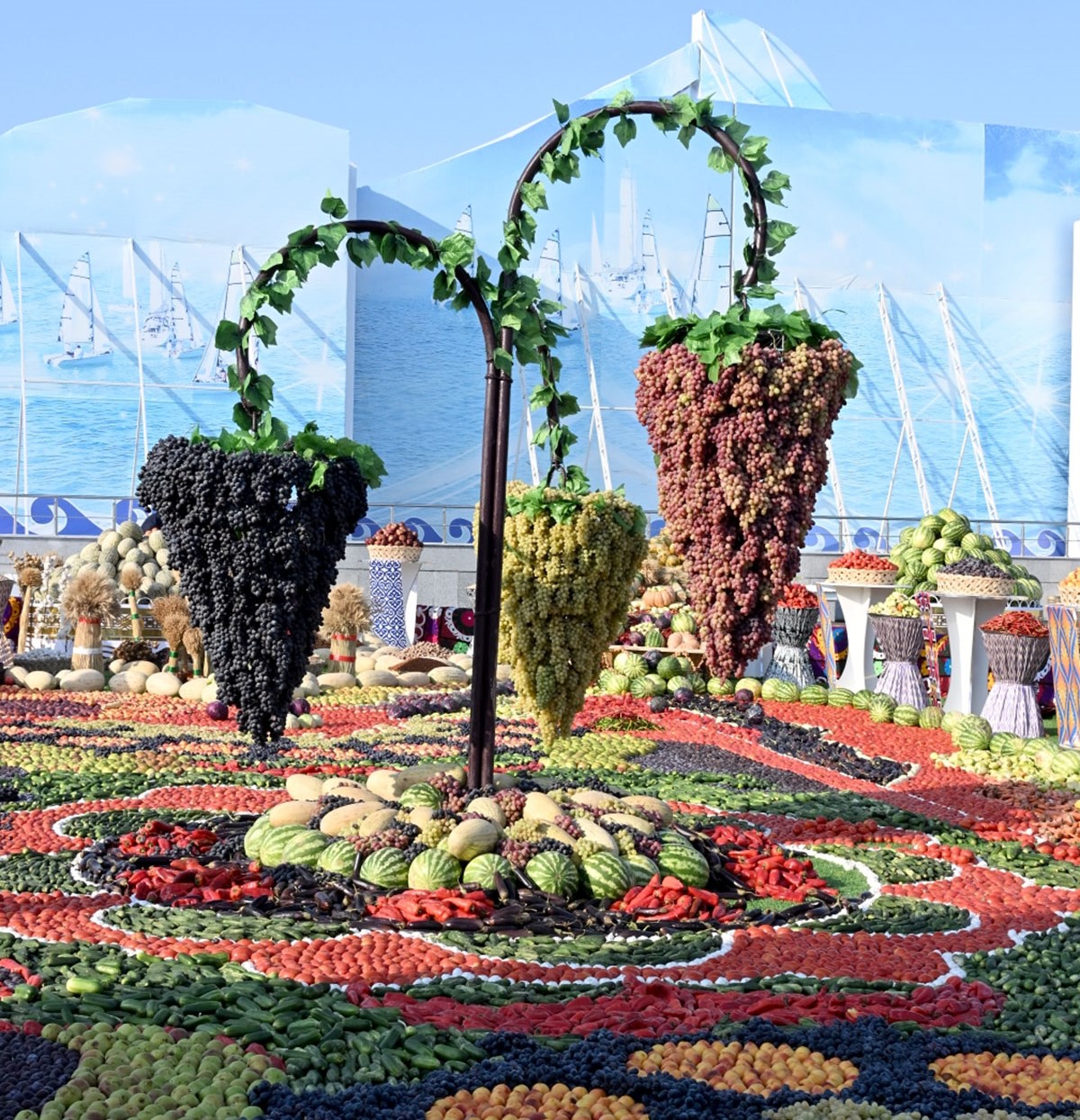
UN Conference in Awaza; image: tdh.gov.tm

Turkmenistan just hosted the UN conference on Landlocked Developing Countries at the Caspian resort city of Awaza on August 5-8. Turkmen state media reported that guests were treated to the “ecologically clean and high-quality vegetables, fruits, greens and berries grown in the favorable climatic conditions of the country” in a display that rivaled those seen in Tajikistan during the CIS and SCO summits. Turkmen state media reports added that the abundance of produce “indicates the successful implementation of modern agricultural technologies aimed at increasing crop yields.”

Let Them Eat Cake

The question every time the melon pyramids, fruit carpets, and hanging grapes appear at these events is, how, or why are these governments doing this when so many people in Tajikistan and Turkmenistan are going hungry?

The reported average monthly wage in Tajikistan is the equivalent of about $279, but many people earn less than half that. If it were not for the remittances sent back to families in Tajikistan by the hundreds of thousands of Tajiks working abroad, many people in the country would have a difficult time making ends meet.

The economic situation in Turkmenistan, meanwhile, has deteriorated so much in the last decade that some people are forced to beg for money or rummage through garbage looking for something to sell, or even something to eat. The Turkmen authorities’ response to this development has been to order police to chase away beggars and people sifting through garbage piles.

One resident of Balkan Province, where Avaza is located, expressed their feelings about the lavish fruit display at the UN conference to Radio Liberty’s Turkmen service. Speaking under the condition of anonymity, the person said. “Guests enjoy all these benefits, and are convinced that Turkmenistan is a beautiful and rich country.” The Balkanabad resident added that this “abundance hides the extreme poverty and humiliation of the Turkmen people.”

UN Conference in Awaza; image: tdh.gov.tm

It turned out that not much of the produce at the UN event in Avaza came from Turkmenistan. Turkmen opposition website Hronika Turkmenistana reported that nine tons of melons came from Uzbekistan, the grapes, pomegranates, and dried fruits from Tajikistan, and the bread and confectionery items were from Kazakhstan.

The amount of fruit used in these decorative arrangements is far more than guests can eat, so what happens to all the leftover fruit, nuts, and bread when the festivities are over? It’s often unclear.

In the case of the gifts to Putin on his birthday, six truckloads of the Tajik produce were reportedly distributed to orphanages in St. Petersburg.

That was also the plan for the excess food at Awaza. It was supposed to be given to orphanages and old folks’ homes, but instead, officials from nearby Turkmenbashi city and Balkanabad Province were taken into custody after they sold the fruit and bread to merchants who then resold it at local bazaars.

Turkmenistan’s emulation of the Tajik fruit arrangement shows the idea is spreading, and, in the future, the importance Central Asian leaders place on meetings and conferences they host could be measured by the number and height of melon pyramids and the length of fruit carpets. *But until prosperity reaches ordinary households, these edible spectacles will read as much mirror as mask – projecting national pride while spotlighting the gap between summit pageantry and everyday needs.