• KGS/USD = 0.01144 0%
  • KZT/USD = 0.00194 0%
  • TJS/USD = 0.10864 0.09%
  • UZS/USD = 0.00008 0%
  • TMT/USD = 0.28571 0%
  • KGS/USD = 0.01144 0%
  • KZT/USD = 0.00194 0%
  • TJS/USD = 0.10864 0.09%
  • UZS/USD = 0.00008 0%
  • TMT/USD = 0.28571 0%
  • KGS/USD = 0.01144 0%
  • KZT/USD = 0.00194 0%
  • TJS/USD = 0.10864 0.09%
  • UZS/USD = 0.00008 0%
  • TMT/USD = 0.28571 0%
  • KGS/USD = 0.01144 0%
  • KZT/USD = 0.00194 0%
  • TJS/USD = 0.10864 0.09%
  • UZS/USD = 0.00008 0%
  • TMT/USD = 0.28571 0%
  • KGS/USD = 0.01144 0%
  • KZT/USD = 0.00194 0%
  • TJS/USD = 0.10864 0.09%
  • UZS/USD = 0.00008 0%
  • TMT/USD = 0.28571 0%
  • KGS/USD = 0.01144 0%
  • KZT/USD = 0.00194 0%
  • TJS/USD = 0.10864 0.09%
  • UZS/USD = 0.00008 0%
  • TMT/USD = 0.28571 0%
  • KGS/USD = 0.01144 0%
  • KZT/USD = 0.00194 0%
  • TJS/USD = 0.10864 0.09%
  • UZS/USD = 0.00008 0%
  • TMT/USD = 0.28571 0%
  • KGS/USD = 0.01144 0%
  • KZT/USD = 0.00194 0%
  • TJS/USD = 0.10864 0.09%
  • UZS/USD = 0.00008 0%
  • TMT/USD = 0.28571 0%
22 December 2025

Opinion: The Ukraine-Russia Peace Talks Need Multiple Platforms for Negotiations

The proposed Istanbul meeting between Zelensky and Putin on May 15 did not take place, with no Russian ministers attending the talks Putin himself had called for, leading Zelensky to describe the Russian delegation as “phony“. Hopes for peace remain, however, as other stakeholders have expressed their eagerness to support a resolution.

With its unique geopolitical position as a bridge between Europe and Asia, Turkey was an obvious choice to host the negotiations. While Turkey has sought to maintain balanced relations throughout the conflict, its provision of military support to Ukraine, including drones, has complicated its image as a neutral party. Despite this, as a NATO member with significant energy partnerships with Russia, Turkey serves as a crucial intermediary. Furthermore, its active role in initiatives like the Black Sea Grain Agreement has reinforced its credibility in international diplomacy. Turkey’s continued involvement, therefore, benefits not only the peace process but also its own economic and strategic interests.

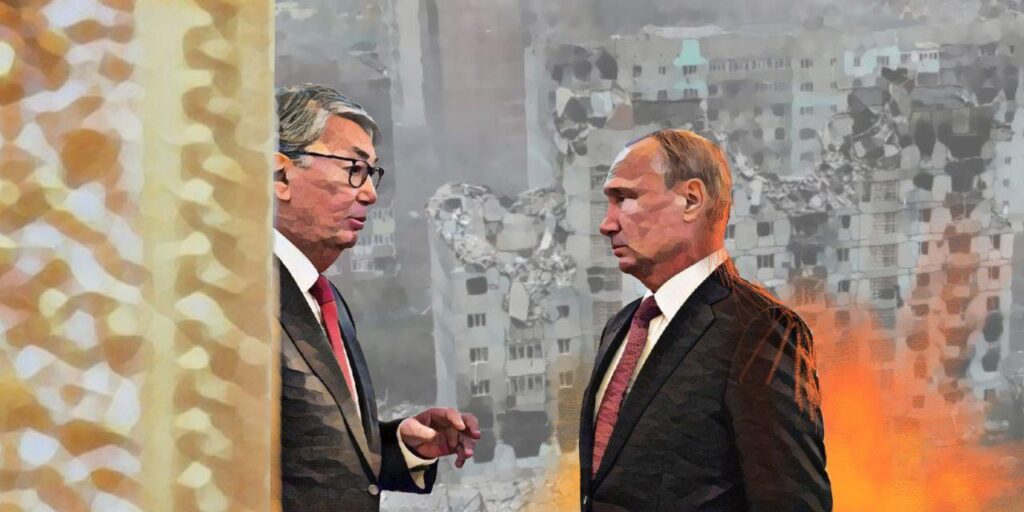
Turkey is not the only stakeholder on the periphery of Russia, however; Kazakhstan is also well-positioned to contribute to the peace negotiations. Kazakhstan’s shared history with Russia and Ukraine as former Soviet republics has shaped mutual economic and security frameworks, rooted in decades of centralized governance and cooperation. The continued use of the Russian language as one medium of communication across these nations underscores intertwined cultural and historical links. Kazakhstan’s relationship with Russia spans centuries, marked by alliances, trade, and cultural exchange, further deepening ties beyond the Soviet era.

In recent years, Kazakhstan has diversified its alliances through its multi-vector foreign policy. It has forged strong relationships with China, the U.S., the EU, and organizations like the SCO and EAEU while cultivating robust economic ties. Its energy sector has attracted major foreign investors such as Chevron, ExxonMobil, and Shell. By hosting peace talks and global summits, Kazakhstan has established itself as a neutral mediator, balancing traditional ties with Russia while expanding its global influence.

Kazakhstan also has an impressive record in terms of peace negotiations. President Kassym-Jomart Tokayev hosted pivotal talks in Almaty in 2024 between Armenia and Azerbaijan, addressing over three decades of conflict in Nagorno-Karabakh. Kazakhstan also played a key role in facilitating the 2018 agreement on the Caspian Sea’s legal status, which resolved disputes over resources and territorial boundaries. The country hosted multiple rounds of Syrian peace talks starting in Astana in 2017, bringing together the Syrian government, opposition groups, and international stakeholders, including Russia and Turkey. Similarly, it provided a platform for the Iran nuclear talks in 2013 and supported the 2015 Iran nuclear deal. Kazakhstan’s neutrality and commitment to diplomacy have earned it credibility as a Middle Power in fostering agreements on contentious issues.

Additionally, Kazakhstan hosted the 2010 OSCE Summit that led to the adoption of the Astana Declaration. This reaffirmed the Helsinki Principles on peace, security, and cooperation from Vancouver to Vladivostok. It represented a critical collective commitment to territorial integrity, sovereignty, and human rights since the dissolution of the USSR. The summit underscored Kazakhstan’s role in addressing Cold War legacies while promoting lasting geopolitical cooperation.

Under President Tokayev, Kazakhstan’s foreign policy has adhered to the principles of the UN Charter, including respecting sovereignty, territorial integrity, and peaceful dispute resolution. Its multi-vector strategy seeks to balance relationships with global powers while upholding international law, asserting the nation’s role as a stabilizing force in an increasingly volatile world.

Kazakhstan’s neutrality has faced challenges during the Ukraine-Russia conflict. By refusing to recognize separatist regions in Ukraine, Kazakhstan affirmed its opposition to unilateral border changes through force. Simultaneously, it engaged with both Kyiv and Moscow, ensuring open channels of communication to mitigate tensions. By offering its capital, Astana, as a neutral venue for diplomatic talks, Kazakhstan has continually emphasized the importance of diplomacy and mutual respect in resolving conflicts.

Kazakhstan’s multi-vector foreign policy positions it as a key player in complex global challenges. While navigating a polarized international environment remains daunting, its balanced approach and adherence to UN principles strengthen its credibility as a mediator in the Ukraine-Russia crisis. Through multifaceted diplomacy, Kazakhstan exemplifies how middle powers can contribute constructively to global peace and security in a multipolar world.


UN Official Urges Tajikistan to Release, Retry Woman Convicted of Treason

A United Nations human rights expert has joined in calls for the release and retrial of a 31-year-old mother in Tajikistan who was convicted of treason and sentenced to eight years in prison after her research on Chinese aid to the Central Asian country allegedly aroused the suspicion of authorities.

A U.N. statement described Rukhshona Khakimova as a “journalist and woman human rights defender” and said it appeared that she had not received a fair trial and may have been targeted for “legitimate human rights journalism” rather than any wrongdoing.

“The case was part of a broader criminal investigation involving former senior officials and politicians allegedly accused of extremism, espionage, and an attempted coup,” said the U.N. announcement, which was released on Wednesday. “Her charges allegedly stemmed from interviews she conducted for a research project on international aid from China to Tajikistan, where she reportedly spoke with two defendants, asking general questions not related to classified information.”

In recent years, China has developed an increasingly robust role as an investor and security partner for Tajikistan, which has a long border with Afghanistan and concerns about militant infiltration.

Mary Lawlor, the U.N.’s special rapporteur on the situation of human rights defenders, said it was “heartbreaking” that Khakimova had been separated from her two young children because the court sent her to jail. Lawlor said Khakimova had a right to a fair and transparent trial and that she was in contact with the Tajik government about the matter.

Tajikistan’s Supreme Court convicted and sentenced Khakimova on Feb. 5. The verdict was upheld on April 2.

International human rights and media groups have also called for Khakimova’s release.

So far, Tajik authorities have not responded publicly to the appeals, which reflect concern about a deteriorating human rights situation in Tajikistan.

However, President Emomali Rahmon removed one restriction on Wednesday, signing a law that “abolishes criminal liability for posting likes or other marks on social networks,” according to the president’s office. The restriction had previously been used to prosecute people accused of endorsing extremist posts on social media, though critics alleged the ban was a way to muzzle opposition to the government.

Tajikistan Lifts Criminal Penalties for Social Media Likes on ‘Extremist’ Content

Tajik President Emomali Rahmon has signed a new law eliminating criminal penalties for liking or reacting to social media posts classified as extremist or threatening to public order. The president’s press office announced the amendment, which revokes part of a 2018 change to the Criminal Code.

Previously, individuals could face prison sentences of 10 to 15 years for openly promoting or supporting purported terrorism or terrorist acts online. Under this legislation, more than 1,500 people have been convicted in Tajikistan, many for merely liking or commenting on posts the government deemed extremist. A significant number of those affected were believed to be affiliated with opposition groups.

It remains unclear whether the new law will result in the release of individuals already imprisoned under the previous statute. However, lawyer Dilshod Jurayev told Radio Ozodi that those convicted may now have grounds to appeal their sentences.

Regional Context

In neighboring Uzbekistan, social media users still face the possibility of legal consequences for engaging with prohibited content if investigators or courts determine that liking such material constitutes distribution. Uzbekistan’s Agency for Information and Mass Communications (AIMC) has cautioned the public against spreading false information. The agency emphasized that engaging with posts containing fake news, disinformation, or extremist content could result in administrative or criminal penalties.

“There is administrative and criminal liability for spreading false or harmful information,” the AIMC stated. “Before you share anything, make sure it comes from a trusted, official source.”

Threads of Power: Women, Heritage, and the Art of the Silk Road

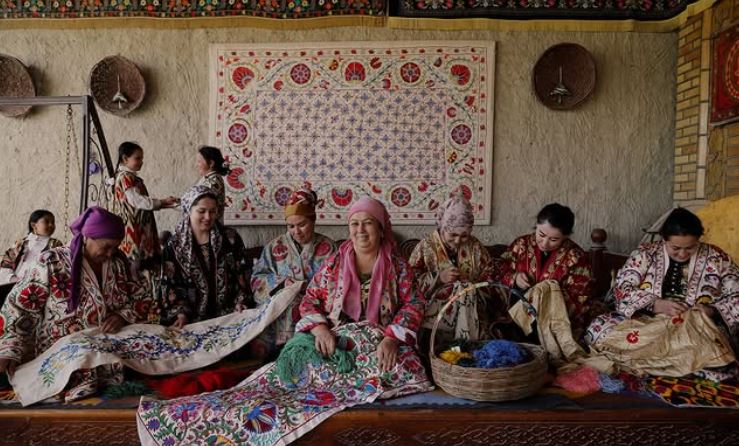
From June 24 to July 10, 2025, the Minerva Association will be presenting the exhibition Weaving the History of Central Asia at the Centre Paris Anim’ Espace Beaujon. This exhibition brings together the artworks of Fatimah Hossaini and the textile creations of Beltepà, paying tribute to the women of the region through the motifs and textile skills inherited from the Silk Road.

In Central Asia, weaving, embroidery, and sewing have long been passed down from mother to daughter, practiced within the home and shared among craftswomen. These domestic yet deeply skilled practices embody an often-overlooked heritage, one that is both intimate and monumental. The exhibition sheds light on how art and fashion can transcend cultural and geographic boundaries, revealing stories of resilience, identity, and creativity.

The exhibition celebrates women not only as artists and artisans but as powerful custodians of heritage. The handmade garments by the women of Beltepà, paired with Fatimah Hossaini’s striking photographic portraits, convey a sense of strength, dignity, and continuity. Together, these works send a compelling message: that of women’s empowerment and the intergenerational transmission of ancestral knowledge.

Fatimah Hossaini’s artwork delves into themes of gender, identity, and cultural resilience. Her portraits of women in Central Asia illuminate lives and traditions that are often rendered invisible, offering a bold visual language that honors their presence and voices. The suzanis featured in the exhibition are rich with meaning. Every motif, color, and pattern tells a story, echoing the layered influences of the Silk Road and the women who continue these traditions today.

Beltepà reinterprets traditional Uzbek fabrics — atlas, adras, bakhmal, and suzani — through a contemporary lens. Her collections merge craftsmanship with innovation, turning textiles into wearable artworks that reflect a living, evolving cultural identity.

Uzbekistan and EU Discuss €12 Billion in New Projects

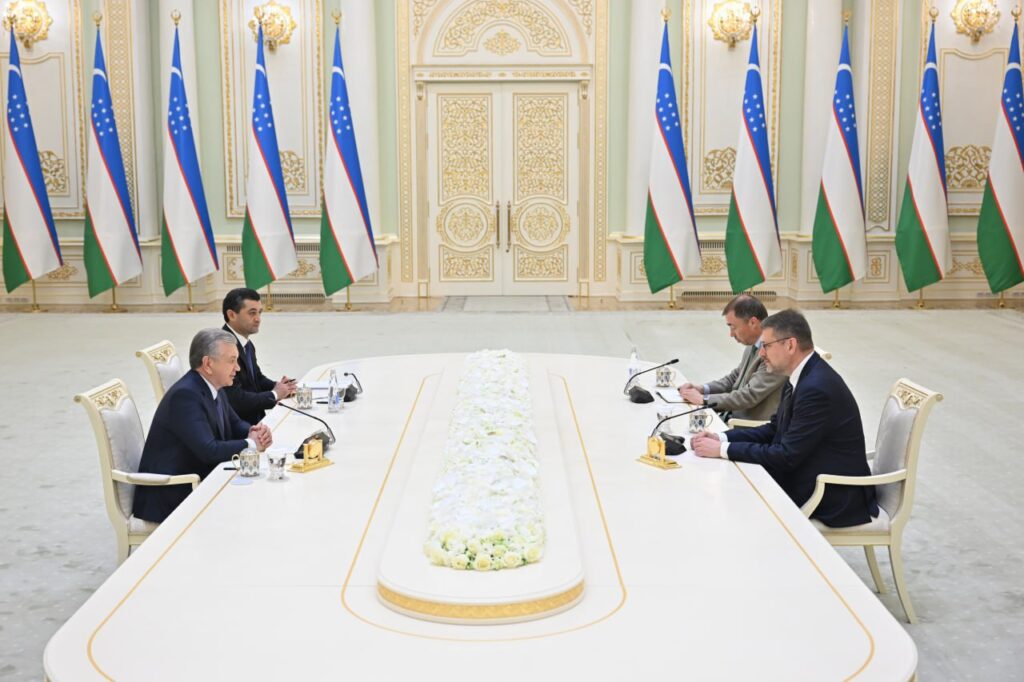
On May 13 in Tashkent, President Shavkat Mirziyoyev met with Eduards Stiprais, the European Union’s Special Representative for Central Asia, according to the presidential press service, with the two sides reviewing the outcomes of the first Central Asia-European Union Summit, held in Samarkand in April, and discussing ways to implement its decisions.

Expanding Strategic Cooperation

The talks focused on strengthening both bilateral and regional partnerships, with particular attention to advancing investment and technical cooperation initiatives valued at €12 billion. The parties also exchanged views on key regional developments and discussed plans for upcoming joint events.

Economic ties between Uzbekistan and the EU have accelerated in recent years. Since 2020, trade between the two has doubled to more than €6 billion, while Uzbek exports to the EU have quadrupled. Over a thousand joint ventures have been launched, and the value of European investment projects in Uzbekistan now exceeds €30 billion.

To attract more European investors, Uzbekistan has undertaken reforms to improve its business environment. In 2024 alone, trade with EU countries reached $6.4 billion, and more than a thousand European firms are currently operating in the country.

Geopolitical Undercurrents

During a separate visit to Uzbekistan in April, Russian Foreign Minister Sergey Lavrov criticized the EU’s growing presence in the region. He accused the EU of using development projects to expand geopolitical influence, particularly in sensitive areas such as customs and border management.

“We are categorically against politicizing cooperation processes and introducing ideological elements associated with Western attempts to dominate,” Lavrov stated, whilst emphasizing that Russia respects the sovereignty of its neighbors and will refrain from interfering in their internal affairs.

A Strategic Pivot

Uzbekistan’s growing ties with the EU reflect a strategic pivot to diversify its economic partnerships and reduce dependence on traditional allies like Russia and China. This move aligns with the region’s broader efforts to balance relations with global powers while fostering local development. The EU’s €12 billion investment and technical cooperation initiatives signal a deeper commitment to Central Asia, enabling countries like Uzbekistan to modernize industries, improve infrastructure, and enhance trade networks. This shift not only boosts Uzbekistan’s economic growth but also creates new opportunities for regional integration by connecting Central Asia with European markets through preferential trade agreements and enhanced supply chains.

However, the deepening EU-Uzbekistan partnership does not come without challenges in the region’s geopolitical landscape. Russia, historically a dominant influence in Central Asia, views the EU’s expanded presence as a potential threat to its sphere of influence. Likewise, China, which has established extensive connectivity projects under the Belt and Road Initiative, may perceive Uzbekistan’s alignment with the EU as a cautious step towards reducing reliance on Beijing-led projects. This strategic recalibration creates a more competitive environment, with Uzbekistan leveraging its geographical position to attract diverse investments while carefully navigating tensions between rival powers. By maintaining a delicate balance, Uzbekistan could emerge as an economic and diplomatic bridge linking Europe, Central Asia, and East Asia.

Brutal Assault on Kazakh Politician Raises Questions

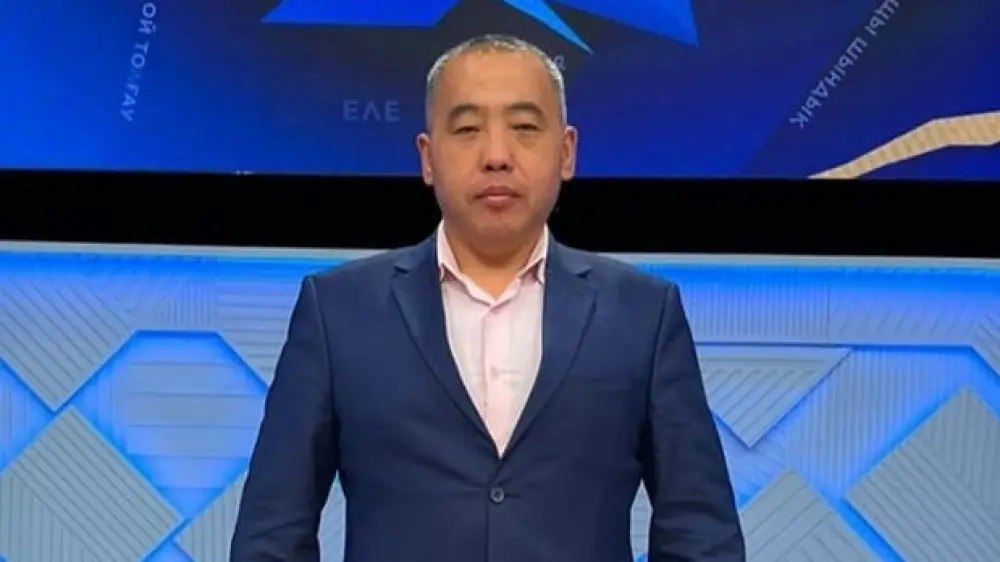
Nurlan Baigaziev, a local politician in the Ili district in the Almaty region, has been brutally beaten in Taraz, according to reports that quickly spread across social media and were subsequently confirmed by law enforcement authorities.

Incident Details

Police confirmed that the incident occurred on the evening of May 13 at a local café. Baigaziev, who sustained facial injuries, was taken to a hospital but declined further treatment. The Zhambyl region police stated that a pre-trial investigation has been launched under Part 1 of Article 293 of the Criminal Code (hooliganism). An individual identified as being involved in the attack has been detained, and investigators are working to determine all the circumstances surrounding the case.

Background and Possible Motives

Social media reports indicate that Baigaziev was in Taraz on a business trip, purportedly meeting with clients in his capacity as a lawyer. Some accounts suggest that the assailant used brass knuckles during the attack. However, the exact motives remain unclear.

This incident comes on the heels of an earlier controversy involving Baigaziev. On April 28, a video circulated online showing juvenile police officers in the Almaty region stopping a 17-year-old girl and offering her a ride in an official vehicle. Baigaziev, who publicly criticized the police for what he described as an abuse of power, attracted widespread attention. The fallout from that video led to the dismissal of one officer and the removal of another.

Related Incidents

Notably, attacks on officials in Kazakhstan are not uncommon. For example, on April 21, Ruslan Berdenov, the deputy mayor of Shymkent, was seriously injured near the city administration building when an assailant fired shots with a Saiga-12 shotgun. The attacker, identified as 30-year-old Zhiinbai Yernar Zhiinbaiuly, was detained at the scene following the intervention of Berdenov’s driver, and a criminal case has been opened on charges of attempted murder. The investigation into that incident remains ongoing.