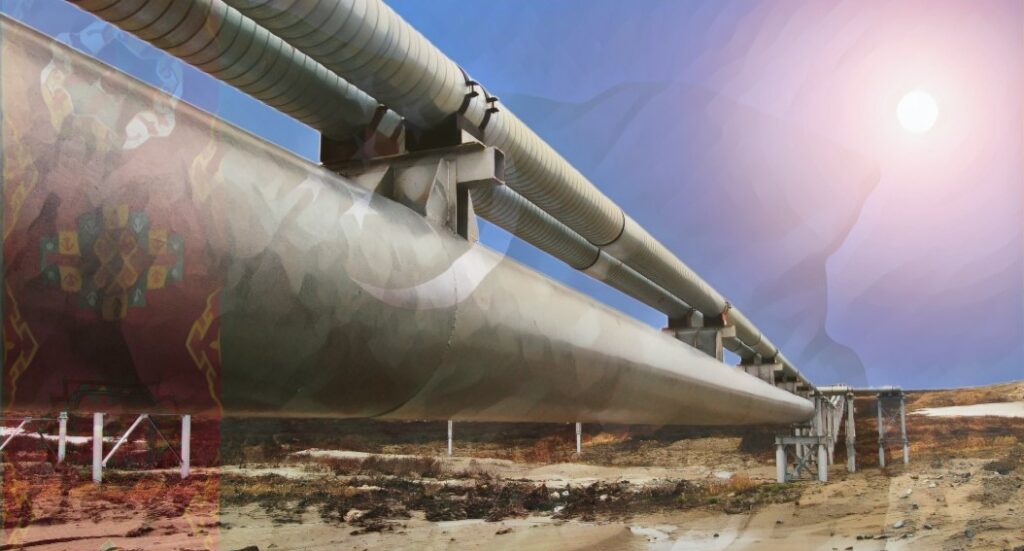
Turkmenistan holds the world’s fourth-largest proven gas reserves. And yet, its energy diplomacy has until quite recently remained inert. The paradox is systemic: it possesses more gas than infrastructural escape routes; yet as demand for non-Russian energy rises across Eurasia’s westward axis, Ashgabat’s relevance grows, not so much because it radically evolves but because the system around it does.
Historically, 80–90% of Turkmen gas has flowed east through the Central Asia–China pipeline, sometimes called the Turkmenistan–China corridor. The dependency is acute, and the pricing asymmetrical. Previous efforts to increase flows in other directions — across Iran, via Azerbaijan, southward to South Asia, or across the Caspian Sea — have been dashed on the rocks of logistics and geopolitics. The early 2000s were especially pivotal, when Turkmenistan’s delay in engaging with the EU’s Southern Gas Corridor initiative shaped a decade of missed leverage. What we are seeing now is not a late start but a late modulation of the country’s energy vectors across weakly emerging paths.
Geoeconomic Constraints as Strategic Catalysts
Dependency on China as a monopsonist (sole purchaser) implies not just limited diversification but two deeper vulnerabilities. First, price-setting mechanisms remain inscrutably opaque. Second, the lack of alternative outlets structurally reinforces the asymmetry. Attempts to broaden options through Iran or Azerbaijan, though nominally ongoing, rely more on swaps than corridors, and even these are uneven.
The Dauletabad–Sarakhs–Khangiran pipeline, completed in 2010, should have represented a minor second axis. However, it operates at a trickle, if at all, due to Iran’s past failure to pay contracted sums in a timely fashion, requiring international arbitration. Another example is the Turkmenistan–Afghanistan–Pakistan–India (TAPI) pipeline, discussed since the 1990s, and in which India lost interest two decades ago. TAPI remains on hold, hampered by Afghanistan’s security volatility and a practical lack of commercial prospects that produce financing shortfalls.
The Trans-Caspian Gas Pipeline (TCGP) was long stalled by legal uncertainties over Caspian Sea seabed rights and opposition from Russia and Iran. Even since the sea’s status under international law was settled by the Caspian Convention, signed in 2018, planning for this pipeline remains somnolent, despite its removal of many legal barriers to TCGP construction.
Swap agreements are usually regarded as workaround tools, but for Turkmenistan, they have become more permanent structural mechanisms, allowing Ashgabat to insert itself into third‑party supply chains without transit risk. Iran’s infrastructure is unreliable but offers compression and metering; Azerbaijan’s network enables reverse flows and flexibility.
A modest but symbolically important addition is the Dostluk field, a previously disputed offshore deposit between Azerbaijan and Turkmenistan in the Caspian Sea. A 2021 Memorandum of Understanding resolved maritime delimitation and designated the field for joint development.
Even when summed all together, these vectors remain mainly null. Once seen as “backup” export routes, they have failed structurally. Turkmenistan, infrastructurally entangled yet geopolitically uncommitted, still lacks true backup and instead manages redundancy, maintaining multiple provisional export channels simultaneously. It must still respond adaptively to shifting constraints while balancing fragile options.
Turkmenistan’s Attempts to Rewire Its Client Network
Since 2023, Ashgabat’s behavior has shifted. Bilateral agendas have softened, and regulatory murmurings hinted at pragmatic change. In February 2025, Turkmenistan finalized a gas swap with Ankara whereby Turkmenistan would deliver up to 2 bcm/y to Iran while Türkiye received an equivalent volume via its northern pipeline grid. Flows began on March 1 this year, with Türkiye’s offtake volume by year’s end projected at 1.3 bcm. For a country that consumes 50 bcm annually, it’s marginal. For Turkmenistan, it’s a crossing.
Though small relative to Türkiye’s 50 bcm/y consumption, the swap symbolizes its diversification beyond Russia and Iran, even as Turkey develops domestic offshore production in the Sakarya gas field. A similar framing applies to Iraq. In 2024, an MOU was signed with Turkmenistan for five years of supply. Implementation, however, has stalled due to U.S. sanctions on Iran complicating Iraqi payments. Nonetheless, the architecture is important: Turkmen gas would help shore up Iraq’s north‑central grid amid Iranian shortages.
The EU remains marginal but attentive. Since 2023, high-level EU delegations have resumed consultations in Ashgabat. Hungary has lobbied for deeper engagement within the Turkic States format; Romania and Bulgaria have signaled quiet interest in Caspian–EU tie-ins via Georgian connectors. These include not only the Bulgaria–Romania–Hungary–Austria (BRUA) pipeline, but also the reverse-flow, which has just begun through the Trans-Balkan Pipeline (TBP) to Ukraine, from where larger volumes could eventually reach Europe itself.
Brussels’s 2024 update to its Central Asia Strategy emphasized energy interdependence, if cautiously. Meanwhile, companies like Eni and OMV have renewed dormant feasibility studies in Turkmenistan’s western fields. These engagements operate as symbolic client activation that expresses Ashgabat’s readiness to pre-structure possible corridors.
Changing Systemic Significance of Turkmenistan’s Neutrality
Turkmenistan’s long-standing rhetoric of “positive neutrality” is now less of an ideological posture and more of a practical mode of functioning. The attempt to implement it through the country’s gas diplomacy illustrates this shift, exhibiting three systemic properties. First, Ashgabat is trying to distribute its leverage. No longer really counting on one breakthrough pipeline (such as TAPI or TCGP), Turkmenistan is implementing a series of smaller, incremental linkages. Second, this strategy, where multiple channels operate in parallel, creates the principle of redundancy and optionality, reducing reliance on any one route and allowing for adaptive shifts. Third, swap diplomacy can adjust faster than large-scale infrastructure projects, also permitting swift diplomatic signaling.
Turkmenistan’s neutrality is ceasing to be an absence of alliances and becoming an ongoing reconfiguration of possibilities. The several corridors do not destabilize the overall field of geoeconomic constraints. Ashgabat cooperates with partners without aligning itself, not yet hedging but seeking strategic leverage. In this connection, it is very significant that Ashgabat has also increased its engagement in what may be called technical multilateralism: OSCE energy working groups, Turkic States logistics forums, and EU–Central Asia energy roundtables.
Turkmenistan’s Significance for the Evolving Caspian Sea System
Turkmenistan’s gas diplomacy in 2024–2025 continues to seek to rebalance its geoeconomic system. The economy is still trying to avoid betting on a single pipeline by investing in multiple, contextual, contingent connections. From Türkiye via Iran, to nascent Iraqi flows, to pipelines through Azerbaijan, Ashgabat is reframing its historic neutrality as flexibility.
Constrained by overreliance on China and stalled corridor projects like TAPI and TCGP, Ashgabat is now adopting a modular, multi-vector posture: leveraging swap arrangements, logistical intermediaries, and symbolic client activation across Türkiye, Iraq, and the EU. Turkmenistan’s “positive neutrality” has evolved into a method for modulating infrastructural connections in an attempt to manage constraints. In the Caspian system-of-systems, Turkmenistan emerges as an “interstitial” node mediating the network by redistributing its shifting tensions.
A mid-July 2025 meeting between the Chair of the Turkmenistan People’s Council, Gurbanguly Berdimuhamedov, and Azerbaijani President Ilham Aliyev in Baku gains significance in this context: it is emblematic not because of final deliverables, but because of its focus on corridor-building dynamics. Turkmenistan appears to be learning to live within system constraints, using gas diplomacy as a principal interface with its geopolitical environment.
Within the systems logic set out above, the Baku meeting marks a point of coupling between Turkmenistan’s flows and the Azerbaijani-Turkish node. Azerbaijan has also deepened institutional coordination outside the energy sector, as container traffic along the Turkmenbashi-Baku route has risen sharply, increasing bilateral logistical interdependence. Not a high-profile summit, the meeting marks routine energy planning, with the routine itself signaling the operation and standardization of a modular multi-vectorism by Ashgabat.
This approach confirmed a phase shift in Turkmenistan’s practice of neutrality from rigid nonalignment to selective entanglement. Ashgabat’s strategy is neither an abrupt realignment nor an overt turn to the West, but rather an adjustment in diplomatic posture whereby gas transit animates a dynamic system of geoeconomic extension within the broader configuration of policy issue-areas.
The meeting and its results underscore the general argument offered here, about how the Caspian Sea basin is becoming a “system-of-systems”: trade corridors, pipeline paths, financial architectures, and diplomatic cooperation within and beyond the region; these phenomena include Kazakhstan’s oil swaps through Azerbaijan, Georgia’s infrastructural dependability, and Russia’s tolerance of swaps but resistance to TCGP. Turkmenistan’s relevance lies not in its scale of activity or level of integration, but in how it modulates friction among larger actors by utilizing its gas resources as an instrument of differential connectivity.