• KGS/USD = 0.01144 0%
  • KZT/USD = 0.00210 0%
  • TJS/USD = 0.10438 0%
  • UZS/USD = 0.00008 0%
  • TMT/USD = 0.28490 0%
  • KGS/USD = 0.01144 0%
  • KZT/USD = 0.00210 0%
  • TJS/USD = 0.10438 0%
  • UZS/USD = 0.00008 0%
  • TMT/USD = 0.28490 0%
  • KGS/USD = 0.01144 0%
  • KZT/USD = 0.00210 0%
  • TJS/USD = 0.10438 0%
  • UZS/USD = 0.00008 0%
  • TMT/USD = 0.28490 0%
  • KGS/USD = 0.01144 0%
  • KZT/USD = 0.00210 0%
  • TJS/USD = 0.10438 0%
  • UZS/USD = 0.00008 0%
  • TMT/USD = 0.28490 0%
  • KGS/USD = 0.01144 0%
  • KZT/USD = 0.00210 0%
  • TJS/USD = 0.10438 0%
  • UZS/USD = 0.00008 0%
  • TMT/USD = 0.28490 0%
  • KGS/USD = 0.01144 0%
  • KZT/USD = 0.00210 0%
  • TJS/USD = 0.10438 0%
  • UZS/USD = 0.00008 0%
  • TMT/USD = 0.28490 0%
  • KGS/USD = 0.01144 0%
  • KZT/USD = 0.00210 0%
  • TJS/USD = 0.10438 0%
  • UZS/USD = 0.00008 0%
  • TMT/USD = 0.28490 0%
  • KGS/USD = 0.01144 0%
  • KZT/USD = 0.00210 0%
  • TJS/USD = 0.10438 0%
  • UZS/USD = 0.00008 0%
  • TMT/USD = 0.28490 0%

Uzbekistan and Azerbaijan Forge $1B Trade Vision

President Shavkat Mirziyoyev of Uzbekistan arrived in Baku on July 2 for a state visit at the invitation of Azerbaijani President Ilham Aliyev. He was received at the airport by Deputy Prime Minister Yagub Eyyubov and other senior officials, with an official reception taking place at the presidential residence in Zagulba. 

A Thirty-Year Economic Partnership

During bilateral talks, Presidents Mirziyoyev and Aliyev reaffirmed their commitment to enhancing the strategic partnership between Uzbekistan and Azerbaijan as the two nations mark 30 years of diplomatic ties. “Never in history have our relations been at such a high level as they are today,” said Mirziyoyev.

Economic cooperation was a key focus of the discussions. Trade between the two countries has increased by 25% over the past year, and there are now approximately 300 joint ventures with a combined project portfolio valued at $4 billion. The leaders agreed to a new goal of boosting bilateral trade and investment to $1 billion annually by 2030. A comprehensive cooperation program was adopted to facilitate this, covering sectors such as industry, infrastructure, agriculture, healthcare, tourism, and banking.

Advancing Transport and Logistics Links

Significant progress was reported in the transport and energy sectors. The two presidents welcomed the growth of cargo transit along the Trans-Caspian International Transport Route, also known as the “Middle Corridor.” Uzbek cargo volumes on the route rose by 25% in 2024, surpassing one million tons, a development supported by the launch of a new electronic permit system in March. The leaders also committed to accelerating work on a joint green energy export initiative targeting European markets.

Institutionalizing Strategic Ties

Several bilateral documents were signed to formalize cooperation. These included a roadmap for implementing the 2023 Treaty on Alliance Relations through 2029, as well as agreements in environmental protection, science, higher education, and industry for the 2025-2026 period. Additional deals addressed agriculture, food security, social protection, maritime navigation, and municipal partnerships. New sister-city agreements were signed between Tashkent and Sumgayit, and between Navoi and Gabala.

At a joint press briefing, Mirziyoyev lauded Azerbaijan’s efforts to restore its UN-recognized territorial integrity, stating, “You have fulfilled the long-standing dream of your father and every citizen of Azerbaijan.” He also praised infrastructure development in formerly disputed territories of Nagorno-Karabakh and described Azerbaijan as a “reliable ally and strategic partner.” The two leaders emphasized their shared positions on regional and global issues and pledged continued coordination in international forums. Mirziyoyev reaffirmed Uzbekistan’s commitment to the diplomatic resolution of conflicts.

Cultural Diplomacy and Symbolism

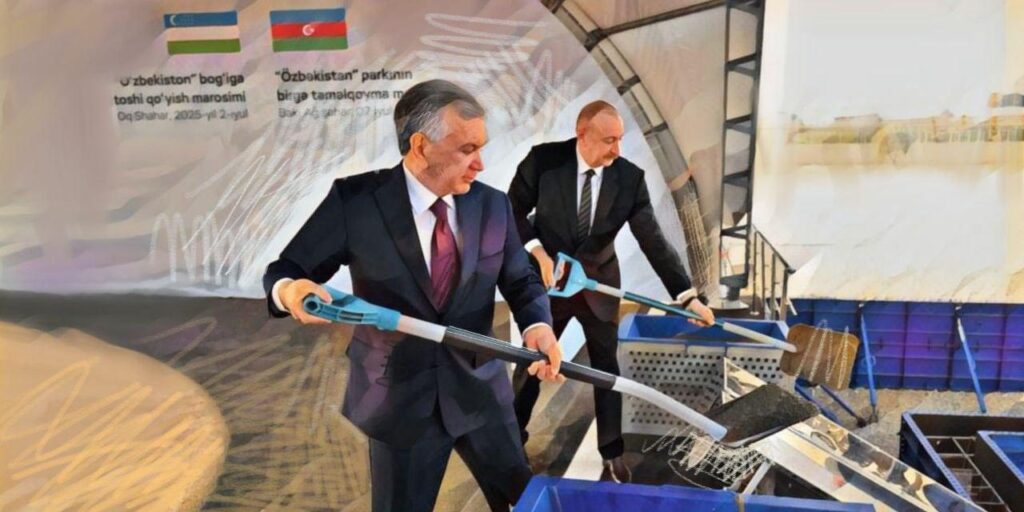
The visit featured symbolic and cultural highlights. In Baku’s Ag Sheher district, the presidents laid the foundation for Uzbekistan Park, a 4.5-hectare space celebrating Uzbek culture and architecture. They also inaugurated Uzbekistan’s new embassy in Baku, which includes halls named after different Uzbek regions, with Mirziyoyev proposing to name one of the halls after Karabakh as a gesture of friendship.

The two leaders later toured the Sea Breeze resort complex on the Caspian coast, part of the broader Caspian Riviera tourism project. A similar development, Sea Breeze Uzbekistan, is being considered near Tashkent by private investors.

On July 3, Mirziyoyev and Aliyev attended the 17th summit of the Economic Cooperation Organization (ECO) in Aghdam, Karabakh. They visited the restored Imaret complex, including the mausoleum of Panah Ali Khan, founder of the Karabakh Khanate. The visit concluded with a cultural event titled Zafar (Victory), featuring music and Karabakh horse performances. The leaders agreed to deepen collaboration in trade, logistics, education, and culture, and announced a series of joint cultural and youth events this fall to commemorate 30 years of bilateral ties. Mirziyoyev expressed confidence that the outcomes of the visit would enhance the prosperity of both nations.

A Shifting Geopolitical Landscape

Since 2022, particularly after the Second Karabakh War, Azerbaijan has pursued a policy of geopolitical multi-vectorism, intensifying ties with Turkey, Israel, the European Union, and the Central Asian states. In 2024-2025, Baku’s relationship with Moscow soured due to shifts in the South Caucasus power balance and the downing of an Azerbaijan Airlines flight over Kazakhstan, said to have been caused by accidental Russian ground fire. As previously reported by The Times of Central Asia, in January, Aliyev stated that the “guilt for the deaths of Azerbaijani citizens in this accident lies with the representatives of the Russian Federation. We demand justice, we demand punishment of the guilty.” Against this backdrop, Uzbekistan has emerged as a key ally for Azerbaijan on its eastern flank.

Uzbek-Azerbaijani relations exemplify the evolving geopolitical architecture of Eurasia, where regional powers are seeking greater autonomy, a balanced approach to global powers, and the increasing assertion of national identity. The growing partnership between Uzbekistan and Azerbaijan strengthens both countries’ positions on the international stage and elevates the Trans-Caspian corridor as a strategic priority in Eurasian policy.


Kyzyl-Ompol Mining Resumes Under New Law, Public Concern Persists

Trial production of titanomagnetite has commenced at the Kyzyl-Ompol deposit near Balykchy in Kyrgyzstan’s Issyk-Kul region, First Deputy Prime Minister Bakyt Torobaev announced in a recent interview with local media.

According to Torobaev, the deposit holds an estimated 20 million tons of titanomagnetite, and the total value of useful elements in the subsoil could approach $1 billion.

“When this project was just starting, few believed in it. Today we see concrete results: experimental development has begun, infrastructure and technology are being developed. The potential of the deposit is enormous,” he said. Torobaev added that the site is also being used to test new technological solutions that could be implemented elsewhere in the country.

A Controversial Resource and Legal Shifts

Mining at Kyzyl-Ompol was previously prohibited due to the presence of uranium and thorium, radioactive elements often found alongside titanomagnetite. Their extraction has been banned in Kyrgyzstan since 2019, following widespread public protests over environmental and health concerns.

However, a 2023 law lifted the ban under strict environmental compliance conditions. The bill’s explanatory note cited the need for alternative revenue sources in light of economic challenges stemming from the COVID-19 pandemic and regional sanctions.

President Sadyr Japarov emphasized that titanomagnetite comprises roughly 95% of the deposit’s reserves. The Ministry of Natural Resources, Ecology, and Technical Supervision has assured the public that current extraction technologies meet all safety and environmental standards and pledged ongoing oversight.

Economic Potential and Public Concerns

Government estimates suggest that the project’s initial phase could contribute approximately $150 million to the state budget and generate around 1,000 jobs. Torobaev described Kyzyl-Ompol as having the potential to become a “second Kumtor”, a reference to the country’s largest and most profitable gold mine.

Nonetheless, public debate continues. Critics caution that the area’s known uranium reserves could pose environmental risks if disturbed, particularly in the ecologically sensitive Issyk-Kul region.

Titanomagnetite is used in metallurgy, particularly for producing specialized steels, and also has applications in the chemical and energy sectors. Discovered in 1951, the Kyzyl-Ompol deposit comprises five sites. To date, detailed geological surveys have been conducted on only one, with its reserves officially registered in the state balance.

Kyrgyzstan Approves Plan to Achieve Carbon Neutrality by 2050

On July 3, Kyrgyzstan’s Cabinet of Ministers approved the Concept for Achieving Carbon Neutrality of the Kyrgyz Republic along with the action plan for its initial implementation phase.

The approval marks a significant step in the country’s climate policy, setting long-term guidelines for sustainable development and signaling Kyrgyzstan’s political commitment to global climate goals.

The concept outlines a phased transition to a carbon-neutral economy, targeting key sectors such as energy, transport, industry, agriculture, waste management, and forestry. It aims to reduce greenhouse gas emissions, promote renewable energy, enhance energy efficiency, restore forest ecosystems, adopt digital and innovative technologies, and integrate climate risk into state planning processes.

The government sees the concept as a foundation for attracting climate finance, creating green jobs, and ensuring environmental security for future generations. It also reinforces Kyrgyzstan’s status as an active and responsible participant in the international climate framework under the Paris Agreement.

Kyrgyzstan has pledged to achieve carbon neutrality by 2050, a commitment first announced by President Sadyr Japarov at the 2021 World Leaders Summit during the UN Climate Change Conference in Glasgow. The country has also set a target to reduce greenhouse gas emissions by 44% by 2030.

Kazakhstan Considers “Green” Tax on Plastic Packaging

Azhar Sagandykova, a deputy in Kazakhstan’s Mazhilis, has proposed introducing a “green” tax on non-environmentally friendly packaging. She announced the initiative during the IX Eurasian Business Forum Green Energy & Waste Recycling Forum (GEWR-2025).

The proposed tax would apply to packaging materials that are difficult to recycle or non-biodegradable, such as polyethylene terephthalate (PET) bottles, plastic bags, and other polyethylene-based containers.

“It is time to seriously consider introducing a green tax on non-environmentally friendly packaging and directing the funds collected towards the development of waste recycling,” Sagandykova stated.

According to the United Nations Development Programme (UNDP), Kazakhstan produces approximately 4.5 million tons of waste annually. Of this, 80% is generated by the municipal sector, while 20% comes from industry, healthcare, and other sectors. Only about 26% of the total waste is recycled. These figures were confirmed by Zhomart Aliyev, Kazakhstan’s Deputy Minister of Ecology and Natural Resources, who also addressed the forum.

Speaking on the sidelines of the event, Aliyev commented on the complexities of implementing such a tax. “It is very difficult to say at this stage what a green tax on a particular product should look like. It could affect virtually all sectors of the economy. We have begun preparatory work, but it is still at an early stage. We need to calculate the figures for the whole country in detail,” he said.

In addition to the tax proposal, Sagandykova advocated for a dedicated law on waste management to clarify responsibilities, define infrastructure needs, and introduce government incentives.

“The existing Environmental Code contains a number of vulnerabilities and does not cover all aspects of waste management. Therefore, within the framework of a working group in the Mazhilis, we intend to review the systemic approach to solving this problem,” she explained.

During the summer, deputies plan to collect proposals from businesses, environmentalists, and civil society stakeholders. These suggestions will inform a draft bill to be discussed in the fall.

Aliyev added that the government is already working on a comprehensive waste management concept, excluding radioactive waste, which remains under the jurisdiction of the Atomic Energy Agency. The concept, commissioned by the prime minister, is expected to be finalized by September, when a decision will be made on whether a standalone waste management law is necessary.

As previously reported by The Times of Central Asia, Kazakhstan had aimed to phase out plastic packaging and tableware by 2025. However, due to a lack of sufficient alternatives in domestic production, the government was forced to abandon the timeline.

How Can Britain Benefit From the Middle Corridor?

On July 2nd, a roundtable held at the House of Lords, the upper chamber of the British parliament, brought together diplomats, trade envoys, logistics professionals, and academics to promote the Middle Corridor – the overland route connecting China to Europe via Kazakhstan, the Caspian Sea, Azerbaijan, Georgia, and Turkey.

The session aimed to highlight the strategic and economic case for British involvement in the corridor. However, in a crowded political landscape, the pitch struggled to gain airtime. On the same day, British economic minister Rachel Reeves shed tears in parliament’s lower chamber, sparking fears of political instability, and, a few miles away, the Wimbledon tennis season had just begun. In short, Westminster and the British media were elsewhere.

Nonetheless, speakers made their case for the corridor’s importance to China-Europe freight. The Middle Corridor has gained attention as an alternative to the Northern Corridor – a rail network that runs from China through Kazakhstan, Russia, and Belarus, all members of the Eurasian Economic Union (a shared customs zone). The Northern route could, in theory, deliver goods from China to Europe in as little as ten days. But its viability has been damaged by Russia’s invasion of Ukraine and the sanctions regime that followed.

Since then, cargo traffic along the Middle Corridor has surged. “Before the war in Ukraine, 99% of goods travelled along the northern corridor, and just 1% along the Middle Corridor,” said Dr Chris Brooks, Global Director of Risk, Quality and Compliance at Bertling Logistics. “Now it’s about 90% along the Middle Corridor.”

In raw numbers, the increase has been stark. Back in 2021, cargo volume transported through the Middle Corridor was around 800,000 tonnes; that stood at 4.5 million tonnes at the end of 2024.

“It is never going to be an alternative to the maritime route,” Brooks said, estimating that even with major investment, capacity would top out at around 16,000 tonnes per month, which is dwarfed by maritime trade between China and Europe, which totals around 800,000 tonnes a month.

However, he did call the route a “strategic insurance policy,” citing its neutrality, flexibility, and compliance with Western sanctions. For automotive, electric, and fast-moving consumer goods (FMCG) with short shelf lives, the route will prove particularly useful.

“Whether you’re going through the Red Sea or around the Cape of Good Hope, maritime typically takes anything between 35 and 52 days. The Northern Russian corridor is 10 to 20 days. The Middle Corridor can actually do similar.”

But Brooks added that infrastructure and the weather remain limiting factors, meaning that lead times are anything between 14 and 45 days, with some shipments taking up to two months.

“We have as many as 400 trucks queuing up… not because of customs – they’re just queuing to get onto the ferry from Baku to Kazakhstan… Drivers are waiting anything from one week to one month,” he said, adding his concerns that the corridor also has limited capacity to move large cargo.

Image: middlecorridor.com

Many speakers called for a long-term commitment to addressing these infrastructure issues, with fears that as soon as relations with Russia improve, the corridor will be swiftly abandoned. “We need to look at the Middle Corridor not only as a commercial corridor, but also as a strategic corridor,” said Arzu Abbasova of the Royal United Services Institute. “European stakeholders ought to engage… not only when it’s geopolitically convenient, but also [for] the long haul.”

Abbasova also highlighted the corridor’s east-west imbalance: “If a truck driver is only getting its goods from China and then comes back empty, then that raises the costs for the logistics companies.”

British officials have expressed their support in principle. Lord Alderdice, Britain’s Trade Envoy to Central Asia, said in comments to Kazakh media that the corridor offers “a promising area for UK collaboration, expertise, and investment.” Dr Afzal Khan, Trade Envoy to Turkey, noted that the discussion coincided with active UK-Turkey free trade negotiations and called Turkey a key link in strengthening ties across Central Asia.

Britain’s concrete commitments remain limited, however. While the EU has pledged €10 billion through its Global Gateway initiative, the UK has yet to announce specific funding or projects. The event featured little participation from British industry or the financial sector, a fact not lost on the Central Asian delegations.

Ambassador of the Republic of Kazakhstan to the United Kingdom, Magzhan Ilyassov

Kazakhstan’s ambassador, Magzhan Ilyassov, expressed concern that the country not be seen merely as a transit zone. “In the U.S., there are the flyover states – Nebraska, Omaha, and Idaho,” Ilyassov said. “We don’t want to be a passed-by country on that route from China to Europe because we’re in the middle. We are a country with huge potential.” The ambassador added that Kazakhstan is seeking value-added partnerships, including in processing rare earths and industrial materials.

From a European perspective, the timing of those remarks raised eyebrows. Just weeks before the event, Kazakhstan had awarded a nuclear power plant contract not to France’s EDF but to Russia’s Rosatom, a decision that led to questions about the country’s willingness to receive Western investment that risked putting it on a collision course with Moscow.

Still, despite the obstacles, there is definite enthusiasm on both sides for increased collaboration.

Dr Assylbek Nurgabdeshov of Heriot-Watt University, who moderated the session, concluded by reiterating the corridor’s potential. “With effective coordination, high-quality human capital, and strategic investment, trade volumes could triple and transit times be halved by 2030,” he said, stressing that the UK is well-placed to support logistics, education, and infrastructure development across the region.

For now, however, little of that opportunity is being grasped. With British political attention decidedly short-termist, the strategic opportunities risk passing London by.

The backdrop to the roundtable made that much clear. Long queues formed outside Parliament as attendees, including ambassadors and executives, waited under the summer sun to clear security. Inside, the event began late and ended abruptly, with guests being ushered out to make way for the next session on the Lord’s packed agenda. Some did at least manage to grab as many scones as they could make off with, but the cheese and pickle sandwiches went untouched.

More Than a Quarter of Tajikistan’s Population Lives Below the Poverty Line – World Bank Report

Tajikistan continues to make gradual progress in reducing poverty, but over 25% of the population still lives on less than $3.65 a day, according to the World Bank’s newly released Poverty, Prosperity, and Planet Report 2024.

Revised Poverty Line and Structural Vulnerabilities

The World Bank recently raised the extreme poverty threshold from $2.15 to $3.00 per day, adjusting for updated purchasing power parity. Under the international poverty line of $3.65 per day, approximately one in four Tajik citizens remains in poverty.

Globally, around 700 million people, 8.5% of the world’s population, live on less than $2.15 per day. The report highlights that economies reliant on remittances and imports are particularly vulnerable. Tajikistan fits this profile, with a large portion of its population employed in the informal sector, especially agriculture, and limited coverage by social assistance programs.

National statistics show a decline in the domestic poverty rate from 26.3% in 2022 to 23.5% in 2023, with forecasts indicating a possible drop to 21.3% this year. Nonetheless, the country’s poverty rate remains high by international standards.

Rural Poverty and Social Disparities

Poverty in Tajikistan disproportionately affects rural areas, where 80% of the poor reside. Around 70% of adults living in poverty lack vocational education. Vulnerable groups include women, large families, single-parent households, and children, many of whom require sustained, targeted social support.

In comparison with its neighbors, Kyrgyzstan has the region’s highest poverty rate by national standards at 29.8%, while Uzbekistan reports 11.2% and Kazakhstan 3.7%. Less than 5% of Kazakhstan’s population lives below the international poverty line. Turkmenistan continues to withhold poverty-related data.

Climate Change Adds to Economic Pressures

The report warns that climate change further exacerbates poverty risks. From 2000 to 2020, temperatures in Central Asia rose by an average of 1.23°C, and regional glaciers shrank by 30%. For Tajikistan, where glaciers are the primary source of freshwater, these developments pose a growing threat to agricultural sustainability and food security.

Nonetheless, the report acknowledges progress in adaptation efforts. Tajikistan is implementing precision farming technologies and modernizing water management practices, which have improved crop yields while reducing water usage in arid regions.

The World Bank emphasizes that without structural reforms, including quality job creation, expanded support systems, and sustainable income protection, millions in Tajikistan will remain at risk, despite the appearance of macroeconomic stability.