• KGS/USD = 0.01144 0%
  • KZT/USD = 0.00196 -0%
  • TJS/USD = 0.10899 -0%
  • UZS/USD = 0.00008 -0%
  • TMT/USD = 0.28490 0%
  • KGS/USD = 0.01144 0%
  • KZT/USD = 0.00196 -0%
  • TJS/USD = 0.10899 -0%
  • UZS/USD = 0.00008 -0%
  • TMT/USD = 0.28490 0%
  • KGS/USD = 0.01144 0%
  • KZT/USD = 0.00196 -0%
  • TJS/USD = 0.10899 -0%
  • UZS/USD = 0.00008 -0%
  • TMT/USD = 0.28490 0%
  • KGS/USD = 0.01144 0%
  • KZT/USD = 0.00196 -0%
  • TJS/USD = 0.10899 -0%
  • UZS/USD = 0.00008 -0%
  • TMT/USD = 0.28490 0%
  • KGS/USD = 0.01144 0%
  • KZT/USD = 0.00196 -0%
  • TJS/USD = 0.10899 -0%
  • UZS/USD = 0.00008 -0%
  • TMT/USD = 0.28490 0%
  • KGS/USD = 0.01144 0%
  • KZT/USD = 0.00196 -0%
  • TJS/USD = 0.10899 -0%
  • UZS/USD = 0.00008 -0%
  • TMT/USD = 0.28490 0%
  • KGS/USD = 0.01144 0%
  • KZT/USD = 0.00196 -0%
  • TJS/USD = 0.10899 -0%
  • UZS/USD = 0.00008 -0%
  • TMT/USD = 0.28490 0%
  • KGS/USD = 0.01144 0%
  • KZT/USD = 0.00196 -0%
  • TJS/USD = 0.10899 -0%
  • UZS/USD = 0.00008 -0%
  • TMT/USD = 0.28490 0%
08 December 2025

ADB to Help Uzbekistan Introduce Smart Water Management

The Asian Development Bank (ADB) has approved a $125 million loan to support Uzbekistan’s government in modernizing water management, improving water security, and expanding access to safe and reliable water.

Advancing Smart Water Management

ADB’s Climate-Smart Water Management Improvement Project will assist Joint Stock Company Uzsuvtaminot, the country’s national water utility, and its regional branches in enhancing water infrastructure and efficiency. Key initiatives include:

  • Completing the nationwide installation of bulk flow metering and telemetry systems at major water sources.
  • Conducting a comprehensive asset inventory and geographic mapping of all water supply and wastewater infrastructure, covering approximately 4 million customer connections.
  • Implementing climate-smart, IT-based utility management systems, including training programs for national water utility staff.
  • Upgrading customer service centers with new financial management software, ensuring transparent financial statements aligned with international standards.

Addressing Water Security Challenges

ADB Country Director for Uzbekistan Kanokpan Lao-Araya emphasized the urgency of improving water management in the face of climate change and inefficient usage.

“Uzbekistan’s water resources are under acute threat from climate change and inefficient usage. ADB’s project introduces smart water management systems to improve water usage, reduce energy consumption, and increase operational efficiency to lower Uzbekistan’s carbon footprint,” she stated.

ADB’s Ongoing Support for Uzbekistan

Since Uzbekistan joined ADB in 1995, the bank has committed $14.3 billion in public sector loans, grants, and technical assistance to support the country’s development.

Kazakhstan to Help Jordan Assess Uranium Reserves

During Kazakh President Kassym-Jomart Tokayev’s official visit to Jordan, a memorandum of understanding was signed between Kazakhstan’s Kazatomprom National Atomic Company JSC and the Jordan Uranium Mining Company (JUMCO). The agreement outlines plans for cooperation in uranium exploration and mining in Jordan.

Kazatomprom CEO Meirzhan Yusupov emphasized that the partnership with JUMCO presents new opportunities to strengthen Kazakhstan’s position in the global uranium industry.

“This memorandum aligns with our strategic goals of efficiently utilizing our resource base. Additionally, studying foreign projects will provide valuable international experience and contribute to the sustainable development of both countries,” he said.

Assessing Uranium Potential in Jordan

The primary goal of the agreement is to evaluate the potential for uranium exploration and development in Jordan. This includes assessing reserves and analyzing the feasibility of using heap leaching technologies for extraction. Special attention will be given to environmental safety and economic viability. Based on the study results, both parties will decide on the next steps for project development.

JUMCO CEO Mohammad Al-Shannagh stated that partnering with the world’s largest uranium producer could accelerate Jordan’s commercial uranium production.

“Cooperation with Kazatomprom will open new horizons for us in uranium mining, allowing us to share knowledge, use advanced technologies, and jointly develop marketing strategies,” he said.

Joint projects are expected to give new impetus to Jordan’s nuclear industry, creating jobs, attracting local contractors, and improving infrastructure.

Kazakhstan’s Expanding Uranium Industry

Kazakhstan’s collaboration with JUMCO provides an opportunity to expand its international reach, strengthen economic ties with Jordan, and enhance its influence in the global uranium sector.

Kazatomprom is the world’s largest producer of natural uranium, with priority access to one of the world’s most significant resource bases. Since November 2018, Kazatomprom’s shares have been traded on the Astana International Financial Center Exchange and the London Stock Exchange.

Four New Foreign Low-Cost Carriers to Launch Flights from Kazakhstan

Four new low-cost airlines are set to enter Kazakhstan’s aviation market, further expanding the country’s international air connectivity, according to Vice Minister of Transport Talgat Lastayev.

Lastayev highlighted that the number of international flights to and from Kazakhstan has been increasing annually. The country currently has air links with 31 countries and 58 cities, operating 119 international routes. In 2024, 12 new flights were introduced across 22 routes, including major cities such as Mumbai (India), Jeddah (Saudi Arabia), and Prague (Czech Republic). Additionally, flights on 10 previously suspended routes were resumed.

In 2025, Kazakhstan plans to launch flights to 16 new destinations, including Rome, Munich, Budapest, Shanghai, Guangzhou, and Busan. The country’s low-cost flight options will also expand with the arrival of four new budget airlines:

  • SpiceJet (India)
  • Eastar Jet (South Korea)
  • T’way Air (South Korea)
  • Thai AirAsia (Thailand)

The entry of these carriers is expected to make international travel more affordable for passengers.

Lastayev also noted that Kazakhstan’s “open skies” policy, aimed at liberalizing the aviation sector, was expanded in 2024 to include airports in Kyzylorda, Kostanay, and Atyrau. The policy is now in effect at all of Kazakhstan’s international airports.

High Methane Emissions May Hinder Turkmenistan’s Gas Exports to Europe

High methane emissions could pose a significant obstacle to Turkmenistan’s entry into the European gas market, according to an updated report by the U.S. Department of Energy, published on February 6. The main findings of the study were summarized by Eurasia Review on February 19.

The report, which examines oil and gas production in the Caspian region, notes that four countries, Azerbaijan, Kazakhstan, Turkmenistan, and Uzbekistan, account for 3% of global energy production.

Turkmenistan’s Gas Reserves and Export Ambitions

According to the report, Turkmenistan ranks fifth worldwide in natural gas reserves, estimated at 400 trillion cubic feet in 2025. In 2023, the country set a record by producing 3.0 trillion cubic feet of dry natural gas, the highest level since official statistics began in 1992.

Currently, Turkmenistan’s primary gas exports are directed to China, but Ashgabat is seeking to expand its market reach, including potential supply routes through Afghanistan. However, the U.S. Department of Energy warns that excessive methane emissions from Turkmenistan’s fields could complicate access to the European market via the Trans-Caspian pipeline.

In terms of oil reserves, Turkmenistan holds a relatively modest 600 million barrels, with an average daily production of 275,000 barrels in 2024.

Diversification Efforts and New Export Deals

Meanwhile, Turkmenistan is taking steps to diversify its export destinations. Gas supplies to Turkey are set to begin on March 1.

During a phone call on February 10, Chairman of the Halk Maslahaty Gurbanguly Berdimuhamedov informed Iranian President Masoud Pezeshkian that an agreement had been reached to transit gas through Iran under a swap supply arrangement with Turkish energy company BOTAŞ.

Efforts to Reduce Methane Emissions

Turkmenistan has also been actively engaging in international initiatives to curb methane emissions. On December 1, 2023, the country joined the Global Methane Pledge (GMP), an initiative aimed at reducing greenhouse gas emissions.

In November 2024, Bloomberg reported that the state-owned Turkmengaz plans to hire specialists to measure methane emissions more accurately and is preparing a tender for emission monitoring.

That same month, the U.S. Environmental Defense Fund (EDF) released satellite data showing that methane leakage from oil and gas fields in Turkmenistan, the U.S., and Venezuela is significantly higher than official ground-based measurements suggest.

Kazakhstan Fears Electric Cars Will Strain Energy Infrastructure

Kazakhstani lawmaker Nauryz Saylaubai has raised concerns over the country’s ability to support the growing number of electric vehicles (EVs), citing infrastructure challenges and regulatory gaps. In a request to First Deputy Prime Minister Roman Sklyar, the Mazhilis (lower house of parliament) member called for urgent measures to address these issues.

Growing Number of Electric Vehicles

According to the Bureau of National Statistics, the share of electric-powered vehicles in Kazakhstan remains relatively small. As of February 1, 2025, the country had 12,655 registered electric cars, 350 electric trucks, and 189 electric buses. In contrast, there were 4.45 million gasoline-powered cars, 91,100 diesel-powered vehicles, 10,100 gas-powered cars, and 400,300 hybrid vehicles running on a mix of gasoline, gas, and electricity.

Despite the low overall share, EV adoption has been accelerating. A year ago, on February 1, 2024, Kazakhstan had only 8,366 electric cars, 277 electric trucks, and 38 electric buses. This represents a 25% increase in electric cars and a fivefold rise in electric buses over the past year.

Energy Infrastructure Concerns

The rapid growth of EVs has raised concerns among lawmakers about the ability of Kazakhstan’s aging power grid to handle the additional demand.

“It is well known that an increase in the number of electric vehicles puts additional pressure on power grids. Given that our grid infrastructure is already outdated, won’t this lead to future accidents? What measures are being taken to address this issue?” Saylaubai asked.

Kazakhstan’s EV market is expected to keep expanding, as electric vehicles are exempt from the country’s scrappage tax and import registration fees, making them approximately 15% cheaper than conventional cars.

Charging Infrastructure and Service Gaps

Saylaubai also highlighted the country’s insufficient charging infrastructure.

“According to international standards, the optimal ratio of electric vehicles to public charging stations should be 10 to 1. In Kazakhstan today, there is just one charging station for every 43 electric cars,” the lawmaker noted.

State-owned road infrastructure operator KazAutoZhol had planned to install 40 new charging stations along intercity highways in 2024, but by the end of last year, only 23 had been completed.

Another major issue is the lack of service centers for EV repairs and maintenance, particularly in rural regions. Owners outside major cities struggle to find specialists and spare parts, while logistical challenges further complicate EV accessibility in remote areas. Saylaubai urged the government to develop a nationwide network of service stations and ensure the availability of spare parts.

Legal Uncertainty Over Autopilot Systems

The lawmaker also pointed to regulatory gaps regarding the use of autopilot features in electric vehicles.

“The vast majority of electric cars are equipped with autopilot functions, but it remains unclear whether drivers are legally allowed to activate them within city limits or who would be held responsible in the event of an accident,” he said.

Additionally, he warned that electric cars can reach high speeds within seconds, potentially posing risks to road safety.

As The Times of Central Asia previously reported, Kazakhstan’s car market set a new record for sales of new vehicles across all fuel types last year. 

Right Place, Right Time: Central Asia Basks in Russia’s Eastern Energy Pivot

On January 1, with the closure of pipelines through Ukraine, deliveries of Russian gas to Europe came to a virtual standstill. Prices across the continent have ratcheted up in the first six weeks of 2025 and have now hit two-year highs.

In Central Asia, the effects of the Russo-European decoupling have also been profound. In 2024, Kyrgyzstan posted a 48% year-on-year increase in Russian gas imports, while Uzbekistan’s inbound gas purchases soared over 142% to $1.68 billion.

But while Gazprom’s reorientation has been a boon to Central Asia’s economies, this phenomenon appears to be more than short-term supply dumping due to the war in Ukraine. Rather, it is part of a lasting trend that could define the region’s, and the world’s, energy map.

Russia’s Supply Glut

In 2018, Russia exported a record 201 billion cubic meters (bcm) of gas to Europe. The closure of the Yamal and Nord Stream pipelines had already brought these supplies down to 49.5 bcm by 2024 and will be further impacted by the cut in supplies via Ukraine. Despite some gas supplied via Turkstream and a steady trade in liquefied natural gas (LNG), Russian gas supplied to Europe is a fraction of what it once was.

The Central Asian market offers both short and long-term solutions to this.

“Most likely, Gazprom views its expansion into Central Asia as a partial and immediate solution to the challenge of finding new markets for its gas,” said Shaimerden Chikanayev, a partner at GRATA International, a law firm. “While the region cannot fully replace the volumes or profit margins previously achieved in Europe, it offers a readily accessible and stable outlet for Russian gas exports.”

Central Asia is accessible due to old Soviet pipelines that link the region to Moscow. These pipelines, known as Central Asia–Center, were originally built to take gas from Turkmenistan, via Uzbekistan and Kazakhstan to Russia. This system has now been engineered to run in reverse. The pipeline has a capacity of around 50 bcm per year, but there are ongoing efforts to increase it.

Still, this is only a quarter of what was once supplied to Europe, nor are the revenues as lucrative. In 2023, the average rate charged by Gazprom to Uzbekistan for gas was $160 per thousand cubic meters (tcm), this compares to European prices that fluctuated between $200-400tcm throughout the 2010s.

For Stanislav Pritchin, head of the Central Asia sector at the Institute for World Economy and International Relations (IMEMO), Moscow, the price is not a major factor. “Russia of course sells gas to Kazakhstan, Uzbekistan, and Kyrgyzstan lower than the market price. This is a politically motivated decision. And this is not just because it is struggling with [selling to] Eastern Europe. Russia could sell it to Central Asia at market prices, but this is the Russian approach towards its allies in the region,” he said.

Central Asian Serendipity

For Central Asian states, these new supplies have come at a good time. Countries such as Kyrgyzstan are trying hard to increase the use of gas rather than coal for domestic heating. Meanwhile, traditional gas exporters such as Uzbekistan and Kazakhstan are using the opportunity to buy cheap Russian gas while selling their own gas further afield, particularly to China.

“Kazakhstan and Uzbekistan have faced difficulties in fulfilling their gas export obligations to China due to rising domestic demand,” said Eldeniz Gusseinov, co-founder of the political advisory firm Nightingale International Intelligence. Uzbekistan was forced to briefly suspend its gas exports in 2022, with Kazakhstan also slashing its supplies. “Access to Russian gas enables these countries to meet their domestic needs and, theoretically, frees up resources to fulfill their export commitments to China,” Gusseinov added.

Tashkent in particular is in desperate need of these supplies. “Uzbekistan used to be a leading gas producer, but they lack the resources, technology, and investment to develop [their gas industry],” said Pritchin. “They are now in quite a vulnerable situation because they can barely even meet their demands for basic gas and electricity.”

According to Uzbekistan’s official statistics authority, gas production has fallen by around a third from 66 bcm/year in 2010 to 44.6 billion in 2024. Pritchin forecasts that this decline will continue, despite the increased demand for electricity and gas from Uzbekistan’s growing population and economy.
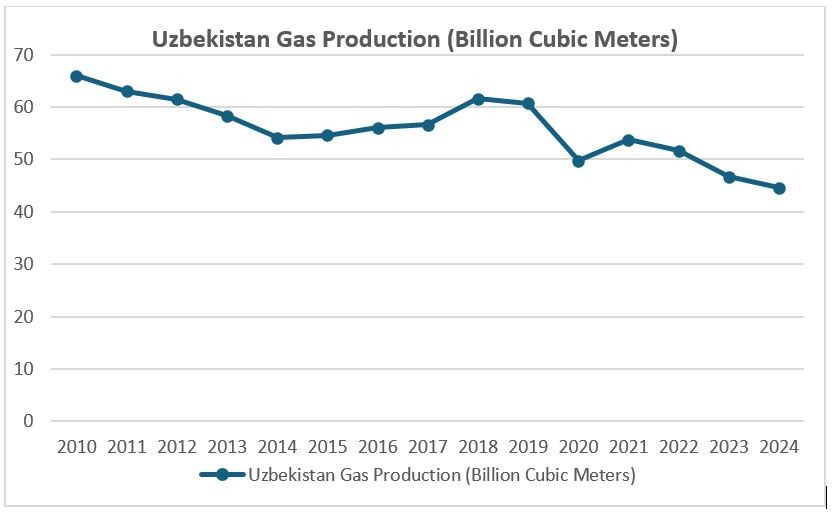
Uzbekistan’s gas production has declined over the past decade. Credit: Joe Luc Barnes. Sources: 2010-2023 Stat.uz; 2024 figure as reported in The Tashkent Times


Chikanayev refers to the paradoxical situation where resource-rich countries such as Uzbekistan and Kazakhstan are struggling with energy resources as the cobbler without boots. “Both [countries] have failed to invest adequately in their gas and power sectors since the collapse of the USSR. This includes neglecting the development of new gas fields and modernizing energy infrastructure,” Chikanayev said.

Uzbekistan has repeatedly stated that it intends to raise gas production to 62bcm as part of its Uzbekistan 2030 strategy, but the trend does not look positive.

No European Comeback

The increase in Russian gas imports is not without its critics. One fear is that Russia may simply abandon Central Asia and seek to prize open its old European markets should a peace deal be agreed in Ukraine.

Pritchin does not think so. “Even at the end of the special military operation, I don’t think the situation will dramatically change,” he said, adding that reopening pipelines between Russia and the EU is a decision for the Europeans, and even if there is re-engagement from Europe, the expansion of the Central Asian pipelines provides diversification.

Gusseinov agrees – “Diversify or die has become the prevailing mantra nowadays. Russia will want to remain at the center of Eurasian processes; [gas] allows the state to wield considerable geopolitical influence in the region with relatively modest resources.”

As evidence of Russia’s long-term plans for the region, he also points to a fifteen-year agreement signed at the St. Petersburg International Economic Forum 2024 between Sanjar Zhareshov, chairman of QazaqGaz, and Gazprom’s Alexey Miller, undertaking to supply Uzbekistan and Kyrgyzstan with Russian gas until at least 2040.

Transit to China (and India?)

Kazakhstan is seen as essential to Russia’s strategic pivot. According to Chikanayev, “Kazakhstan has effectively replaced Ukraine as the key transit region for Russian gas.” He said that this does not necessarily mean that Kazakhstan will be reliant on the Kremlin, instead seeing it as mutual dependence, particularly if new pipelines are built to bring gas to China and India.

Currently, the Power of Siberia gas pipeline provides China with 38 bcm/year, but there are plans to increase this capacity. In a recent interview with Rossiya 24 TV Channel, Russian Deputy Prime Minister Alexander Novak announced that talks were underway between Russia, Kazakhstan, and China on the joint construction of a new pipeline with a capacity of 45 bcm/year – 10 bcm of this would be made available to supply the northern and eastern parts of Kazakhstan, with the rest going to China.

The other huge benefit of these cheap Russian supplies is that it allows Central Asian countries to export their own gas at higher prices. Both Kazakhstan and Uzbekistan recently announced a surge in gas exports to China, despite imports also increasing. “This development supports the assumption that Uzbekistan and Kazakhstan are purchasing cheaper gas from Russia and reselling their own freed-up gas volumes to China at higher prices,” said Chikanayev.

Another prize is potentially even greater. For over a decade, Russia and India have discussed a pipeline to connect the two countries. However, the length of the route, mountainous terrain, and instability in Afghanistan have all conspired to keep such an option off the table.

“However, in the context of the new geopolitical realities – such as Russia’s pivot away from Europe and its growing focus on Asia – there may now be additional arguments in favor of revisiting this direction,” said Chikanayev.

The arrangement makes sense – on the one hand, the world’s most populous nation with limited natural resources, on the other, an enormous gas supplier. Should Central Asia be able to connect the two, it could be very lucrative.