• KGS/USD = 0.01144 0%
  • KZT/USD = 0.00192 -0%
  • TJS/USD = 0.10849 0.37%
  • UZS/USD = 0.00008 0%
  • TMT/USD = 0.28571 0.28%
  • KGS/USD = 0.01144 0%
  • KZT/USD = 0.00192 -0%
  • TJS/USD = 0.10849 0.37%
  • UZS/USD = 0.00008 0%
  • TMT/USD = 0.28571 0.28%
  • KGS/USD = 0.01144 0%
  • KZT/USD = 0.00192 -0%
  • TJS/USD = 0.10849 0.37%
  • UZS/USD = 0.00008 0%
  • TMT/USD = 0.28571 0.28%
  • KGS/USD = 0.01144 0%
  • KZT/USD = 0.00192 -0%
  • TJS/USD = 0.10849 0.37%
  • UZS/USD = 0.00008 0%
  • TMT/USD = 0.28571 0.28%
  • KGS/USD = 0.01144 0%
  • KZT/USD = 0.00192 -0%
  • TJS/USD = 0.10849 0.37%
  • UZS/USD = 0.00008 0%
  • TMT/USD = 0.28571 0.28%
  • KGS/USD = 0.01144 0%
  • KZT/USD = 0.00192 -0%
  • TJS/USD = 0.10849 0.37%
  • UZS/USD = 0.00008 0%
  • TMT/USD = 0.28571 0.28%
  • KGS/USD = 0.01144 0%
  • KZT/USD = 0.00192 -0%
  • TJS/USD = 0.10849 0.37%
  • UZS/USD = 0.00008 0%
  • TMT/USD = 0.28571 0.28%
  • KGS/USD = 0.01144 0%
  • KZT/USD = 0.00192 -0%
  • TJS/USD = 0.10849 0.37%
  • UZS/USD = 0.00008 0%
  • TMT/USD = 0.28571 0.28%
11 December 2025

In Doha, Central Asian Artists Dismantle Orientalism

Completely covered by a huge textile patchwork piece, softly moved by the wind, the façade of the Mathaf Museum in Doha promises visitors something fascinating and alluring. Coming closer, attendees could read a series of statements in various languages on the fabric.

The effect of familiarity and estrangement at once was the purpose of Azerbaijani artist Babi Badalov, who realized the piece. By layering phrases in Arabic, Cyrillic, and Latin with calligraffiti and employing disjointed grammar and syntax, the artist meant to visually disrupt “linguistic imperialism” and show how Europe’s modern civilization owes much to Arab civilization.
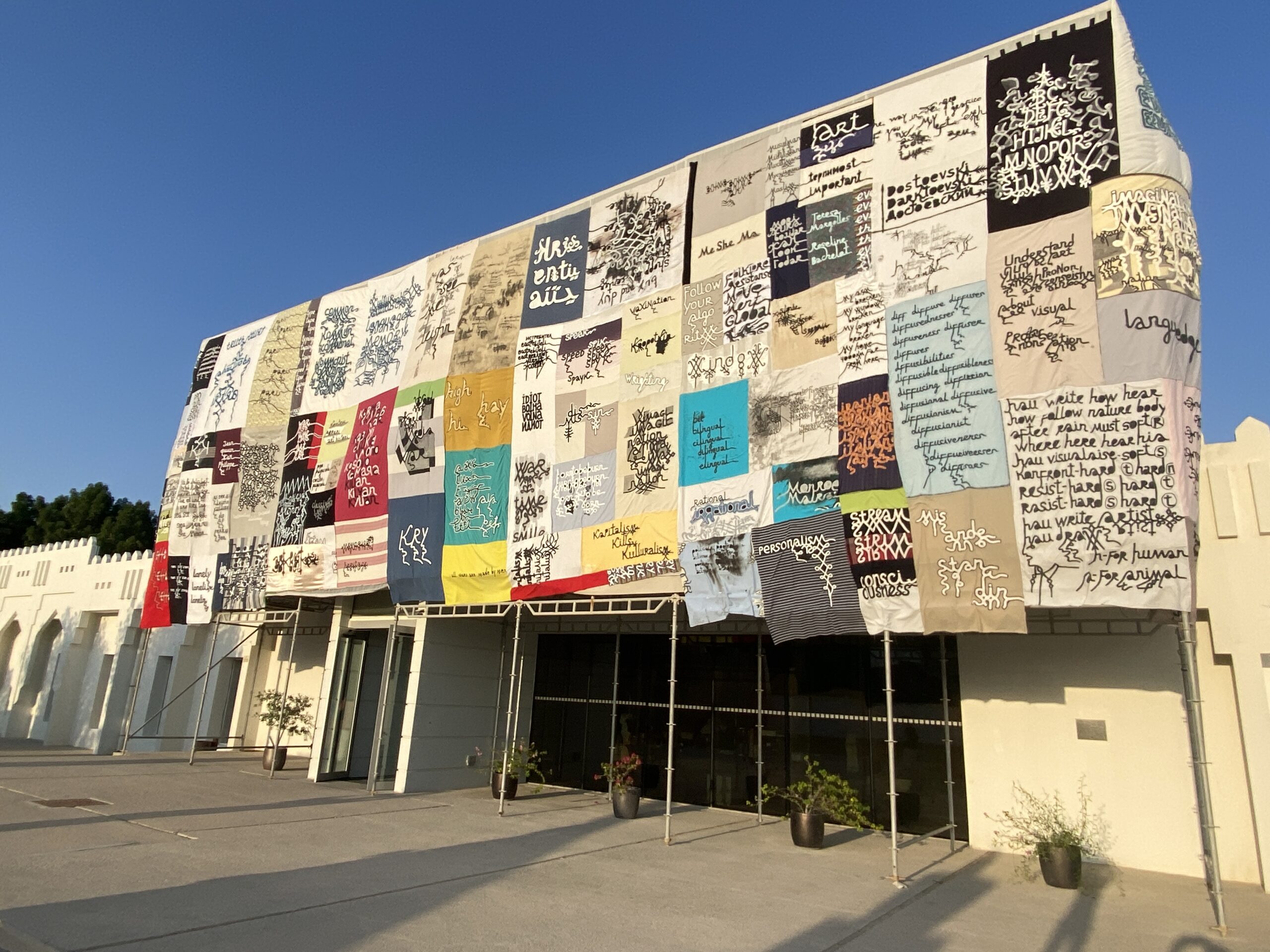
The Mathaf Museum in Doha; image: TCA, Naima Morelli

This specially commissioned work, called Text Still (2024), is nothing but an appetizer for the show Seeing is Believing: The Art and Influence of Gérôme. Organized by the forthcoming Lusail Museum — an institution under development in northern Doha that will house the largest collection of the so-called Orientalist art — the exhibition features loans from institutions such as the Metropolitan Museum of Art in New York and the Islamic Arts Museum in Malaysia.

The main part of the show is dedicated to French artist Jean-Léon Gérôme, who lived and worked in the 19th century and was profoundly influential in his depictions of the Middle East, North Africa, and South Asia. His works shaped Western perceptions of these regions during an era when colonialism and “Oriental Studies” were cementing global power dynamics.

The show included a historical and biographical exploration of Gérôme’s life, timed to celebrate the 200th anniversary of his birth, as well as a photographic section curated by Giles Hudson dedicated to visions of the Orient from Gérôme’s time to today.

But it is in the third section, centered on contemporary art and called “I Swear I saw That”, that Central Asian artist really enter into a close dialogue with Gérôme’s Orientalism, turning it on its head.

Sara Raza, curator of this section, takes Badalov’s textile work as a case in point: “Badalov inverts Edward Said’s mission of examining Western perceptions of the Orient, focusing instead on Eastern perceptions of the Occident, and vice versa,” she told The Times of Central Asia.

Edward Said’s concept of Orientalism, as detailed in his groundbreaking 1978 work of the same name, is an institutionalized program of Western knowledge, based mostly on projections, mystification, and imagination – and includes works of art as well as the academy – which is directed to justify a supposed Western superiority and imperialism over Eastern populations.

“I Swear I Saw That” interrogates Jean-Leon Gerome’s way of seeing, which Sara Raza recognizes as a “fantastical and highly mythologized vision of the East,” and looks at how artists from both the Middle East, the Arab world and Central Asia fought back.

A Central Asia and Caucasus expert who works extensively in the Middle East, Raza has examined the process of the exoticization of Eastern populations for a long time. She coined the term “Punk Orientalism,” which also became the name of her book and curatorial studio. She takes the reflections of Edward Said as a starting point, and looks at how the Central Asian population has been seen through a stereotyped lens by both Europe and the Soviet Union. Raza brings a punk, DIY approach to her curatorial method, which reflects the same attitude of many Central Asians who have a rebellious spirit and create art with a grassroots, bottom-down approach.
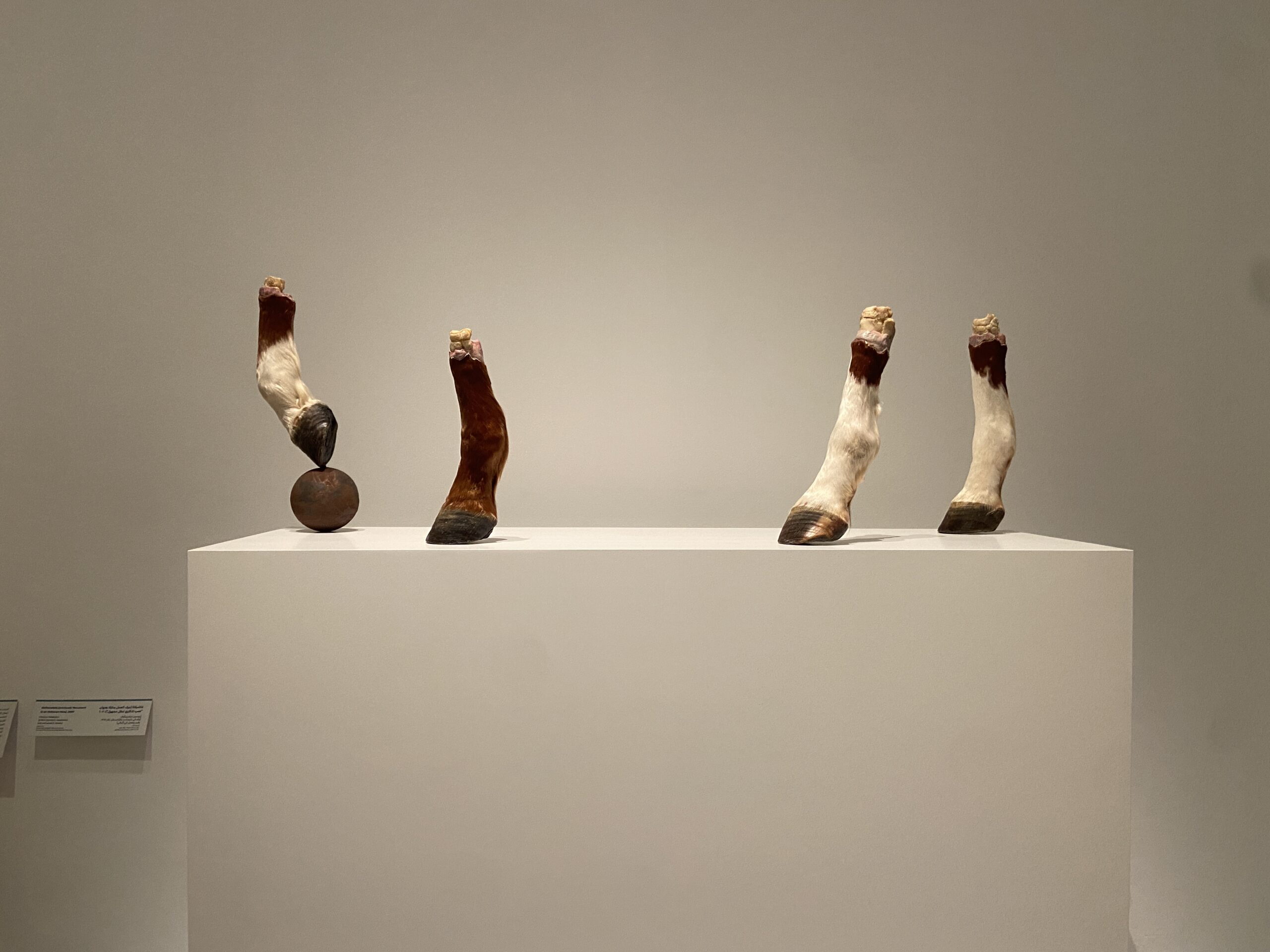
Installation by Erbossyn Meldibekov; image: TCA, Naima Morelli

From the stylized figures of Moroccan artist Baya – a trailblazer in the last century who was close to the surrealists – to contemporary artists like the Kazakh Erbossyn Meldibekov, the selection doesn’t only span Eastern geographies, but also different generations.

The installation by Meldivekov, featuring a horse’s lower legs frozen in motion and placed on a white podium, is particularly haunting. The work was conceived as a commentary on the rise and fall of historical figures celebrated by statues across Central Asia. The felling of these statues started following the collapse of the USSR as part of a state-sponsored nationalist agenda and was part of a plan to revive the region’s epic past, a topic dear to Meldibekov.

While his installation is dedicated to 15th-century Italian Captain Erasmo Gattamelata, and his statue to Italian Renaissance painter Donatello, Meldibekov also references Gérôme’s bronze statue of the 14th-century Uzbek emperor, Timur.

But the work which is probably more impactful in moving forward the discussion on Orientalism is a series of photographs titled “Girls of Kyrgyzstan,” which have distinctive GenY/ GenZ aesthetics.

Created by Uzbekistan-born Kyrgyzstan-bred artist Aziza Shadenova, a multidisciplinary artist and musician of Kazakh ethnicity, it encapsulates the ethos of the generation born right after the collapse of the USSR in 1991, who grew up familiar with the internet from an early age.

The series speaks of the pervasiveness of images on the internet as a means to represent the self, freeing themselves from both Western and the Soviet narratives, as well as debunking previous social norms and myths around the representation of Central Asian women.
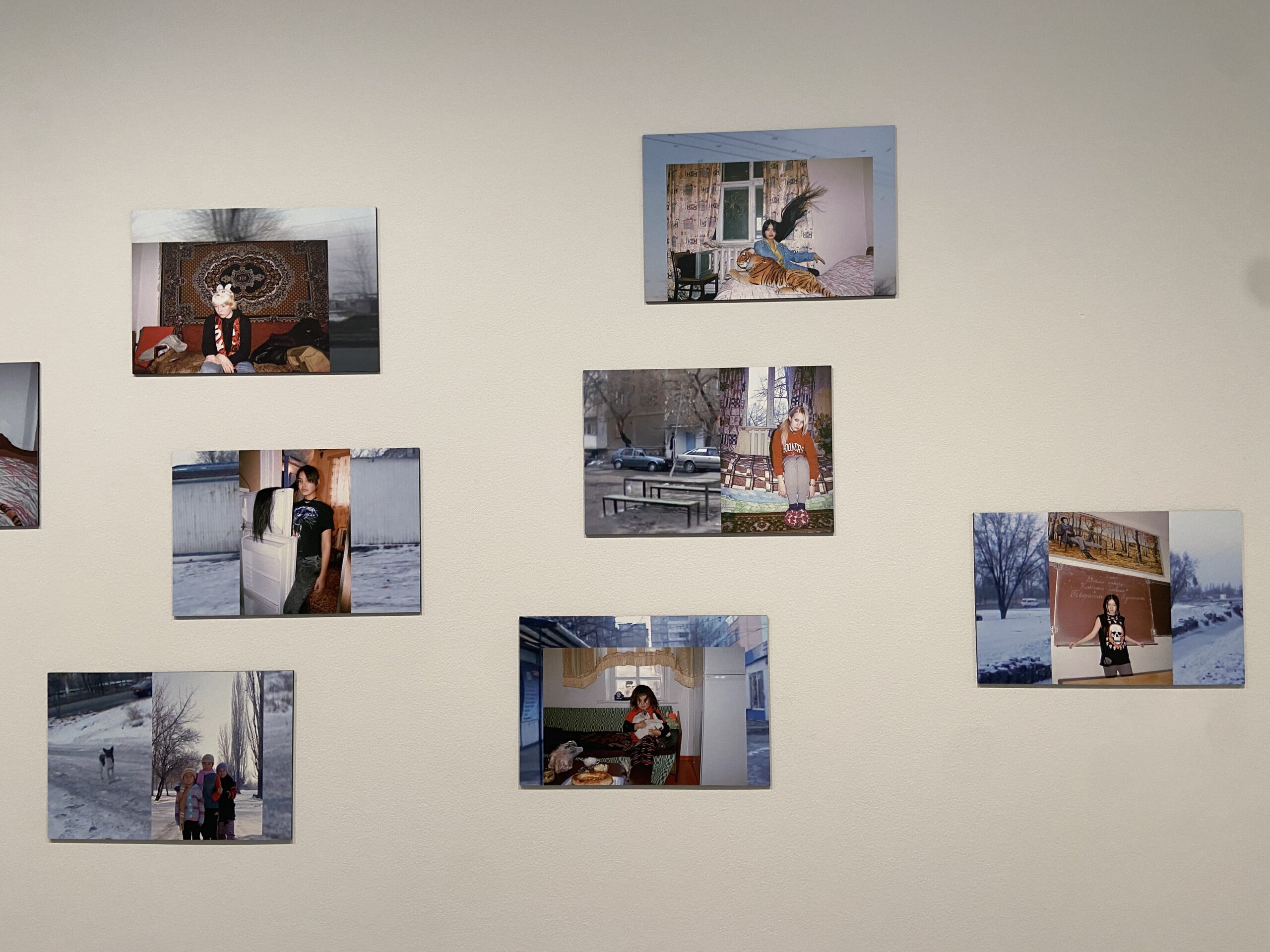
Aziza Shadenova, “Girls of Kyrgyzstan”; image: TCA, Naima Morelli

In the catalogue essay, Sara Raza explains that social media is a space where Kyrgyz girls can reclaim their sense of autonomy, posting images and texts that involve encoding hidden messages in clothing, hairstyles, gestures, and postures that are generationally-specific.

Overall, what emerges from the third chapter of “Seeing is Believing: The Art and Influence of Gérôme,” is a clear vision of how artists are entering a new era of de-orientalization. What Sara Raza and the artists suggest in the show is that in order to move forward the discourse on Orientalism, artists from all geographies must be aware of stereotyping and correct historical inaccuracies.

“Collectively the artists in ‘I Swear I Saw That’ embody conceptual positions that challenge obsolescent Eurocentric historical precedents and can tackle issues of prejudice, power and knowledge by way of conscious visioning,” says Sara Raza. “Witnessing becomes holy writ: mysterious, complicated, powerful. Necessary.”

And if the Gulf countries are providing the ideal framework, in terms of institutions, to be a place for these voices and narratives, Central Asian artists are at the forefront of this vision.


Uzbek Footballer Abdukodir Khusanov to Sign for Manchester City

When the English champions Manchester City suffered a shock run of losses recently, soccer fans began guessing what moves coach Pep Guardiola would make to stop their winter slump. No-one expected him to call for a defender from Uzbekistan.

Abdukodir Khusanov, still only 20 but already with 18 appearances for the White Wolves, is set to become Guardiola’s first signing of 2025. On 11 January the tall center-back agreed to join City in a €40 million ($41 million) transfer from the French team RC Lens. Once the move is complete, Khusanov is expected to sign a contract for four and a half years,

Manchester City have won five of the last six Premier League titles. They were European club champions in 2023 after winning a first UEFA Champions League.

With Europe’s giants very rarely looking to Asia for their next young star, Khusanov has taken an unconventional route to the Etihad Stadium. He began his career in the youth team of local side Bunyodkor, before moving to Belarus in 2022, at the age of 18, to play for Energetik-BGU Minsk.

In 2023 Khusanov was part of the Uzbekistan youth team that won the AFC Under-20 Asian Cup. There his confident passing and physicality caught the attention of RC Lens. He became a fan favorite in northern France, and the youngest Uzbek to play in the Champions League.

Conor Bowers, a British fan of Uzbek soccer, has followed Khusanov’s career closely, and mentions that the €40 million man once struggled even to make teams in his homeland. “Although he is now over six feet tall, his youth coaches thought he would be too small to make it professionally. And that was even as a child, when he played as a striker.”

Of his season in France, Bowers adds: “People had high hopes for Khusanov, but no-one expected him to move to a club the size of Manchester City this fast. People feel it will put Uzbekistan in the spotlight of the football world.”

It was his strong performances in the French league that put Khusanov on the radar of Europe’s best clubs – Manchester City beat other English teams to his signature – but the defender is also vital to his national team. With the striker Eldor Shomurodov (of Roma in Italy) leading the attack, and Khusanov the team’s rock in defense, Uzbekistan has become Central Asia’s most accomplished side. The senior team is on course to qualify for next year’s men’s FIFA World Cup in North America.

Khusanov will be the first footballer from anywhere in Central Asia to play in the English Premier League. However, he is not the first player born in Tashkent to grace the so-called “best league in the world”. The Nigerian forward Peter Odemwingie spent his early childhood in Uzbekistan’s capital, before playing in the EPL for West Bromwich Albion and Stoke City.

As news of Khusanov’s move to Manchester swept across Uzbek media over the weekend, sports fans were excited by the prospect of one of their footballers playing under the legendary coach, Guardiola. “It’s a big thing for us to get to see one of our young players winding up at Pep’s team”, says Donat Iskanderoff, an Uzbek sports journalist.

Iskanderoff adds: “One fact people might not know is that his father [Hikmat Hashimov] used to play football as well, for Metallurg Bekabad [and the Uzbek national team]. But Abdukodir plays under a different surname – the father wanted to take pressure off his son.”

Salvaging Manchester City’s season while taking his nation towards a first World Cup, Abdukodir Khusanov will have no way of escaping the pressure now. But whether or not he is a success in England, the impressive young defender will have the whole of Uzbekistan behind him.

KazMunayGaz Looking to Buy Another European Oil Refinery

Kazakhstan’s KazMunayGaz (KMG) is seeking to acquire an oil refinery in Bulgaria from Russia’s LUKoil at a bargain price. The purchase of Lukoil Neftohim Burgas, the largest oil refinery in the Balkans, would, according to some media sources, more than double [KMG’s] European refining capacity.” KMG reported a bid of $1 billion for the refinery, which one outlet stated “seems small.”


Pressured Out

The Burgas refinery was built in the early 1960s and “joined the LUKoil Group” in 1999. The European Union decision to impose a ban on Russian oil imports after the Kremlin launched its full-scale war on Ukraine deprived Lukoil Nefthohim Burgas of its major source of crude oil.

According to a Financial Times report from November 2024, the Bulgarian government pressured LUKoil to sell the refinery, hitting the Russian company “with a 60% tax on profits in an effort to force out its owners” and prohibiting the “export of Russian crude-based products from Lukoil Neftohim Burgas.” In turn, LUKoil complained about “discriminatory laws and other unfair, biased political decisions toward the refinery.”

KMG reportedly lost interest in the refinery in late 2024, but BNN Bloomberg reported on January 7 that the Kazakh company was still among the bidders for the Bulgarian refinery.


Advantage KMG

When the EU banned Russian oil imports, Lukoil Nefthohim Burgas compensated by purchasing oil from Kazakhstan and the Middle East.

If KMG buys the Bulgarian refinery, presumably most or all of the crude processed there will come from Kazakhstan.

Kazakhstan exported some 70.5 million tons of oil in 2023, and expects figures will be slightly less in 2024, some 68.8 million tons, due to maintenance at the Tengiz and Kashagan fields.

Some 80% of those oil exports are shipped from Kazakhstan through the Caspian Pipeline Consortium (CPC) pipeline to Russia’s Black Sea port at Novorossiysk.

Prior to Russia’s full-scale invasion of Ukraine, the EU purchased about 50% of the Kazakh oil shipped through the CPC pipeline, but that amount has risen to 80% since the ban on Russian oil imports was imposed.

Kazakhstan is also increasing the amount of oil it exports through Azerbaijan to Georgia’s Black Sea port at Batumi, where KMG subsidiary KazTransOil owns the oil terminal. Kazakhstan has a deal to ship 1.5 million tons of oil annually through Azerbaijan, but Kazakh Energy Minister Abdusalam Satkaliyev said in November 2024 that his country was looking to boost that to 20 million tons.

Kazakhstan currently has two Aframax-class oil tankers (deadweight 80,000 tons each) operating in the Black Sea, but plans to bring this number to 12 during the coming years.

The Lukoil Nefthohim Burgas refinery has a capacity to process some seven tons of oil annually.

KMG International already owns two oil refineries in Romania. The Petromidia refinery, with an annual capacity of some five million tons, is located 20 kilometers from the Black Sea port city of Constanta, and the much smaller and older Vega refinery, north of Bucharest, with an annual capacity of some 350,000 tons.


A Great Deal

KMG’s $1 billion bid for the Lukoil Nefthohim Burgas is attracting attention.

The Bulgarian oil refinery completed $1.5 billion in upgrades in 2015.

BNN Bloomberg quoted senior oil and gas analyst Jonathan Lamb of the Wood & Company Financial Services as saying KMG’s $1 billion bid “looks cheap.”

The need for LUKoil to sell the refinery is obvious, but Azerbaijan’s SOCAR and Turkish oil company Opet also submitted bids for the Bulgarian refinery, and “at least half a dozen groups have expressed interest in buying” Lukoil Nefthohim Burgas.

Kazakhstan is discussing financing for the purchase of the Bulgarian refinery with the Swiss-based company Vitol, which has been called the “king of oil in Kazakhstan” and is connected to Temir Kulibayev, the son-in-law of former Kazakh President Nursultan Nazarbayev.

Kulibayev is not directly connected to LUKoil, but he did serve on the board of directors at Russian gas giant Gazprom from 2011 to 2022 and has been linked to state-owned energy companies in Kazakhstan.

A condition of the refinery’s sale is that the money will not be transferred to Russia, so the sale and payment will be watched closely by the Bulgarian government and the EU.


From the Ground to the Petrol Pumps

Kazakhstan is already working to control its oil exports, from extraction in Kazakhstan’s oil fields to its transportation and processing into a finished product available for sale as filling stations abroad.

If KMG does indeed acquire the oil refinery in Bulgaria, it would give the Kazakh company the ability to process more than 12 million tons of oil at refineries in Europe.

The EU ban on Russian oil imports provides Kazakhstan with an excellent opportunity to increase its share of the oil and gasoline markets in Europe.

U.S. Magazine Highlights French Cave Explorers’ Discoveries in Koytendag, Turkmenistan

The December 2024 issue of NSS News, a U.S. magazine, featured an in-depth report on the spring expedition of French speleologists to Koytendag, Turkmenistan.

The expedition brought together 17 specialists in topography, photogrammetry, biospeleology, geology, and karstology. Their primary objectives were to document existing cave systems, create updated maps, and identify unexplored caves. Over 21 days, the team surveyed approximately 19 kilometers of caves, conducted over 8,500 topographic measurements, and refined maps created by Russian researchers.

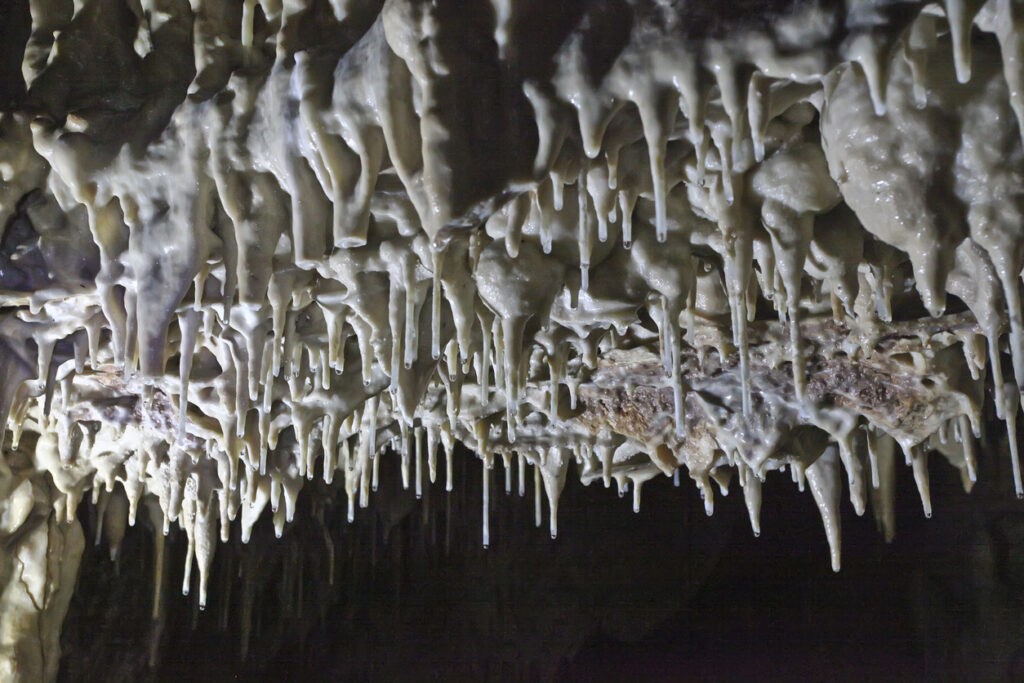
A major focus of the expedition was 3D photogrammetric modeling of the Geophysical (Gulshirin) Cave, renowned for its stunning gypsum formations. Using a Disto X laser rangefinder and the Topodroid app, the researchers enhanced mapping accuracy and created a digital replica of the cave. This cutting-edge model serves both scientific and educational purposes.

“We took more than 50,000 photos in four days, allowing us to produce a highly accurate 3D model,” one expedition participant explained. “This technology not only reveals the cave’s internal structure and unique gypsum formations but also offers an immersive viewing experience.”

The team also explored the northwestern part of the massif, identifying small gypsum systems and passages several tens of meters in length. To the east, near the snowy peak of Airybaba at an altitude of 2,400 meters, they discovered a cave marked on their maps. However, adverse weather conditions delayed a full survey of the site.

Despite challenges in accessing some areas, the expedition yielded significant results. Koytendag reaffirmed its reputation as a geologically and biospeleologically rich region.

The expedition’s findings were presented at a conference held at the French Institute in Ashgabat. Koytendag’s unique caves remain an untapped treasure, holding immense potential for advancing scientific and ecological understanding.

Kazakhstan Strengthens Locust Control to Protect Agricultural Crops

Kazakhstan plans to double its machinery and equipment for combating locust infestations during the 2025 growing season. The expansion of locust control measures and preparations for spring fieldwork were key topics discussed at a government meeting on January 9​.

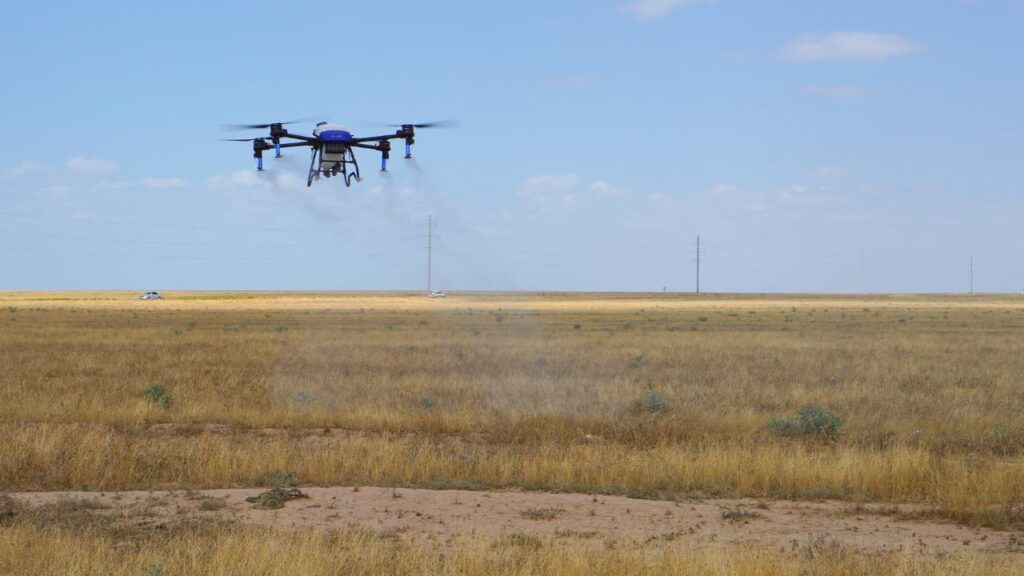
Deputy Minister of Agriculture Ermek Kenzhekhanuly reported that 247 pieces of equipment were deployed for chemical field treatments in 2024. This number will rise to 443 in 2025, including 46 agro drones and 7 monitoring drones newly acquired by the Ministry of Agriculture.

Enhanced Strategies and Subsidies

Building on a successful pilot project in the Turkestan region last spring, the Ministry has adopted centralized services for the purchase, transport, and storage of pesticides and field treatment. The program tested agro drones for spraying fields and operated under a unified “one supplier – all work” principle.

To further support farmers and service providers, the government will reimburse 25% of the cost of wheeled spraying machinery and agro drones, making these technologies more accessible.

Deputy Prime Minister and Minister of National Economy Serik Zhumangarin emphasized the need to restructure sown areas, reducing wheat cultivation in favor of oilseed and other high-margin crops.

Results and Regional Cooperation

Kazakhstan’s locust control measures proved effective in 2024, with over 3.1 million hectares treated – 23% more than the planned 2.5 million hectares. This protected agricultural crops from significant damage by grasshopper swarms.

Locust infestations in Kazakhstan have escalated in recent years, affecting 514,000 hectares in 2020 and rising to 1.6 million hectares by 2023. According to the UN’s Food and Agriculture Organization, locust outbreaks threaten agriculture across Central Asia and the South Caucasus, endangering over 25 million hectares of farmland and impacting approximately 20 million people.

To address the issue, Kazakhstan continues close cooperation with neighboring countries, including Russia, to monitor and mitigate the potential spread of locusts.

Uzbekistan Receives Historic Manuscript Copies from Malaysia

Uzbekistan’s cultural heritage will soon be added to with facsimile copies of ancient manuscripts provided by Malaysia. This initiative is part of a collaboration between the Center for Islamic Civilization in Uzbekistan and Malaysia’s International Institute of Islamic Thought and Civilization.

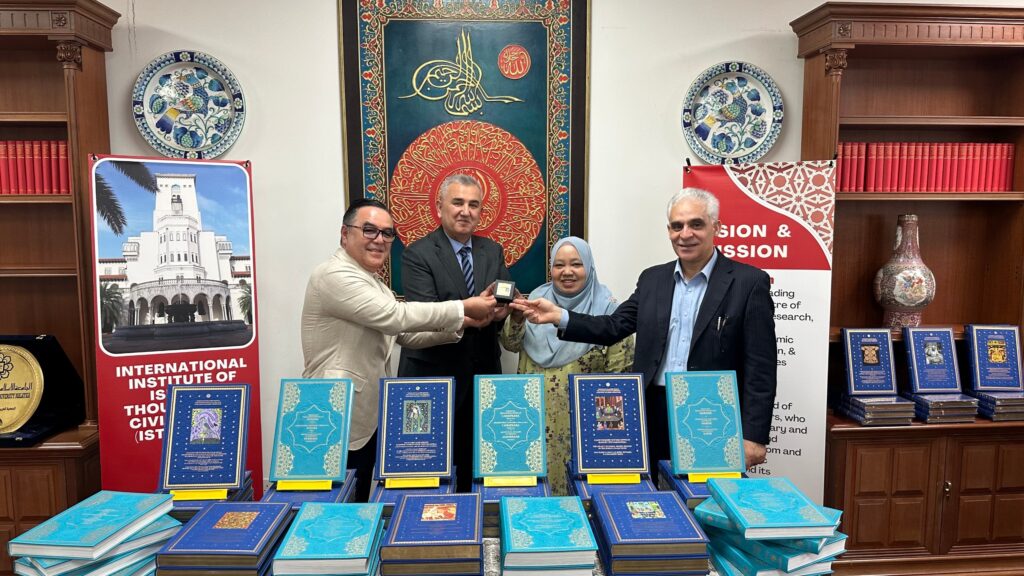
During a recent visit to Malaysia by an Uzbek delegation, the Center’s Director, Firdavs Abdukhalikov, received copies of two invaluable works: Abu Rayhan Beruni’s At-Tafhim and Abulkasim Firdavsi’s Shahnameh, both transcribed during the Timurid era.

Abdukhalikov believes this initiative aligns with broader efforts to promote humanitarian values and preserve Uzbekistan’s historical heritage. “The copies of manuscripts received today will further enrich the exposition of our center,” he stated.

Beruni’s At-Tafhim, originally transcribed in 1197, holds immense significance for world science. Meanwhile, the Timurid-era transcription of Firdavsi’s Shahnameh, produced in the 15th century, reflects the traditions of book printing from that period and showcases the distinctive features of Kamoliddin Behzod’s renowned school of miniature painting.

These manuscripts will be displayed at the Center for Islamic Civilization, which was established eight years ago to celebrate the contributions of Uzbek scholars to global civilization and to preserve the nation’s rich cultural legacy.