Made in Kazakhstan: Building an AI for a Nation

On a cold November morning at Al-Farabi University in Almaty, students gathered in a drafty lecture hall, many still wrapped in their coats. The setting was more reminiscent of a forgotten Soviet-era classroom than a venue for cutting-edge technology. But amid the peeling paint and rickety seats, some of the country’s most ambitious young researchers had come to discuss Kazakhstan’s latest steps into the world of artificial intelligence.
The star billing came from the Institute of Smart Systems and Artificial Intelligence (ISSAI) at Nazarbayev University in Astana. Last year, the institute released KazLLM, its first Large Language Model (LLM), to much fanfare, inspired by a philosophy of building AI systems that understand the country’s language and culture rather than borrowing second-hand from Silicon Valley.
But can Kazakhstan keep pace in the global AI race? And despite the government’s efforts to back local products, can it convince the population to use them over Western alternatives?
Recent developments
The Institute’s founder, Doctor Huseyin Atakan Varol, was keen to stress that steps have been taken to develop Kazakhstan’s native AI ecosystem over the past twelve months.
“Since the release of KazLLM last year, we have witnessed what I would describe as a ‘Cambrian explosion’ of generative AI development,” he told The Times of Central Asia. “The KazLLM project enabled us to create the team and amass the know-how to build a new generation of multilingual and multimodal models tailored to Kazakhstan’s needs.”
Among these, he lists Oylan, a multimodal language–audio-vision model; MangiSoz, a multilingual speech and text translation engine; TilSync, a real-time subtitle and translation engine; and Beynele, a text-to-image generation model. All these models have been fine-tuned to better reflect Kazakh culture and linguistic norms.
“In short, we are building AI made in Kazakhstan, by Kazakhstani youth, for Kazakhstan –models that understand the language, culture, and needs of the people,” said Amina Baikenova, ISSAI’s Acting Deputy Director of Product and External Affairs, in an interview with TCA.
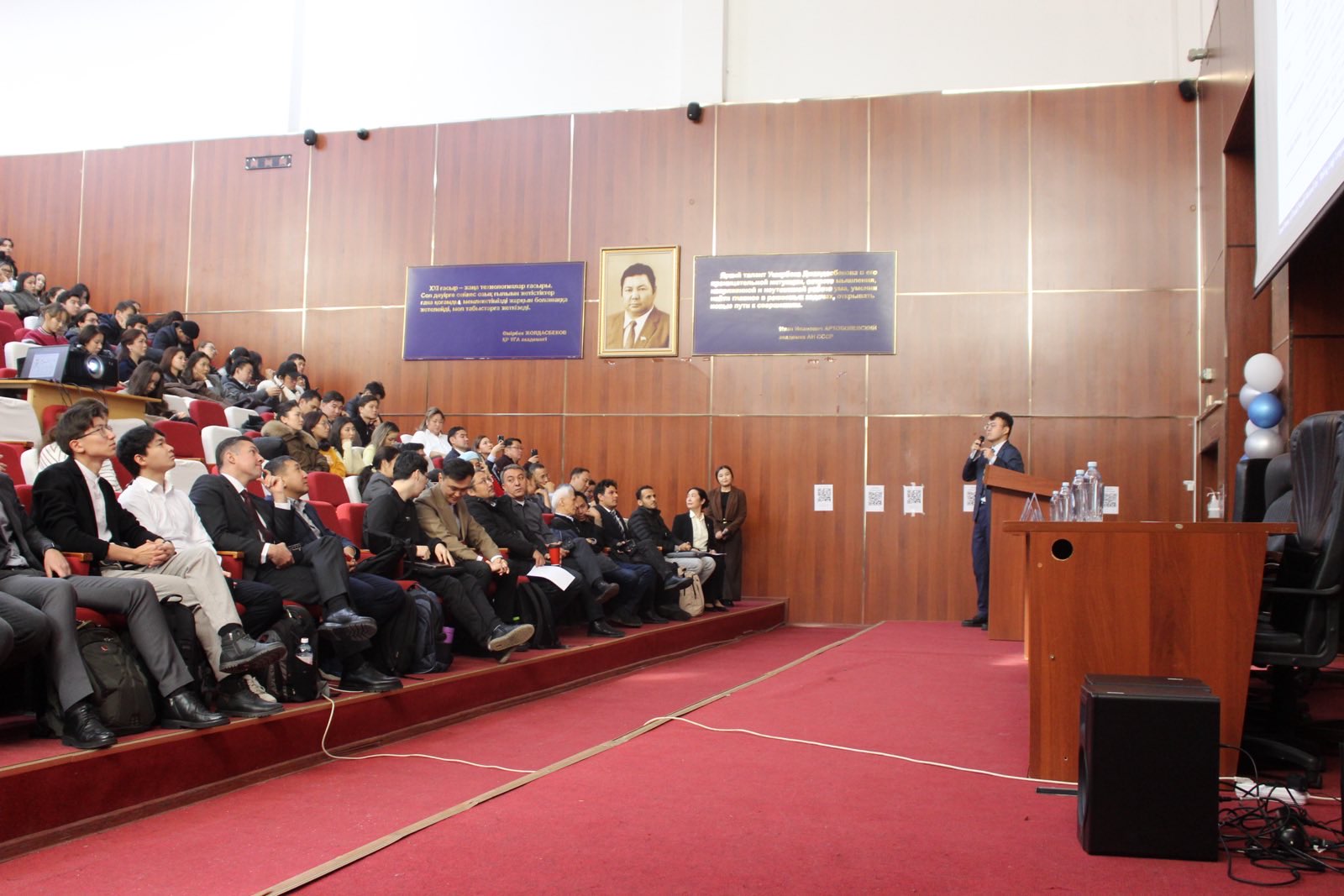
The old lecture hall at Al-Farabi University, Almaty; image: TCA, Joe Luc Barnes
Much of this progress stems from the enthusiasm of a generation of students, whom Kazakhstan has invested heavily in training. Indeed, the country has become a magnet for young researchers from across Central Asia.
“After completing my bachelor’s degree in Kyrgyzstan, I was looking for opportunities to build my research career. That’s why I moved to Kazakhstan,” said Adam Erik, an ISSAI student from Bishkek. “Kazakhstan has become a scientific center of Central Asia.”
Erik believes strongly in building local language models. “There is a thing called bias in data sets,” he said. “Models from the U.S., China, or Europe are incredible, but they’re trained mostly on Western culture and literature. Local solutions are still necessary.”
These sentiments reflect a common frustration among researchers: even the best global AI systems stumble when asked about Kazakh idioms, rural social norms, or local history. The data used to train the world’s most powerful models rarely includes more than a sliver of Central Asian content. For a region with a long history of linguistic marginalization, this is especially galling.
“When you need something specifically about Kazakh culture or traditions, our local KazLLM does it better than ChatGPT,” Adilet Yerlanuly from Kyzylorda, told TCA. “ChatGPT simply isn’t focused on Kazakh in that way.”
Kazakhstan’s government has placed heavy emphasis on digital development in recent years. Tech fairs such as Digital Bridge in Astana, which this year drew high-profile guests including Telegram founder Pavel Durov, have become the public face of this push. More than 31,000 students are now enrolled in AI-related fields.
Nevertheless, while it is one thing to create a model, it is quite another to get people to use it. American apps such as Google’s Gemini or OpenAI’s ChatGPT remain far more popular than local alternatives. But ISSAI believes things are trending in their direction.
“Over the past year, we’ve seen steadily growing interest in ISSAI’s AI solutions across Kazakhstan, especially from government institutions, educational organizations, and large enterprises,” Amina Baikenova, Acting Deputy Director of Product and External Affairs, told TCA.
Some of this is due to government support, but non-tariff barriers have also helped put wind in the sails of local products. “Businesses are increasingly seeking locally developed AI tools that respect data sovereignty,” said Baikenova.
ISSAI also hopes to draw users with models tailored to uniquely Kazakh problems. Its newest model, Qolda, is what researchers call a “Lightweight Language Model,” small enough to run directly on a smartphone and even operate offline. In a country where mobile coverage drops off sharply outside big cities and where some schools still struggle with internet access, this has the potential to be a USP.
Another advantage is responsiveness to ongoing political developments, such as the country’s torturous road to converting to the Latin Script. “A substantial portion of the feedback we received requested the addition of Latin support,” said Varol. “Recognizing this social trend, we integrated Kazakh Latin support into our latest model, Oylan 2.5.” He adds that this makes it easier for users to move seamlessly between Cyrillic and Latin, making it adaptable for everyone.
Competing Seriously
Kazakhstan’s ambitions, however, are not without limits. The country lacks the computational power to train models on the scale of GPT-5 or Google’s Gemini. Much of the heavy lifting still relies on foreign cloud infrastructure, and quality Kazakh-language data remains scarce, requiring researchers to cobble together materials from literature, media, government archives, and social networks.
Kazakhstan’s balancing act between China and the United States has also affected hardware procurement. For the country’s first supercomputer, Kazakhstan faced a long wait for a U.S. export license to use the latest Nvidia chips.
Kazakhstan is also not the only country racing to improve its AI capabilities.
“Many other countries are also cognizant of the potential of AI and are intensifying their efforts and investments in this field,” said Varol. He says that to keep pace, Kazakhstan will need more investment in R&D, as well as better collaboration between universities, research institutes, industry, and government. “This includes further developing national computing infrastructure, supporting deep-tech startups, fostering academic AI research, and encouraging businesses to adopt and build AI solutions locally.”
Despite growing investment, Kazakhstan continues to lose top talent to Europe and the United States. Even the strongest local models cannot compete with the breadth of foreign systems trained on trillions of tokens. What they can do is excel in places where the big models falter: the nuances of Kazakh grammar, regional dialects, and Kazakh faces in video content.
This balance between aspiration and realism is visible in almost every corner of Kazakhstan’s AI scene. Schools across the country now offer coding and robotics classes, universities promote AI training, but students often work in buildings that feel as though they haven’t been renovated since the early 1990s. The ambition is modern; the infrastructure is catching up at its own pace.
Varol says he is “cautiously optimistic” about Kazakhstan’s position and AI potential. He notes that the country seems to have an AI strategy and has invested in infrastructure such as a supercomputer (with another in the works), the Alem AI Center in Astana, as well as creating a dedicated AI ministry. If the current momentum continues, he believes the country may become a regional leader in AI and see significant economic gains.
The determination is unmistakable. When the Qolda demonstration ended at Al-Farabi, students peppered its creators with earnest and enthusiastic questions. The heating was no better, and the plaster was still flaking above their heads, but the atmosphere had shifted into something lively and collective. It felt like the start of a conversation Kazakhstan has decided it doesn’t want outsourced.