• KGS/USD = 0.01144 0%
  • KZT/USD = 0.00213 0%
  • TJS/USD = 0.10456 0.19%
  • UZS/USD = 0.00008 0%
  • TMT/USD = 0.28490 0%
  • KGS/USD = 0.01144 0%
  • KZT/USD = 0.00213 0%
  • TJS/USD = 0.10456 0.19%
  • UZS/USD = 0.00008 0%
  • TMT/USD = 0.28490 0%
  • KGS/USD = 0.01144 0%
  • KZT/USD = 0.00213 0%
  • TJS/USD = 0.10456 0.19%
  • UZS/USD = 0.00008 0%
  • TMT/USD = 0.28490 0%
  • KGS/USD = 0.01144 0%
  • KZT/USD = 0.00213 0%
  • TJS/USD = 0.10456 0.19%
  • UZS/USD = 0.00008 0%
  • TMT/USD = 0.28490 0%
  • KGS/USD = 0.01144 0%
  • KZT/USD = 0.00213 0%
  • TJS/USD = 0.10456 0.19%
  • UZS/USD = 0.00008 0%
  • TMT/USD = 0.28490 0%
  • KGS/USD = 0.01144 0%
  • KZT/USD = 0.00213 0%
  • TJS/USD = 0.10456 0.19%
  • UZS/USD = 0.00008 0%
  • TMT/USD = 0.28490 0%
  • KGS/USD = 0.01144 0%
  • KZT/USD = 0.00213 0%
  • TJS/USD = 0.10456 0.19%
  • UZS/USD = 0.00008 0%
  • TMT/USD = 0.28490 0%
  • KGS/USD = 0.01144 0%
  • KZT/USD = 0.00213 0%
  • TJS/USD = 0.10456 0.19%
  • UZS/USD = 0.00008 0%
  • TMT/USD = 0.28490 0%

Kyrgyzstan Explores English Common Law to Boost Investment Appeal

On March 11, Adylbek Kasymaliyev, Chairman of Kyrgyzstan’s Cabinet of Ministers, met with British Ambassador Nicholas Bowler and a group of international consultants to discuss adopting English common law principles for resolving investment disputes in Kyrgyzstan.

English common law is a legal system based on judicial precedents rather than codified statutes.

According to the Kyrgyz government’s press service, the meeting focused on establishing an independent arbitration mechanism to handle investment and commercial disputes under English common law. This initiative aims to enhance Kyrgyzstan’s investment appeal and strengthen investor protections, key factors in attracting foreign capital for sustainable economic growth.

Discussions also covered potential funding models for consulting and methodological support necessary to implement the initiative successfully.

Another key topic was the possible creation of a special investment zone with a distinct legal framework designed to offer more favorable conditions for businesses and investment projects.

Kasymaliyev underscored that creating a business-friendly environment and guaranteeing robust legal protections for investors are top priorities for Kyrgyzstan. He stated, “We are keen to study and apply international practices, including English law, to boost investor confidence in our legal system.”

Ambassador Bowler reaffirmed the U.K.’s willingness to share its legal expertise to support Kyrgyzstan’s economic development and investment climate.

The introduction of English common law principles for resolving investment disputes could improve investor confidence in Kyrgyzstan’s legal framework, ensuring greater predictability and security for foreign investments.

Ukrainian Fugitive Arrested in Poland for Organ Trafficking in Central Asia

A 35-year-old Ukrainian woman has been arrested in Przemyśl, Poland, based on an Interpol Red Notice, according to the country’s prosecutor’s office. She has been on the run since November 9, 2020, after being sentenced to 12 years in prison by a court in Kazakhstan for her role in an organized crime group involved in human organ trafficking.

On March 6, 2025, border guards at the railway crossing in Przemyśl detained Ksenia P. (whose name is protected under Polish privacy laws) during a routine inspection. Authorities confirmed that she had been convicted in Kazakhstan for her involvement in an international criminal group that operated between 2017 and 2019. The group illegally harvested human tissues and organs for sale on the black market.

Ksenia P. was found guilty of obtaining human kidneys from 56 victims across several countries, including Kazakhstan, Armenia, Azerbaijan, Ukraine, Kyrgyzstan, Tajikistan, Uzbekistan, and Thailand. The illegal trade was conducted for financial gain, with the criminal network relying on it as a steady source of income.

Following her arrest, the District Prosecutor’s Office in Przemyśl questioned Ksenia P. and, on March 7, 2025, requested the District Court to impose a temporary seven-day detention. This measure is intended to facilitate her extradition to Kazakhstan, where she is expected to serve her sentence.

Uzbekistan Joins International Code for the Protection of Tourists

Uzbekistan has officially joined the International Code for the Protection of Tourists (ICPT), becoming the 26th country to do so. The announcement was made by the United Nations World Tourism Organization (UN Tourism), the agency responsible for promoting responsible and sustainable tourism worldwide.

The ICPT aims to safeguard tourists’ rights and ensure their safety while traveling.

UN Tourism works to position tourism as a driver of economic growth, social inclusion, and environmental sustainability. The organization supports its 160 member states by providing policy guidance, educational resources, and crisis management strategies. It also helps countries enhance their tourism competitiveness through knowledge-sharing and training programs.

Uzbekistan has been actively expanding its tourism sector, drawing visitors with its rich cultural heritage and historical landmarks. Aziz Abdukhakimov, Uzbekistan’s Minister of Ecology, Environmental Protection, and Climate Change, emphasized the significance of joining the ICPT, stating: “The International Code for the Protection of Tourists not only enhances the rights and protections of travelers but also strengthens trust in Uzbekistan as a welcoming and reliable destination.”

Uzbekistan’s efforts in tourism development have been widely recognized. According to the World Economic Forum’s Travel and Tourism Development Index, the country was named the “World’s Most Active Country in Tourism Development” in 2024. Additionally, at a ceremony in London, Uzbekistan won the “Best Emerging Destination” award at the prestigious Wanderlust Reader Travel Awards 2024.

To facilitate travel for foreign visitors, Uzbekistan has implemented key policy changes. Citizens of more than 90 countries can now enter Uzbekistan visa-free for up to 30 days, and an electronic visa system has been introduced to simplify the application process. As a result, in 2024, Uzbekistan welcomed 8.6 million foreign tourists, generating $2.7 billion in tourism revenue.

Kazakhstan Cancer Drug Could Hit the Market This Year

Kazakhstan’s Minister of Science and Higher Education, Sayasat Nurbek, has announced the development of a domestic anti-cancer drug currently undergoing clinical trials.

According to Nurbek, Phase II clinical trials were completed in 2023, and the number of patients participating in the testing has since been significantly expanded.

“At the moment, the drug is being tested on different types of cancer. Last year, trials were conducted exclusively on patients with colorectal cancer. By the end of 2024, we expect the drug to be officially registered and introduced to the market. Preliminary results indicate stable positive dynamics,” the minister stated.

He noted that patients in clinical trials have experienced remissions, with tumor sizes decreasing by an average of 30%.

“By the end of the year, we plan to hold a conference to present the results. The Ministry of Health has been highly supportive, and we have optimized the registration process without violating regulations,” Nurbek added.

The official registration of the drug is expected to be finalized as soon as possible.

Kazakhstan’s development of its first domestically produced anti-cancer drug was first reported in January 2024. Later, Nurbek provided updates on the trial progress and expressed confidence in the drug’s effectiveness.

Bulgarian Spy Ring Attempted to Threaten Kazakh President’s Western Ties

A spy cell in the UK, including five Bulgarian nationals, targeted multiple individuals and locations over nearly three years, according to court documents at the Old Bailey, officially known as the Central Criminal Court of England and Wales.

The Bulgarian nationals had stood accused of spying for Russia at the behest of the fugitive Jan Marsalek, the former COO of Wirecard, described by prosecutors as “believed to be linked to the Russian state”. The trial centered around thousands of sinister messages between Marsalek and Bulgarian national Orlin Roussev, who compared himself to the fictional character of ‘Q’ from the James Bond movies, and his “team leader” Bizer Dzhambazov, who managed the other three defendants, all belittlingly referred to as “the minions”. Roussev and Dzhambazov had pleaded guilty to their role in the spy ring prior to the trial.

The Central Criminal Court of England and Wales; image: TCA, Stephen M. Bland

The story has all the hallmarks of a Hollywood script: gadgets, beautiful women, and dozens of fake IDs used to rent cars and properties across Europe for various operations. The defendants plotted espionage, psyops, and disinformation campaigns, and even kidnapping and murder, some of which were partially carried out in the UK and across continental Europe, including in Germany, Austria, and Spain, as well as other locations.

Messages presented to the court indicate that, beyond their alleged collaboration with the Russian FSB, the gang operated as mercenaries for any party willing to pay. The Bulgarians devised schemes appealing to their purported connections in Russia, Kazakhstan, Serbia, China, Malaysia, and Colombia.

Germane to Central Asia, the spy ring engaged in a range of covert activities targeting Kazakhstan. In 2021, they botched a surveillance operation against Bergey Ryskaliyev, a long-time adversary of former President Nursultan Nazarbayev. Ryskaliyev, the former governor of Kazakhstan’s Atyrau region, fled to London after being accused of embezzling hundreds of millions of U.S. dollars and was sentenced in absentia to 17 years in prison for leading an organized criminal group.

Targeting Kazakhstan’s President

By 2022, the group’s efforts had escalated into an elaborate scheme to influence Western government officials to impose punitive measures against Nazarbayev’s successor, President Kassym-Jomart Tokayev.

The plan began with the creation of an entity designed to lend legitimacy to a fabricated grassroots opposition movement, the inception of which was discussed in Telegram chats between Marsalek and Roussev.

“If you have a preferred name… otherwise I will use my imagination and historical facts from the past centuries. Also… how about for the fake company or real company that we register to use some Chess terms…”, Marsalek suggested with regards to naming the NGO.

To which Roussev replied: “Let’s call it ‘Truth on the Steppes Publishing Ltd.’” The duo would later refer to the entity as “TOTS”.

Marsalek agreed, saying, “UK… will be done in a few days… that one I will register tomorrow – UK company ‘Truth on the Steppes Publishing Ltd.’”

Shortly after, “Truth on the Steppes Publishing Ltd” was established with the registered address given as a premises in Harrow, London.

The website truthonthesteppes.org was launched on September 14, 2022, and became a platform for disinformation. By October 19, 2022, or possibly earlier, as indicated by internet archives, it featured narratives pushing for sanctions against Tokayev and his family, with unverified claims of funds having been stolen and laundered by his relatives. The website’s contact address corresponded with that of the above-mentioned UK entity.
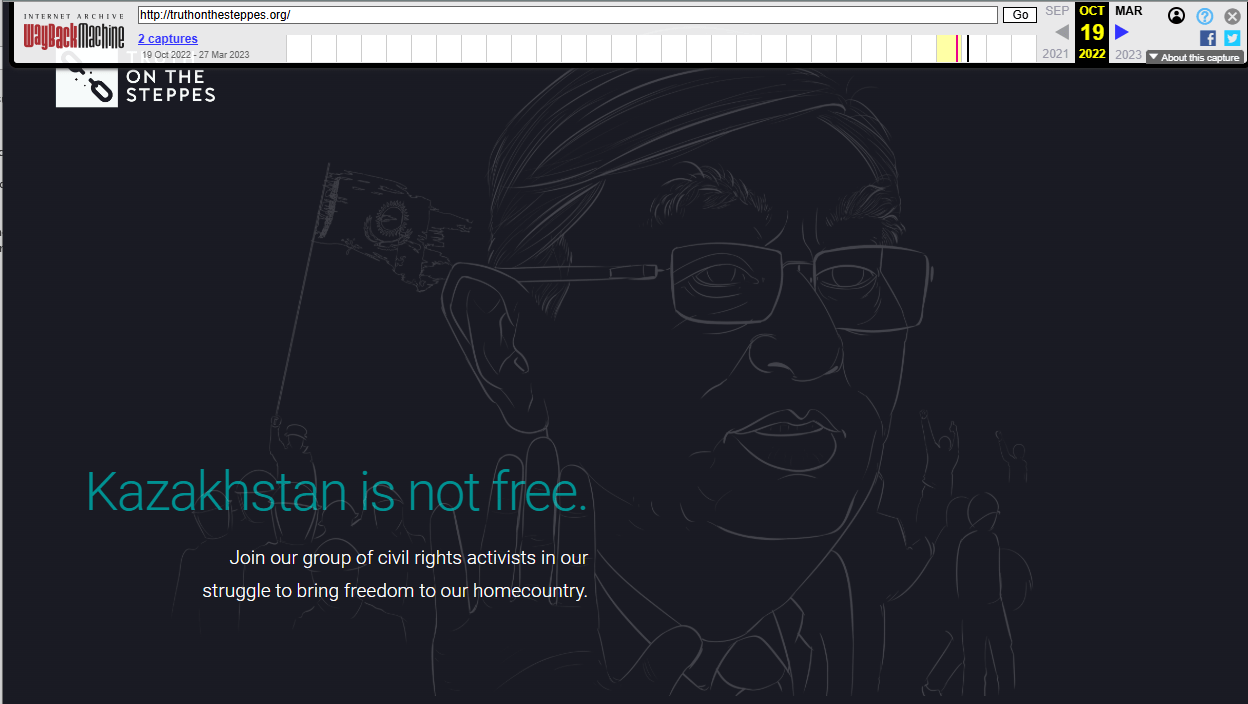
Screenshot of internet archive for truthonthesteppes.org

TOTS’ schemes included staging protests, such as spraying 100 liters of pig’s blood on the London Embassy of Kazakhstan. Roussev described the plan, stating: “The idea is we film it and publish it saying it’s the blood of the innocent Kazakh people, which the president has on his hands.”

In addition to these efforts, the conspirators worked to tarnish Kazakhstan’s reputation among Western policymakers by spreading narratives of collusion with Russia, human rights violations, and corruption. On September 6, 2022, Marsalek wrote to Roussev: “I’m preparing a mailing campaign to write letters to public officials in Europe and the U.S. urging them to sanction Kazakhstan as well as the President and his family for their support of Putin and their murderous actions in January this year.” Four days later, he added: “Drafting first love letters from TOTS to various European politicians.”

Evidence uncovered on Roussev’s laptop included a draft letter addressed to EU President Ursula von der Leyen. The letter, dated September 20, 2022, delivered a scathing critique of President Tokayev, accusing him of corruption, human rights violations, and ties with Russia, urging an international investigation as well as sanctions against Tokayev and his family.
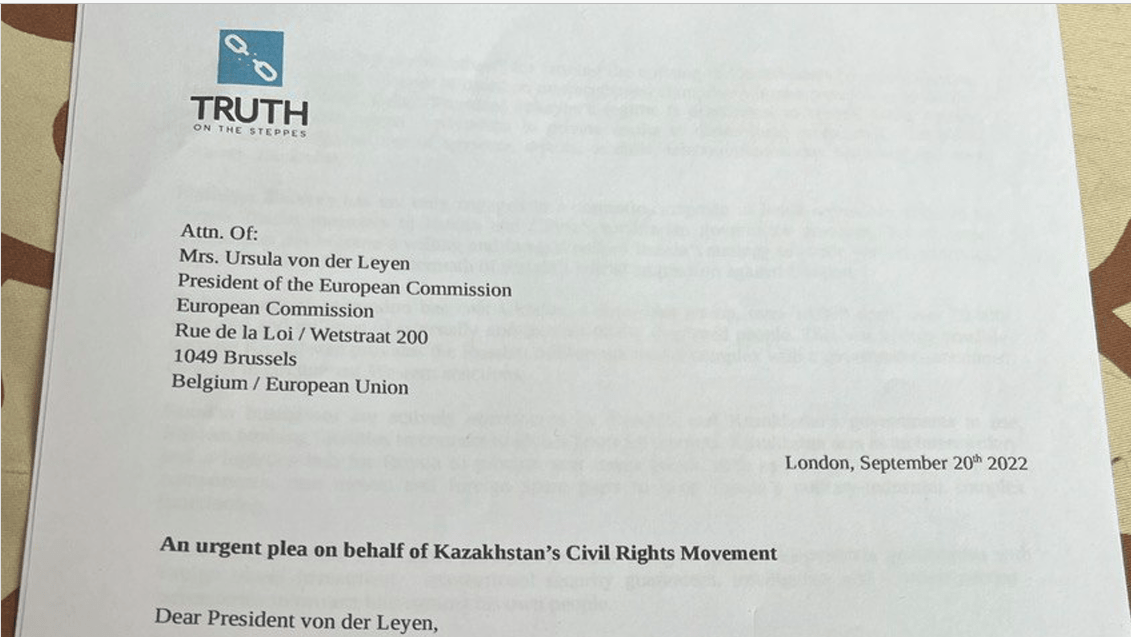
Image of letterhead of the draft letter to President Von der Leyen shared with The Times of Central Asia and corroborated with court documents

Other planned measures included slandering the President’s son. Marsalek emphasized to Roussev that, to be convincing, the fake derogatory content to be published should be mixed with some verifiable information, according to Telegram chats from the summer of 2022.

In late August 2022, the conspirators also discussed approaching Bellingcat, an esteemed investigative journalism organization, to write a story about the President’s family. Further proposals involved hacking Kazakh nuclear power plants and crashing the country’s currency.

The intended client for these “services” remains unclear and contradictory. In one instance, Marsalek and Roussev discussed fabricating evidence of protest activities that could potentially be sold to Russia, which could then share it with Kazakhstan to gain favor. In another, Marsalek argued that the attacks on the President’s family were warranted because Tokayev had not condemned Russia’s invasion of Ukraine, despite maintaining a neutral stance to keep Kazakhstan out of the conflict.

While the defense in the UK court case highlighted the conspirators’ unprofessional and clumsy methods, prosecutors successfully argued their culpability in conspiring to endanger state security. Alison Morgan KC, serving as the prosecutor, warned the jury that the defense would focus on the spies’ “amateurish antics being funny”, adding, “but it’s not funny at all… They were not stupid.”

Verdict

According to the prosecution, the defendants were accused of “monetizing a gap in the market,” engaging in what was described as “high-level espionage with very high stakes.” A money flowchart presented as evidence revealed that approximately €380,000 had been transferred between three of the suspects, further supporting the allegations.

Two men, Orlin Roussev, 47, and Bizer Dzhambazov, 43, had already pleaded guilty to their role in the spy ring prior to the trial. For the remaining three defendants (Katrin Ivanova, 33, Vanya Gaberova, 30, and Tihomir Ivanchev, 39) following 32 hours of deliberation, the jury returned a guilty verdict on charges of conspiracy, contrary to section 1 of the Criminal Law Act 1977, to commit an offence under section 1 of the Official Secrets Act 1911.

Only Ivanchev was present in court, while Ivanova and Gaberova joined via video link from HMP Bronzefield, a women’s prison in Surrey, England. Their crimes carry a maximum sentence of 14 years’ imprisonment. Sentencing is scheduled for May 2025.

Kazakh Researchers Uncover Important Step Towards Treating Parkinson’s Disease

Kazakhstan’s reputation in the global scientific community is evolving, thanks to research conducted by local scientists. Aizhan Ahmadi, a doctoral graduate from Nazarbayev University’s (NU) School of Natural, Social, and Human Sciences, and her team have made a discovery that could pave the way for future treatments for Parkinson’s disease.

TCA: Tell us about your research.

Aizhan: I recently completed my doctoral studies, defended my dissertation, and earned my PhD. Before that, I worked at a university for five years. During my research, I focused on a mutated protein called DJ-1, which is found in patients with Parkinson’s and Alzheimer’s diseases.

More than 20 years ago, European scientists identified mutations in DJ-1 in some patients suffering from these diseases. Despite extensive research in dozens of laboratories, the protein’s exact role remained unclear. While analyzing previous studies, we came across a large European research project with an interesting hypothesis about DJ-1. We decided to explore this direction further and we succeeded in proving that DJ-1 has a previously unknown function.

Understanding how DJ-1 protects biomolecules is not only crucial for developing new treatment methods for Parkinson’s disease but also for explaining cell aging. This discovery is vital for pharmacologists, as they cannot develop effective drugs without fully understanding a protein’s function.

For the first time, we have proven a new function of DJ-1. I believe this is a fundamental breakthrough for both global science and Kazakhstan’s scientific community. We submitted our findings to Nature Communications, a leading scientific journal. After a rigorous eight-month review process, our research was accepted. This was a difficult but rewarding journey. Our study is the first from independent Kazakhstan to be published in such a prestigious journal, making it a landmark achievement for our country.

TCA: What challenges come with studying biology in Kazakhstan?

Aizhan: Basic biological research is extremely resource-intensive. It takes time, energy, and has no guaranteed results. We invested grant funding and used millions of dollars’ worth of equipment. However, when a discovery is made, its contribution to science and medicine is invaluable.

Our study was conducted entirely within Kazakhstan, without relying on foreign laboratories. This is particularly significant because many still doubt whether serious scientific breakthroughs can come from Kazakhstan, especially in biochemistry.

Alongside me, my supervisor, Darkhan Utepbergenov, and several undergraduate students participated in the research. Professor Utepbergenov, a Kazakhstani scientist, graduated from Novosibirsk State University, worked in Germany and the U.S. for nearly 20 years, and then returned to Kazakhstan as a professor. He has said that this is his most significant work to date, and even he still finds it hard to believe that such a discovery was made in Kazakhstan. His contribution to both research and teaching at Nazarbayev University has been immense.

TCA: As a young woman in science, what motivated you to pursue this path? How can Kazakhstan raise the status of scientists?

Aizhan: First and foremost, better financial support is essential. Salary structures need improvement, bureaucratic obstacles must be reduced, and science communication should be strengthened. I would like to see more popular science publications, as the COVID-19 pandemic showed us how much people lack scientific knowledge.

Personally, I have always been curious about why things happen. Every step I take in my work is driven by this. When I add a solution, I want to understand what’s happening at the molecular level. I apply the same principle when selecting students, science is not just about performing tasks but about thinking critically.

I come from an ordinary family, my mother is a teacher, and she always told me that a girl must get an education. She believed that while men might find work as laborers, women need knowledge to secure their future.

The most important thing is to see our work make an impact. I sincerely hope that in 10 to 20 years, our research on DJ-1 will lead to the development of a drug that improves patients’ lives. We have laid a small but crucial foundation for this. We also have many new ideas, and Nazarbayev University has the necessary equipment to bring them to life. However, continued investment in fundamental science is essential if we want to make further discoveries in the future.