• KGS/USD = 0.01144 0%
  • KZT/USD = 0.00214 0%
  • TJS/USD = 0.10508 0.48%
  • UZS/USD = 0.00008 0%
  • TMT/USD = 0.28571 0%
  • KGS/USD = 0.01144 0%
  • KZT/USD = 0.00214 0%
  • TJS/USD = 0.10508 0.48%
  • UZS/USD = 0.00008 0%
  • TMT/USD = 0.28571 0%
  • KGS/USD = 0.01144 0%
  • KZT/USD = 0.00214 0%
  • TJS/USD = 0.10508 0.48%
  • UZS/USD = 0.00008 0%
  • TMT/USD = 0.28571 0%
  • KGS/USD = 0.01144 0%
  • KZT/USD = 0.00214 0%
  • TJS/USD = 0.10508 0.48%
  • UZS/USD = 0.00008 0%
  • TMT/USD = 0.28571 0%
  • KGS/USD = 0.01144 0%
  • KZT/USD = 0.00214 0%
  • TJS/USD = 0.10508 0.48%
  • UZS/USD = 0.00008 0%
  • TMT/USD = 0.28571 0%
  • KGS/USD = 0.01144 0%
  • KZT/USD = 0.00214 0%
  • TJS/USD = 0.10508 0.48%
  • UZS/USD = 0.00008 0%
  • TMT/USD = 0.28571 0%
  • KGS/USD = 0.01144 0%
  • KZT/USD = 0.00214 0%
  • TJS/USD = 0.10508 0.48%
  • UZS/USD = 0.00008 0%
  • TMT/USD = 0.28571 0%
  • KGS/USD = 0.01144 0%
  • KZT/USD = 0.00214 0%
  • TJS/USD = 0.10508 0.48%
  • UZS/USD = 0.00008 0%
  • TMT/USD = 0.28571 0%

Uzbekistan Extends Agreement on Hairaton-Mazar-e-Sharif Railway with Afghanistan

Uzbekistan has reached an agreement with Afghanistan’s Taliban interim government to extend the contract for operating and maintaining the Hairaton-Mazar-e-Sharif railway. Uzbekistan’s Minister of Transport, Ilhom Mahkamov, met with Mohammad Ishaq Sahibzada, Afghanistan’s Deputy Minister of Public Works for Railways, during talks held in Tashkent from January 21 to 23. Uzbekistan’s Ministry of Transport agreement has confirmed the agreement.

The meetings, chaired by Mahkamov, focused on accelerating the construction of the Trans-Afghan Railway project and planning the next stages of work. Both sides emphasized the importance of enhancing regional connectivity and ensuring the smooth operation of the existing railway infrastructure.

Under the extended agreement, Sogdiana Trans LLC, a subsidiary of Uzbekistan Railways Joint Stock Company, will continue managing the Hairaton-Mazar-e-Sharif railway. This railway, constructed in 2010 for $129 million, has been operated by Sogdiana Trans since its completion.

In August 2024, the Naibabad railway station — part of the Hairaton-Naibabad-Mazar-e-Sharif railway line — was reopened after restoration. The work was carried out by Sogdiana Trans in collaboration with the Termez Regional Railway Hub under a contract with the Afghan Railways Administration.

Despite a 2022 proposal from Afghan authorities to transfer the railway’s management to local companies to reduce operational costs, the plan wasn’t implemented. In 2024, the Hairaton-Mazar-e-Sharif railway facilitated the transport of 4,200 containers of goods between Afghanistan and China, according to the Afghan Ministry of Public Works.

The Hairaton-Mazar-e-Sharif railway forms a critical part of the China-Kyrgyzstan-Uzbekistan-Afghanistan railway corridor. The corridor’s capacity is expected to expand significantly following the completion of the China-Kyrgyzstan-Uzbekistan railway. Currently, neither Kyrgyzstan nor Uzbekistan has a direct rail connection to China, with Central Asia’s rail access to China limited to a route through Kazakhstan.

Construction of the China-Kyrgyzstan-Uzbekistan railway officially began on December 27, 2024. The 523-kilometer route will run from Kashgar (China) through Torugart, Makmal, and Jalal-Abad (Kyrgyzstan), before reaching Andijan (Uzbekistan). Once operational, the railway is expected to handle up to 15 million tons of cargo annually, creating a vital new trade link across the region.

This agreement between Uzbekistan and Afghanistan secures the continued operation of the Hairaton-Mazar-e-Sharif railway and reinforces Uzbekistan’s commitment to regional cooperation and infrastructure development. These efforts aim to boost trade, connectivity, and economic opportunities across Central and South Asia.

Tver Court Convicts Salokhiddin Ashurov for Fraudulent Registrations Linked to Crocus City Hall Terror Case

A court in Tver, Russia, has found Salokhiddin Ashurov guilty of fraudulently registering individuals, including Aminchon and Dilovar Islomov, who are defendants in the Crocus City Hall terrorist attack case. The verdict was reported by RIA Novosti, citing court documents.

In April 2024, the Moscow District Court of Tver placed Ashurov in custody for his involvement in the fictitious registration of Russian citizens at his residential address. Among those registered were the Islomov brothers, Dilovar and Aminchon. By the summer, the case was transferred to the interdistrict court, which later forwarded it to a justice of the peace for review.

Ashurov was convicted on 14 charges of fraudulent registration of Russian citizens. According to RIA Novosti sources, the Islomov family — comprising father Isroil and sons Dilovar and Aminchon — were implicated in the Crocus City Hall case. The investigation revealed that Dilovar had owned a Renault Symbol vehicle, which the attackers reportedly used to flee the crime scene before being detained in Russia’s Bryansk region. Although Dilovar sold the car in February, the insurance policy remained under his name.

The Islomov brothers, Russian citizens who lived in Tver and worked as taxi drivers, deny any involvement in the terrorist act. Their father, Isroil, is a Tajik citizen with a Russian residence permit. Initially, the brothers faced charges of committing a terrorist act, but in September 2024, the charges were reduced to aiding and abetting a terrorist act under Part 3 of Article 205.1 of the Russian Criminal Code.

The Russian Investigative Committee has charged 27 individuals in connection with the terrorist attack at Crocus City Hall in the Moscow Region, according to committee chairman Alexander Bastrykin. The case remains one of the highest-profile investigations in recent years, as authorities continue to probe the circumstances surrounding the attack.

New Labor Code Comes Into Force in Kyrgyzstan

A new Labor Code has been implemented in Kyrgyzstan, introducing significant changes to labor relations in the country. The updated code includes provisions for remote work, digital labor records, and streamlined labor contracts. Additionally, relations between employees and employers will now be regulated by a separate law, “On Social Partnership.”

President Sadyr Japarov signed the new Labor Code into law following its approval by Kyrgyzstan’s parliament. The reforms aim to modernize the nation’s labor practices by accelerating the digitalization of processes. Under the new code, paper labor contracts are no longer mandatory. Instead, electronic contracts will suffice for official use and inspection purposes.

One of the notable provisions in the code allows for remote and hybrid work arrangements. “The labor contract, by agreement of the parties, may establish both remote work and combined remote work,” states the law, marking a shift toward more flexible employment practices.

The reforms also address labor books, which traditionally served as a lifelong record of an individual’s work history. Citizens now have the option to use digital labor books, though paper versions remain valid. However, the exact platform or system for storing the digital data has yet to be determined.

Another change eliminates the longstanding practice of shifting days off to accommodate public holidays. Previously, the Ministry of Labor, Social Security, and Migration could declare surrounding weekdays as non-working days. Under the new code, this practice has been discontinued, reducing the total number of non-working holidays.

The Labor Code introduces several worker protections. Employers are now required to provide lump-sum benefits in the event of labor-related injuries or the death of an employee. A single penalty rate of 0.25% has been established for late payments of wages, vacation pay, severance pay, and other compensation. Employees will also have a three-year limitation period to file wage-related disputes.

Additionally, the code prohibits the employment of pregnant women and nursing mothers in hazardous or physically demanding jobs, further strengthening workplace protections for vulnerable groups.

These reforms are expected to streamline labor relations, improve worker protections, and align Kyrgyzstan’s labor policies with modern international standards.

Kazakhstan Sumo Wrestler Takes Third Place at Japan’s Emperor’s Cup

According to the Japanese publication Tachiai, Kazakhstan’s Yersin Baltagul, known in Japan as Kimbodzan Haruki, has achieved a historic milestone at the Emperor’s Cup, one of the most prestigious tournaments in the sumo world.

Baltagul entered the tournament’s final round with an impressive record of 12 wins and 3 losses. However, in the decisive matches, he was bested by Japan’s Ojo Konosuke and Mongolia’s Sugarragchaagiin Byambasuren, known by his ring name Hoshoryu Tomokatsu. This secured Baltagul a commendable third-place finish.

While Hoshoryu Tomokatsu ultimately claimed the championship title, Baltagul did not leave the tournament empty-handed. He was awarded the “Fighting Spirit” prize, a special recognition for his skill, determination, and resilience in the ring. This accolade cements Baltagul’s place as the first Kazakhstani athlete to reach such heights in the professional world of Japanese sumo.

Baltagul, 27, began his wrestling journey in his childhood, training in traditional kazaksha kures (national wrestling) and judo. Aged 18, he moved to Japan to pursue a career in sumo, and in 2019, he claimed the title of Japan’s youth sumo champion, marking an important early milestone. Since then, he has steadily risen through the ranks to become one of the strongest competitors in a sport deeply rooted in Japanese culture and tradition.

Baltagul’s 12th victory during the Emperor’s Cup has spotlighted his elite level of training and competitiveness, ranking him among the sport’s top athletes. His success demonstrates the growing prominence of Kazakhstan’s athletes on the international stage and paves the way for the development of sumo in Kazakhstan.

Baltagul’s story is one of perseverance and excellence, marking a proud moment for Kazakhstan in the global sports arena.

Criminal Charges Against MEP Maria Arena Spark Renewed Debate on Central Asia Influence-for-Hire

In the latest chapter of a slow-burning story, on January 18, 2025, Antonio Panzeri’s successor as head of the European Union’s Subcommittee on Human Rights (DROI), Maria Arena, was charged with participating in a criminal organization concerning the Qatargate scandal. As far back as December 2022, shocking revelations had exposed collaboration between Panzeri, EU officials, and certain NGOs. This alliance turned their human rights advocacy into a self-serving commercial enterprise, yielding them €2.6 million and their clients favorable motions and resolutions in the European Parliament. The roles of Arena and Panzeri in commercializing their office by curating human rights targets and taking protective measures for monetary exchange warrant closer scrutiny.

After leaving DROI, Panzeri continued to operate behind the scenes, having “almost 400 telephone calls” in ten months with Arena. As reported by Politico, her ties to the NGOs Fight Impunity (FI) and No Peace Without Justice (NPWJ) raised concerns about transparency and influence within DROI, especially as key figures from these NGOs faced corruption and money laundering charges in the EU’s Qatargate scandal. Arena’s leadership has also been criticized for allowing unbalanced hearings that favored Qatar’s interests while sidelining its critics.

The scope of corruption extends beyond Qatar, with both Morocco and Mauritania mentioned as attempting to influence European Parliament decisions through bribery. All three countries — Qatar, Morocco, and Mauritania — deny any involvement.

Germane to Central Asia, Maria Arena reportedly penned a letter to the Ambassador of Kazakhstan in Brussels calling for the release from prison of Karim Massimov, the former head of Kazakh intelligence who was sentenced to long-term imprisonment in his homeland for high treason, attempted coup and abuse of power. Journalists’ investigations have documented Massimov’s alleged links to major corruption, and he was closely associated with the authoritative regime of former President Nazarbayev.

Arena’s push coincides with social media postings on 8 November 2022 by FI and NPWJ calling for Massimov’s release. Francesco Giorgi, an ex-parliamentary staffer at Fight Impunity and Panzeri aide who admitted partial guilt in the Qatargate bribery scandal, retweeted the post.

A broader investigation suggests further malfeasance similar to Qatargate, in which Panzeri, Arena, and other EU officials collaborated with Mukhtar Ablyazov, a known criminal with judgments against him exceeding $4.8 billion dollars in the U.S. and British courts. Ablyazov is facing potential deportation from France following his evasion of a 22-month UK prison sentence for contempt of court.

Despite this high-profile conviction in the UK, under DROI’s leadership, a faction of European politicians, including prominent names from the S&D including Panzeri and Maria Arena, along with their legislative partner Renew Europe, continued to align themselves with Ablyazov.

An analysis of Ablyazov’s supporters in the European Parliament, PACE, and national legislatures reveals a discernible pattern. During his time in Strasbourg, Ablyazov met with Panzeri – a figure labeled by The Spectator as one of Ablyazov’s “most diligent lawyers and active supporters.” Alongside Ablyazov was his daughter, Madina, who is married to Ilyas Khrapunov – found by a federal judge in the U.S. to have created shell companies “for the sole purpose of laundering money.”
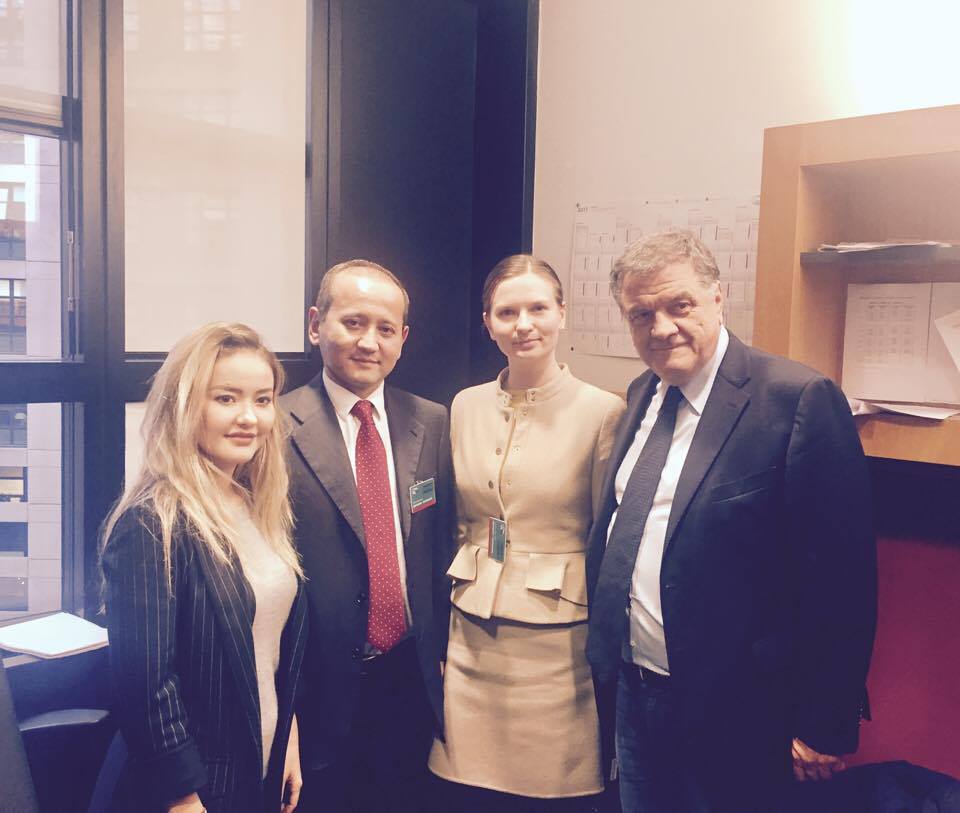
From left to right: Madina Ablyazova, Mukhtar Ablyazov, Lyudmila Kozlovska, and Antonio Panzeri

Signs of collusion between Panzeri and Ablyazov date back to 2016, when he spearheaded a motion on Kazakhstan in the European Parliament. This motion was adopted on March 10th of that year. On the same day, during a plenary session, Panzeri denounced a “clampdown” on Ablyazov’s Moscow-based newspaper, Respublika, which coincided with a court case involving Respublika and the hacking and publishing of emails belonging to Ablyazov’s adversaries.

As the head of DROI, Panzeri was key in a 2019 study on the Misuse of Interpol’s Red Notices, which mentioned Ablyazov fourteen times. A month later, he chaired a European Parliament event featuring Bota Jardemalie, who served as Ablyazov’s “right hand” during the disappearance of $8 billion from Kazakhstan’s BTA Bank into a sprawling network of over 1,000 shell companies.

Like Panzeri, Arena shared an unusual sympathy for Ablyazov. In February 2020, Arena attended an event where she engaged with Jardemalie and Dana Zhanay alongside outspoken Ablyazov supporter, Anna Shukeyeva. Zhanay and Shukeyeva are under indictment for allegedly “distributing funds received” from Ablyazov.

These suspiciously coordinated actions were further highlighted when EU bodies either plagiarized from or used similar wording to an opaque NGO called the Open Dialogue Foundation (ODF), which has lobbied for Ablyazov for over a decade. This advocacy, disproportionately focused on Kazakhstan, has influenced numerous European Parliament and PACE declarations which align with ODF and Ablyazov’s agendas.

Multiple PACE declarations and European Parliament motions have relied on the ODF for “evidence,” creating an echo chamber that reinforces the ODF’s narrative. Notably, an ODF report on Kazakhstan was copied into a resolution by the Renew Europe group, introduced shortly after the report’s release by MEPs Róża Thun and Petras Auštrevičius, who have both been strong ODF supporters. The resolution was adopted on January 20, 2022.

Perhaps unbeknownst to the MPs, the ODF’s leadership has financial ties to Russian-annexed Crimea and to sanctioned Russian entities through multiple family members.

Despite European Parliament President Roberta Metsola’s December 2022 acknowledgment that the parliament is “under attack [by] malign actors,” progress in countering this influence has remained limited. Despite being implicated in the Qatargate scandal, former MEPs Eva Kaili and Marc Tarabella returned to the parliament until 2024 and were subsequently involved in voting on ethics changes. In July 2023, meanwhile, Niccolò Rinaldi, Head of Unit for relations with Central Asia at the time, was found to be “very close to the ODF and, above all, to Botagoz Jardemalie,” quoting her in his correspondence and calling Ablyazov’s Democratic Choice of Kazakhstan (DVK) a “credible opposition party.” Yet Metsola dismissed these concerns, asserting that Rinaldi was “completely impartial.”

The abovementioned issues raise critical questions about the formulation of the EP’s 2022 resolution on Kazakhstan and the motives behind European officials advocating for a known international criminal and his associates. This concerning relationship has led to unsubstantiated allegations made by Ablyazov’s network finding their way into official documents as evidence.

More than fifteen years have passed since Ablyazov fled from the authorities in his homeland, and he continues to be embroiled in multiple transnational court cases. Since 2023, he has increasingly been using social media to ask for donations to pay his army of lawyers in his fight against extradition. A growing sense of desperation is evident in such posts as one dated November 27, 2024: “THERE IS NO MORE THAN A YEAR LEFT BEFORE RUSSIA ABSORBS KAZAKHSTAN, IF WE SLEEP AND DON’T OVERTHROW THIS REGIME! [SIC]” Ablyazov’s heightened desperation coincides with the rise of Kazakhstan’s multi-vector foreign policy as well as its adoption of democratic and human rights reforms and constitutional reforms, including limiting presidents to a single term in office, and its refusal to support Russia’s war in Ukraine or recognize “quasi-state territories… Lugansk and Donetsk.”

While Qatargate exposed how vulnerable European institutions are to corruption, the fight is far from over, and further measures are urgently needed to investigate European officials and prosecute wrongdoers. Otherwise, criminals can continue to capture the political elite and weaponize human rights to the detriment of the EU’s relationships with its strategic partners, including in Central Asia, at a time when Europe needs these partnerships more than ever.

Gender Inequality in Marriage: The Role of the Kelin in Kyrgyzstan

Gender inequality in marriage remains a significant issue in Kyrgyzstan, particularly with regard to the role of the kelin – the daughter-in-law – who is traditionally expected to shoulder numerous household responsibilities. In this patriarchal society, women often face pressure from their husbands’ families, limited career opportunities, and an unequal division of domestic labor.

According to recent data, 12.9% of women in Kyrgyzstan marry before the age of 18. This figure nearly doubles in rural areas compared to urban ones, reflecting stark regional disparities. Many families continue to uphold traditional expectations for women, especially the kelin, who is considered responsible for caring for her husband, his parents, the children, and the household.

The Kelin: Between Tradition and Change

Kyrgyz women have varying attitudes toward their role in the family. While some accept these expectations as part of their cultural heritage, others see them as a problem requiring change.

Personal Stories

Aizhan, 24, Osh (name changed):

“After marriage, I was expected to leave my job and devote myself fully to the household. Although my husband supports my career aspirations, there is pressure from both his parents and mine. In the early years of our marriage, I had to prove that I was a good wife – cooking, cleaning, and pleasing my mother-in-law – even though I had the opportunity to build a career. My parents also insisted that I focus on household duties to avoid being ridiculed by others. This frustrates me, but my husband stands by me.”

Nuria, 25, Naryn (name changed):

“In our social circle, it is rare for young couples to strive for equality in marriage. Traditional expectations remain strong, and sometimes compromises are necessary to maintain peace in the family. Early in my marriage, I didn’t feel much pressure, but after the birth of my child, I was often reminded that my primary role was now to be a mother and the keeper of the hearth.”

Ainura, 23, Bishkek (name changed):

“In the capital, it’s easier to be independent. More people here support the idea of equal rights. However, even in Bishkek, many girls face the expectation of becoming perfect kelins. This pressure usually comes from parents who cling to traditional values.”

Societal Expectations Beyond Marriage

For many young women, gendered expectations begin long before they marry. From an early age, girls are taught to prioritize marriage and family above personal ambitions.

Saule, 22, Bishkek:

“I’m 20 and don’t want to get married yet, but my relatives constantly hint that ‘the clock is ticking’ and that I should start looking for a groom. They don’t understand that I have other plans. Sometimes they introduce me to potential suitors, which is awkward and frustrating.”

In some families, restrictions are imposed on daughters to preserve their “marriage prospects.”

Kamilla, 23, Bishkek:

“I was often told to be modest, avoid friendships with boys, and dress conservatively because ‘I had to get married.’ Many girls like me missed out on a full teenage experience. However, I’ve noticed that the younger generation is growing more independent, which gives me hope.”

Regional Differences in Gender Norms

As the capital and largest city, Bishkek offers slightly more freedom and opportunities for women to balance family life with professional ambitions. Yet, even here, young wives often face pressure from parents who maintain traditional views.

Nationwide, the gender gap in domestic labor remains stark. Women in Kyrgyzstan spend nearly five times more time on unpaid household work than men. Among working women, this figure rises to 6.5 times. As a result, women have 1.4 times less free time for leisure and self-development compared to men.

Path Toward Equality

Despite persistent challenges, Kyrgyzstan is on the path to change. Progress will require a broader societal commitment to gender equality, including dismantling stereotypes, redistributing domestic responsibilities, and supporting women’s career aspirations.

Achieving true equality will involve not only changes in policy but a cultural shift in how the roles of women, particularly the kelin, are perceived within the family and society at large.