• KGS/USD = 0.01144 0%
  • KZT/USD = 0.00193 -0%
  • TJS/USD = 0.10811 -0.28%
  • UZS/USD = 0.00008 0%
  • TMT/USD = 0.28490 0%
  • KGS/USD = 0.01144 0%
  • KZT/USD = 0.00193 -0%
  • TJS/USD = 0.10811 -0.28%
  • UZS/USD = 0.00008 0%
  • TMT/USD = 0.28490 0%
  • KGS/USD = 0.01144 0%
  • KZT/USD = 0.00193 -0%
  • TJS/USD = 0.10811 -0.28%
  • UZS/USD = 0.00008 0%
  • TMT/USD = 0.28490 0%
  • KGS/USD = 0.01144 0%
  • KZT/USD = 0.00193 -0%
  • TJS/USD = 0.10811 -0.28%
  • UZS/USD = 0.00008 0%
  • TMT/USD = 0.28490 0%
  • KGS/USD = 0.01144 0%
  • KZT/USD = 0.00193 -0%
  • TJS/USD = 0.10811 -0.28%
  • UZS/USD = 0.00008 0%
  • TMT/USD = 0.28490 0%
  • KGS/USD = 0.01144 0%
  • KZT/USD = 0.00193 -0%
  • TJS/USD = 0.10811 -0.28%
  • UZS/USD = 0.00008 0%
  • TMT/USD = 0.28490 0%
  • KGS/USD = 0.01144 0%
  • KZT/USD = 0.00193 -0%
  • TJS/USD = 0.10811 -0.28%
  • UZS/USD = 0.00008 0%
  • TMT/USD = 0.28490 0%
  • KGS/USD = 0.01144 0%
  • KZT/USD = 0.00193 -0%
  • TJS/USD = 0.10811 -0.28%
  • UZS/USD = 0.00008 0%
  • TMT/USD = 0.28490 0%
10 December 2025

AI Creator Ilona Brazhnik on Kazakh Myths and Creative Freedom

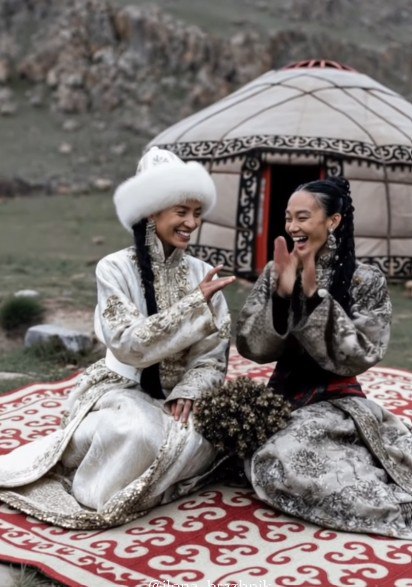
Alena Brazhnikova, better known by her pseudonym Ilona Brazhnik, is in many ways a product of her time. A decade ago, she was transferring art onto skin as a tattoo artist. Today, she creates viral videos powered by artificial intelligence, bringing to life mermaids, Zvezdy, and mythological girls with hooves and wings, symbols of a digital era in which neural networks replace paintbrushes, yet the pursuit of beauty, meaning, and freedom remains unchanged.

TCA: Ilona, did your artistic journey begin with tattooing?

Brazhnik: Yes, it all started rather quickly. When I began, there weren’t many artists in Karaganda, a mining town in central Kazakhstan, offering the style I worked in. At the time, “old school” tattoos with bold, rough lines were popular. But I wanted to explore subtlety, fine lines, and detailed work. Inspired by European artists, I posted an ad online. Within a month, I was fully booked for the next three months. My client base grew on its own because I was offering something different.

TCA: Are there particular tattoo motifs that resonate with you?

Brazhnik: I wouldn’t say I have one favorite. I rotate motifs regularly to avoid burnout. But I do love working with thin lines and soft dot shading, it gives the image depth and detail.
@ilona_brazhnik

TCA: The tattoo trend seems to have quieted. Is that your impression too?

Brazhnik: Absolutely. The hype has passed. There was a time when everyone was getting tattooed just for the sake of it. Now, people are more thoughtful. They take their time, consult with others, and carefully choose their designs. The “everyone’s doing it, so I will too” trend ended around eight years ago.

TCA: You’ve transitioned to AI and now earn money creating videos?

Brazhnik: You could put it that way. There’s definitely demand for AI-generated content. But I didn’t start doing it for the money, I just found it interesting. When people started to respond positively to my work, I thought, why not?

TCA: Your videos are visually striking. How much does a project like that cost?

Brazhnik: It depends on the complexity. Is it a brand advertisement or a fantasy story? Do you need to showcase clothing, jewelry, or a specific location? Will the same character appear throughout? And of course, duration matters. I can only quote a price once I receive the technical brief.

TCA: Are brand commissions more expensive?

Brazhnik: Not necessarily. I never charged tattoo clients more just because they could afford it. It depends on the task. Brand work is usually more technically demanding. AI doesn’t like repetition; it redraws objects each time, so logos, packaging, and inscriptions often need to be added manually. I once made a video where glasses were disassembled into ornaments and then reassembled. When asked to replicate it, it took 20-30 failed attempts. AI just doesn’t do “exactly the same.”

TCA: Did you start making videos to grow your TikTok and monetize content?

Brazhnik: In Kazakhstan, you can’t earn money from views on TikTok. The only monetization is through livestreams, donations, and gifts, and that’s not for me. I can’t even imagine doing it. I’d probably need another pseudonym to go live.

TCA: So, you work under a pseudonym now?

Brazhnik: Yes. My real name is Alena. The pseudonym helped me step into the public eye. I used to have a regular job, didn’t use social media, and didn’t share anything personal. But I wanted to express myself creatively. So, I chose: stay hidden or come forward. Ilona was born. Alena is reserved; Ilona is creative and media-savvy.

@ilona_brazhnik

TCA: Be honest, are you real, or is Ilona a fictional persona created by a team?

Brazhnik: (Laughs.) I’m real. You can check: scroll down my feed, and you’ll see it used to be a personal account with old photos. I never deleted them.

TCA: With the rise of neuro-actresses, are you concerned people might confuse you with them?

Brazhnik: I understand the concern. But neuro-characters are still distinguishable, at least to me. I once did a neuro-photo session using my face. It looked realistic to others, but I could tell it wasn’t me.

TCA: Your videos feature complex lighting and camera angles. Where did you learn that?

Brazhnik: My tattoo work taught me. For ten years, I photographed clients after their sessions. You learn how to light a shot, position the subject, and make the design look appealing.

TCA: Fog is notoriously hard to render in graphics, yet you use fog and underwater scenes. What’s most challenging for AI to generate?

Brazhnik: Water movement. Simple swimming is fine, but realistic motion with splashes is hard. I did a scene for a fitness club, someone swimming beside a dolphin. Nothing looked right. Limbs moved like propellers, and physics broke down. Fast movements are still difficult. Birds flapping their wings look off, though gliding birds are fine. But that’s for videos made from still photos, which is what I work with. Videos generated from scratch might fare better. Interestingly, AI handles animal movement better than humans.

TCA: One of your videos shows a knight in pierced chainmail with a cat on his shoulder, like a short film on loneliness. Have you submitted such works to AI festivals?

Brazhnik: Not yet, but I plan to. I heard about a competition in Dubai. Maybe I’ll enter.
@ilona_brazhnik

TCA: Many AI creators say neural networks struggle with Kazakh ornaments. Yet your work includes many. How do you manage it?

Brazhnik: I often add them manually. Sometimes AI gets close, but usually it’s off. For accurate Kazakh decorations, I use Photoshop, AI assistance, or draw by hand. The issue is the training data; AI has lots of Chinese elements, but very little Kazakh content. We don’t have enough users uploading such images.

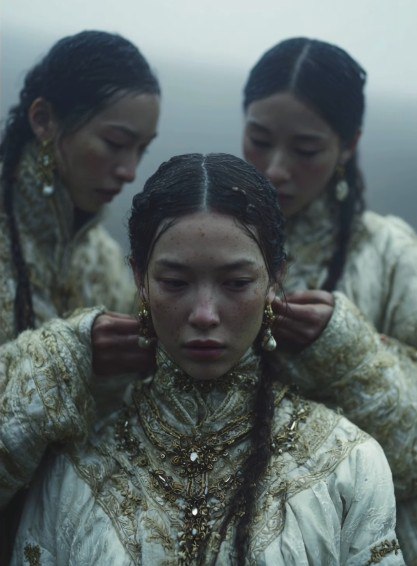
TCA: You have a video featuring Tuyaqty Kyz (Tұяқты қыз), a girl with hooves. How did you achieve that effect?

Brazhnik: At first, AI didn’t get it. It showed furry slippers, paws, everything except hooves. Then I found a photo of hoof-shaped shoes in a museum. That helped. I used them as a visual reference and explained, “These are the shoes.” Then the AI understood.

TCA: Does your work get stolen often? Is there any protection?

Brazhnik: It happens a lot. Someone recently downloaded my mermaid video, removed my signature, and posted it as their own. Social media platforms are better now at detecting plagiarism, and exact copies are less likely to spread. I get alerts when someone reposts my work. If they credit me, great, it boosts exposure. But stealing for profit is frustrating. Legally, the only protection is copyright registration.

TCA: You were born in Karaganda, spent your childhood in Almaty, and now live in Astana. Which feels like home?

Brazhnik: Astana. I like its pace; everyone is moving, working, doing something. Almaty is more laid-back; I go there for the mountains. Karaganda is dear to me too. I suppose I’ll always be a Karaganda girl at heart.

TCA: What do you dream of as an artist?

Brazhnik: Freedom. The freedom to express myself, to show people my inner world. To tell my story, to show my soul, and to be understood. That’s what I dream of.


Kyrgyzstan Achieves Self-Sufficiency in Six Staple Food Products

Kyrgyzstan is now fully self-sufficient in six of nine socially important food products: potatoes, milk, meat, vegetables, eggs, and sugar, according to the Ministry of Water Resources, Agriculture, and Processing Industry, which oversees national food security through agricultural production monitoring.

The country achieved full self-sufficiency in sugar in 2024, having previously relied on imports.

Regarding meat, Kyrgyzstan meets its domestic demand for beef and lamb and is close to achieving self-sufficiency in poultry. However, higher meat prices in neighboring Uzbekistan and Tajikistan led Kyrgyz farmers to export meat for greater profits. In response, the government introduced a ban on meat exports and imposed price controls to stabilize domestic markets.

To support local egg producers, the government has banned egg imports amid rising domestic production. Kyrgyzstan now exports chicken eggs; from January to August 2025, the country exported 3.3 million eggs.

The remaining three staple food products, bread (including flour and grain), vegetable oil, and fruit, are still partially dependent on imports.

Kyrgyzstan Introduces Voluntary Loan Ban to Curb Financial Fraud

Starting November 1, Kyrgyzstan will implement a self-restriction mechanism allowing citizens to voluntarily block the issuance of loans and credits in their name, a measure aimed at protecting individuals from financial fraud involving unauthorized loans.

Announcing the initiative at a press conference on October 30, Bektur Aliyev, Deputy Chairman of the National Bank of Kyrgyzstan, said the new regulation comes in response to a rise in cases where fraudsters used fake or stolen passports to secure loans online.

The self-restriction can be activated or revoked remotely at any time via the State Portal of Electronic Services or the Tunduk mobile app. Once submitted, the restriction takes effect immediately, while cancellations require a 12-hour waiting period.

Financial institutions, including banks and microfinance organizations, are legally required to check for any active self-restriction before issuing a loan. If such a restriction is in place, the loan cannot be granted. Should a loan be issued during the restricted period, the contract is deemed legally invalid and the lender has no legal grounds to demand repayment.

According to the National Statistics Committee, microcredit organizations issued over 40 billion soms in loans to more than 567,000 recipients in the first half of 2025. More than 60% of those loans were for consumer purposes, and the volume of microloans increased by 34% compared to the same period last year.

A similar voluntary loan restriction system has been in place in Kazakhstan since 2023.

Kyrgyz Startup Designs ‘Growave’, an E-Commerce Tool to Retain Customers on Shopify

Eldar Galiev is the CEO and Co-Founder of Growave, a Kyrgyz startup that helps companies retain customers on the retail platform Shopify. 

“There were times in my life when I seriously thought about moving abroad. The deciding factor [in staying] was the realisation that many people close to me live in the Kyrgyz Republic. That is something to be cherished. That is why I stayed here”, explained Galiev in 2020.

Success after several failures

Galiev started his career early. During his sophomore year, he started working for the software company Skalfa. Like many talented founders, he left university during his senior year to focus on building his own products.

Growave was not the first company Galiev started. “My first serious project, Hire-Experts, came after three years of working at a product company. At that point, I decided to start my own business and found a startup. The first two attempts failed. The third one, Hire-Experts, turned out to be more or less successful — it later became a company that develops software solutions for online communities,” Galiev said in 2021.

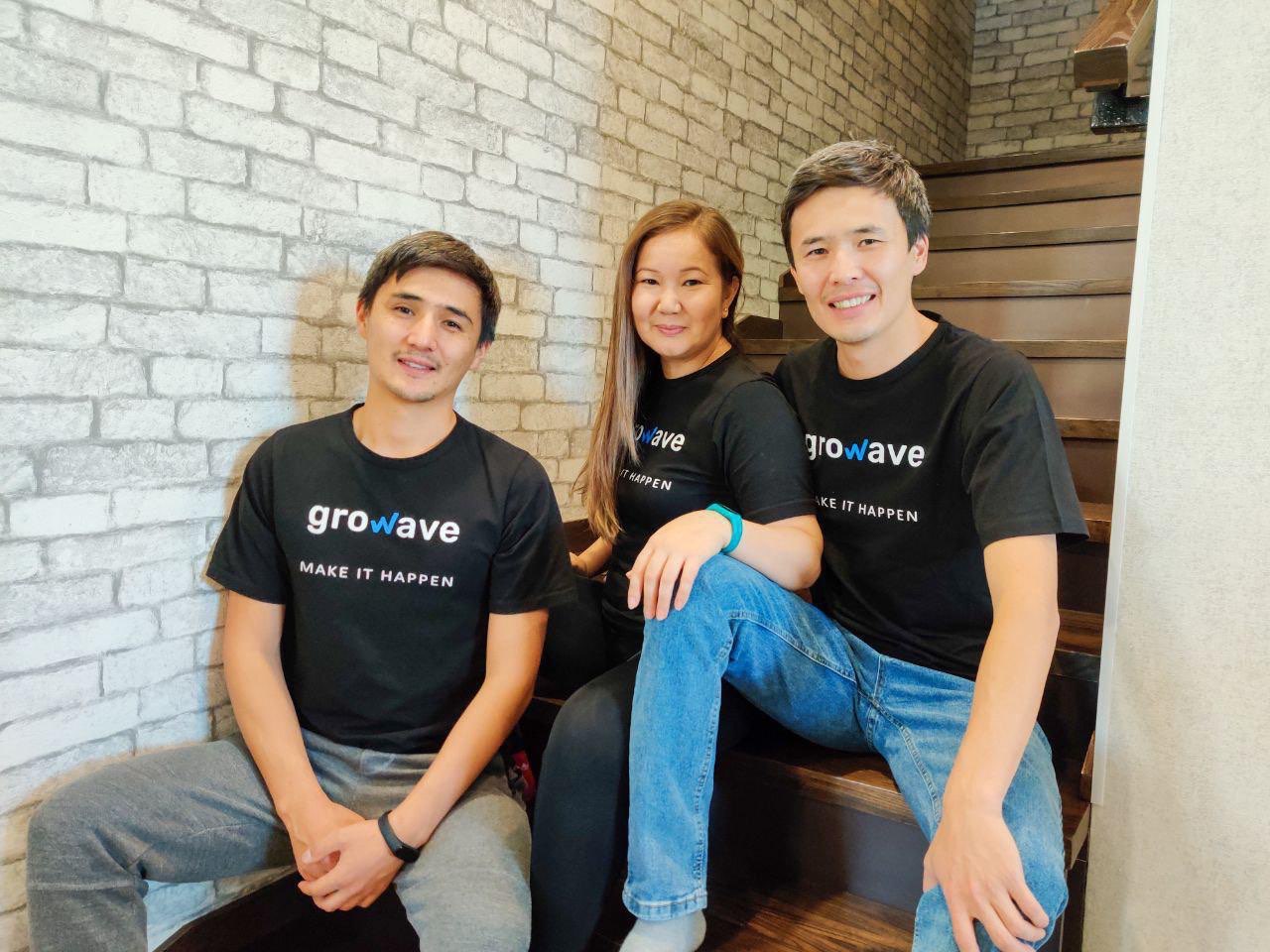
This experience helped Galiev when he decided to build Growave in 2014. Growave is a family startup; Galiev created the company with his wife, Munara, and brother Ermek. Their skillsets complement each other, with Galiev overtaking business development, Munara handling HR and finance, and Ermek leading on the tech side. 

Galiev and his co-founders saw an opportunity when they couldn’t find products focusing on relationships between brands and their customers. Galiev understood that the local markets were too small and went straight to building a global product from scratch. The team did not have experience of being sellers themselves, so the first iterations of the product did not perform very well. 

Soon, they came up with a free plan for customers, which helped them gain their first 500 clients. And with feedback collected from them, they managed to build something that customers actually needed.

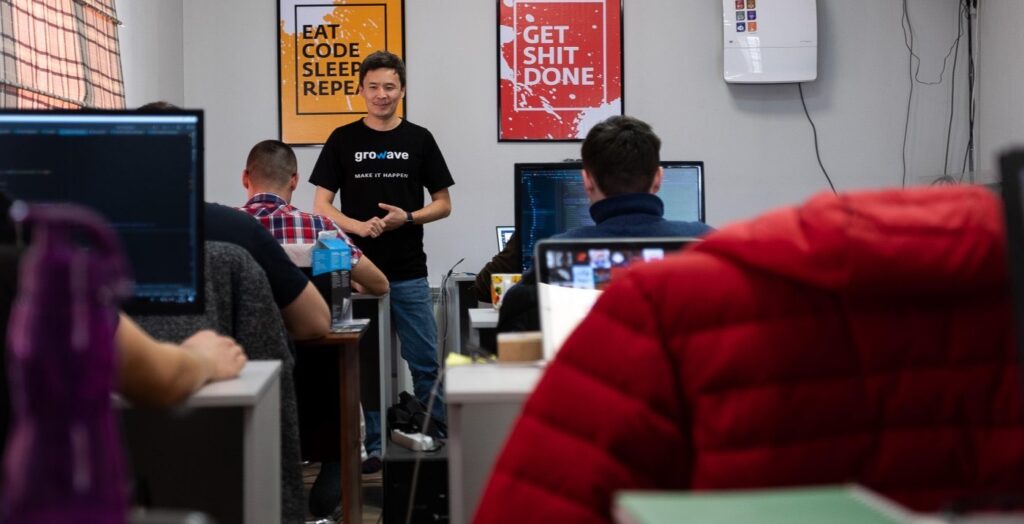
Now, Growave is a marketing platform for e-commerce, helping companies to retain their customers with an all-in-one solution including loyalty, referrals, wishlists, reviews, and Instagram UGC. Galiev believes that it is not only advertising that is important, but also building long-term relationships with customers. This, in turn, prompts customers to stay loyal to certain Shopify sellers.

Image: Growave

‘Bootstrapping’ ninjas

Unlike many global startups, Growave has not raised any external funding from VCs to date, making the company an amazing example of bootstrapping — growing a business without external funding. In 2017, three years after its launch, Growave became profitable. Before that, Growave had gone through a turbulent time when the co-founders had to invest their income from other projects. 

This great example of bootstrapping now has 60+ employees. Still, Galiev is talking to VCs to get their feedback about the startup and to pitch Growave as a solution for their portfolio companies.

Now Growave can boast a customer base of over 15,000 companies from more than 150 countries. Over half of their clients are in North America, including large brands like Boeing, Unilever, SONY, and Xiaomi. The company has an ARR (annual recurring revenue) of over $4 million. Few startups operating in Kyrgyzstan can claim such results.

“I have had great ambitions since childhood”, Galiev has said on WE. This is reflected in Growave’s ambitious plans to reach a valuation of $100 million by 2030 and seek exit opportunities through an acquisition by some larger players.

“We have been in the market for over 10 years — during this time, we have built a strong international team, attracted 15,000 customers, and held dozens of events in the US and Europe. But it feels like we are just getting started. We are still trying, learning, making mistakes, and growing — with the same hunger and ambition as on day one. This is what drives us toward our goal of becoming a global leader in eCommerce loyalty programs.” Galiev told The Times of Central Asia.

How the Ferghana Valley Might Become Central Asia’s Laboratory of Peace

On October 15-16, in the heart of the Ferghana valley, which for decades has been associated with border conflicts, mistrust, and unresolved issues, the heads of Ferghana (Uzbekistan), Batken (Kyrgyzstan), and Sughd (Tajikistan) gathered to discuss the further peaceful development of the region. The forum brought together not just officials but also experts, diplomats, civil society, and international organization representatives from Central Asia, Europe, and other regions. The first Ferghana Peace Forum, entitled “Ferghana Valley: Joining Forces for Peace and Progress”, was not simply another gathering behind closed doors but a table where everyone was offered a seat.

The valley, with territory of roughly 20,000-22,000 km² shared by three countries, was one of the main routes for the ancient Silk Road. It embodies diverse cultures and fertile lands, but also, until recently, the unresolved problems and deep contradictions of Central Asia. Complex issues, including water management, border demarcation, and conflicting national narratives. People’s connections were severed by visa regimes and land mines. It was, until recently, impossible to imagine today’s reality where people are crossing borders without long lines or bureaucratic barriers.

The Khujand Declaration, signed in early 2025 by the presidents of Kyrgyzstan, Tajikistan, and Uzbekistan, paved the way for the forum. The document marked a historic shift, reflecting the countries’ desire for dialogue, open borders, economic cooperation, and cultural exchange. However, it remained only a vision without an implementation mechanism that would turn the declaration into sustainable interaction. The Ferghana Peace Forum promises to fill this gap by becoming the first peacebuilding platform designed specifically for the territory, and managed by the three countries themselves with support from external organisations, rather than by external intermediaries or actors.

The Forum’s founding communiqué defines its goal as creating a permanent platform for building trust, developing a common development strategy, attracting investment, and forming a new political climate in Central Asia. It is a rare occasion when Central Asian countries organize inclusive platforms for open discussions and the participation of civil society, academia, and business. With more than  300 participants, including officials from the UN, EU, and OSCE, as well as leading international NGOs, the forum promises to become a truly historical event. As one of the Forum participants noted, “If peace is possible in Ferghana, it is possible anywhere in Central Asia, and perhaps anywhere in the world.”

Discussions were focused on the practical implementation of regional cooperation. Participants addressed issues that have long fueled tensions in the valley: border procedures, joint water management, trade facilitation, labor migration, and crisis prevention. At the same time, the platform created a space for exploring new areas of cooperation, such as digitalization, education, renewable energy, and tourism. There was a shared understanding that peace cannot be sustainable without economic opportunities and social integration.

The timing of the forum could not have been better. With the flow of current geopolitical events, Central Asian countries have a narrow window of opportunity to strengthen the internal cooperation and to institutionalize it, while Russia is distracted by Ukraine, and China needs a stable neighborhood for the Belt and Road initiative. The latest trend of considering Central Asian countries together in formats such as CA+Europe, C5+1, or CA+China shows that the region is entering a new stage of integrational processes.

However, the road ahead will not be easy. The first Ferghana Peace Forum signals a rare moment of political will and regional activism. The valley that once symbolized division is now being reimagined as a valley of peace. If this initiative is successful, the Ferghana model could lay the foundation for a new era of cooperation in Central Asia, based not on external influence or geopolitical competition, but on the common interests and aspirations of its peoples.

Tajikistan Upgrades Nurek Dam to Boost Power Supply Ahead of Winter Crunch

Tajikistan’s massive Nurek hydroelectric dam – the world’s second-tallest – is undergoing a sweeping modernization to shore up the nation’s electricity supply ahead of the demanding winter season. The 300-meter-high dam, completed in 1980 on the Vakhsh River near the Afghan border, has long been a strategic asset, supplying approximately 70% of Tajikistan’s power.

As winter approaches and energy demand peaks, crews at the 3,015 MW hydropower plant are racing to upgrade aging turbines and infrastructure to ensure reliable electricity across the country. The overhaul, which began several years ago, promises not only to keep the lights on through harsh weather but also to boost Nurek’s capacity and extend the life of a facility that has defined Tajikistan’s energy landscape for five decades.

A Soviet-Era Marvel at the Heart of Tajikistan’s Power Grid

When it was completed in 1980, Nurek was the tallest dam in the world, a record it held for years as a feat of Soviet engineering, with the earth-fill embankment forming a vast reservoir of 98 km² that stores some 10.5 billion cubic meters of water. Between 1972 and 1979, nine giant hydro turbines were installed, giving Nurek an original design capacity of approximately 2,700 MW. Over time, improvements brought its output to just over 3,000 MW. In addition to producing power, the reservoir also supports major irrigation across the Amu Darya basin with one scheme alone – via the Dangara tunnel – irrigating roughly 70,000 hectares, underscoring its dual importance for energy and agriculture.

For Tajikistan, a mountainous country of roughly 10.8 million people, Nurek has been nothing short of an economic lifeline. Hydropower accounts for roughly 98% of Tajikistan’s electricity generation, one of the highest shares of renewable energy in the world. This green energy dominance is largely thanks to Nurek and a network of smaller dams.

However, the infrastructure is aging, and after 50 years of service, Nurek’s machinery had begun to falter. By the mid-2010s, winter electricity shortages had become common. During the cold months from late September to April, the hydrological cycle leaves Tajikistan with reduced river flow, just as heating needs spike. In those winters, rural areas often faced power rationing and outages, while the capital Dushanbe and other major cities narrowly avoided blackouts. Modernizing Nurek became essential to prevent a return to the severe energy crises of the past and to meet the country’s development goals.

Upgrading and Expanding a Giant

A comprehensive rehabilitation of Nurek began in earnest in recent years, backed by international financing, including the World Bank. The overhaul is split into phases: Phase I of the modernization — covering four of Nurek’s nine generating units along with major dam-safety works — is scheduled for completion by the end of 2026. Phase II will then refurbish the remaining six units. The upgrades are substantial – new high-efficiency Francis turbines will raise each unit’s capacity from 335 MW to 375 MW.

In October 2022, the first upgraded unit came online, producing about 10% more power than before. By August 2024, a fourth unit had been modernized and reconnected to the grid. Work is now underway on a seventh unit, with two fully rehabilitated units confirmed in donor documentation and further units under active refurbishment. Engineers are carefully balancing construction schedules so that most of the plant remains operational to meet demand. Once all nine turbines are rehabilitated, Nurek’s total generating capacity will climb to approximately 3,375 MW, up from 3,015 MW today. That boost effectively adds the equivalent of a mid-sized power station to Tajikistan’s grid without building a new dam. It will help cover growing domestic needs and could create surplus electricity for export in the summer months when rivers run high.

According to Anvar Kiromoddinov, Nurek’s deputy chief engineer, these measures “aim to ensure the country’s energy supply during the challenging winter months” and are essential for “guaranteeing high-quality electricity.”

Beyond the turbines, the project is improving Nurek’s safety and reliability. Crews have been reinforcing the dam structure, overhauling spillway gates, and installing new monitoring instruments to watch for seismic activity or seepage. Aging Soviet-era control systems are meanwhile being replaced with modern automation. In September 2025, Nurek’s management reported preparations for the 2025–26 winter period, with the modernized units performing reliably and work on the next turbines advancing. Together, these measures will extend Nurek’s operating life by decades, ensuring it remains the backbone of Tajikistan’s power supply well into the future.

Project oversight and financing remain robust. International partners, including the World Bank and the Asian Infrastructure Investment Bank (AIIB), report that Nurek’s rehabilitation is progressing on schedule, with Phase I expected to finish by the end of 2026. These institutions continue to provide technical and financial support to ensure the dam meets modern safety and efficiency standards.

Powering Prosperity and Regional Cooperation

Stabilizing Tajikistan’s electricity system has immediate human and economic benefits. In winter, a reliable grid means households in remote villages can depend on electric heat and light instead of burning wood or coal. Industries and hospitals can operate without diesel generators. In recent years, Tajikistan’s economy has been hampered by energy shortfalls in colder months; solving this issue is key to sustaining growth. The country already leads Central Asia in renewable energy production, and with extra capacity from Nurek, it could send surplus summer electricity to energy-hungry markets like Afghanistan and Pakistan via the CASA-1000 transmission project or help balance regional grids.

In August 2025, officials from Uzbekistan and Tajikistan met to coordinate the 2025–2026 winter season and discuss reconnection to the Unified Energy System of Central Asia. Rehabilitating Nurek boosts confidence in such partnerships, as a stronger Tajik grid can be integrated with Uzbekistan and other neighbors for mutual benefit.

The Nurek project also carries symbolism beyond its megawatts. It was a crown jewel of Soviet Tajikistan and remains a point of pride for the nation. Now, as the country undertakes this high-tech retrofit, Nurek stands as a testament to progress, keeping a half-century-old colossus relevant in the 21st century.

Tajikistan is also building a new dam upstream at Rogun, aiming to surpass Nurek and become the tallest in the world with an installed capacity of 3,780 megawatts. Rogun’s construction was once a source of friction with downstream Uzbekistan, but changing political leadership has transformed the dispute into a source of cooperation in recent years. This evolution underscores a hopeful trend: Central Asia’s great rivers, long a cause of inter-state tension, can become a catalyst for collaboration when countries recognize their shared interests in water and energy.

As winter looms, the lights in Tajikistan are set to burn a bit brighter. The revamp of the Nurek Dam is far from just an engineering project; it is a cornerstone of energy security for millions of people. By restoring and enhancing a critical asset, Tajikistan is taking a major step toward an empowered, connected, and resilient future. The ripple effects may well be felt across Central Asia, where cooperation over resources is as precious as the electricity flowing from Nurek’s turbines.