• KGS/USD = 0.01144 0%
  • KZT/USD = 0.00193 -0%
  • TJS/USD = 0.10876 0.55%
  • UZS/USD = 0.00008 0%
  • TMT/USD = 0.28490 0%
  • KGS/USD = 0.01144 0%
  • KZT/USD = 0.00193 -0%
  • TJS/USD = 0.10876 0.55%
  • UZS/USD = 0.00008 0%
  • TMT/USD = 0.28490 0%
  • KGS/USD = 0.01144 0%
  • KZT/USD = 0.00193 -0%
  • TJS/USD = 0.10876 0.55%
  • UZS/USD = 0.00008 0%
  • TMT/USD = 0.28490 0%
  • KGS/USD = 0.01144 0%
  • KZT/USD = 0.00193 -0%
  • TJS/USD = 0.10876 0.55%
  • UZS/USD = 0.00008 0%
  • TMT/USD = 0.28490 0%
  • KGS/USD = 0.01144 0%
  • KZT/USD = 0.00193 -0%
  • TJS/USD = 0.10876 0.55%
  • UZS/USD = 0.00008 0%
  • TMT/USD = 0.28490 0%
  • KGS/USD = 0.01144 0%
  • KZT/USD = 0.00193 -0%
  • TJS/USD = 0.10876 0.55%
  • UZS/USD = 0.00008 0%
  • TMT/USD = 0.28490 0%
  • KGS/USD = 0.01144 0%
  • KZT/USD = 0.00193 -0%
  • TJS/USD = 0.10876 0.55%
  • UZS/USD = 0.00008 0%
  • TMT/USD = 0.28490 0%
  • KGS/USD = 0.01144 0%
  • KZT/USD = 0.00193 -0%
  • TJS/USD = 0.10876 0.55%
  • UZS/USD = 0.00008 0%
  • TMT/USD = 0.28490 0%
11 December 2025

Roundtable on Uzbekistan’s Reform Agenda

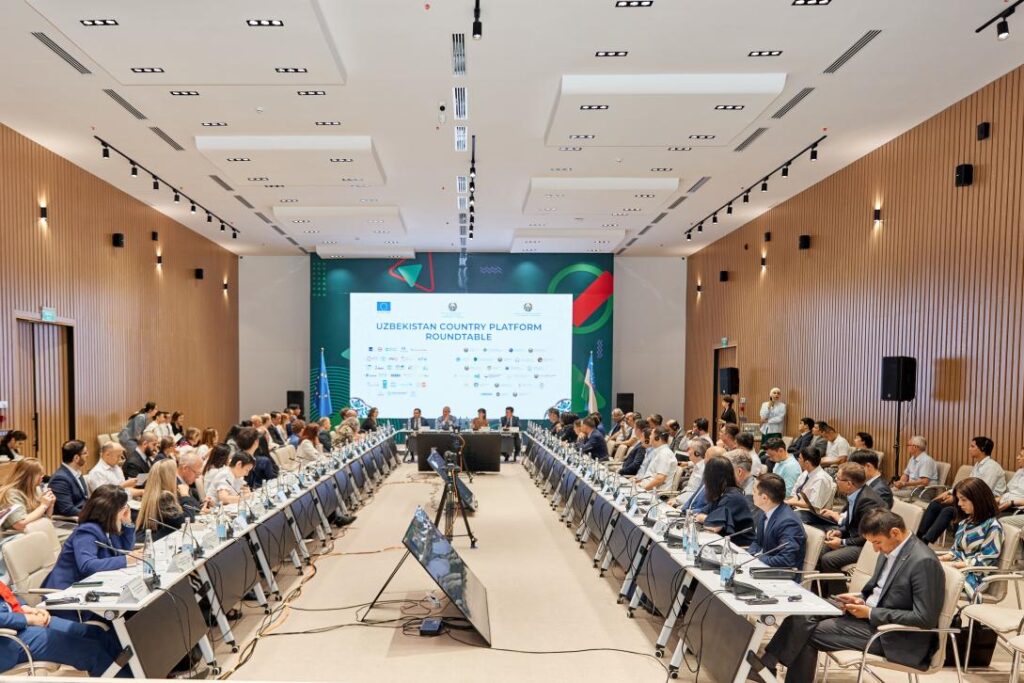
The 2nd Roundtable of Uzbekistan’s Country Platform was held last week in Tashkent. Backed by the European Union, the event provided a platform for discussions amongst over 80 government partners and international institutions on Uzbekistan’s reform agenda and coordinate support activities.

As reported by the Delegation of the European Union to Uzbekistan, the participants agreed to continue collaboration through more than 13 sectoral working groups supporting issues prioritized by the Uzbekistan–2030 Strategy including agriculture, energy security, green growth, and the rule of law.

Led by the Agency for Strategic Reforms (ASR) under the President of Uzbekistan and the Ministry of Economy and Finance of Uzbekistan, and with secretarial assistance from the European Union, the Country Platform aims to foster effective coordination.

Bakhodir Rakhmatov, Director of the Agency for Strategic Reforms, commented: “Constructive collaboration between development partners and government ensures achievement of the priority reform objectives identified by President Mirziyoyev aimed at creating a more prosperous and sustainable future for all. The ASR plays a pivotal role in coordinating the engagement of ministries and agencies with development partners.”

Taking over the support previously provided by the World Bank in May, the European Union committed to assisting the Country Platform until the end of 2025.

“The European Union is honored to co-chair and promote the Country Platform as a forum for open dialogue, cooperation and collaboration between Uzbekistan and development partners,” said Charlotte Adriaen, Ambassador of the European Union to Uzbekistan. “The common goal is to support Uzbekistan in its reform path. The Platform is an opportunity to join forces, to effectively move together bringing prosperity, sustainable development, leaving no one behind.”


EDB Identifies Key Risks for Tajikistan’s Economy

Analysts from the Eurasian Development Bank (EDB) have presented a macroeconomic forecast for Tajikistan for 2024-2026. In it they identify the main short-term risks for the country’s economy.

According to the forecast, the critical risks for Tajikistan come from outside.

“High interest rates in developed countries and structural problems in China’s economy may lead to a slowdown in global economic growth and lower prices for raw materials,” the report says.

This could reduce the demand for goods exported by Tajikistan.

Another consequence of this scenario will be a reduction in remittances coming into the country, mainly from oil-exporting countries. This would lead to a slowdown in household consumption growth and a decline in non-state investment, pushing GDP growth below the equilibrium level.

In such a development, fiscal policy, assistance from international financial organizations, and lower prices for imported food and energy will support the economy.

Despite these challenges, EDB analysts forecast high growth rates for Tajikistan’s economy: 8.0% in 2024, 8.2% in 2025 and 7.8% in 2026. This growth is due to strong domestic demand, higher-than-expected prices for gold and base metals exported by Tajikistan, and favorable remittance dynamics due to rising wages in the region.

Until the end of this year, according to EDB economists’ estimates, the slowdown in demand growth in external markets will have a restraining effect on the economy. This will negatively affect real exports and the inflow of remittances and investments into the country. However, as the authors of the forecast note, the growth of prices for metals exported by Tajikistan, especially gold, will balance this negative impact.

Kyrgyz Council Deputy Arrested for Calling for Riots

An unnamed member of the city council in Kyrgyzstan’s Jalal-Abad region has been detained for calling for the organization of mass riots and a violent seizure of power, 24.kg reports.

Kyrgyzstan’s State Committee for National Security (SCNS) announced in a statement: “[An] investigation has established that [a] deputy of Kerben city council from the ‘Ata-Jurt Kyrgyzstan’ political party systematically published provocative materials and calls for the organization of mass disorder and violent seizure of power on Facebook.”

The suspect was taken to the security committee’s detention center. The investigation is ongoing.

According to the security committee, the attempt was scheduled for August 31, which is Kyrgyzstan’s Independence Day.

“The suspects, under the influence of certain destructive political forces, hatched plans for a violent seizure of power by destabilizing the socio-political situation in the country and organizing mass riots in Bishkek, including the death of citizens. They planned to organize a sporting event near Bishkek on Independence Day to gather young people from all around the country,” the SCNS said.

On the eve of Independence Day, special services detained five Kyrgyz men who were planning an armed seizure of power. A search of their homes revealed a large cache of weapons, explosives, and police uniforms.

A total of 50 weapons (20 pistols and 255,238 rounds of ammunition), 200 sets of law enforcement uniforms, 150 pieces of police and 100 pieces of military headgear, 38 sets of body armor, two drones, radios, homemade explosives, and extremist literature were seized from them. It has also been established that the detainees are involved in organizing rallies against foreign citizens.

OECD Representative Office May Open in Kazakhstan

An initiative to open a representative office for the Organization for Economic Cooperation and Development (OECD) in Kazakhstan has been announced by Deputy Prime Minister Nurlan Baibazarov and William Thompson, Head of the OECD Eurasia Division, who met earlier this week. To date, OECD regional offices operate in China, Indonesia, Ukraine, and Greece, according to the website of the Government of Kazakhstan.

During the meeting, the parties discussed implementing OECD recommendations, implementing the Joint Action Plan of the Government of the Republic of Kazakhstan and the OECD Secretariat until 2025, and cooperation within the framework of the OECD Eurasian Competitiveness Program.

William Thompson noted the positive experience of OECD interactions with Kazakhstan. Following recommendations from the OECD, several political and economic reforms have been carried out in the country. In particular, institution of investment ombudsman was introduced, parliamentary control over the use of budgetary funds was strengthened, the Low Carbon Development Strategy of the country until 2060 was developed, and the National Contact Center for Responsible Business Conduct and the Supreme Audit Chamber were established. Direct elections of akims (heads) of districts and cities of regional significance has also been introduced.

“Our country has been a stable partner of the OECD for more than 15 years and a Central Asian leader in implementing its recommendations. In 2025, Kazakhstan intends to apply to join this authoritative international organization as a full member. We are confident that further cooperation will have a qualitative impact on the socioeconomic and legal aspects of the development of our state,” Nurlan Baybazarov stated.

Foreign Political Parties Banned in Uzbekistan

Uzbekistan has added to the law “On Political Parties,” prohibiting the establishment and operation of foreign political parties and their subdivisions in Uzbekistan. The corresponding amendments were signed by President Shavkat Mirziyoyev, Kun.uz reports.

Furthermore, the amendments broadened the conditions under which the powers of a deputy of the lower house and a senator could be terminated early. Elected representatives are prohibited from engaging in other paid activities (except for scientific, creative, and pedagogical work) and holding their positions if they have a permanent residence permit abroad.

Additionally, parliamentarians will lose their mandate if they fail to participate for 30 days without a valid reason in the activities of their respective chamber, political party faction, committee, or commission.

Similar measures are envisaged for deputies of regional, district, and city councils of people’s deputies (local parliament).

Five political parties are registered in Uzbekistan: the Liberal Democratic Party, the Milliy Tiklanish (National Revival) Democratic Party, the Adolat (Justice) Social Democratic Party, the People’s Democratic Party, and the Ecological Party.

Nuclear Race: Will Central Asia Build a Nuclear Power Plant?

The answer to the question posed in the title remains uncertain. While Uzbekistan has plans to construct a nuclear power plant and Kazakhstan is set to hold a referendum this fall to gauge public opinion on building one, progress is sluggish. Tashkent has postponed the start of construction, and the issue sparks heated debate in Kazakhstan.

The First Nuclear Power Plant in Central Asia

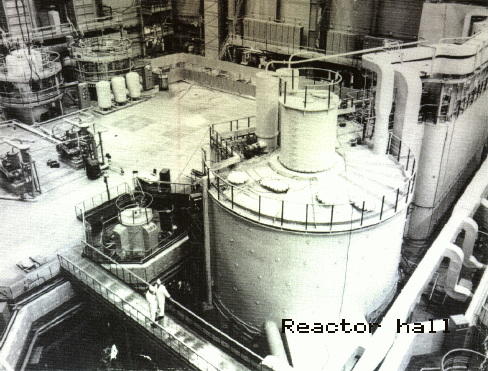
Historically, Central Asia did host a nuclear facility. Located on the shore of the Caspian Sea in Kazakhstan, this was not a conventional nuclear power plant but a fast neutron reactor known as BN-350. The reactor was the core of the Mangistau Nuclear Power Plant, designed to transform the Mangyshlak Peninsula by providing energy to the city of Aktau (formerly Shevchenko) and powering large-scale desalination plants that supplied drinking water to the arid region.
BN-350

Operational from 1973 until its shutdown in 1999, the BN-350 reactor was decommissioned due to the allocation of U.S. funds for new desalination and heating equipment and the disposal of its remaining fuel.

The extensive maintenance and decommissioning work on the BN-350 have given Kazakhstani nuclear physicists significant experience with such complex and hazardous technology. However, younger generations in Kazakhstan are largely unaware of the BN-350 reactor’s existence. Their knowledge of nuclear physics is often limited to the harrowing stories passed down about nuclear warhead tests at the Semipalatinsk test site and their devastating effects.

Fear and Nuclear Power: Kazakhstan’s Dilemma

The societal fear surrounding nuclear energy in Kazakhstan is deeply intertwined with political concerns. For a long time, the leadership in Kazakhstan has hesitated to move beyond merely discussing the need for a nuclear power plant (NPP) to actually initiating the project. President Kassym-Jomart Tokayev recently announced that a referendum would take place in the fall of 2024. However, Ministry of Energy’s officials avoided mentioning the word “referendum” until the last moment, previously asserting it was unnecessary.

Public hearings were held last year in the village of Ulken, Zhambyl district, Almaty region, a proposed site for the nuclear plant. The Ministry of Energy’s press release stated that the local populace supported developing nuclear power, highlighting its significance for regional socio-economic growth. However, media reports revealed that the hearings were contentious, with opposing viewpoints almost disrupting the speech of Nurlan Ertas, the head (akim) of the Zhambyl district. Activists even displayed banners and posters against the plant’s construction.

Certain groups have exploited the population’s fear of another disaster like Chernobyl. Additionally, the government has struggled to convince the public that nuclear technologies are becoming safer. In contrast, Europe now includes nuclear power plants in its list of green energy sources, similar to other renewable energy sources (RES).

In Kazakhstan, renewable energy accounts for only 5% of the total energy produced. The introduction of NPPs could significantly enhance the country’s position in reducing carbon emissions. The government faces a growing electricity shortage that can be addressed either harmfully or fearfully. The harmful options are coal-fired thermal power plants and traditional thermal power stations. The frightening option, in the eyes of many, is nuclear power.

Uzbekistan’s Nuclear Drift

Uzbekistan’s journey towards establishing its own nuclear power plant (NPP) somewhat mirrors that of Kazakhstan. The notion of building an NPP in Uzbekistan first emerged in the 1980s, with the identification of over seven dozen potential sites through surveys. However, the collapse of the USSR halted progress, and the topic became taboo. Concerns about seismic activity rendering nuclear technologies hazardous — similar to those expressed by opponents of NPPs in Kazakhstan — also played a role.

As the need for its own NPP became apparent — given Uzbekistan (and Kazakhstan) lacked alternative means to accelerate energy generation — Tashkent evaluated projects from companies in the U.S., China, France, South Korea, and others. Ultimately, Russia was chosen as the prospective partner.

On December 29, 2017, the governments of Russia and Uzbekistan agreed to cooperate in nuclear energy, after six months of preparation. The initial project proposed constructing a nuclear power plant with Russian-designed VVER-1200 reactors in the Jizzakh region. Each reactor would have a capacity of 1200 MW, totaling 2400 MW from two reactors. This plant was expected to meet about 15-18% of Uzbekistan’s electricity demand by 2030, with a launch date set for 2029.

However, construction did not commence until Russian President Vladimir Putin’s official visit to Tashkent at the end of May this year. During his visit, Putin and the President of Uzbekistan, Shavkat Mirziyoyev, signed a new agreement to construct a low-capacity nuclear power plant — a novel Rosatom development with no global analogs. The new project entails a nuclear power plant with six reactors, each with a capacity of 55 MW, totaling 330 MW. This is significantly less powerful than the 2017 project.

The new plan retains the original timeline, with a phased launch starting in 2029 and ending in 2033. The sluggish progress in building NPPs in both Tashkent and Astana is largely attributable to Russia’s current status as a pariah in the Western world. Geopolitical considerations aside, technological expertise plays a crucial role. Rosatom is still considered more advanced in nuclear technology compared to competitors in the U.S., France, South Korea, and China. While Kazakhstan attempts to placate its citizens with explanations, both Astana and Tashkent are biding their time. It remains to be seen what progress can be made whilst Russia’s geopolitical isolation endures.