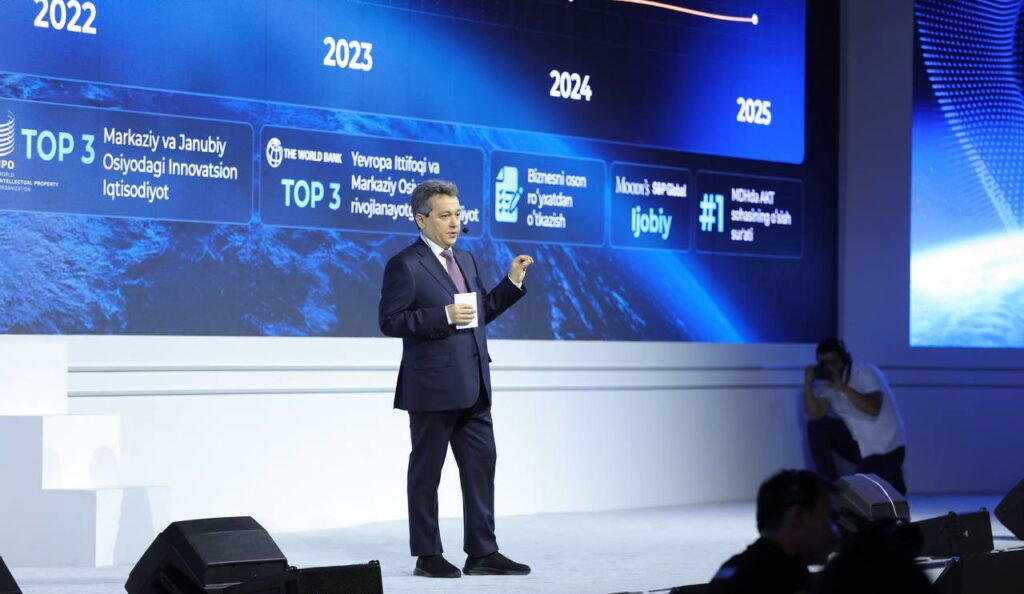
Uzbekistan’s ambitions to position itself as Central Asia’s digital powerhouse took center stage during ICT Week Uzbekistan 2025 this September – the country’s largest-ever technology forum, drawing more than 20 official delegations, 300 companies, and 20,000 participants from over 50 countries. With artificial intelligence and future technologies at its core, the event showcased how Tashkent aims to turn international partnerships into lasting investment, innovation, and talent pipelines.
At the forefront of these efforts stands Sherzod Shermatov, Minister of Digital Technologies, who has overseen landmark initiatives extending IT Park incentives until 2040, launching the IT Visa for foreign specialists, and embedding AI education across Uzbekistan’s schools and universities. The Times of Central Asia spoke to Minister Shermatov to discuss how Uzbekistan plans to sustain investor confidence beyond ICT Week, prepare its workforce for an AI-driven economy, and balance rapid digitalization with data protection and national sovereignty.

ICT Week 2025; image: The Ministry of Digital Technologies of the Republic of Uzbekistan
TCA: Uzbekistan showcased itself as a regional IT hub during ICT Week. What concrete steps will the Ministry take to ensure foreign investors and global tech firms remain engaged in Uzbekistan?
Shermatov: In order to comprehensively stimulate and develop the activities of foreign investors and global technology companies in the Republic of Uzbekistan, a number of key preferences for IT Park residents have already been implemented.
The Government of Uzbekistan has extended and reinforced the system of benefits and guarantees for foreign investors and IT Park residents, ensuring long-term stability and predictability of the investment climate. Among these measures, IT Park tax incentives have been officially extended until 2040, offering exemption from a range of taxes, a simplified foreign currency regime, and a 5% dividend tax for non-residents, provided that more than 50% of their revenue is generated from export activities. These reforms provide a reliable and attractive environment for both established global players and emerging startups.
To further strengthen the country’s position as a regional digital hub, the Government has also introduced the IT Visa – a three-year visa designed for founders, investors, and foreign specialists of IT Park resident companies. The IT Visa facilitates simplified entry, residence, and employment procedures for international professionals and their family members, making Uzbekistan one of the most open and accessible markets for global technology talent.
In parallel, a “One Stop Shop” service has been launched to streamline administrative procedures. It provides fast-track company registration, bank account opening, and work and residency permits, enabling investors and foreign specialists to begin operations in Uzbekistan with unprecedented efficiency.
At the same time, the Ministry continues to expand cooperation between global technology partners and the national innovation ecosystem under the “ZERO Risk” and “Local to Global” mechanisms, as stated in the relevant decrees of the President of the Republic of Uzbekistan. These instruments create a foundation for long-term growth, stimulate venture financing, and support the international scaling of Uzbek startups.
Also, comprehensive programs are being implemented to train highly qualified IT specialists to meet the needs of both local and international companies. This includes partnerships with global technology leaders and universities, ensuring that Uzbekistan’s talent pool remains globally competitive.
Importantly, according to the Startup Genome Global Startup Ecosystem Report, Uzbekistan has been recognized as the fastest-growing IT ecosystem in Central Asia, reflecting the country’s dynamic progress and investment potential.

ICT Week 2025; image: The Ministry of Digital Technologies of the Republic of Uzbekistan
TCA: With Al and future technologies at the center of ICT Week, how is Uzbekistan preparing its education and workforce systems to supply the high-skilled talent these industries demand?
Shermatov: Uzbekistan is rapidly developing a technology-driven economy – with full internet coverage across all schools, over 125,000 students trained annually in 210 universities, and a growing ICT workforce that now exceeds 200,000 specialists nationwide.
At a strategic level, the preparation of qualified professionals in artificial intelligence is embedded in the National AI Development Strategy and the Resolution of the Cabinet of Ministers of the Republic of Uzbekistan No. 425 of July 10, 2025. Within this framework, the national program “One Million Leaders of Artificial Intelligence” has been launched. It includes the educational platforms aistudy.uz and omp.aistudy.uz, which currently offer five free online courses. By 2027, this program aims to train one million young people equipped with modern AI knowledge and practical skills.
Furthermore, the opening of the Yandex ML School – the first specialized educational center in Uzbekistan focused on machine learning, mathematical modeling, and data analysis – marks another important milestone in building national expertise in artificial intelligence.
To sustain this progress, the Ministry is also working to revise national school and university curricula, integrating new disciplines such as programming fundamentals, robotics, and artificial intelligence into the core education system.
Education and technology go hand in hand. This month, Uzbekistan launched the country’s first-ever nationwide series of hackathons in digital healthcare – the HealthTech AI Hackathon. The opening stage took place in Nukus, bringing together IT developers, doctors, and students to co-create digital solutions for the healthcare sector. The event gathered over 300 participants forming 44 teams, who presented their AI-driven applications for medicine. The initiative is part of the large-scale National AI Hackathon Project, which will reach all regions of Uzbekistan by 2026 and engage thousands of young specialists in AI innovation.
Together, these efforts demonstrate Uzbekistan’s strategic approach to building a skilled, future-ready workforce and a sustainable IT ecosystem – ensuring that education, technology, and entrepreneurship grow in step with the country’s ambitions in technology and AI.
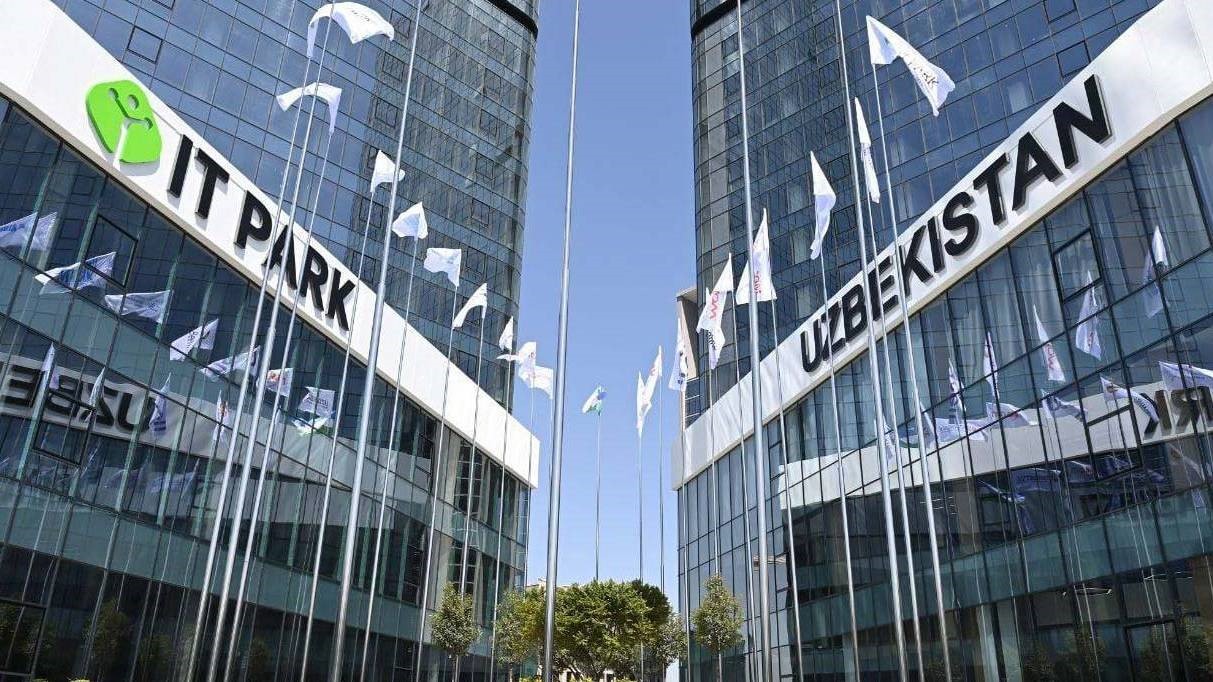
IT Park; image: Embassy of Uzbekistan in the United States
TCA: Uzbekistan announced major digital platforms in tourism and insurance: how will the government balance rapid digitalization with data protection, cybersecurity, and digital sovereignty concerns?
Shermatov: The development of major digital platforms in priority sectors such as tourism, insurance, and payments is a key element of the national strategy. However, rapid digitalization is accompanied by a critical need to ensure information security and national control over data. The goal of current efforts is to create digital platforms where the accelerated implementation of modern technologies is inseparably combined with the principles of data protection, cybersecurity, and digital sovereignty.
Platforms integrating payments and tourist infrastructure management are a priority target for cyberattacks. The following measures are being taken to minimize risks:
The active construction and modernization of Data Centers (DPCs) is underway across the Republic. This ensures strict adherence to data localization requirements, guaranteeing that critical information of citizens and guests is stored and processed exclusively within the national jurisdiction. This measure eliminates risks associated with legal regimes and the extraterritorial access of third countries to national data.
Furthermore, to prevent threats at the design stage, the project and technical documentation for all digital platforms being developed in the tourism sector (as well as in the financial and government sectors) is subject to mandatory expert review by the authorized state Cybersecurity Center.
The combination of developing robust national infrastructure (DPCs) with strict control and supervisory procedures demonstrates a balanced governmental approach to digital transformation. These measures not only ensure the protection of user data and enhance the cybersecurity of critical systems but also strategically strengthen the digital sovereignty of the Republic of Uzbekistan amid the rapid growth of the digital economy.
TCA: How will you ensure the initiatives announced at ICT Week are implemented on schedule and deliver measurable results?
Shermatov: The reliability of the initiatives announced at ICT Week 2025 is reinforced by Uzbekistan’s consistent record of turning commitments into concrete results. The country’s approach emphasizes structured implementation, interagency coordination, and ongoing monitoring to ensure that every memorandum and agreement translates into measurable progress.
For example, following ICT Week 2024, a memorandum between IT Park Uzbekistan and Astana Hub led to the creation of Central Asian Innovation Hubs, enabling regional startups to scale internationally. Within a year, startups from both ecosystems showcased their solutions at Web Summit 2024 (Lisbon), TechCrunch Disrupt 2024 (San Francisco), and the INMerge Innovation Summit (Baku). This collaboration also launched the Silkway Accelerator in partnership with Google for Startups, providing Central Asian entrepreneurs with mentorship and global exposure.
Building on this track record, ICT Week 2025 resulted in nine new international memorandums, including with partners from the United States, Korea, Iran, Kazakhstan, Jordan, and Estonia, as well as investment agreements worth over $10 million. More than 20 foreign companies announced plans to open offices in Uzbekistan, collectively expected to create over 1,000 new jobs. These outcomes reflect a direct continuation of Uzbekistan’s results-oriented strategy and its growing role as a regional innovation hub.
At IT Park Uzbekistan, we are fully committed to ensuring that every initiative announced during ICT Week 2025 moves from agreement to action. Our team is actively supporting these commitments through dedicated project management units and other departments, continuous engagement with foreign partners, and regular progress reviews in coordination with the Ministry of Digital Technologies.
Such achievements demonstrate that agreements made during ICT Week are not symbolic but represent actionable, result-driven partnerships. Building on a proven framework, the ICT Week 2025 initiatives will be implemented under clear timelines, joint working groups, and regular progress assessments, ensuring accountability and tangible impact in advancing Uzbekistan’s digital transformation agenda.