• KGS/USD = 0.01143 -0%
  • KZT/USD = 0.00192 -0%
  • TJS/USD = 0.10820 0.19%
  • UZS/USD = 0.00008 0%
  • TMT/USD = 0.28575 0%
  • KGS/USD = 0.01143 -0%
  • KZT/USD = 0.00192 -0%
  • TJS/USD = 0.10820 0.19%
  • UZS/USD = 0.00008 0%
  • TMT/USD = 0.28575 0%
  • KGS/USD = 0.01143 -0%
  • KZT/USD = 0.00192 -0%
  • TJS/USD = 0.10820 0.19%
  • UZS/USD = 0.00008 0%
  • TMT/USD = 0.28575 0%
  • KGS/USD = 0.01143 -0%
  • KZT/USD = 0.00192 -0%
  • TJS/USD = 0.10820 0.19%
  • UZS/USD = 0.00008 0%
  • TMT/USD = 0.28575 0%
  • KGS/USD = 0.01143 -0%
  • KZT/USD = 0.00192 -0%
  • TJS/USD = 0.10820 0.19%
  • UZS/USD = 0.00008 0%
  • TMT/USD = 0.28575 0%
  • KGS/USD = 0.01143 -0%
  • KZT/USD = 0.00192 -0%
  • TJS/USD = 0.10820 0.19%
  • UZS/USD = 0.00008 0%
  • TMT/USD = 0.28575 0%
  • KGS/USD = 0.01143 -0%
  • KZT/USD = 0.00192 -0%
  • TJS/USD = 0.10820 0.19%
  • UZS/USD = 0.00008 0%
  • TMT/USD = 0.28575 0%
  • KGS/USD = 0.01143 -0%
  • KZT/USD = 0.00192 -0%
  • TJS/USD = 0.10820 0.19%
  • UZS/USD = 0.00008 0%
  • TMT/USD = 0.28575 0%
14 December 2025

Eurasian Development Bank To Finance Another Solar Plant in Kyrgyzstan

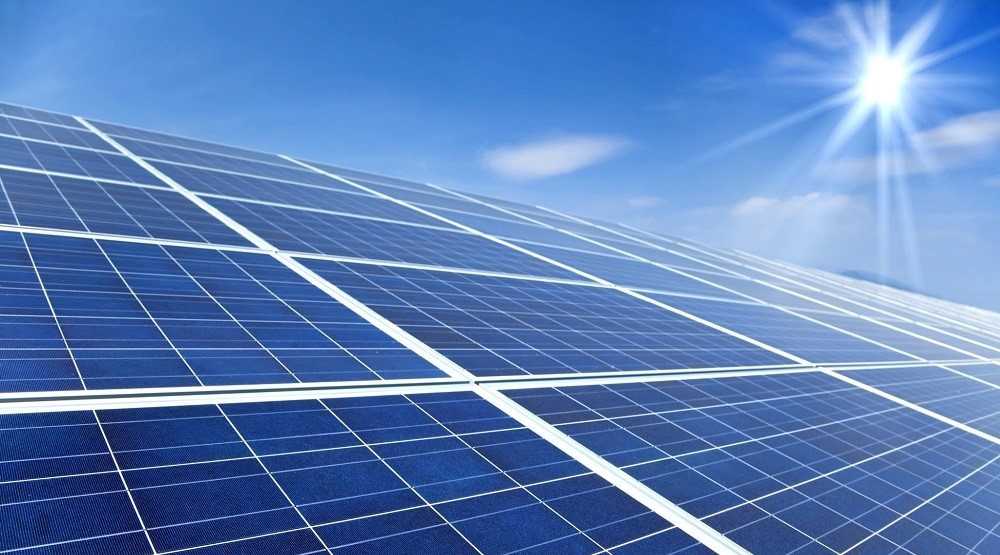
The Eurasian Development Bank has signed an agreement to finance the construction of a solar power plant in the village of Toru-Aigyr in Kyrgyzstan’s Issyk-Kul region.

The project, which will use photovoltaic solar energy conversion with an installed capacity of up to 300 MW, will be undertaken in partnership with Bishkek Solar LLC.

EDB has commented: “The project includes several key agreements, including an agreement with JSC “NES Kyrgyzstan” to purchase all electricity for 25 years, an agreement on public-private partnership with the Ministry of Energy of the Kyrgyz Republic, as well as an investment agreement on the implementation of the project with the Cabinet of Ministers of the Kyrgyz Republic for 25 years.”

It is assumed that EDB will work out the terms of long-term financing, including the involvement of tied funding in the amount of up to $210 million (in Chinese yuans) for 15 years. The facility is scheduled to be commissioned by the end of 2025.

Added EDB senior managing director Denis Ilyin: “This project is of key importance for the development of the renewable energy sector, and in particular solar energy, in the Kyrgyz Republic, contributing to improving energy security and stability, as well as achieving the Sustainable Development Goals. The power plant will fully comply with international environmental and technical standards.”

EDB is currently also financing the construction in Kyrgyzstan of the Kulanak hydropower plant. It is expected that the Kulanak project, which is part of the megaproject “Water and Energy Complex of Central Asia”, will increase the level of energy security and strengthen Kyrgyzstan’s position in the Central Asian electricity market .

The Outlook for Kazakhstan’s Rail Network

As a core infrastructure industry, railways play a strategic role in Kazakhstan’s economy. Today, over 50% of freight in the country is transported by rail, while the figure for passengers is 15%. Kazakhstan’s favorable geographical position between the largest producer of goods in the world, Asia, and the largest consumer, Europe, is spurring the development of transit freight transport and related income. However, government regulations and imperfect reforms have failed to reverse a degradation of Kazakhstan’s rail infrastructure and solve its capacity shortage problems.

The robust rail network created during the Soviet period for a single national economy turned out to be ineffective under the new conditions of market dynamics. The country’s railway infrastructure, while reaching almost every region in Kazakhstan, meets neither current nor possible future needs of freight owners and has already nearly reached its limit in terms of throughput and processing capacity.

The national railway carrier of both passengers and freight, Kazakhstan Temir Zholy (KTZ), cannot provide by itself the financial resources and investments at the scale needed to meet current and future challenges. The national budget is also unlikely to allocate such funding. A lack of prompt, large-scale modernization of key areas of rail transport, however, may hurt the country’s economy.


Tentative sources of funding for improvements

According to the Ministry of Transport’s plan for the modernization of rail infrastructure, 1,300 km of railway track is to be added by 2030, while 4,800 km of second track is to be constructed. The expected price tag for these additions is over $11 million.

It is currently unclear where these funds will come from. There have been mentions of borrowing around $400,000 from the national pension fund. According to the Ministry of Transport’s modernization plan, private investments will also be a key source through public-private partnership projects (PPP).

In recent years, state participation in financing the construction and reconstruction of sections of the rail network has been limited and paled in comparison to those involving road projects. As part of the Nurly Zhol (“Bright Path”) infrastructure initiative, $9.2 billion has been allocated for just two programs to develop roads versus only $16.1 million allocated for railways. Added to this is the involvement of KTZ in implementing major transport infrastructure projects – the Khorgos dry port, the Kuryk port ferry complex and more than 1,000 km of railway track built in recent years, among others – using borrowed funds. Thus, the company bears a considerable burden in terms of servicing and repaying loans already raised for these projects, which represent its long-term assets. Given this debt burden, it is clear that the rail industry remains underfunded.


Tariffs present a further dilemma

Across the world, funding for the development of main rail networks is typically allocated from the national budget. In many European countries, for example, government funding covers up to 97% of operating and capital costs of rail infrastructure. Besides direct subsidies from the state, other sources of funds for modernizing and renewing rail infrastructure include bond issuance and sponsorship by financial institutions. The other main natural source of funds remains railway tariffs.

In Kazakhstan, the current growth of the “tariff for mainline rail network services” is insufficient to finance the investment needs of KTZ to construct new sections and reconstruct existing sections of track, as well as for junction stations, digitization, electrification, and automation. This is despite the fact that at the beginning of 2024, KTZ hiked this tariff by 5%.

The Ministry of Transport has a three-year plan to boost the railway tariff, which has been sent for approval to the Committee on Regulation of Natural Monopolies at the Ministry of National Economy. This tariff policy reform – which represents a new methodology for calculating tariffs for mainline rail network services – is seen as one of the strategic initiatives needed for the sustainable development of the sector and of KTZ, making infrastructure use more efficient and motivating the company to provide customized services in line with the demands of different market segments.


Focus on track modernization

According to KTZ, the existing tariff for mainline rail network services makes it possible to undertake capital repairs on 500-600 km of rail given the current annual transport volumes. However, these volumes are not enough. To maintain the rail infrastructure in standard condition, about 800 km of track should see capital repairs annually.

Last year, 1,443 km of railway track was repaired with 557 km of this going through capital repairs. Overall, KTZ annually invests about $123 million in the repair and development of the mainline network.

At the same time, reconstruction of transport infrastructure must be accelerated, and rail transport hubs developed. The latter includes the infrastructure of KZT public stations, i.e., freight stations that serve the population and businesses that do not have private access, and large industrial enterprises. As much as 99% of the freight carried by the Kazakhstani rail network starts at industrial rail hubs. In Kazakhstan today, there are about 4,000 access tracks, most of which belong to large enterprises and have daily traffic of 50 to 200 cars.

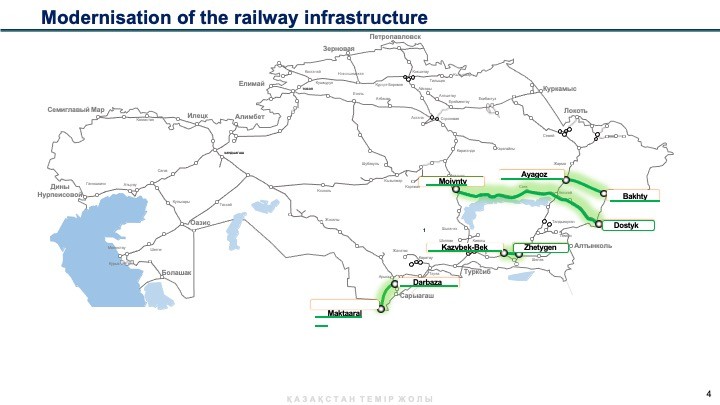
The implementation of several major projects is expected to boost the capacity of rail sections. These include the Bakhty-Ayagoz rail line, opening a third border crossing with China; a bypass line around Almaty, which is expected to decongest the Almaty hub by an average of 30%; and the Darbaza-Maktaaral line, set to decongest the Saryagash Station in the direction of the Central Asian countries and provide a more than fivefold boost to Kazakhstan’s transit potential.

The construction of second track on the Dostyk-Moyynty railway section is also underway. Once completed, the project should increase the capacity of the rail infrastructure of the section fivefold from 12 to 60 pairs of freight trains per day.


Dauren Moldakhmetov is the Editor-in-Chief of industry transportation publications of Kazakhstan, railway magazine “Trans-Express Kazakhstan”, and the business magazine, “Trans Logistics Kazakhstan”.


Airport Opens in Talas, Kyrgyzstan

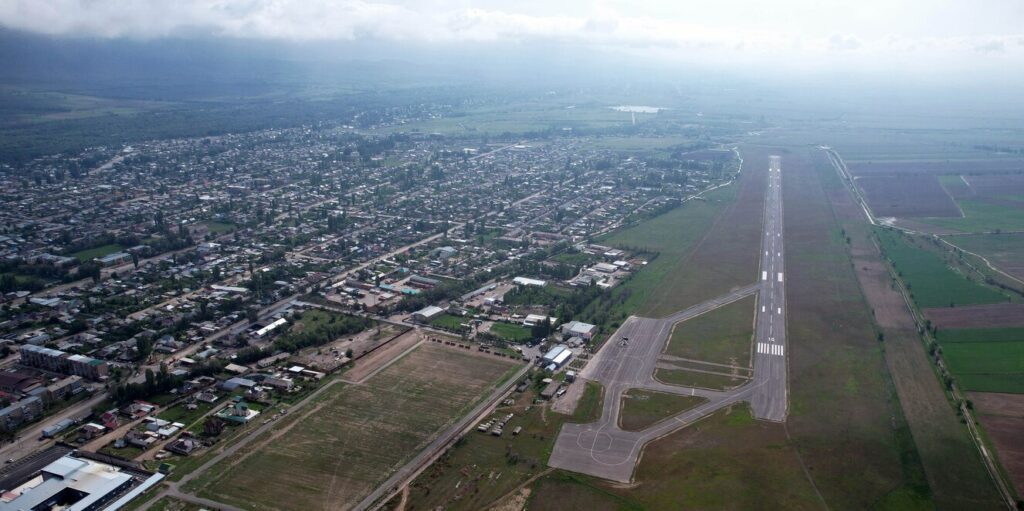
Following its year-long reconstruction, Talas airport in north-west Kyrgyzstan reopened on 21 May.

Built in 1979 to receive planes and helicopters, the airport had not been operational since the collapse of the Soviet Union.

The facility now has a runway that adheres to international standards and a terminal which can accommodate 100 passengers per hour.

Speaking at the launch, Kyrgyzstan President Sadyr Japarov stated that the reconstruction in Talas marked a significant step in progressing the government’s plans to resume air communication with the country’s regions through the revival of several redundant airports.

Construction of terminals is currently underway at international airports in the city of Karakol and the village of Tamchy in the Issyk-Kul region. The runway at the Naryn regional airport is under repair and the reconstruction of the runways at airports in Kazarman, Kerben, and Batken in the south, are nearing completion.


Uzbekistan to Build Central Asia’s First Solar Plant with Battery Energy Storage System

On 21 May, the Asian Development Bank (ADB) and Abu Dhabi Future Energy Company PJSC (Masdar) signed off a $46.5 million loan for the construction of greenfield solar power plant and battery energy storage system (BESS) in Uzbekistan’s Bukhara region. The Nur Bukhara plant will be Central Asia’s first renewable power facility with  utility-scale battery storage.

ADB reported that a further $26.5 million has been secured from the Japan International Cooperation Agency. Loans for the realization of the project have also been agreed by the International Finance Corporation, the Canada–IFC Blended Climate Finance Program and the Dutch Entrepreneurial Development Bank.

The new facility, with a capacity to generate 250 megawatts and store 126 megawatt-hours of energy, will include the construction of a 20-kilovolt substation and a 3.1-kilometer transmission line to connect to the grid.

Set to deliver 555 gigawatt-hours of clean energy per annum, the plant will provide power for some 55,000 households. By enabling electricity to be stored and delivered on demand, BESS  will reduce grid instability, and provide the flexibility to integrate intermittent solar resources. Generated power will be sold exclusively to the National Electric Grid of Uzbekistan.

Commending the project, Masdar Director of Corporate Finance and Treasury Bruce Johnson commented: “Masdar is proud to be a key partner in Uzbekistan’s clean energy journey. We are strong supporters of the country’s ambitious renewable energy targets, alongside key partners including ADB. Projects like Nur Bukhara will enhance the affordability and accessibility of reliable, clean energy for all Uzbek citizens and drive private sector growth.”

To meet the increasing demand for energy from Uzbekistan’s economy and growing population, the government aims to increase renewable energy generation by up to 25 GW, equivalent to 40 percent of the country’s overall electricity consumption, by 2030.


Turkic Investment Fund Begins Operations

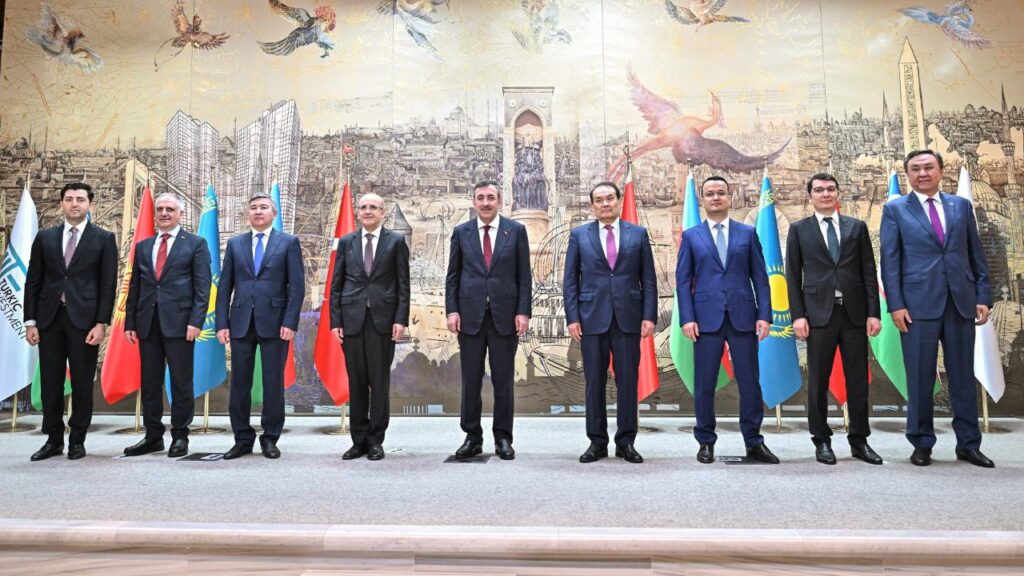
The inaugural meeting of the Board of Governors of the Turkic Investment Fund (TIF) was hosted by Istanbul on 21 May.

The Turkic Investment Fund, the first financial institution for economic integration of the countries of the Turkic world was officially established by Azerbaijan, Kazakhstan, Kyrgyzstan, Uzbekistan, and Turkey on 16 March 2023   at the summit of the Organization of Turkic States in Ankara.

With an initial capital of $500 million, TIF’s main objective is the development of economic and commercial relations between the Turkic countries. According to estimates by the Turkish Ministry of Finance, by the end of 2024, the Turkic states will occupy an important place in the global economy, reaching an economic volume of $1.9 trillion to the benefit of a population of  178 million.

Commenting on the importance of Turkic integration for his country, Deputy Prime Minister – Minister of National Economy Nurlan Baybazarov and Kazakhstan’s representative on the TIF Board of Governors, said: “The Government of Kazakhstan fully supports the start of the Fund’s operation. I am confident that it will become a catalyst for economic growth and development of the participating countries, contribute to the deepening of investment cooperation and effective interaction in the implementation of joint projects.”

The key sectors to receive funding include infrastructure, renewable energy, agriculture, tourism, and IT.


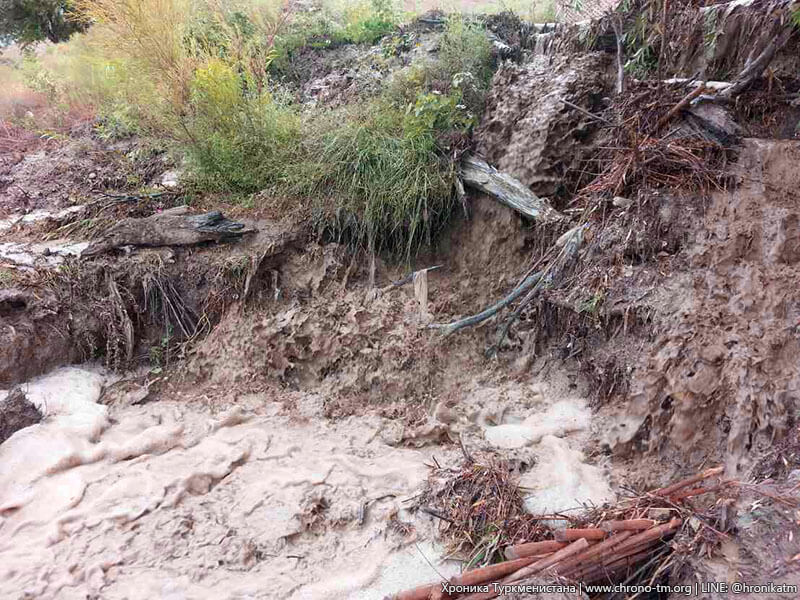
One Dead and Six Missing in Turkmenistan Mudslides

One soldier has been killed and six are missing during mudslides caused by recent heavy rains in Turkmenistan. It is being reported that the man died at the Serakhs border outpost in Akhal province.

“On May 17, around 17:00 hours, seven soldiers from the 16-border outpost of the Border Troops connection in Serakhs [on the border with Iran] went missing. The body of one of them was found May 18. The searches for the other six soldiers continue,” an anonymous source commented.

“The search work is being carried out by the border troops’ forces of the adjacent territories,” the source said. Special means, such as drones or helicopters, are not involved in the search operations.

The source adds that on the day of the incident, the soldiers were sent to repair the automobile roads next to the military unit, which were washed away by mud-flows. The Turkmen government is trying to stop information about the incident from being published, and “it is dangerous to ask and inquire about the details”. But in conversations among themselves, servicemen are discussing that “sending soldiers in such weather to this area was a wrong decision and the cause of the accident was the negligence of the commanders and management of the border guard unit.”

“It was not possible to get comments on the disappearance of several soldiers and the death of at least one of them from the Turkmen authorities, including the aforementioned military unit,” the source notes.

For almost ten days, Turkmenistan’s capital Ashgabat has been flooded with rain, in what local meteorologists think have been the worst downpours since the 1970s. The rain has caused significant damage to the city’s infrastructure.

The Akhal province has also been badly affected, with agricultural land flooded. Mud-flows hit the cities of Anev and Kahka, and in many areas electricity and part of the rail network were shut down. However, there have been no reports in Turkmen media about the rains and the damage they are causing.