• KGS/USD = 0.01144 0%
  • KZT/USD = 0.00210 0%
  • TJS/USD = 0.10454 -0.1%
  • UZS/USD = 0.00008 0%
  • TMT/USD = 0.28571 0.28%
  • KGS/USD = 0.01144 0%
  • KZT/USD = 0.00210 0%
  • TJS/USD = 0.10454 -0.1%
  • UZS/USD = 0.00008 0%
  • TMT/USD = 0.28571 0.28%
  • KGS/USD = 0.01144 0%
  • KZT/USD = 0.00210 0%
  • TJS/USD = 0.10454 -0.1%
  • UZS/USD = 0.00008 0%
  • TMT/USD = 0.28571 0.28%
  • KGS/USD = 0.01144 0%
  • KZT/USD = 0.00210 0%
  • TJS/USD = 0.10454 -0.1%
  • UZS/USD = 0.00008 0%
  • TMT/USD = 0.28571 0.28%
  • KGS/USD = 0.01144 0%
  • KZT/USD = 0.00210 0%
  • TJS/USD = 0.10454 -0.1%
  • UZS/USD = 0.00008 0%
  • TMT/USD = 0.28571 0.28%
  • KGS/USD = 0.01144 0%
  • KZT/USD = 0.00210 0%
  • TJS/USD = 0.10454 -0.1%
  • UZS/USD = 0.00008 0%
  • TMT/USD = 0.28571 0.28%
  • KGS/USD = 0.01144 0%
  • KZT/USD = 0.00210 0%
  • TJS/USD = 0.10454 -0.1%
  • UZS/USD = 0.00008 0%
  • TMT/USD = 0.28571 0.28%
  • KGS/USD = 0.01144 0%
  • KZT/USD = 0.00210 0%
  • TJS/USD = 0.10454 -0.1%
  • UZS/USD = 0.00008 0%
  • TMT/USD = 0.28571 0.28%

Kazakhstan Expects to Double Influx of Foreign Gambling Tourists

Kazakhstan’s Ministry of Tourism and Sports expects the number of foreign gambling tourists to double following the planned opening of new casinos in four regions of the country.

Gambling tourists are foreign nationals who travel specifically to visit casinos and other gambling establishments. Currently, gambling is legally permitted only in two designated zones: the city of Konaev in the Almaty region and the Shchuchinsk-Burabay resort area in the Akmola Region. These facilities are open to both Kazakh and foreign citizens.

The government is considering a significant expansion of the gambling sector’s footprint. Plans are underway to open new casinos that will be accessible exclusively to foreign tourists.

Deputy Minister of Tourism and Sports Baurzhan Rapikov said the proposed locations for the new facilities include the East Kazakhstan, Almaty, Mangistau, and Zhetysu regions. He added that the expected economic impact includes about 500 jobs per casino, annual tax revenues of $4 million to $8 million, and an increase in gambling tourists from 100,000 to 200,000 per year.

In parallel, Kazakhstan is prioritizing the digitalization of its tourism sector. Beginning in February, the ministry will launch the development of a unified digital tourism ecosystem based on the Kazakhstan.Travel platform. 

The upgraded system will feature an intelligent, AI-powered route planner, online booking tools, and optimal travel date suggestions. A new feature, KazTuristBot, will provide personalized recommendations and 24/7 support for travelers.

For businesses, the platform will offer a showcase of tourism products, demand analytics, and digital tools for accessing government support. Authorities will also gain access to real-time data on tourist flows, enabling targeted infrastructure development in high-demand regions.

As previously reported by The Times of Central Asia, Kazakhstan emerged in 2025 as one of the fastest-growing destinations in Central Asia for South Korean tourists. Data from the Agoda platform showed a 295% increase in travel interest between January and October.

Kazakhstan’s Foreign Minister Yermek Kosherbayev in Washington: Critical Minerals Cooperation

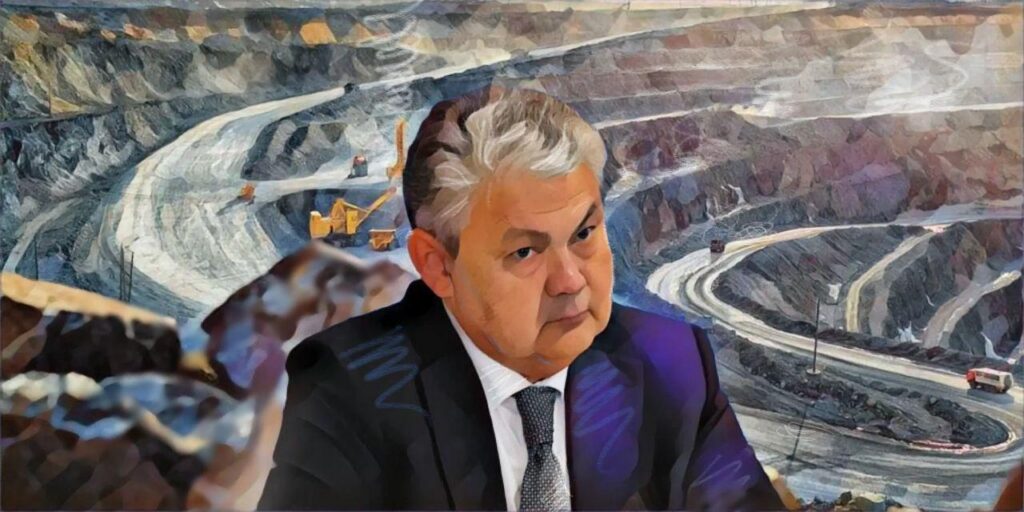
Foreign Minister Yermek Kosherbayev will travel to Washington, DC, to attend the Critical Minerals Ministerial on 3–4 February. A meeting with the Department of State and other rare earth element (REE) supplier countries will take place on 3 February.

This will be Kosherbayev’s first official visit to the United States as foreign minister. A career diplomat, he assumed office on 26 September 2025. Prior to his appointment as foreign minister, he served as Kazakhstan’s ambassador to the Russian Federation, governor of the East Kazakhstan Region, and, earlier in 2025, as deputy prime minister, combining senior diplomatic experience with executive and regional governance roles.

His visit will include engagement with Ambassador Yerzhan Kazykhan, appointed as the President’s first-ever Special Envoy to the United States on 13 January 2026, reflecting the priority Kazakhstan places on engagement with Washington.

U.S.–Kazakhstan Strategic Convergence on Critical Minerals

The visit follows a period of sustained diplomatic engagement beginning in November, marked by intensified trade and investment discussions. Since then, Presidents Kassym-Jomart Tokayev and Donald Trump have met twice in person and held one phone call, during which an invitation was extended for the G20 meeting scheduled for 14–15 December 2026. During this period, Kazakhstan also acceded to the Abraham Accords, a signature foreign policy initiative of the Trump administration.

This diplomatic momentum has converged with U.S. strategic priorities on critical minerals. Rare earth elements (REEs) are a core component of the U.S. critical minerals strategy. While the United States maintains domestic REE production, it continues to pursue supply-chain diversification to enhance resilience. In this context, Kazakhstan’s identified REE deposits and resource potential—including elements not currently produced at scale in the United States—position it as a relevant partner in broader diversification efforts.

This alignment has been formalized through a memorandum of understanding on cooperation in critical minerals, signed by President Tokayev. The agreement is intended to strengthen supply chains and deepen economic ties related to strategic raw materials and has been complemented by engagement from U.S. and Kazakh stakeholders, including Amont, interest from U.S. investors such as Cove Capital, and potential financing support from the Export-Import Bank of the United States, which has issued a letter of interest for up to $900 million.

These signals reflect growing momentum at an early stage. Letters of interest and initial investor engagement lay the groundwork for defining commercial structures, offtake agreements, and development timelines, with progress ultimately driven by effective project sequencing and alignment between public support and private-sector risk appetite.

Kazakhstan’s growing cooperation with the United States on critical minerals takes place within a well-established multi-vector foreign policy framework. Astana’s approach prioritizes stability and pragmatic engagement across a broad set of economic partners. Within this context, additional compliance and due-diligence requirements to support resilient supply chains are likely to remain part of project development, representing a manageable—but non-trivial—consideration for stakeholders.

Kazakhstan’s Full-Value-Chain Advantage in Rare Earths

Unlike many prospective rare earth element suppliers to the United States, Kazakhstan is not a greenfield destination limited to upstream extraction. The country already possesses established processing and refining capabilities across multiple strategic metals, enabling participation across the REE value chain rather than serving solely as a source of raw materials.

These capabilities are rooted in Kazakhstan’s Soviet-era industrial and metallurgical base and have been expanded and modernized since independence. Today, Kazakhstan operates integrated production chains in copper, uranium, chromium, zinc, aluminum, titanium, gold, and other critical metals. This industrial base provides the infrastructure, technical expertise, and energy capacity required to support downstream REE processing and separation.

Kazakhstan also has a decades-long track record of working with global blue-chip companies, including Chevron and Exxon Mobil, particularly on large-scale, capital-intensive resource projects. These partnerships demonstrate Kazakhstan’s ability to execute complex projects within international commercial and regulatory frameworks, reducing execution and supply-chain risk for U.S. partners.

Despite these advantages, Kazakhstan’s development as a reliable rare earth supplier is still at an early and promising stage. The country’s substantial geological potential offers a strong foundation, even as several identified REE deposits continue to move through exploration and evaluation phases. Continued progress on regulatory clarity, permitting processes, and coordination across mining, environmental, and industrial policy will be important in supporting timely and commercially viable project development. For U.S. stakeholders, these evolving factors—alongside resource endowment—will shape assessments of Kazakhstan’s long-term role in supply diversification.

The Test of Execution

In critical minerals diplomacy, signaling intent is easy; execution is not. Turning shared priorities into functioning supply chains requires sustained engagement, capital, and delivery on the ground. The State Department–hosted meeting during Kosherbayev’s visit is a step toward that harder work. Kazakhstan’s high-level participation, combined with emerging ventures and investor activity, points to a country moving beyond expressions of interest and toward the practical requirements of becoming a supplier of choice for rare earths as U.S. diversification efforts shift from strategy to implementation.

Jackson-Vanik Repeal Gains Momentum as U.S. Courts Central Asia

For many years, U.S. relations with Central Asia were primarily political in nature, while economic ties developed slowly. However, in the past year, engagement has intensified significantly, with recent agreements suggesting the U.S. is poised to strengthen its economic presence in the region. A recent statement by U.S. Secretary of State Marco Rubio reinforces this outlook. Calls to repeal the outdated Jackson-Vanik trade restrictions have been framed by U.S. officials as a way to facilitate trade with Central Asia and strengthen U.S. energy security.

The Jackson-Vanik Amendment

The Jackson-Vanik Amendment, enacted in 1974, restricts trade with countries that limit their citizens’ right to emigrate. At the time of its passage, Central Asia was still part of the Soviet Union. 

The amendment prohibits granting most-favored-nation (MFN) status, government loans, and credit guarantees to countries that violate their citizens’ right to emigrate, and allows for discriminatory tariffs and fees on imports from non-market economies.

The amendment was repealed for Ukraine in 2006, and for Russia and Moldova in 2012. However, it remains in effect for several countries, including Azerbaijan, Kazakhstan, Tajikistan, Turkmenistan, and Uzbekistan, which continue to receive only temporary normal trade relations.

In May 2023, a bill proposing the establishment of permanent trade relations with Kazakhstan, which included repealing the Jackson-Vanik Amendment, was introduced in the U.S. Congress. A follow-up bill with similar provisions was submitted in February 2025.

Then-nominee and now Secretary of State Marco Rubio previously noted that some policymakers viewed the amendment as a tool to extract concessions on human rights or to push Central Asian states toward the U.S. and away from Russia. However, he characterized such thinking as outdated, stating that, “In some cases, it is an absurd relic of the past.” 

Rubio has consistently supported expanding U.S. ties with Central Asia.

Expanding Cooperation

In 2025, relations between the U.S. and Central Asia deepened significantly, particularly with Kazakhstan and Uzbekistan, which are seen by analysts as the primary beneficiaries of this cooperation.

In late October 2025, U.S. Deputy Secretary of State Christopher Landau and U.S. Special Representative for South and Central Asia Sergio Gor visited Kazakhstan and Uzbekistan.

One of the year’s major events was the Central Asia-U.S. (C5+1) summit held in Washington on November 6. Leaders of the five Central Asian states met with President Donald Trump and members of the U.S. business community. Uzbekistani President Shavkat Mirziyoyev also met with U.S. Senator Steve Daines, co-chair of the Senate Central Asia Caucus, with both sides focusing heavily on economic cooperation.

At the summit, Uzbekistan finalized major commercial agreements with U.S. companies, including aircraft orders by Uzbekistan Airways and deals spanning aviation, energy, and industrial cooperation.

Kazakhstan signed agreements worth $17 billion with U.S. companies in sectors including aviation, mineral resources, and digital technologies. This included a deal granting American company Cove Kaz Capital Group a 70% stake in a joint venture to develop one of Kazakhstan’s largest tungsten deposits, an agreement valued at $1.1 billion. 

Further agreements were signed on critical minerals exploration. Kazakhstan and the U.S. committed to joint development of these resources, while Uzbekistan signed similar agreements with Denali Exploration and Re Element Technologies. 

Central Asia holds nearly 170 identified rare earth element occurrences. Experts argue the region’s largely untapped reserves could provide a viable alternative to China’s near-monopoly on the global supply chain.

Strategic Balancing

In November 2025, Kazakhstan announced its accession to the Abraham Accords. The Foreign Ministry stated that this move aligns with Kazakhstan’s strategic interests and commitment to a fair resolution of the Middle East conflict. 

The Abraham Accords, initially signed in 2020, normalized relations between Israel and several Arab nations, including the UAE, Bahrain, and Morocco, with the U.S. acting as mediator.

In January 2026, Kazakhstan, Uzbekistan, and Azerbaijan joined the Trump-initiated Board of Peace as founding signatories. According to the draft charter, extended or permanent membership may require significant financial contributions.

An Economic Shift Toward Central Asia

Central Asia was long a peripheral concern for U.S. foreign and economic policy. That began to change following the outbreak of the war in Ukraine and amid rising concerns over China’s control of rare earth markets.

Kazakhstan has identified at least 15 rare earth deposits and occurrences, many of which are crucial for modern technologies. Kazakhstan hosts some of the world’s largest undeveloped tungsten deposits. The U.S. approach to regional cooperation has shifted significantly under President Trump, who has prioritized deal-making and economic interests.

Still, the extent to which Kazakhstan and Uzbekistan are prepared to help the U.S. compete with China remains unclear. Beijing remains Central Asia’s largest economic partner, even surpassing Russia.

In 2025, trade between China and Central Asia totaled $106.3 billion, a 12% increase year-on-year.  In contrast, U.S. trade with Kazakhstan, its top regional partner, amounted to around $5.5 billion in 2024, making Kazakhstan by far the United States’ largest trade partner in Central Asia.

While recent agreements may improve this imbalance, closing the gap with China will be a long-term challenge. Nonetheless, repealing the Jackson-Vanik Amendment could mark a pivotal step.

“From an economic point of view, the Jackson-Vanik amendment has not directly restricted U.S. trade with Central Asian countries in recent years,” political commentator Janibek Suleev told The Times of Central Asia. “Most already enjoy normal trade relations.”

However, Suleev noted that a full repeal of the amendment could offer several upgrades, most importantly, an improved investment climate.

“This is particularly relevant for hydrocarbon projects, energy, transport infrastructure, and the processing of critical minerals. The regional economy could also access new markets beyond China and Russia,” he stated.

Suleev argued that the political significance of any repeal outweighs the economic effect.

“Central Asia has become a stage for strategic rivalry between China, Russia, and the West. A new model is now emerging. From recent developments, it appears Washington is aiming to expand bilateral ties without formal alliances,” he said, cautioning that a dramatic increase in U.S. investment should not be expected.

“Still, the shift is clear. For most of the post-independence period, U.S. engagement focused heavily on promoting human rights and democratic norms,” Suleev concluded. “Today, relations are taking a more pragmatic turn.”

Kazakhstan and Israel Deepen Cooperation in Astana

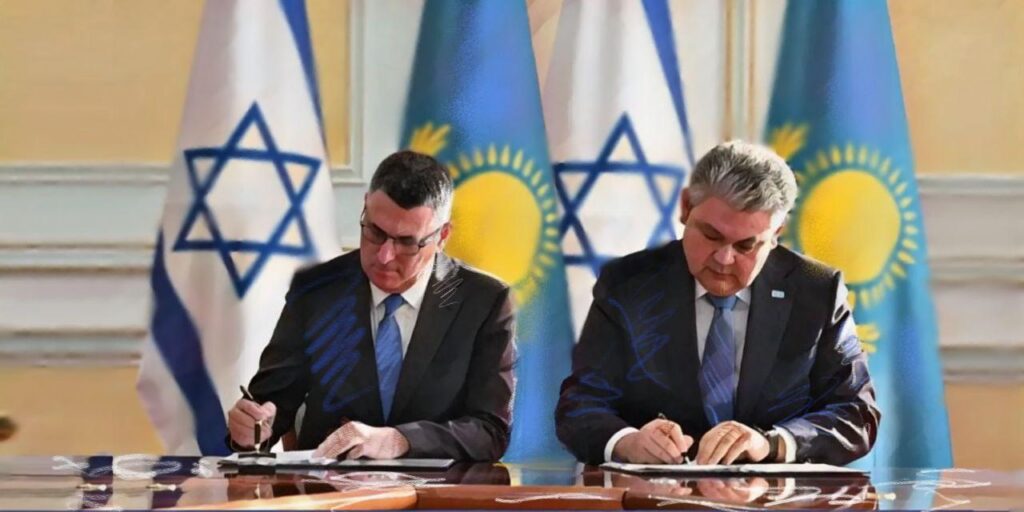
Israeli Foreign Minister Gideon Sa’ar’s official visit to Astana on January 27, 2026, was the first by an Israeli foreign minister to Kazakhstan in 16 years, and it yielded a package of institutional and economic steps. President Kassym-Jomart Tokayev received Sa’ar and Foreign Minister Yermek Kosherbayev, holding talks that both sides framed as elevating cooperation to a new level. The two foreign ministries signed documents on diplomatic training and public diplomacy, and agreed to pursue visa-free travel for holders of ordinary passports. A Kazakhstan–Israel business forum convened in parallel, with January–November 2025 trade of about US$162.4 million cited as the baseline for expansion.

The visit’s value lay in its forward-looking measures to deepen cooperation. The sides agreed to convene the Kazakhstan–Israel Joint Economic Commission at a ministerial level. This move creates a regular venue where sector priorities can be translated into specific workstreams. The Kazakhstan–Israel business forum was framed as the practical feeder for that process, as both sides publicly identified a project map running from high-tech agriculture and water-resource management through digital technologies (including artificial intelligence) to infrastructure and logistics, energy efficiency and renewables, and healthcare and pharmaceuticals. In parallel, the two foreign ministries’ political consultations, in their twelfth round, covered wider international and regional agendas, including Middle East confidence-building and peaceful-settlement initiatives.

Regularizing Cooperation Channels

The documents signed in Astana were narrow-gauge instruments designed to regularize contacts. The memorandum on diplomatic training provides for structured interaction in the preparation of diplomatic personnel. What this means in practice is that exchanges between the two foreign-policy services will be routinized through their training institutions rather than on an ad hoc basis. The memorandum on public diplomacy set a framework for coordinated outreach, providing an agreed approach to presenting their cooperation. Taken together, these instruments are the administrative layer that will operationalize joint political intent.

The visa initiative was narrowly framed as a statement of intent to conclude a visa-exemption agreement for holders of ordinary passports, not as an agreement already in force. In practice, such a regime would lead to higher tourism flows and denser business travel. The latter development would widen the base of commercial contacts, which could in turn be carried into ministerial-level economic follow-up. The visa track is thus an enabling measure for the economic agenda.

At the leadership level, Sa’ar publicly invited President Tokayev to visit Israel. This move signals an intent to sustain momentum beyond merely ministerial channels. The visit coincided with International Holocaust Remembrance Day in Kazakhstan, and Sa’ar participated in a state ceremony in Astana connected to the commemoration. The ceremony included senior officials and diplomatic representatives, with official messaging from Tokayev to Israel’s president on the occasion. The civic and humanitarian nature of this event complemented a visit that otherwise concentrated on governance mechanisms, economic priorities, and institutionalizing diplomatic follow-through.

First Steps Toward Joint Projects

Beyond merely listing priority sectors, the business forum also surfaced first-step commercial and quasi-commercial documents providing a basis for follow-through. Kazakhstan’s investment agency reported three signed items: a memorandum with Mekorot Development & Enterprises Ltd. on the modernization of housing-and-communal services and water infrastructure, an investment agreement for a bitumen plant in the Atyrau Region, and a renewable-energy cooperation memorandum in the East Kazakhstan Region. The identification of these projects means that parts of the agreed agenda are already engaging cooperation that is not dependent on state-to-state agreements, and which have identifiable counterparties and near-term transaction forms. They are also probes to establish the institutional fit of the modalities of implementation.

Astana framed the economic and technological agenda as a direct complement to Kazakhstan’s domestic modernization priorities. As previously reported by TCA, Tokayev and Sa’ar highlighted artificial intelligence, agrotechnology, water-resource management, and digital governance as concrete cooperation targets. Israeli firms were also invited to participate in national digital-transformation work, including e-government, data-driven public services, and digital infrastructure. This suggests that Kazakhstan will not treat Israel as a generic trade partner, but rather as a technology and public-administration partner, with project selection to be guided by Kazakhstan’s own reform and productivity agenda.

The visit has now created enough declared mechanisms for follow-through to be visible in the short term. The first indicator is whether the Kazakhstan–Israel Joint Economic Commission is convened at a ministerial level and assigned a defined initial agenda. The second is whether the statement of intent on visa exemption for ordinary passports advances into a signed agreement with an announced entry into force. The third is whether the three project items reported from the business forum move from memoranda and investment declarations into contracting, financing, and implementation, notably on water and utilities modernization, the Atyrau bitumen plant, and renewables in East Kazakhstan.

The Middle East Dimension

The Middle East dimension also came into play, as Astana has lately aligned itself more explicitly with U.S.-centered regional initiatives that include Israel. Thus, Kazakhstan’s accession to the Abraham Accords is a largely symbolic act that nevertheless improves Astana’s positioning in Washington. In the Astana meetings, Sa’ar welcomed Kazakhstan’s engagement with the Abraham Accords framework and characterized it as constructive. Separately, Tokayev has agreed to join Trump’s proposed “Board of Peace” mechanism for post-war Gaza governance and reconstruction on a standard three-year term, with no required financial contribution.

On a broader level, the Astana package shows the two sides exploring contacts in a mutually beneficial way without forcing premature strategic overcommitment. For Kazakhstan, the cooperation maintains an emphasis on applied modernization and implementation. Project selection is constrained by domestic reform priorities and by the need for workable modalities. For Israel, the visit strengthened bilateral instruments, also confirming Kazakhstan’s entry into a U.S.-centered regional vocabulary through the Abraham Accords framework and related Gaza discussions.

As Tokayev put it earlier this month when explaining Kazakhstan’s decision to become a party to the Abraham Accords, such agreements are “a diplomatic innovation stemming from President Trump’s deep understanding of the historical context and current political realities.” This context facilitates a practical upgrade of the Kazakhstan–Israel relationship through governance mechanisms, mobility enablers, and identified projects. The Middle East overlay increases diplomatic visibility without defining the partnership as a formal bloc alignment.

Unbent, Unbowed, Unbroken: The Art of Saule Suleimenova

“I’m a very emotional person,” says artist Saule Suleimenova with a bright, open laugh from her home studio in Almaty. Widely recognized as one of the most significant Kazakh artists working today, Suleimenova’s spontaneity and passion emerge clearly as the artist lightens up when talking about the joy and necessity of making work, when she excavates memories of the early days of making art, or when suddenly, she grows gloomy, remembering some of the most painful moments in the history of her country.

Behind her back stands a large canvas, where translucent elements, almost resembling stained glass from a distance, slowly reveal themselves as fragments of discarded plastic bags fused together through heat and a whole lot of patience.

Born in 1970, Suleimenova has developed a practice that spans painting, drawing, photography, and public art, consistently navigating the delicate and often hard to define boundary between personal memory and collective history: “I feel my personal life can’t be detached from politics and everything that happens around me,” she says, embodying, in a way, a motto from the seventies: “the personal is political.”

Suleimenova was an early member of the Green Triangle Group, an experimental artist collective known for its avant-garde and punk-influenced art, which emerged during the Perestroika era and the collapse of the USSR, playing a significant role in revolutionizing contemporary art in Kazakhstan.

Today, she is working mostly with archives, vernacular imagery, and the visual language of contemporary urban space. In her work, she investigates how narratives are formed, distorted, and even rewritten over time, particularly within the historical and political context of Kazakhstan.

An example is her ongoing series, Cellophane Paintings, composed entirely from used plastic bags, transforming everyday waste into luminous, layered pictorial fields that hold together subjects as vast as socio-political trauma, from the Kazakh famine of 1930–1933, human rights violations, Karlag, one of the largest Gulag labor camps, and the Uyghur genocide. Those heavy themes are associated with some that are more intimate: family members, flowers, and cityscapes.

Suleimenova is currently participating in the Union of Artists at the Center of Modern Culture Tselinny in Almaty (15 January – 19 April 2026), curated by Vladislav Sludsky, an exhibition reflecting on artistic partnerships as systems of survival in a region where art historically survived through shared spaces and personal alliances between artists, rather than institutional support.

The Times of Central Asia spoke to Suleimenova about memory, material, and the ways personal experience and political history converge in her art.
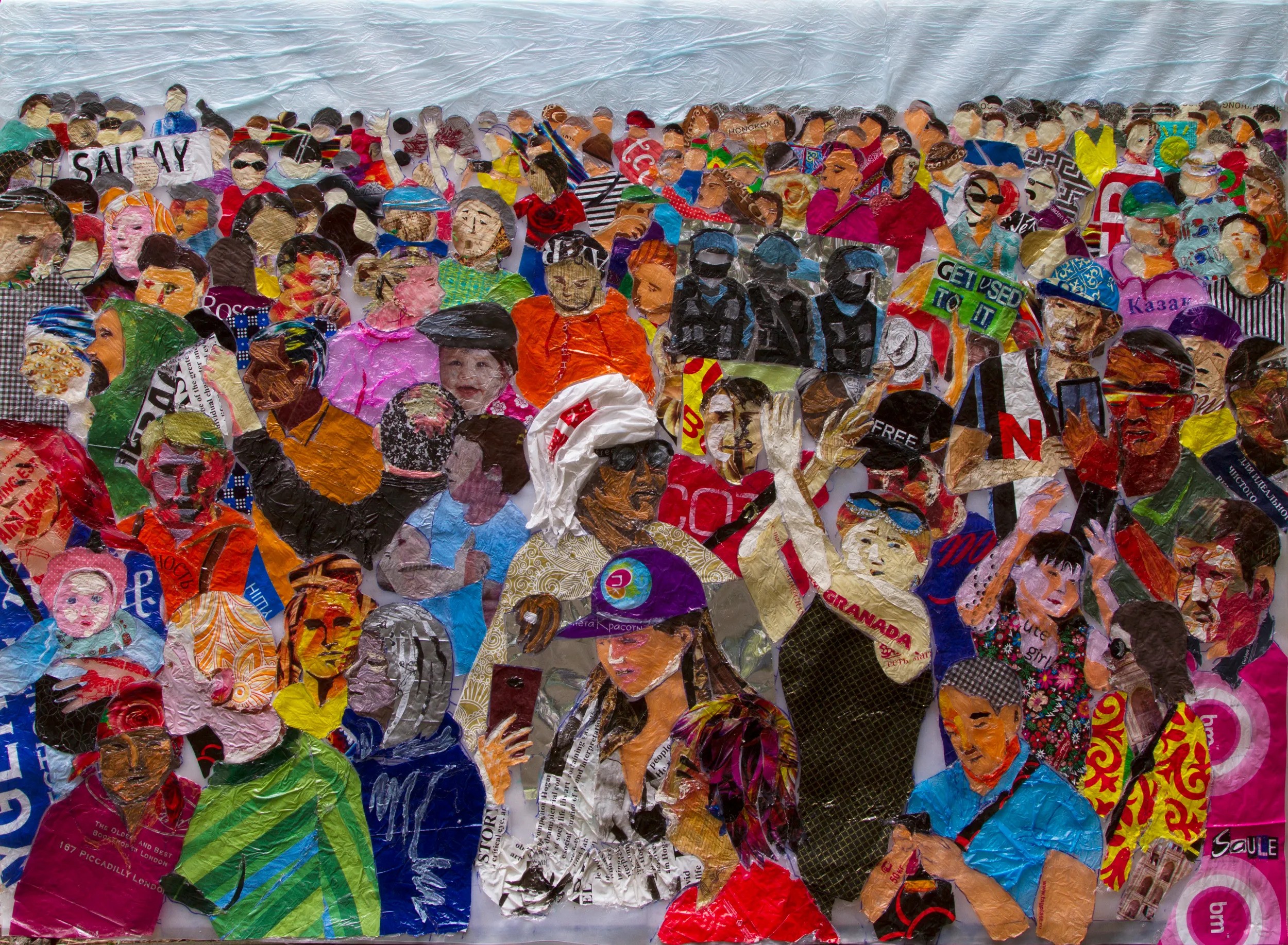
From the series, One Step Forward

TCA: Your recent work at the Bukhara Biennial, Portraits of the people of Bukhara, was made from polyethylene bags collected by the community itself. Can you tell me how your work on this project took shape?

Suleimenova: From the beginning, the work was meant to be collaborative with local artists or artisans rather than something already finished and brought from outside. I decided to collaborate with a folk ensemble of Bukhara women – the retired performers of the Shiru Shakar folk ensemble – who dance and sing, and whose presence carries traditions in a living way. I made a site-specific installation of seven polyethylene transparent films with some images, so the visual part and its embodied practice existed together in the same space.

During the biennial, these women performed two times a week, so the installation was constantly activated by their presence and movement. It ended up being very popular.
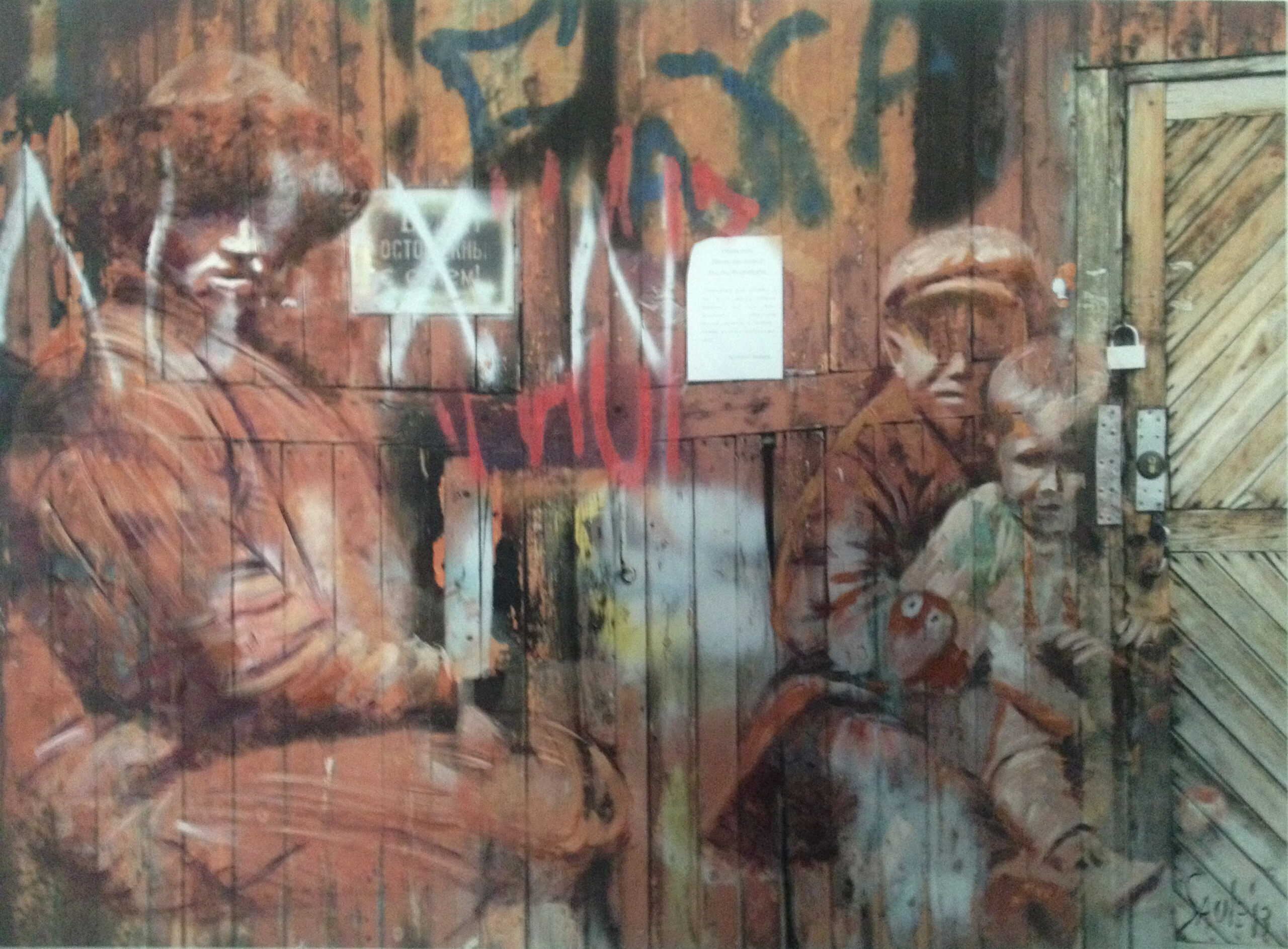
From the series, Aruakhs (Ancestors Spirits)

TCA: You were born into an artistic family, yet you’ve said you initially resisted art school. What was your relationship with art as a young girl?

Suleimenova: When I was a child, I went to art school, but I didn’t feel there was something interesting for me there at that time, so I couldn’t connect to it in a real way. I even lied to my mom that I was going to art school, but instead I spent time somewhere else, because I didn’t feel that what was happening there was truly for me.

Only when I was 16 did I realize that I physically needed to do something with my hands, to paint, to use some pastels and watercolors, and that this need was not coming from outside expectations but from inside my body.

TCA: Was there a particular moment that triggered this need?

Suleimenova: It was a kind of painful time, because I was heartbroken, which made everything feel very intense. It was a time when even breathing felt painful, and the only way to survive was to do something with my hands, to express this feeling that was quite heavy and difficult to carry inside.
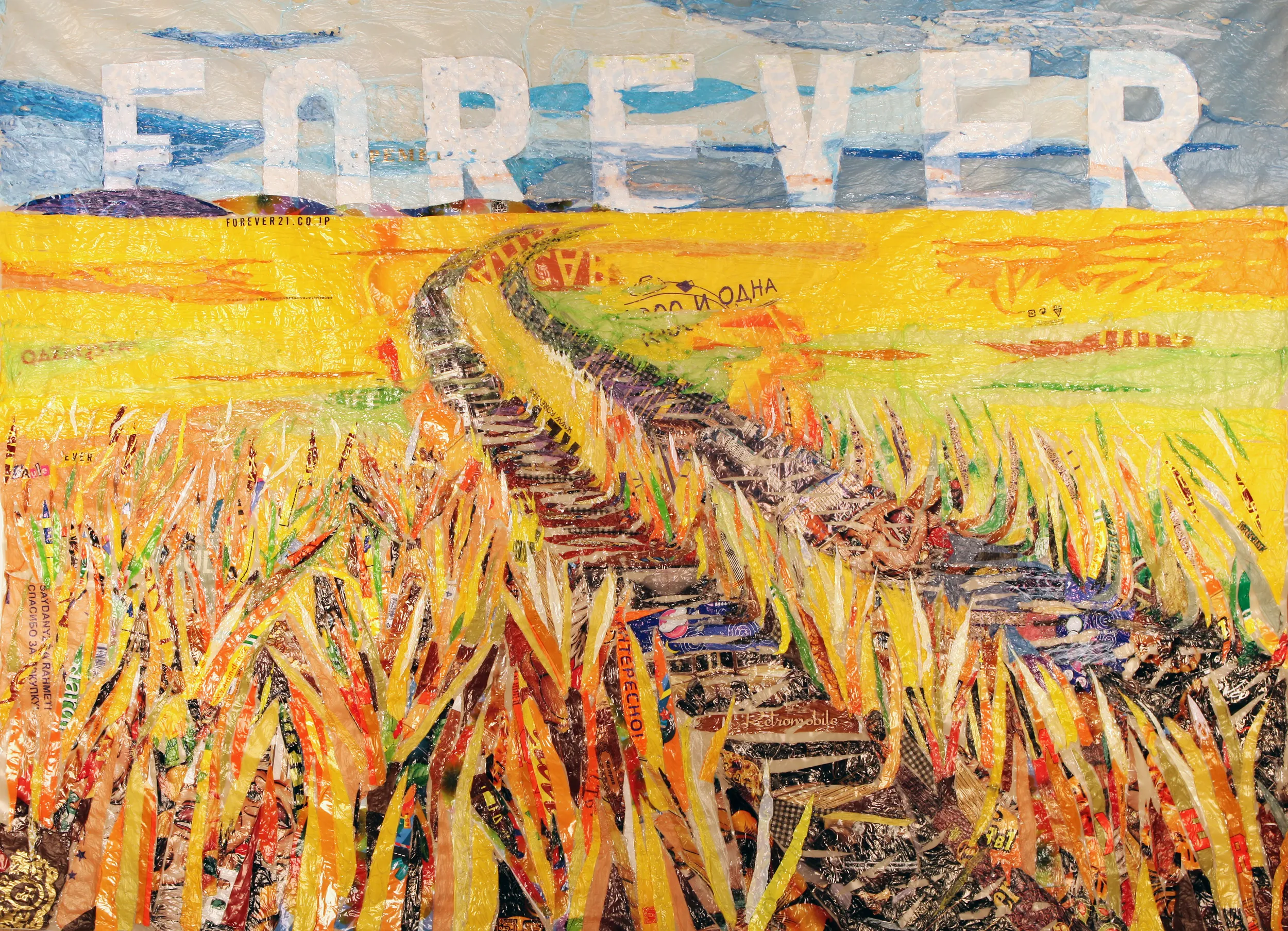
From the series, One Step Forward, “Forever.”

TCA: What did your earliest works look like during that period?

It was mostly work on paper, because that was what I could access. I even had my first attempt to use oil, but I didn’t have an opportunity to buy oil paints and canvas, so mostly it was paper, newspaper, cardboard, or something like that, materials that were simply available.

TCA: Later on, you formed the underground group Green Triangle. What was that moment like?

Suleimenova: Green Triangle really brought together young people who were searching for another way. It was Almagul Menlibayeva, Ablikim Akmullaev, and me, and then a number of young artists joined in. We were just trying to make alternative exhibitions, mostly underground, outside official structures.

When we first met in October 1987, the first time, on the Day of Almaty, which was a big festival, I was trying to earn some money by making portraits of people in the street. There was a huge crowd of people, and it was the first time in the Soviet period that something like this could happen. It felt so open; it was Perestroika.
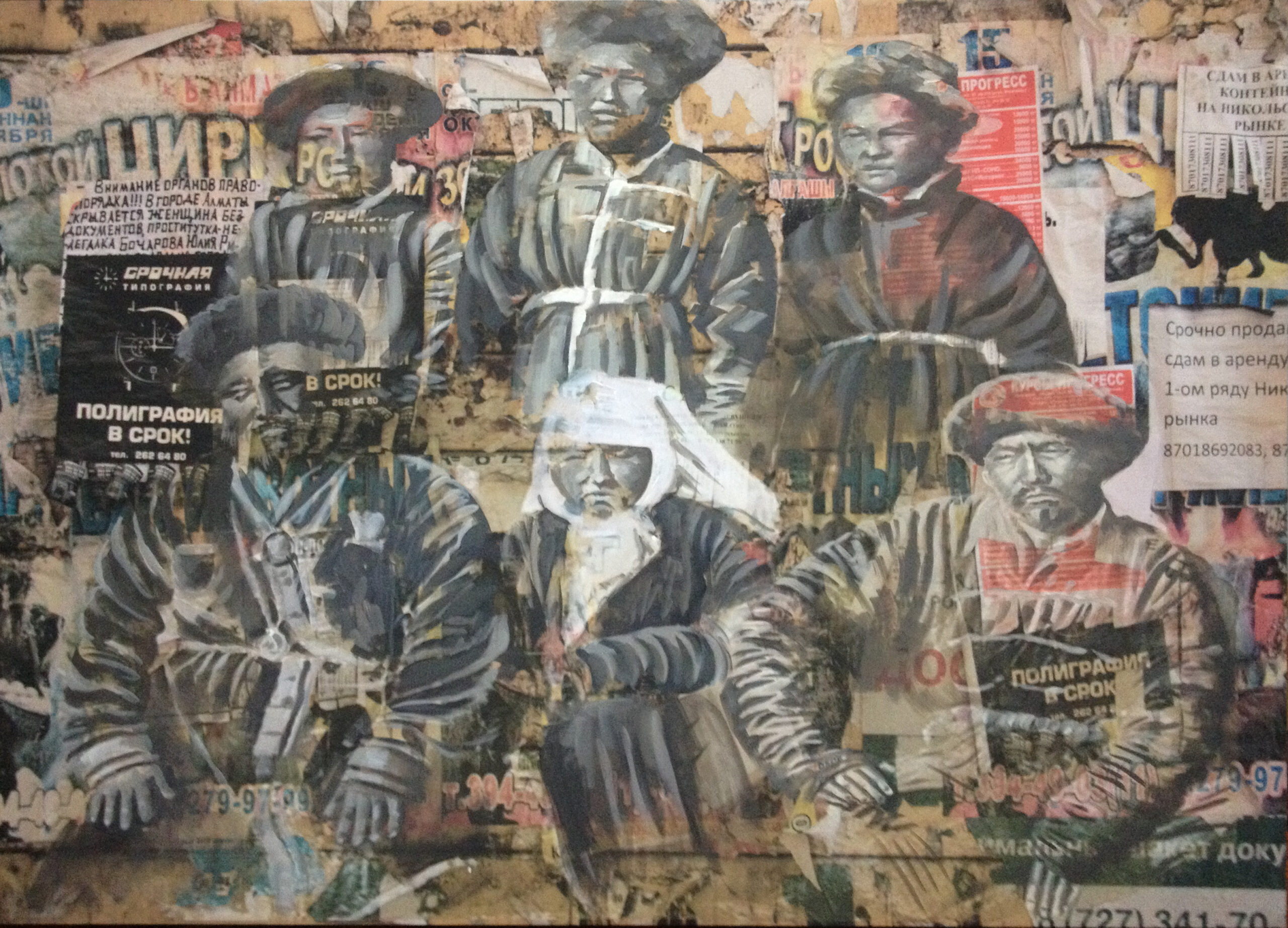
From the series, Aruakhs (Ancestors Spirits), “Family.”

TCA: What do you remember about that atmosphere?

Suleimenova: I was trying to be different, I was wearing hippie clothes and trying to go out and make a performance every day, just to feel I was participating in some way in that moment of change.

And I met these people, these young, beautiful guys with long hair…. we just met each other in the street and found each other. We recognized a similar spirit in each other. We all looked very different than Soviet people, but this was dangerous at the time. This was almost 40 years ago.

TCA: You’ve consistently worked with found materials. Where does that impulse come from?

Suleimenova: I used what I could find on the street – for example, window glass, because it was difficult to find art materials. For the same reason, I just used old clothes and glued them, grounding them as a canvas, using what was there.

Besides the practical element, for me it was always very interesting to work with value, to question what value means and how it works. Why is gold more important than, for example, waste? This question was very interesting for me, and it was important to create a value myself, not to use a kind of already well-known value.
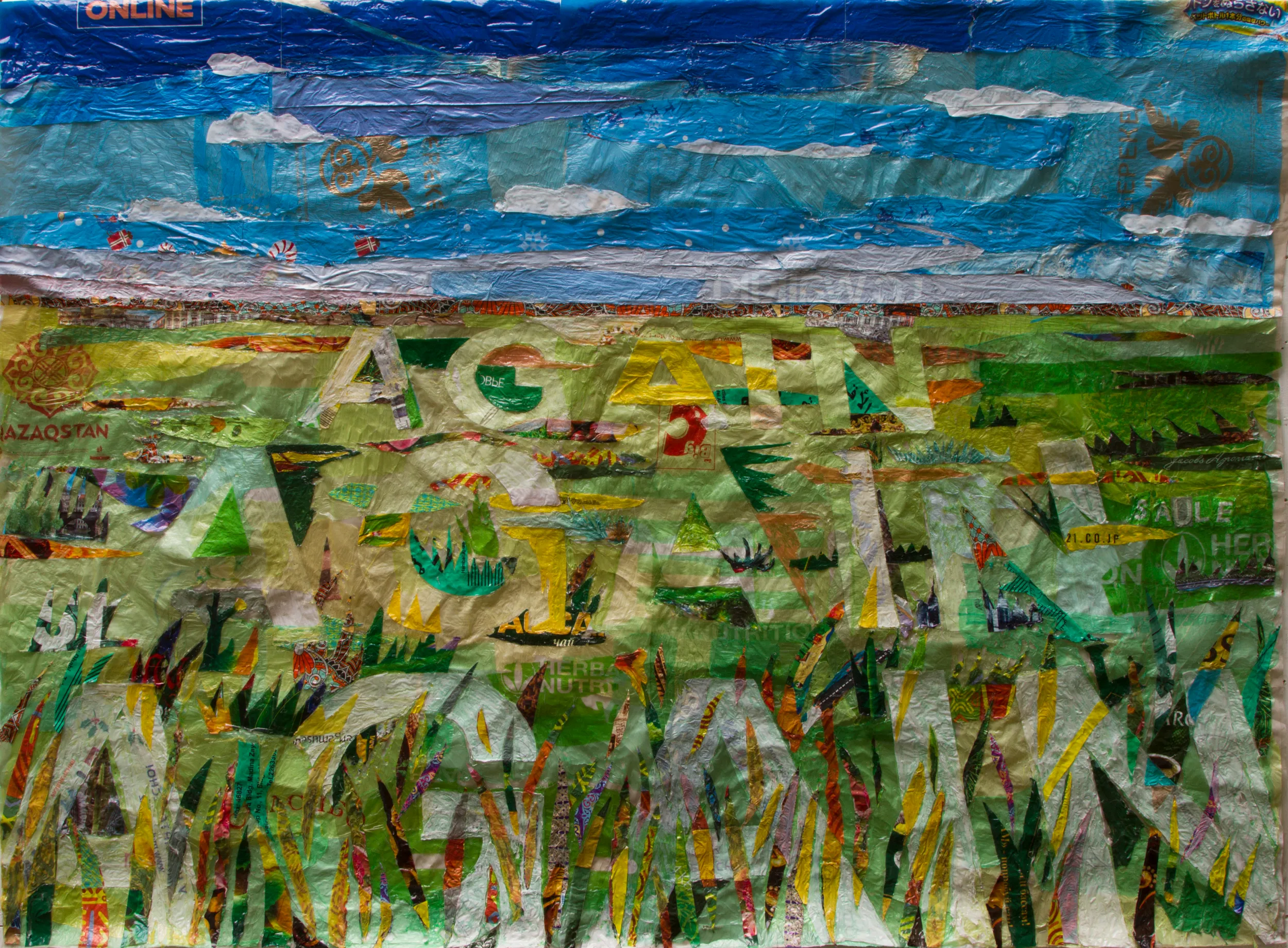
From the series, One Step Forward, “Again.”

TCA: You later began painting over archival photographs. How did that phase develop?

Suleimenova: It was again about measuring values, and I realized in that moment that the most beautiful things I see around are old surfaces, shutters from the garages, or old walls that carry time. There was a lot of graffiti and some ‘do not park your car nearby’ signs, a lot of advertisements, and all these layers. I love this play of light and fades on the surfaces, how time and weather change them.

For the images, it was very important to find this ‘Kazakh-ness’, this proper intonation, because we have a kind of official art that is very idealized. It’s like fairytale images of beautiful girls and warriors, who all look perfect. It was so far from real life, and based on a complex of not feeling proud to be Kazakh. It’s almost like artists needed to create a more glamorous version of ourselves, instead of appreciating what already existed.

I was thinking the best way is to find archival photos, photo documents, and paint them like models on the urban surfaces I mentioned before, corresponding to our current life. I did this juxtaposition of past and present, of different surfaces, so they could exist together in the eye of the viewer.

TCA: And then from there, how did plastic finally enter your practice?

Suleimenova: I found this bag, a plastic bag with little plastic bags inside my mother’s home, and found that I had enough amazing colors there. For several years, I was trying to find a way to glue them, not to use any paint at all. The problem is that polyethylene and polymers are very hard to glue to each other, and there is only one way, which is at a high temperature.

I became very well versed in chemistry… polymers, plastic, polyethylene, polycarbonate, all this horrible stuff holds no secrets for me now. I started to use hot silicone in a glue gun and plastic surfaces, fuel, or polycarbonate, and then I glued the plastic bags together.
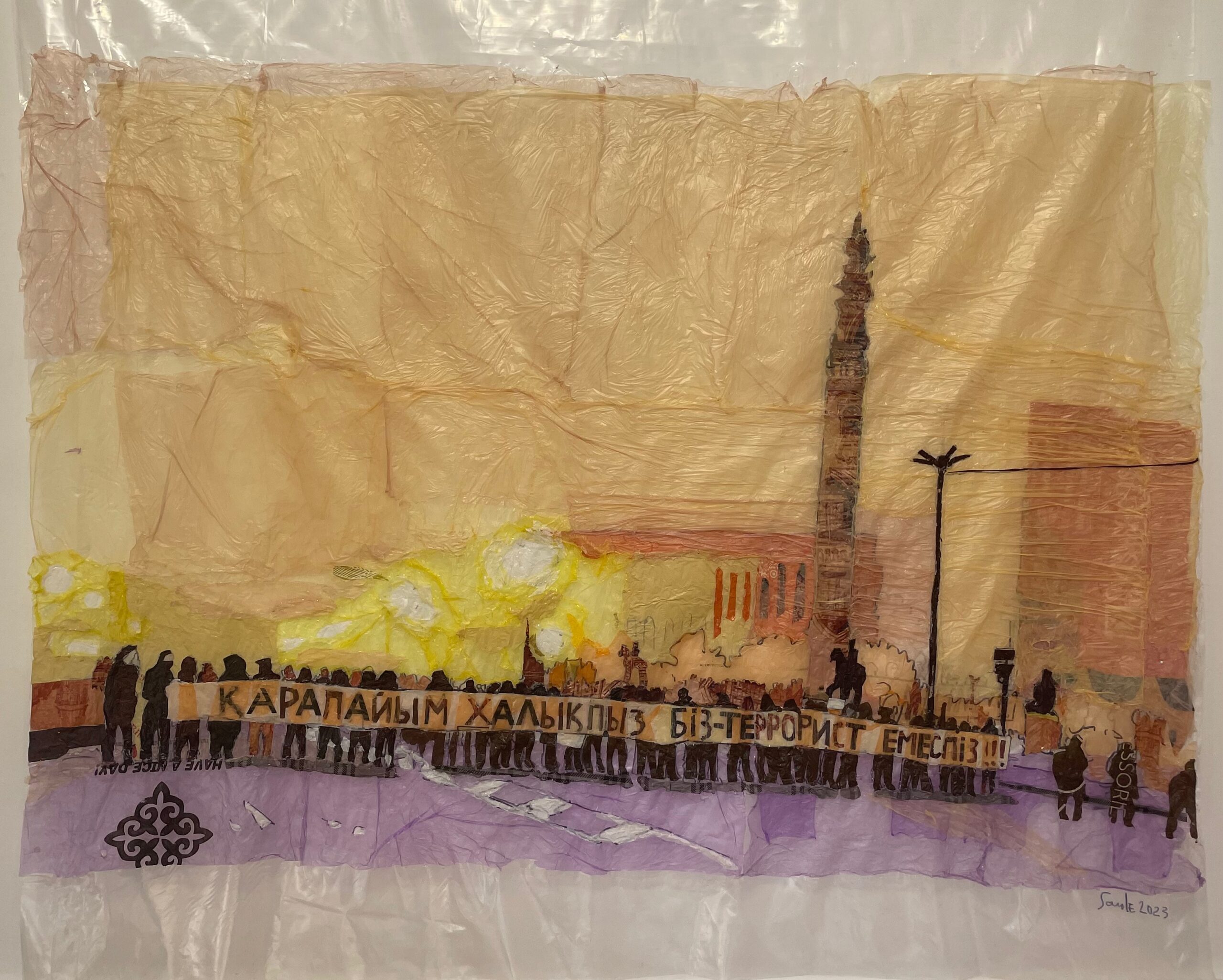
Fog. Qandy Qantar

TCA: Your work merges political and personal themes. How do you see that relationship?

Suleimenova: When I start a series, I cannot finish it; it’s open, because I’m very emotional. Politics is also about emotions, about empathy for people, about what they feel, and I’m just trying to express what I’m feeling through the work. For me, I don’t feel a big difference between my private, personal, and political life. Personal is political.

TCA: You addressed the 2022 events in Kazakhstan in works like Sky Above Almaty. Is it tricky to show this kind of work in your home country?

Suleimenova: That work was first exhibited in Warsaw, and then recently the Almaty Museum of Art wanted to buy it. There was a long discussion, two years. Finally, when the deal was almost sealed, the museum backed away at the very last minute because of concerns about the opening. The work was acquired by another institution, but you can see how there is still unease and a willingness to forget a part of recent history.

TCA: Your work can be very militant; have you ever been subjected to censorship?

Suleimenova: I remember a show that I had four years ago, in a public space in Almaty, which was open 24 hours, a place artists could rent studios and make performances and installations.

Some people from the government visited the show and tried to shut it down. But while they started to see if it was possible to remove the work, all of a sudden, people started to take selfies, and next thing you know, these government officials were taking selfies too. It was a nice exhibition, with many visitors, and those images of the works circulated. I hope that somehow art can make a small impact and speak of a history that must not be erased.

Kazakhstan-Based Actor Nyshanbek Zhubanaev on His Journey, Faith, and the Future of Cinema

Nyshanbek Zhubanaev is a professional actor, a graduate of the T.K. Zhurgenov Kazakh National Academy of Arts, and a rising star of series such as Sheker, 1286, and Munai. His path into acting, however, did not begin with red carpets or casting calls, but at a phosphorus plant.

Taking a leap of faith to escape a life he describes as scripted by others, Zhubanaev pursued his childhood dream with persistence and conviction. In an interview with The Times of Central Asia, he reflects on his first steps in cinema, the role of faith, inner conflict, and why, for him, humanity matters more than talent.

TCA: Your popularity came with the web series Sheker 2, 1286, and Munai. Two of them are set in the 1990s. Why do you think this decade continues to fascinate directors?

Zhubanaev: It was a time of contrasts and complexity. When people say Munai romanticizes crime, I feel they’ve missed the point. It’s not about crime, it’s about the clash of personalities and how the oil business emerged in our country.

The 90s serve as a backdrop. And in cinema, atmosphere is half the battle. As an actor, I want to be part of projects where that atmosphere is palpable. Whether it’s the 90s or another era doesn’t matter. What matters is telling strong, vivid stories.

TCA: What themes do you feel are missing in Kazakh cinema today?

Zhubanaev: Our cinema is still developing, and there’s so much left to explore. People often say we lack films about love and relationships. We do have them, but not the kind you want to talk about seriously. And love is one of the hardest topics to portray, it leaves you no room to hide behind genre, action, or style. It demands talent.

I read a lot, and I’m constantly amazed by the richness of Kazakh literature and history, and how little of it we bring to the screen. Take Mukhtar Auezov’s Karash Okigas, it’s a ready-made screenplay. During Soviet times, Kyrgyz director Bolotbek Shamshiyev adapted it, but today it deserves a modern retelling.

TCA: You often cite literature as a source of cinematic inspiration.

Zhubanaev: Absolutely. Look at Remarque’s All Quiet on the Western Front. Its recent film adaptation won an Oscar, though I found the film debatable. We have our own counterpart, Kazakh Soldier by Gabit Musrepov. Why not adapt that with a modern cinematic language?

I also love the works of Beimbet Mailin. He’s an incredibly cinematic writer who remains relevant today. His Shuganyn Belgisi, written nearly a century ago, still speaks to issues like equality and the role of women in traditional society.

As far as I know, Akan Satayev is currently preparing a film adaptation of Mailin’s Kulpash, the story of a woman who takes a desperate step to save her family during a famine. It’s powerful, dramatic material.

The problem isn’t a lack of themes, it’s about who tells the story and how. You can create a visually perfect film and still fail to touch the audience’s heart.

TCA: Perhaps young directors are simply unfamiliar with national literature?

Zhubanaev: That’s no excuse. No one has canceled self-education.

I always say: the best education is the one you give yourself.

Yes, I was fortunate with my mentor. If I’d had a different teacher, I wouldn’t be who I am today. But what I read, watched, and studied on my own also shaped me.

TCA: You’re originally from Uzbekistan. Was it difficult moving to Kazakhstan?

Zhubanaev: It wasn’t easy. It was 2007. I was almost 20, an age when many people are finishing university and I was just dreaming of becoming an actor.

I had no relatives, no friends, and no money. I arrived in Almaty with a single bag and the wages I’d earned at the factory. What made it possible was, first of all, God, and secondly, my mentor Orazkhan Kenebaev. No one else wanted to take me on, but he said, “I’ll take you. You’ll study.”

TCA: You worked at a factory before becoming an actor?

Zhubanaev: Yes, at a hydrometallurgical plant, GMZ-2, in workshop eight, where phosphorus was extracted. I worked as a kipovets, handling automation and process control.

Honestly, I didn’t understand why I was there. Every day I went to work and cried. It was completely alien to me. I went to college because my parents wanted me to. I got married, lived “as expected.” But the dream of acting never left me. And thank God I took the risk. If I hadn’t, I’d regret it my whole life.

TCA: You often portray negative characters. Does that conflict with your faith?

Zhubanaev: Why should it? God gave me the gift of transformation, and I must use it. I see myself as a conduit.

I’m not a deeply religious person, just someone who tries. I go to the mosque, I fast, I read the Quran, I pray, I love my family.

I have a dark side too. I accept it, I’m no angel. But the key is not to lose your humanity. For me, that’s more important than talent. If someone behaves despicably, I won’t work with them, no matter how brilliant they are, even if they’ve won three Oscars.

TCA: That’s not easy in the creative world.

Zhubanaev: There are no simple people, especially among the talented. Geniuses often carry inner turmoil. But regardless of your personality, you must remain human.

There are many temptations in cinema and show business. It’s easy to lose yourself. My faith and my family keep me grounded. When you’re the father of many children, you simply don’t have the right to fall apart.

TCA: Is “star syndrome” the biggest temptation?

Zhubanaev: It scares me. I never want to be the kind of person who believes he’s achieved everything alone. Fame and money came to me slowly, through hard work. That’s why I always ask God: no matter what happens, whether I become famous or wealthy, let my heart stay simple.

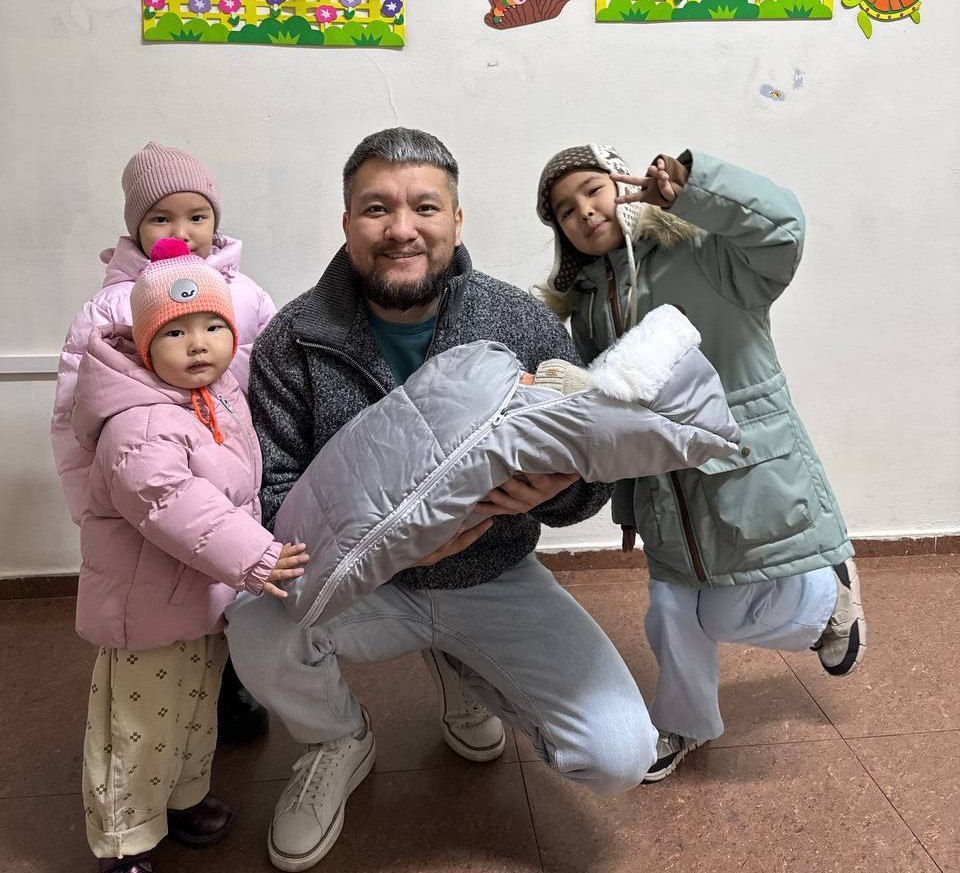
TCA: You recently welcomed your fourth daughter. What is it like being a father to four girls?

Zhubanaev: It’s a blessing. In Islam, it’s said that parents of three daughters are destined for paradise. Among Kazakhs, we say daughters are given to real men. I relate to both.

I always dreamed of having a daughter, and God gave me four. The oldest is seven; the youngest was just born. The gender doesn’t matter. It’s all a great gift.

TCA: Do you think any of them will follow in your footsteps?

Zhubanaev: I don’t know, but they’re all artists. We have a creative family my wife is a trained musician. We’ll raise our children with a love for books, music, and art. But what they choose to become is up to them.