In July 2026, a new constitutional law on Kazakhstan’s administrative-territorial structure came into force. It retained a layered process for changing place names: local authorities must consider residents’ views, while onomastic commissions review proposals before final decisions are made. The previous legal framework dated to 1993. Replacing it with a constitutional law did not dismantle the machinery of onomastic policy but consolidated the roles of public consultation, local government and official commissions. The law formalized a system built over three decades, during which thousands of streets were renamed but the country’s urban map changed at markedly different speeds. Kazakhstan’s experience is often described as a simple substitution of Lenin with Abai and communist terminology with the symbols of independence. The geography of renaming suggests something more precise: a centralized nation-building project whose reach depends on local demography and the political cost of opposition.
Research documenting 6,832 cases across 37 cities between 1991 and 2019 shows the disparity. Five cities accounted for 72% of all recorded renamings: Shymkent had 1,767, Almaty 1,064, Astana 860, Aktobe 783, and Kyzylorda 470. Pavlodar recorded 34, Petropavl 28, Oskemen 23, and Rudny only two. Raw totals partly reflect city size and urban expansion, but the study’s statistical analysis identified both city status and ethnic composition as significant factors. Renaming occurred less frequently where the share of Slavic residents was higher, a pattern the author interpreted as evidence of greater state caution in ethnically mixed cities.
The procedure helps explain why a national symbolic agenda produced such local variation. Proposals move through public consultation, local representative and executive bodies, and onomastic commissions. These stages do not guarantee that public preferences will determine the outcome, but they create points at which opposition can slow or redirect a proposal. Astana, extensively rebuilt after becoming the capital in 1997, could remake its urban identity quickly. Established industrial cities in the north and east moved more carefully.
The contrast between what disappeared and what survived is equally revealing. Explicitly ideological names associated with Lenin, Marx, Engels, and the October Revolution became far less common, while Almaty retained streets named after Soviet scientists, writers, and figures connected to Kazakhstan’s development. The authorities did not treat every Soviet reference alike. They separated communist ideology from cultural and intellectual contribution, producing selective de-Sovietization rather than wholesale symbolic purification.
Municipal practice further complicates a purely nationalist reading. Official data from Kyzylorda for 2025 lists 874 city streets: 497 named after individuals, 270 after localities and water features, and 107 carrying conventional names. This snapshot does not identify which streets were renamed, but it shows that the present naming system encompasses historical figures, local geography, and ordinary municipal conventions. In the expanding Arai-Shugyla neighborhood, seven previously unnamed streets received names drawn from localities and water features. Onomastic policy was therefore organizing new urban space as well as redistributing historical visibility. Naming new streets and replacing old ones use the same administrative machinery, although their political consequences are not always comparable.
The politics became clearer when renaming reached independent Kazakhstan’s own history. In 2017, central Almaty’s Furmanov Street became Nursultan Nazarbayev Avenue while Nazarbayev was still president. Unlike the commemoration of Abai or Kenesary, the decision placed an incumbent ruler directly into the city’s symbolic landscape. After the January 2022 unrest, activists staged a symbolic renaming of the avenue as Qantar and called for the change to be made permanent. The demand was not adopted, but it extended the argument beyond Soviet memory. Streets could now be used to contest which figures and events from the post-Soviet period deserved public legitimacy.
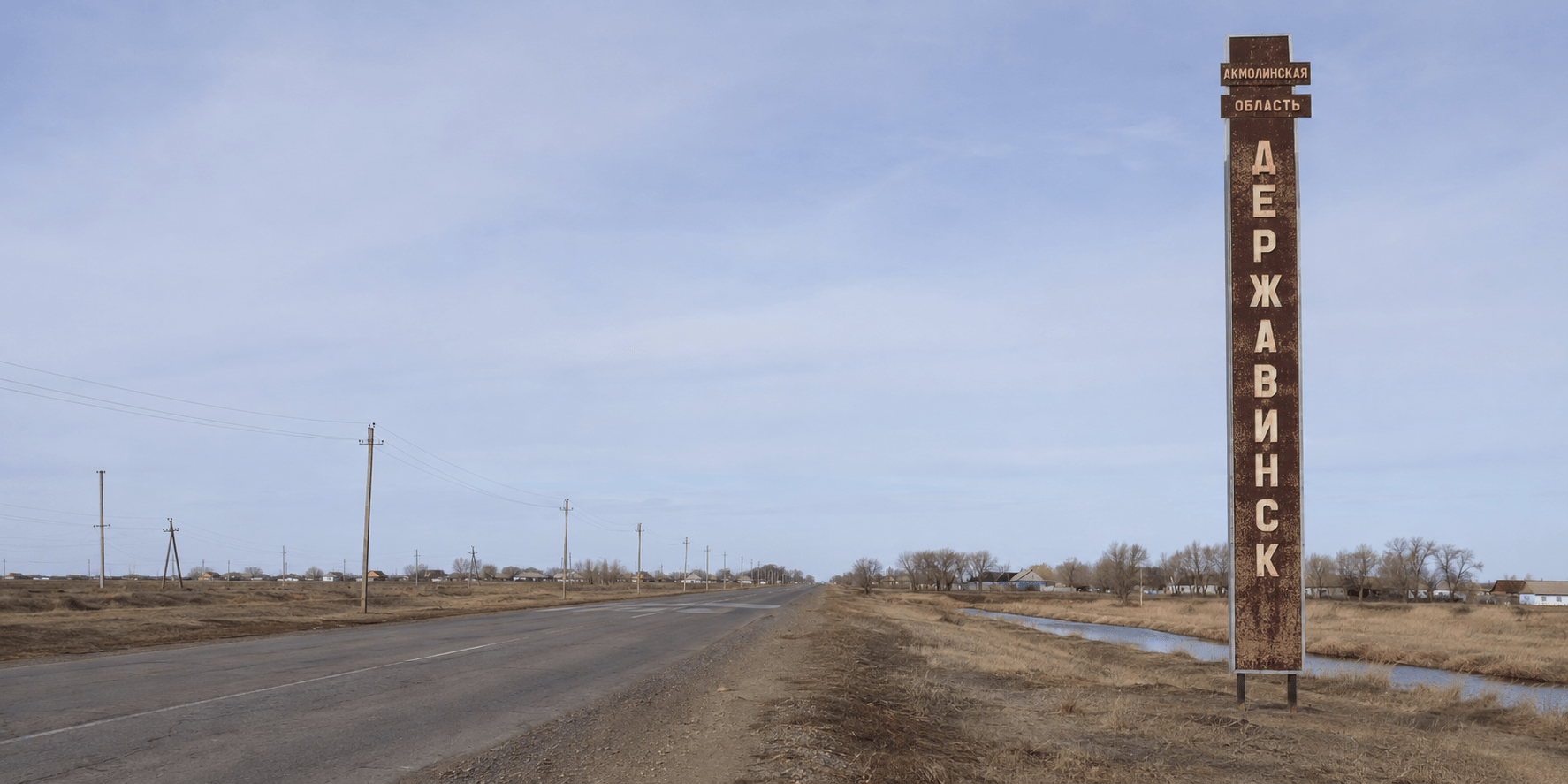
Derzhavinsk in Akmola Region exposed the limits of consultation. In 2023, local authorities proposed renaming the town after Kenesary Khan, the 19th-century leader of resistance to Russian imperial rule. At a public meeting, 192 residents voted in favor and 125 opposed. Opponents subsequently gathered nearly 400 signatures, questioned the consultation process, and argued that Kenesary had no direct connection to the area. Officials described the vote as an initial test rather than a final decision, and the process stalled. Three years later, official district announcements were still using the name Derzhavinsk in August 2026. A majority at one meeting had not settled the larger dispute over whose history the town should represent.
Kazakhstan’s renaming policy is selective both in the symbols it removes and the places where it proceeds most decisively. Its effect on public identity remains empirically uncertain: administrative records show which names changed, but not how residents interpreted the new urban landscape. The next disputes are likely to concern less the Soviet past than the legitimacy of the post-Soviet order. As the country evaluates the Nazarbayev era, renaming will no longer be only about where national history begins. It will also become an argument over how independent Kazakhstan chooses to remember itself.