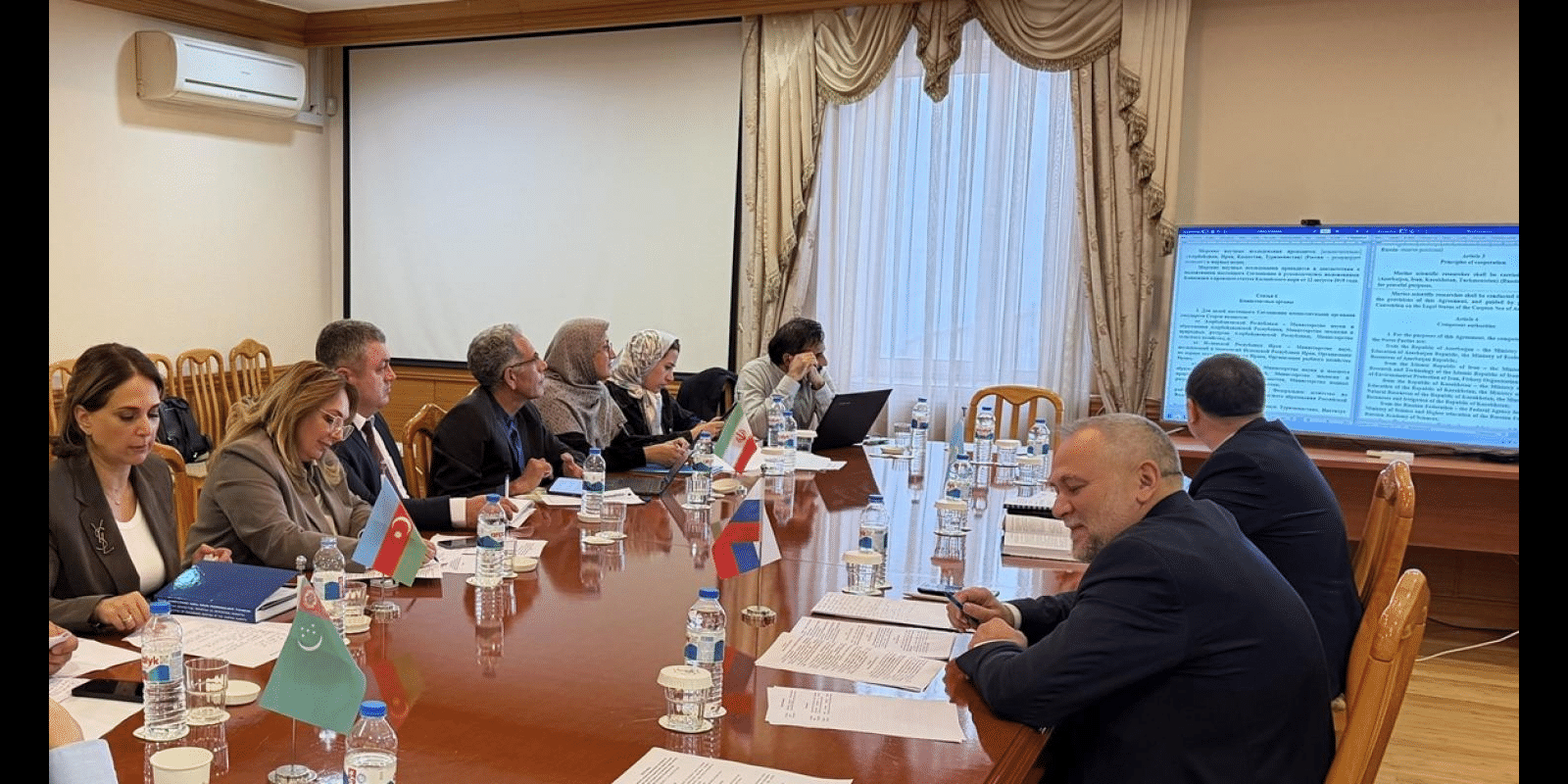
Turkmenistan hosted a meeting of the Caspian Sea littoral states to discuss cooperation on marine scientific research, part of a wider effort by the Central Asian country to promote regional collaboration over the fragile, strategic body of water.
Turkmenistan’s Ministry of Foreign Affairs said delegates discussed a draft agreement about research in the Caspian Sea, where countries want to develop large oil and gas reserves while trying to mitigate the impact on the marine environment. The five littoral states are Azerbaijan, Iran, Kazakhstan, Russia, and Turkmenistan.
“The current meeting is expected to facilitate further progress in finalizing the remaining provisions of the draft,” the ministry said, noting that the two-day meeting was scheduled to end on Wednesday. It said the initiative on scientific research was first proposed at a Caspian summit in 2018 by Gurbanguly Berdimuhamedov, then president of Turkmenistan.
Berdimuhamedov ceded the presidency to his son, Serdar, in 2022, but remains an influential figure and has the official title of National Leader of the Turkmen people.
Turkmenistan also advocated collaboration in the Caspian at an oil and gas conference in the capital earlier this month. Myrat Atajanov, director of Turkmenistan’s Caspian Sea Institute, said the region faced the challenge of declining water levels in the sea and the potential risk to offshore platforms, sub-sea pipelines, and coastal infrastructure.
“Atajanov stressed that the 2018 Convention on the Legal Status of the Caspian Sea provides a framework for cooperation, while finalizing sector boundaries is essential for geological exploration, field development rights and offshore infrastructure planning,” said the Turkmen Energy Forum, an organizer of the oil and gas conference.
Turkmenistan wants the demarcation of Caspian Sea sectors of the various countries to be finalized, saying it would provide legal certainty for offshore energy projects and other investment plans. The Turkmen government wants to expand its role as a transit point on the Middle Corridor, a trade network linking China and Central Asia to Europe via rail and Caspian Sea infrastructure.
Earlier this year, the Iranian government submitted the 2018 Caspian convention to the Iranian parliament for ratification after a long delay. Unlike the other countries, Iran’s parliament had not ratified the deal. Critics in Iran had argued that the agreement would leave the country at a disadvantage in securing its rights to the sea’s resources.
However, Iranian officials showed renewed interest in the convention this year, saying it was a way to strengthen regional cooperation and secure Iran’s maritime rights. The development came amid wider geopolitical tension and pressure on other trade routes, although Tehran said its decision to submit the convention to parliament was not connected to the war.