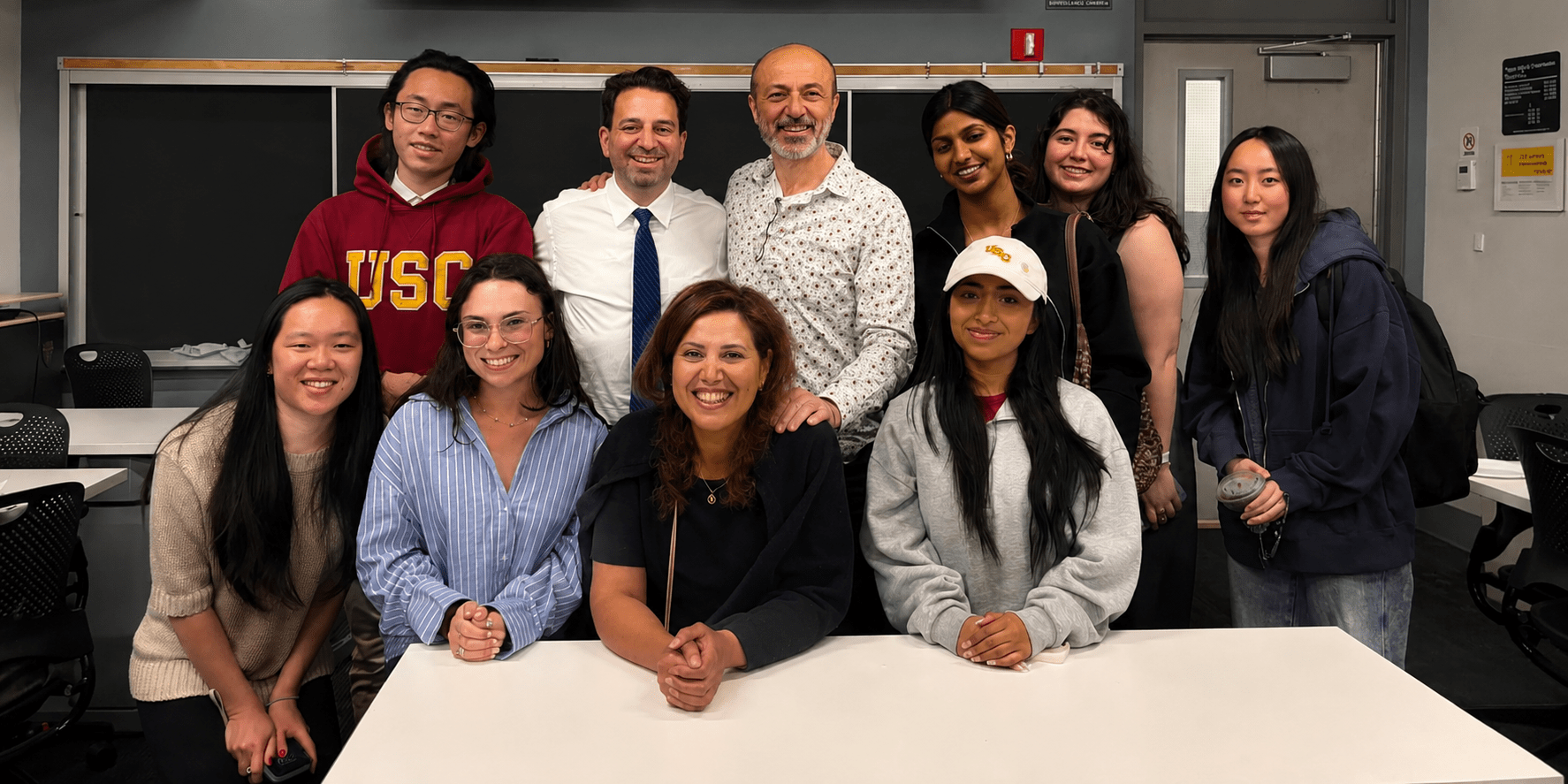
Professor Steve Swerdlow of the University of Southern California (USC) arrived at the Bishkek airport at 4:30 am on May 19, leading a group of 16 students for a trip of a lifetime: two weeks in Kyrgyzstan and two weeks in Kazakhstan.
Swerdlow, a veteran Central Asian researcher who had previously worked for Human Rights Watch in Uzbekistan (2010), Kazakhstan (2011), and Kyrgyzstan (2012-2019), had led similar trips to Kyrgyzstan with USC students in 2022 and 2024.
This time, however, there were problems immediately upon his arrival at Bishkek.
“I was taken out of line at passport control and whisked away to the departure area, and then taken to a little room,” Swerdlow told TCA. “There were three guys there and they said, almost with a smirk, that we only work here and were told not to allow you into the country.”
Swerdlow attempted to get clarification as to why he was being denied entry to Kyrgyzstan, but the border officials merely said their instructions were that Swerdlow was not to be admitted.
They told him that an official letter stating the reason for the denial of entry would come, but Swerdlow said he was never given such a document.
The border officials said he was to be deported on a plane to Istanbul that was due to leave at 10:00 am. The officials gave Swerdlow his passport with a letter in it addressed to the people at Turkish Airlines, who later showed Swerdlow the contents.
It said only that Swerdlow was being denied entry to Kyrgyzstan because entry to Kyrgyzstan was “closed” to him.
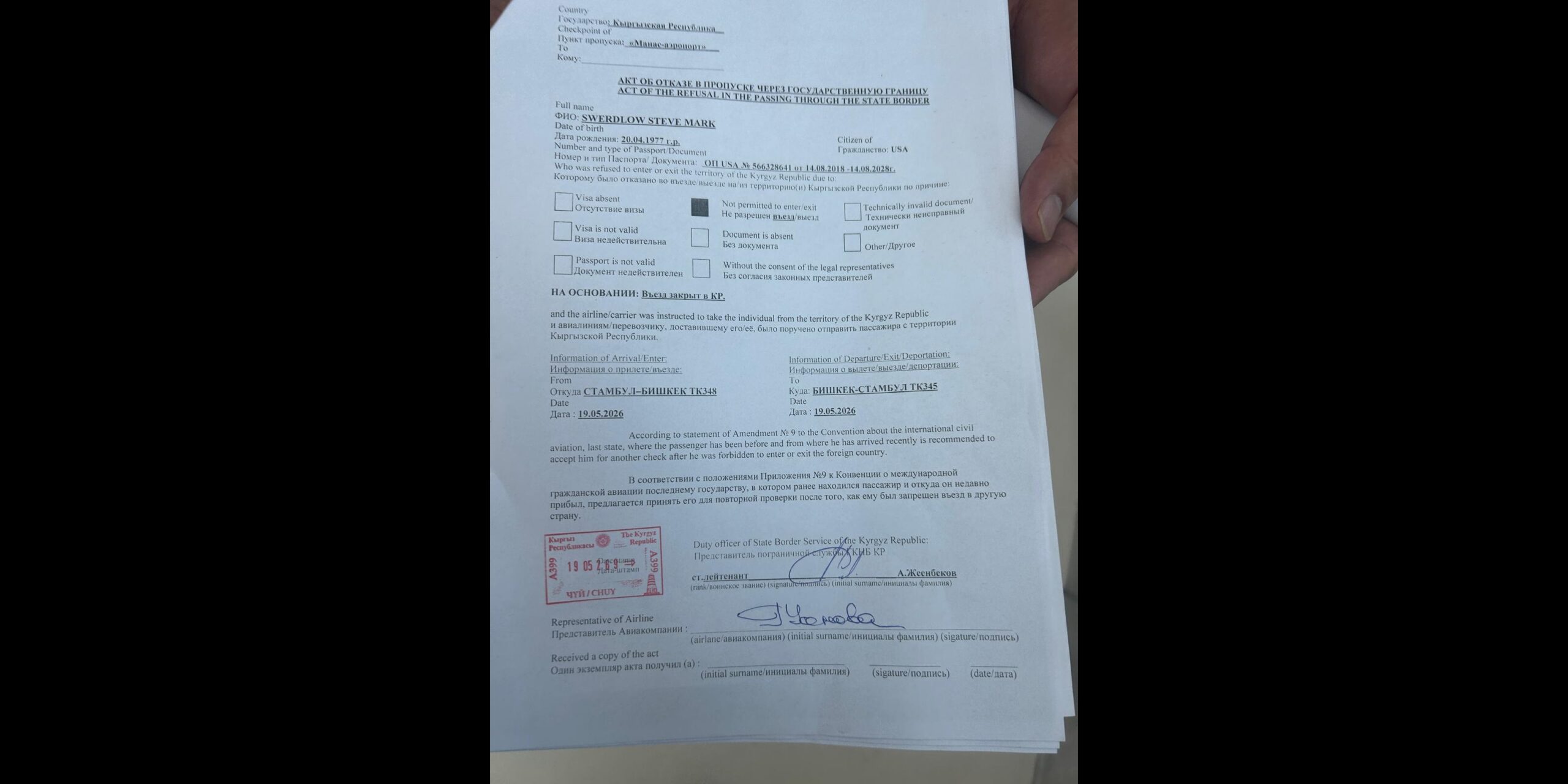
Swerdlow’s passport was returned to him when he reached Istanbul, but there was another complication. Kyrgyz border control officers had told Turkish Airlines that Swerdlow was being sent all the way back to Los Angeles, so his luggage was transferred at Istanbul to a flight preparing to leave for California.
He managed to retrieve his luggage from that flight but remains in Istanbul, where he is trying to coordinate with his students, USC, and officials in Kyrgyzstan.
The students are Swerdlow’s main concern. The trip was organized with help from the American University of Central Asia in Bishkek, so the students have accommodation, and there are people who speak English helping them.
During previous trips, students met with people from Kyrgyzstan’s presidential administration, the human rights ombudsman, and visited parliament. It is unclear if this group will now be able to do the same.
Some parts of the trip will almost surely be canceled. Swerdlow mentioned that the group had yurts reserved at Tamga on the shore of Issyk-Kul, the immense alpine lake that is Kyrgyzstan’s premier tourist attraction.
“It was going to be a cultural event,” Swerdlow said. “We were going to watch a kok-boru match, attend some cooking classes for local dishes, and a reading of Manas.”
Kok-boru is a national sport in Kyrgyzstan, something like polo with players on horseback trying to drag a replicated sheep carcass to goals at either end of the playing field.
Manas is the Kyrgyz epic that tells the tale of the great Kyrgyz hero from centuries ago and the efforts of him and his friends to unite the Kyrgyz peoples and fend off their enemies.
Swerdlow is also an accomplished keyboard player, and during the years he lived in Bishkek became part of the Kyrgyz capital’s jazz community.
He had a show scheduled and planned to bring his students along. Swerdlow lamented not being able to get together with his fellow musicians in Bishkek. “Who would have thought a jazz man would be a security threat?” Swerdlow joked.

Rights groups in Kyrgyzstan have raised concern over Swerdlow’s denial of entry.
Bir Duyno (One World) released a statement while Swerdlow was still at the Bishkek airport, demanding to know why he was detained “without a clear public explanation of the legal basis and reasons for the decision taken.”
The case follows another recent incident reported to TCA involving a visiting professor, who was held at Bishkek airport for more than 12 hours in April after arriving from Istanbul. According to a person familiar with the case, no reason was given at the time.
Kyrgyzstan has a history of denying entry to journalists, human rights workers, and academics.
Bir Duyno recalled that Ilya Nuzov of the International Federation for Human Rights was similarly denied entry to Kyrgyzstan and deported from the Bishkek airport in December 2025 without any explanation.
AFP reporter Chris Rickleton was refused entry and deported from Kyrgyzstan in December 2017. Rickleton had lived in Kyrgyzstan since 2010 and was returning from a vacation when he was stopped and told to leave.
HRW office director in Bishkek, Mihra Rittmann, was banned from re-entering Kyrgyzstan and declared persona non grata in December 2015, though she had been living there since 2012.
Swerdlow said he is simultaneously trying to return to Kyrgyzstan and rejoin his students and, in case that does not work, make arrangements to fly to Kazakhstan and meet up with the USC group there for the second half of the trip.
The “Maymester” trips to Central Asia, which cram a semester’s worth of work into one month, have been praised by alumni who made those journeys. One member went on to get a Fulbright Scholarship in Uzbekistan, while others went on to work at the UNHCR, KIMEP University in Kazakhstan, for Bill Browder and the Global Magnitsky Justice campaign.
Waiting in Istanbul, Swerdlow said, “The whole idea behind this class is to introduce the beauty and the sophistication of Kyrgyzstan–a place I dearly love and became my adopted home–to students.”
He added, “I hope the government quickly reverses this decision and lifts the arbitrary ban, allowing me to rejoin my students. That would go a long way toward correcting the bad first impression they received yesterday morning upon entering Kyrgyzstan.”